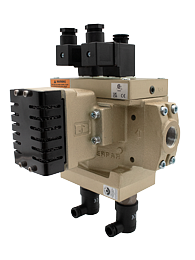




Double Valves with Pressure Switches, Ports 3/8 to 1-1/2 Crossflow 35 Series
 Product Catalog
Product Certification - CSA
Product Catalog
Product Certification - CSA
- Designed to enable users to comply with current safety regulations
- Can be integrated with external monitoring systems to provide for lockout and inhibiting further machine operation until the controls system is reset
- Default to de-energized position upon fault condition
Double Valves with Pressure Switches, Ports 3/8 to 1-1/2 Crossflow 35 Series Product Overview
The CrossFlow ™ double valve is designed to provide control of clutch/brake mechanisms on stamping presses, and many other critical applications such as alternative lockout systems for energy isolation, air cylinder press load-holding systems, as well as other Category -3 and -4 safety circuits.
Please refer to the side and below for links to easily navigate and download Double Valves with Pressure Switches, Ports 3/8 to 1-1/2 Crossflow 35 Series catalogs, installation instructions, and technical data. Additionally, you have the option to filter through all available options to discover the ideal Double Valves with Pressure Switches, Ports 3/8 to 1-1/2 Crossflow 35 Series variant that meets your requirements.
Unable to load products. Please try again.
loading...
loading...
Product Overview
The ROSS Controls CrossFlow 35 Series Double Valves with Pressure Switches for 3/8 to 1-1/2-inch ports are externally monitored redundant double valves designed for press clutch/brake control on stamping presses, Category 3 and 4 safety circuits, alternative lockout systems for energy isolation, and air cylinder press load-holding systems. Available in Basic Sizes 4, 8, 12, and 30, these valves provide flow coefficients from Cv 3.0 to 21 in-out and up to 43 exhaust.
CrossFlow double valves for external monitoring are equipped with pressure switches (one per valve element, two total) that provide feedback signals to the customer's external monitoring device or main press controls. On every actuation and deactuation cycle, the monitoring system checks that both pressure switches change state correctly and simultaneously. If one valve element fails to open or close as commanded, the corresponding pressure switch state differs from the expected state, and the external monitoring system responds by de-energizing the solenoids and inhibiting further machine operation.
The CrossFlow valve design is distinguished by crossflow passages and spool valving on the main valve stems, producing balanced parallel flow paths that generate equal shifting forces on both valve elements in both the actuated and deactuated modes. This balanced design promotes synchronous element movement across millions of cycles. The poppet construction provides dirt-tolerant, wear-compensating sealing, and PTFE backup piston rings enhance valve endurance for operation with or without in-line lubrication.
Pressure switches are available as mechanical pressure switches (DIN EN 175301-803 Form A connector) or M12 solid-state pressure sensors, offering compatibility with both traditional hardwired and modern digital monitoring architectures. Valves without pressure switches must not be used for press clutch/brake control; however, valve models in this series also include port provisions for pressure switches on all bases, allowing post-installation addition of switches if required.
Key Engineering Features
- Dual Pressure Switches for External Monitoring - One pressure switch per valve element provides independent state feedback to the customer's external monitoring device or press control system, enabling dynamic, cycle-by-cycle monitoring of both valve elements without internal monitoring hardware in the valve body.
- Mechanical and Solid-State Pressure Switch Options - Mechanical pressure switches with DIN EN 175301-803 Form A connectors and M12 solid-state PNP pressure sensors are both available. Solid-state sensors provide PNP NO+NC output with lower contact current requirements for compatibility with digital I/O modules.
- CrossFlow Poppet and Spool Valve Construction - Crossflow passages and spool valving on the main valve stems produce parallel, balanced flow paths that promote synchronous valve element movement and limit outlet pressure to below 2% of inlet during single-element fault conditions.
- PTFE Backup Piston Rings - Enable reliable operation with or without in-line lubrication, extending valve service life in applications where continuous lubrication maintenance is impractical.
- Base Mounting (Sizes 1 and 2) and Inline Mounting (Sizes 4, 8, 12, 30) - Basic Sizes 1 and 2 are base mounted with threaded ports; Basic Sizes 4, 8, 12, and 30 are inline mounted with flanged ports. This series covers Sizes 4 through 30 for the 3/8 to 1-1/2 inch port range.
- High-Flow Non-Clogging Silencers - Built-in exhaust silencers on Basic Sizes 4, 8, 12, and 30 maintain exhaust Cv ratings over the valve's service life, preventing back pressure from extending brake engagement response times.
- Right and Left Inlet Orientation (Size 4) - Basic Size 4 CrossFlow valves are available with right or left inlet orientation for flexible piping layout in compact press control enclosures.
- CAD Models and SISTEMA Library Available - Downloadable 3D CAD models and SISTEMA Library files are available from rosscontrols.com, supporting machine design integration and ISO 13849-1 safety function calculations.
- Category 4 PL e, SIL 3 Certified - Independently certified to Category 4, Performance Level e per ISO 13849-1 and SIL 3 per IEC 62061. DGUV certified and CE marked.
- Caution: Valves Without Pressure Switches Require External Monitoring - CrossFlow valves without pressure switches can provide clutch/brake control redundancy but do not provide the press controls with valve state feedback. Valves without pressure switches must only be used with a monitoring system that inhibits machine operation on valve fault.
Technical Specifications
General Specifications
| Parameter | Specification |
| Valve Function | 3/2 Normally Closed |
| Construction Design | Dual Poppet with CrossFlow passages and spool valving |
| Actuation | Solenoid Pilot Controlled (two solenoids, rated for continuous duty) |
| Monitoring | External monitoring via customer-supplied equipment; pressure switches provide valve element state feedback |
| Mounting - Sizes 4, 8, 12, 30 | Inline mounted with flanged ports; vertically with pilot solenoids on top |
| Basic Sizes (this series) | 4, 8, 12, 30 (Sizes 1 and 2 covered in Series 182) |
| Port Sizes | 3/8", 1/2", 3/4", 1", 1-1/4", 1-1/2" (flanged, see size/port table) |
| Thread Options | NPT (no prefix) and G/BSPP (D prefix) |
| Flow Media | Filtered air; 5-micron filtration recommended |
| Valve Body Material | Cast Aluminum |
| Poppet Material | Acetal and Stainless Steel |
| Seal Material | Buna-N |
| Minimum Operation Frequency | At least once per month |
| Functional Safety Data | Category 4, PL e; B10D: 20,000,000; PFHD: 7.71x10⁻⁹; MTTFD: 301.9 years (nop: 662,400) |
| Safety Integrity Level | SIL 3 per IEC 62061:2001 |
| Enclosure Rating | IP65 per IEC 60529 (Sizes 1, 2) / IP65 per IEC-Publication 144 and DIN 40050 (Sizes 4, 8, 12, 30) |
| Electrical Connection | DIN EN 175301-803 Form A (Sizes 2, 4, 8, 12, 30); Form B (Size 1) |
Temperature Ratings
Temperature limits apply to all CrossFlow 35 Series valve sizes. Media temperature lower limit requires dry, moisture-free compressed air.
| Configuration | Ambient Temperature | Media Temperature |
| All Sizes - Ambient | 15 to 122F (-10 to 50C) | 40 to 175F (4 to 80C) |
Important: At media temperatures near 40F (4C), compressed air must be free of water vapor to prevent ice formation inside valve passages. Voltages at pressure switches must not exceed 250 volts.
Electrical Data (Solenoid Pilot Valves)
All solenoids rated for continuous duty. Two independent solenoid signals are required; both must be energized simultaneously. Pressure switch contact ratings: mechanical type NO/NC contacts 0.1A at 125/250 VAC; 0.1A at 30 VDC; 0.3A at 60 VDC. Solid-state sensor: supply 8-30 VDC, current consumption less than 4 mA.
| Voltage | Power Consumption |
| 24 VDC (Sizes 1, 2) | 7.5 watts (Size 1), 6 watts (Size 2) per solenoid |
| 120 VAC, 50/60 Hz (Sizes 1, 2) | 12 VA inrush / 9.8 VA holding (Size 1); 8.5 VA inrush / 8.5 VA holding (Size 2) |
| 24 VDC (Size 4) | 14 watts per solenoid |
| 120 VAC, 50/60 Hz (Size 4) | 35 VA inrush, 22 VA holding per solenoid |
| 24 VDC (Sizes 8, 12, 30) | 16 watts per solenoid |
| 120 VAC, 50/60 Hz (Sizes 8, 12, 30) | 8.5 VA inrush, 8.5 VA holding per solenoid |
Flow Performance Data
Flow data for CrossFlow 35 Series Basic Sizes 4, 8, 12, and 30. Response time: T(msec) = M + F x V. Valves can be ordered with or without pressure switches; Cv values are the same regardless of pressure switch option.
| Basic Size | Port Size | Cv (In-Out) | Cv (Out-Exhaust) | M (msec) | F (1-2) | F (2-3) | Weight lb (kg) |
| 4 | 3/8" | 3.0 (3000 Nl/min) | 7.0 (6900 Nl/min) | 15 | 0.70 | 0.40 | 8.4 (3.8) |
| 4 | 1/2" | 3.0 (3000 Nl/min) | 9.0 (8900 Nl/min) | 15 | 0.65 | 0.35 | 8.4 (3.8) |
| 4 | 3/4" | 3.0 (3000 Nl/min) | 11 (11000 Nl/min) | 15 | 0.65 | 0.35 | 8.4 (3.8) |
| 8 | 1/2" | 3.5 (3400 Nl/min) | 10 (9800 Nl/min) | 15 | 0.70 | 0.30 | 11.4 (5.2) |
| 8 | 3/4" | 4.0 (3900 Nl/min) | 14 (14000 Nl/min) | 15 | 0.65 | 0.23 | 11.4 (5.2) |
| 12 | 3/4" | 8.0 (7900 Nl/min) | 15 (15000 Nl/min) | 15 | 0.65 | 0.23 | 15.4 (7.0) |
| 8 | 1" | 4.0 (4000 Nl/min) | 14 (14000 Nl/min) | 20 | 0.33 | 0.21 | 15.4 (7.0) |
| 12 | 1" | 8.5 (8400 Nl/min) | 19 (19000 Nl/min) | 20 | 0.28 | 0.21 | 15.4 (7.0) |
| 12 | 1-1/4" | 9.0 (8900 Nl/min) | 21 (21000 Nl/min) | 20 | 0.28 | 0.21 | 15.4 (7.0) |
| 30 | 1-1/4" | 20 (20000 Nl/min) | 42 (41000 Nl/min) | 25 | 0.19 | 0.07 | 33.9 (15.4) |
| 30 | 1-1/2" | 21 (21000 Nl/min) | 43 (42000 Nl/min) | 25 | 0.18 | 0.07 | 33.9 (15.4) |
Response Time Formula: Valve Response Time (msec) = M + F x V, where M is the average time constant for valve element movement, F is the fill/exhaust factor in msec per cubic inch of volume, and V is the volume in cubic inches.
Certifications & Compliance
| Certification/Standard | Detail |
| Functional Safety - Category | Category 4, Performance Level e per ISO 13849-1:2015 when used with properly designed external monitoring system. |
| Safety Integrity Level | SIL 3 per IEC 62061:2001 when used with properly designed external monitoring system. |
| Reliability Data | B10D: 20,000,000 cycles; PFHD: 7.71x10⁻⁹; MTTFD: 301.9 years (nop: 662,400 operations per year). |
| DGUV | DGUV certified (Sicherheit gepruft / tested safety) for European occupational safety requirements. |
| CE Marking | Declaration of Conformity and Certificate of Compliance issued for all CrossFlow 35 Series configurations. |
| SISTEMA Library | SISTEMA Library available for download for ISO 13849-1 safety function calculations. |
| OSHA Compliance | Designed to satisfy OSHA 29 CFR 1910.217 requirements for mechanical power presses with pneumatically controlled clutch and brake mechanisms when used with an external monitoring device. |
| Enclosure Protection | IP65 per IEC 60529 (Sizes 1 and 2); IP65 per IEC-Publication 144 and DIN 40050 (Sizes 4, 8, 12, 30). |
| Vibration/Impact Resistance | Tested to DIN EN 60068-2-6. |
Typical Applications & Industries
Stamping Press Clutch/Brake Control with External Safety PLC
- Stamping press lines where a dedicated safety PLC or press control system already provides external monitoring capability and the CrossFlow pressure switches feed valve state signals directly to the PLC's safety input modules on every stroke.
- High-cycle progressive die press operations where the safety PLC monitors both SWA and SWB pressure switch states dynamically on every actuation and deactuation, detecting asynchronous valve element behavior within the same stroke that caused it.
- Multi-press transfer line controls where a central safety controller monitors CrossFlow pressure switch outputs from multiple press stations simultaneously, providing a single point for press line fault detection and controlled shutdown.
- Press retrofit projects where an existing press safety PLC has available digital input channels for pressure switch monitoring, making the CrossFlow externally monitored valve a cost-effective alternative to internally monitored double valves.
Energy Isolation and Category 3 and 4 Safety Circuits
- Alternative pneumatic lockout systems for energy isolation where an external safety relay or safety PLC monitors the CrossFlow pressure switches to verify valve state before allowing machine zone access.
- Air cylinder press load-holding safety circuits in Category 3 and 4 architectures where the external monitoring system must verify both valve elements are closed before permitting operator access to the tooling area.
- Safety gate and light curtain interlock systems where CrossFlow pressure switch outputs are wired to a safety relay that verifies both valve elements have returned to the closed position after a safety stop before allowing zone re-entry.
Large-Tonnage and High-Flow Press Applications
- Large-tonnage stamping press clutch/brake control requiring 1-inch through 1-1/2-inch port sizes with Cv 4.0 to 21 in-out flow capacity, where Basic Size 8, 12, and 30 CrossFlow valves with pressure switches satisfy both flow and external monitoring requirements.
- Transfer press main clutch/brake control where Size 30 with 1-1/4 or 1-1/2-inch ports provides Cv 20 to 21 in-out and Cv 42 to 43 exhaust for large-volume clutch actuators with fast response time requirements.
- Forging hammer control systems with external PLC monitoring where CrossFlow pressure switches provide the necessary feedback signals and the 30 to 125 psig operating range accommodates forging press air supply pressures.
Machine Safety Upgrades and Modernization
- Press safety control system modernization projects replacing older control-reliable valves with current CrossFlow 35 Series valves that carry updated Category 4, PL e certifications and current safety data (B10D, PFHd, MTTFd) required for new risk assessments.
- Press line re-certification projects for European CE marking where existing press controls already have safety PLC monitoring capability and CrossFlow valves provide Category 4 compliance data suitable for SISTEMA-based safety calculations.
- Automotive supplier press safety upgrades driven by customer OSHA 1910.217 compliance audits, where CrossFlow valves with pressure switches enable compliance when paired with the plant's existing press monitoring system.
Ordering and Model Number Configuration
CrossFlow 35 Series (Sizes 4, 8, 12, 30) uses the standard 35-series model number format. Basic size, port size, inlet orientation (Size 4 only), and pressure switch option are encoded in the port code field.
|
CrossFlow 35 Series Model Number Structure:
35 7 3 C 3276 0 W | | 35 Solenoid 3/2 Rev Port Right Voltage Controlled Level Code (0)/Left (6)
Basic Size 4 Port Codes: 327 = 3/8" 427 = 1/2" 523 = 3/4" (Inlet orientation: 0 = Right, 6 = Left)
Basic Size 8 Port Codes: 4638 = 1/2" 5638 = 3/4" 6638 = 1"
Basic Size 12 Port Codes: 5632 = 3/4" 6632 = 1" 7632 = 1-1/4"
Basic Size 30 Port Codes: 7630 = 1-1/4" 8630 = 1-1/2"
Pressure Switch Option: Blank = Mechanical switch 2 = M12 solid-state sensor
Thread: Blank = NPT, D prefix = G (BSPP) Voltage: W = 24 VDC, Z = 110-120 VAC 50/60 Hz Y = 230 VAC (not available in US)
Example: 3573C3276W = Size 4, 3/8", right inlet, 24 VDC, mechanical PS Example: 3573D6632Z = Size 12, 1", 120 VAC, mechanical pressure switch Example: 3573D6632Z2 = Size 12, 1", 120 VAC, M12 solid-state sensor |
Only valves with pressure switches should be used to control clutch/brake mechanisms on press machinery. Pressure switches must be used in conjunction with an external monitoring device to assist with OSHA 1910.217 compliance.
Valves on this page do not have a built-in monitor. They must only be used in conjunction with an external monitoring system capable of inhibiting valve and machine operation on valve fault detection.
If the system must be reset after a fault, electrical signals to both solenoids must be removed before reset to prevent the machine from immediately recycling and creating a hazardous condition.
Voltage code Y (230 VAC) is not available in the United States. OSHA regulations limit press control voltage to a maximum of 120 VAC.
For Size 4 with G threads, add D prefix (e.g., D3573C3276W). For Size 8, 12, 30 with G threads, add D prefix to model number.
Accessories
Pressure Switches - Electrical Lockout Indicator
Factory-preset pressure switches for valve element state monitoring by external monitoring system.
| Type | Connector | Model | Port Thread | Preset psi (bar) |
| Mechanical Pressure Switch | DIN EN 175301-803 Form A | 1104A30 | M10x1 | 22 (1.5) falling |
| Mechanical Pressure Switch | M12 | 1153A30 | M10x1 | 22 (1.5) falling |
| Solid State Pressure Sensor | M12 | 1335B30W | M10x1 | 17 (1.2) falling |
Downstream Pressure Monitoring Switches
For energy release verification downstream of the valve. Preset at 5 psi (0.3 bar) falling.
| Type | Connector | Model | Port Thread |
| Mechanical | DIN EN 175301-803 Form A | 586A86 | 1/8 NPT |
| Redundant Dual Assembly | DIN EN 175301-803 Form A | RC026-13 | 3/8 NPT |
Prewired Electrical Connectors
For solenoid wiring on CrossFlow 35 Series Sizes 2, 4, 8, 12, and 30 (Form A) and Size 1 (Form B).
| Connector Type | Length | Without Light | Lighted 24 VDC | Lighted 120 VAC |
| DIN EN 175301-803 Form A | 2 m | 721K77 | 720K77-W | 720K77-Z |
| DIN EN 175301-803 Form A | 2 m (10-mm dia.) | 371K77 | 383K77-W | 383K77-Z |
| DIN EN 175301-803 Form B | 2 m | 372K77 | 382K77-W | 382K77-Z |
Exhaust Silencers
Aluminum exhaust silencers for applications requiring remote exhaust. Must have Cv at least as great as valve exhaust Cv.
| Port Size | NPT Model | G Model | Cv (Nl/min) | Max psig (bar) |
| 1/4" | 5500A2003 | D5500A2003 | 2.3 (2300) | 290 (20) |
| 3/8" | 5500A3013 | D5500A3013 | 9.0 (8900) | 290 (20) |
| 1/2" | 5500A4003 | D5500A4003 | 6.8 (6700) | 290 (20) |
| 3/4" | 5500A5003 | D5500A5003 | 15 (15000) | 290 (20) |
| 1" | 5500A6003 | D5500A6003 | 18 (18000) | 290 (20) |
Warning: Exhaust silencers must have flow capacities at least as great as the valve exhaust Cv. Contaminated or undersized silencers cause back pressure that extends brake engagement time and can result in press control timing failures.
Related Products & Accessories
- CrossFlow 35 Series, 1/4 to 3/4" (Series 182) - Externally monitored CrossFlow double valves for smaller port sizes 1/4 to 3/4 inch, Basic Sizes 1 and 2. https://www.rosscontrols.com/en/series/182-double-valves-with-or-w-o-pressure-switches-ports-1-4-to-3-4
- SERPAR 35 Series L-G Monitor, 1/2 to 2" (Series 183) - Internally monitored alternative for 1/2 to 2-inch applications where self-contained monitoring is preferred. https://www.rosscontrols.com/en/series/183-double-valves-with-pneumatic-l-g-monitor-ports-1-2-to-2
- SERPAR 35 Series E-P Monitor (Series 186) - Internally monitored alternative with electro-pneumatic monitor and solenoid reset. https://www.rosscontrols.com/en/series/186-double-valves-with-electro-pneumatic-e-p-monitor
- DM2 Series D (Series 52) - Self-monitored double valve with total dynamic monitoring and complete memory. https://www.rosscontrols.com/en/series/52-double-valves-for-clutch-brake-control
- Piping Flange Kits (Series 2839) - Connection piping kits for inline mounting of CrossFlow and SERPAR double valves. https://www.rosscontrols.com/en/series/2839-piping-flange-kits
- L-O-X Lockout Valves - Energy isolation lockout valves for pneumatic system lockout/tagout. https://www.rosscontrols.com/en/series/1287-lockout-valves-15-series
Frequently Asked Questions (FAQ)
Q: What external monitoring system is required with CrossFlow valves?
A: The CrossFlow valve requires a customer-supplied external monitoring system capable of dynamically, cyclically checking the state of both pressure switches SWA and SWB with any and all changes in the valve control signals. The monitoring system must be capable of inhibiting further valve and machine operation when it detects that the two pressure switch states do not match the expected pattern for normal valve operation.
Q: Why must valves without pressure switches not be used for press clutch/brake control?
A: Without pressure switches, the external monitoring system has no means to verify that both valve elements have shifted correctly on each cycle. A single-element failure would allow the valve to supply partial output pressure that may be insufficient to fully engage the clutch or release the brake, creating a hazardous press condition that the monitoring system cannot detect.
Q: What is the difference between the mechanical pressure switch and the M12 solid-state sensor?
A: The mechanical pressure switch (models 1104A30 and 1153A30) uses electromechanical contacts rated at 0.1A at 125/250 VAC and 0.1A at 30 VDC, suitable for direct hardwired connections to safety relays or PLCs. The solid-state pressure sensor (model 1335B30W) uses a PNP solid-state output compatible with digital input modules (supply 8-30 VDC, current less than 4 mA). Specify the sensor type by appending code 2 to the model number for M12 solid-state sensors.
Q: What safety category and performance level do CrossFlow valves achieve?
A: CrossFlow 35 Series valves with pressure switches, when used with a properly designed external monitoring system, can achieve Category 4, Performance Level e per ISO 13849-1 and SIL 3 per IEC 62061. The published functional safety data is B10D = 20,000,000 cycles, PFHD = 7.71x10⁻⁹, and MTTFD = 301.9 years. The overall safety function rating depends on the safety performance of the external monitoring system as well.
Q: What is the correct procedure if the system must be reset after a fault?
A: When the external monitoring system detects a fault and de-energizes the solenoids, both solenoid signals must remain de-energized until the cause of the fault has been identified and corrected. Reapplying both solenoid signals simultaneously after fault correction constitutes the reset. Both solenoid signals must be removed simultaneously; a single-solenoid reset signal can cause an unexpected partial valve shift.
Q: How does the CrossFlow design detect a malfunction?
A: When both valve elements operate normally, the CrossFlow passages balance the monitoring pressure signals at both pressure switches SWA and SWB equally. If one element fails open with the other closed, the open element's crossflow passage delivers full inlet pressure to SWA while the closed element's passage delivers near-zero pressure to SWB. The external monitoring system detects the mismatch between SWA and SWB states and responds accordingly.
Q: What operating pressure ranges apply to each basic size?
A: Size 4 operates at 40 to 150 psig (2.8 to 10 bar), the widest range in this series. Sizes 8, 12, and 30 operate at 30 to 125 psig (2 to 8.5 bar). All sizes require filtered air; pressure below the minimum can result in incomplete valve element travel, which would appear as a valve fault to the monitoring system.
Q: Can CrossFlow valves be upgraded to include pressure switches after initial installation?
A: All CrossFlow valve bases include pressure switch port provisions for both valve elements. If a valve was initially installed without pressure switches, the appropriate pressure switch can be installed in the base port in the field. Ensure the switch model (1104A30, 1153A30, or 1335B30W) matches the monitoring system's electrical input requirements.
Q: Are Size 4 CrossFlow valves available with right or left inlet orientation?
A: Yes. Basic Size 4 CrossFlow valves (covered in this series at 3/8 to 3/4-inch port sizes) are available with right or left inlet port orientation using the 0 (right) or 6 (left) inlet orientation code in the model number.
Q: How often must CrossFlow valves be cycled for proper function verification?
A: At minimum once per month. This periodic cycling verifies that both valve elements shift freely and that both pressure switches change state correctly on each actuation and deactuation. Monthly cycling also verifies that the valve remains free of contamination or stiction that could cause asynchronous element movement.
Q: What is the SISTEMA Library and how is it used for CrossFlow valves?
A: The SISTEMA Library is a downloadable data file compatible with the SISTEMA safety calculation software developed by the German IFA. It contains the published safety parameters (B10D, PFHd, MTTFd, Category, PL) for CrossFlow 35 Series valves, allowing machine safety engineers to include the valve data directly in ISO 13849-1 safety function calculations without manually entering reliability data.
Installation & Maintenance Guidelines
- Mount inline with pilot solenoids pointing upward as the preferred orientation for consistent response timing and drainage.
- Install 5-micron filtration upstream to protect CrossFlow passage surfaces and poppet seating areas.
- Wire solenoid A and solenoid B independently to separate safety relay outputs or separate safety PLC output channels. Both outputs must energize and de-energize simultaneously.
- Connect pressure switch SWA and SWB outputs to the external monitoring system input channels. Verify that the monitoring system is programmed to check both switch states on every actuation and deactuation cycle.
- Do not connect the two pressure switch outputs to a single monitoring input. Monitoring must be able to distinguish independent states of SWA and SWB to detect single-element faults.
- Verify that the external monitoring system is configured to inhibit further solenoid energization and machine operation when it detects a mismatch between SWA and SWB states.
- Do not restrict exhaust ports. Silencer Cv must equal or exceed the valve exhaust Cv to prevent back pressure buildup that could affect brake engagement timing and pressure switch operation.
- After installation but before connecting the press clutch/brake, perform at minimum 10 complete actuation cycles and verify with the monitoring system that both pressure switches change state correctly on each cycle.
- Ensure pressure switch voltages do not exceed 250 VAC.
- Cycle the valve at minimum once per month as required for ongoing function verification.
Warranty & Global Support
ROSS Controls provides a one-year warranty on all CrossFlow 35 Series products, covering defects in material and workmanship from date of purchase. Warranty is void for misuse, misapplication, improper maintenance, modification, or tampering.
Global technical support available through ROSS offices in USA, Canada, Brazil, Germany, France, United Kingdom, India, China, and Japan.
Contact ROSS Controls USA at +1-248-764-1800 or Technical Service at 1-888-TEK-ROSS (835-7677), or visit rosscontrols.com.
SISTEMA library files, dimensional drawings, response time charts, and CAD models available at rosscontrols.com or by contacting ROSS Controls at (800) GET-ROSS (438-7677).
Download Catalog: https://www.rosscontrols.com/en/series/181-double-valves-with-pressure-switches-ports-3-8-to-1-1-2
Download Documents
Double Valves with Pressure Switches, Ports 3/8 to 1-1/2