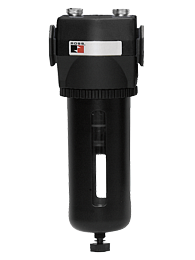




MD4 Series Port Sizes 1/4 to 3/4; Flow to 165 scfm (4673 l/min)
 Product Catalog
Air Preparation Filters Clean Air Packaging MD4 Series Product Overview
The MD4 Series Air Preparation Filters provide comprehensive air filtration options for various applications. These filters are available in both 5- and 40-micron filtration levels to suit different air quality requirements. They offer coalescing filters with filtration levels of 0.3 and 0.01 microns, ensuring efficient removal of fine particles and aerosols. Additionally, the MD4 Series includes oil vapor removal (adsorbing) filters designed to eliminate oil and hydrocarbon vapors from the air stream.
For filter maintenance and drainage, you have various options, including manual, automatic, internal float, and automatic external drains. These filters are versatile, with both modular and in-line mounting options available, allowing for flexible integration into your system. You can also choose between metal and high-strength polycarbonate bowl options to match the environmental conditions of your application. To monitor filtration performance, several differential gauge options are available, ensuring that you can maintain optimal air quality.
Please refer to the side and below for links to Air Preparation Filters MD4 Series catalogs, installation instructions, and technical data. Additionally, you have the option to filter through all Air Preparation Filters MD4 Series variant that meets your requirements.
loading...
loading...
Product Overview
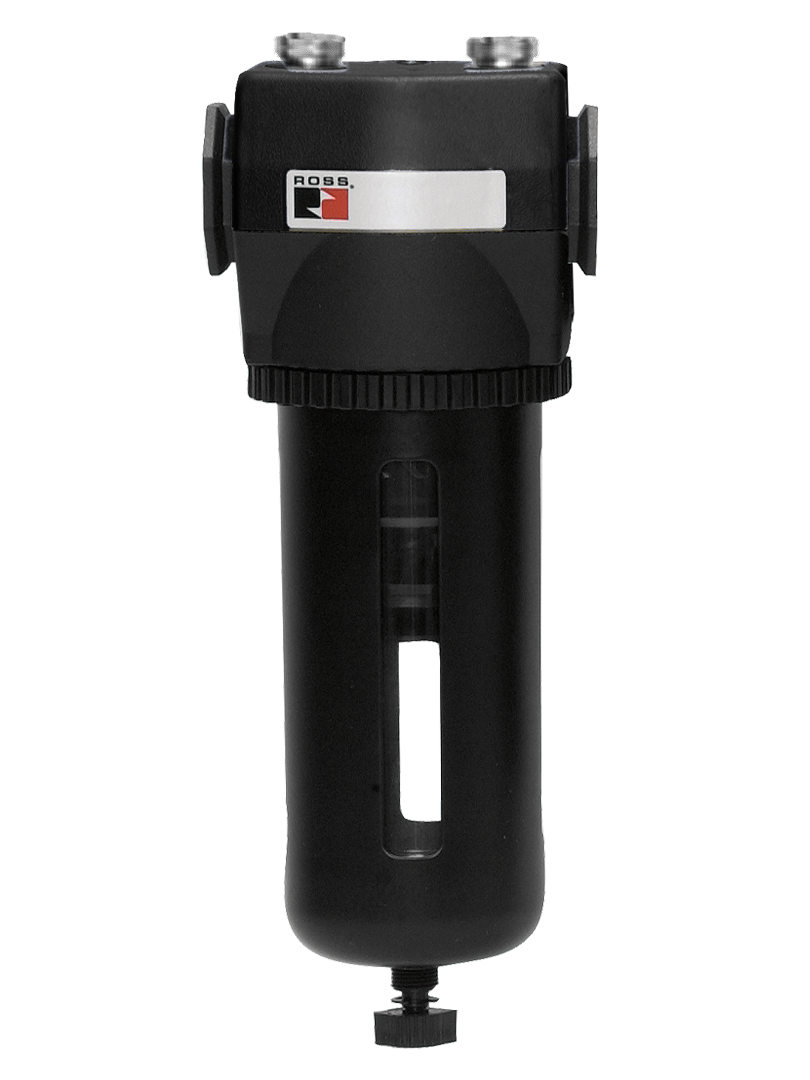
The ROSS Controls MD4 Series adsorbing filters are the higher-flow counterpart to the MD3 adsorbing filter family, offering oil vapor removal capability for compressed air systems with port sizes from 1/4 to 3/4 inch and maximum flow rates up to 165 scfm (4,673 l/min). Using activated carbon cartridges, these filters remove oil vapors, hydrocarbon vapors, and odors from compressed air that cannot be captured by upstream coalescing filtration, delivering air that meets the most demanding purity standards for food processing, pharmaceutical manufacturing, electronics production, and precision instrumentation.
The MD4 adsorbing filter is available with three bowl configurations: polycarbonate with steel shatterguard (9 oz / 270 ml), metal aluminum (9 oz / 270 ml), and extended aluminum (15 oz / 450 ml). The extended bowl version accommodates a larger activated carbon cartridge that provides up to 50 percent greater flow capacity, making the MD4 extended the preferred selection for high-demand production environments where flow restriction through the adsorbing stage would limit system performance. Both internal float drain and manual drain configurations are available, with manual drain being standard for the adsorbing filter stage.
As the third stage in ROSS Controls' MD4 Clean Air Package filtration sequence, the MD4 adsorbing filter is designed to operate downstream of a 5-micron particulate filter and a coalescing filter. This three-stage combination produces outlet air with residual oil content of no more than 0.01 mg/m3, satisfying ISO 8573-1 Class 1 oil purity requirements. The MD4 adsorbing filter is modularly compatible with the complete ROSS MD4 FRL product family for direct inline integration without external pipe fittings.
For applications requiring an especially large bowl to address high moisture loads or where extended service intervals are preferred, the MD4 extended metal bowl option with a 15 oz (450 ml) capacity provides increased liquid retention and access to the R-A115-118E9 extended replacement cartridge. The result is fewer maintenance interventions and lower total cost of ownership in high-demand production environments.
Key Engineering Features
- Activated Carbon Adsorbing Element - Activated carbon cartridge with borosilicate glass fiber construction removes oil vapors, hydrocarbon vapors, and odors from alcohols, esters, and ketones that pass through upstream coalescing filtration stages.
- Higher Flow Capacity Than MD3 - Port sizes to 3/4 inch and maximum flow to 165 scfm (4,673 l/min) make the MD4 appropriate for larger compressed air systems and higher-throughput production lines compared to the 125 scfm MD3 series.
- Three Bowl Options - Polycarbonate with steel shatterguard (9 oz/270 ml), metal aluminum (9 oz/270 ml), and extended aluminum (15 oz/450 ml) bowls address different pressure, temperature, and capacity requirements.
- Extended Bowl for 50% Greater Flow - The extended aluminum bowl accommodates the R-A115-118E9 high-capacity cartridge, providing up to 50 percent greater air flow through the adsorbing stage compared to the standard 9 oz bowl, without changing port size.
- Port Sizes 3/8 to 3/4 - Available in 3/8, 1/2, and 3/4 inch port sizes in NPT (NPTF) or BSPP (G) threads, covering high-flow compressed air systems where the MD3 series would be undersized.
- Modular Assembly Compatible - Designed for direct connection to other ROSS MD4 FRL components without external pipe fittings, enabling compact multi-stage filter assemblies including particulate filter, coalescing filter, adsorbing filter, and regulator.
- High-Pressure Metal Bowl Option - Metal aluminum bowl supports inlet pressures up to 200 psig (14 bar) with manual drain, providing coverage for high-pressure compressed air distribution headers and high-line-pressure systems.
- Configurable Cap Color - Bowl cap is available in gold, gray, yellow, red, and blue for visual identification of filter stage type within multi-component air preparation assemblies.
- Replacement Filter Elements Available - Field-replaceable activated carbon cartridges (R-A115-117E9 for standard bowls, R-A115-118E9 for extended bowls) allow element replacement without replacing the filter body or disrupting adjacent components.
Technical Specifications
General Specifications
| Parameter | Specification |
| Series | MD4 Series Adsorbing (Oil Vapor Removal) Filters |
| Filter Stage | Third-stage adsorbing (must be preceded by particulate and coalescing filters) |
| Filtration Mechanism | Activated carbon adsorption; removes hydrocarbon vapors and odors |
| Port Sizes | 3/8", 1/2", 3/4" |
| Thread Types | NPT (NPTF); BSPP (G) |
| Maximum Flow | 165 scfm (4,673 l/min) standard bowl; up to 50% greater with extended bowl |
| Mounting | Modular and inline |
| Drain Type | Manual drain (standard); internal float drain option |
| Body Material | Zinc |
| Bowl Options | Polycarbonate with steel shatterguard; Aluminum; Extended aluminum |
| Bowl Ring Material | Nylon |
| Seal Material | Nitrile |
| Element Material | Borosilicate glass fiber with activated carbon cartridge |
| Fluid Media | Compressed air |
| Residual Oil Content | No more than 0.01 mg/m3 when used in the MD4 Clean Air Package three-stage assembly |
Certifications & Compliance
Typical Applications & Industries
Food and Beverage Processing
- High-flow direct contact compressed air in food packaging, filling, and conveying systems where any oil or hydrocarbon vapor would contaminate the product, cause off-flavors or odors, and violate food safety regulations. The MD4 extended bowl option addresses high-throughput lines requiring more than 125 scfm.
- Pneumatic actuators and air jets in meat, poultry, and dairy processing where larger port sizes (1/2 and 3/4 inch) supply sufficient flow for high-cycle packaging automation while delivering oil-free air to product contact zones.
- Bottle blow-molding, can-filling, and carton-sealing lines where compressed air activates high-speed packaging machinery and contacts product surfaces, requiring both high flow capacity and oil-free air quality.
Pharmaceutical and Life Sciences
- Large-scale tablet coating pans, fluid bed dryers, and spray drying systems in pharmaceutical manufacturing where high-volume instrument-quality air must be delivered continuously without hydrocarbon contamination that would affect product identity or FDA compliance.
- Sterile filling and aseptic packaging operations where compressed air flow requirements exceed the capacity of MD3 series filters and where ISO 8573-1 Class 1 oil purity is mandated by product specifications.
- Bulk drug manufacturing processes in continuous bioreactor operation where compressed air for pneumatic valves, agitators, and transfer systems must be maintained at oil-free quality throughout extended production campaigns.
Electronics and Semiconductor
- Large-format display panel manufacturing, flat panel coating lines, and large-area semiconductor deposition systems where high-flow oil-free air is required for pneumatic material handling, substrate transport, and precision positioning systems.
- Printed circuit board assembly SMT lines with high-density pneumatic pick-and-place systems that require sustained high flow rates combined with zero hydrocarbon contamination to prevent soldering defects and surface contamination.
- Clean room environmental control systems where large compressed air volumes are required for pressurization, purging, and pneumatic door actuation, all of which must meet clean room air quality classification requirements.
Automotive and Surface Treatment
- High-volume automotive paint spray systems and electrostatic coating booths where large paint guns require sustained 3/4 inch supply flow rates of clean, oil-free air for consistent atomization and film quality across high-production-rate lines.
- Powder coating, anodizing pre-treatment, and conversion coating lines where compressed air for conveying, mixing, and applying surface treatments must be free of hydrocarbons that would contaminate the chemical bath or cause coating adhesion failures.
- Automotive glass laminating and windshield bonding operations where compressed air for clamping and pressing must not deposit oil residue on glass or adhesive surfaces, which would prevent proper bond formation.
Industrial Manufacturing and Assembly
- Large-scale precision machining centers where air gauging and air-bearing spindles require sustained high-flow, oil-free air supply, and where the 3/4 inch port of the MD4 matches the header pipe sizes typically used in machine tool installations.
- Medical device manufacturing clean rooms where high-volume pneumatic systems for molding, assembly, and packaging must meet ISO Class 5 or better air quality requirements throughout multi-shift production operations.
- Aerospace composite part layup and autoclave loading operations where pneumatic material handling equipment requires oil-free air to prevent contamination of uncured composite surfaces.
General High-Flow Air Preparation
- Central compressed air distribution systems at main header points where the 3/4 inch MD4 adsorbing filter provides final oil vapor removal upstream of distribution to multiple process areas.
- Third-stage filtration at major process air takeoffs where flow demands exceed 125 scfm and where the MD4 series is selected over MD3 to avoid undersizing the adsorbing stage.
Ordering and Model Number Configuration
The MD4 adsorbing filter model number is configured by selecting bowl size, pipe size, and cap color. Use the options below to construct the model number.
|
Model Number Structure: MD4 50P B 5 2
MD4 Series (MD4 Adsorbing Filter)
50P Bowl Size (50P = Polycarbonate 9 oz; 50M = Metal 9 oz; 50E = Extended Metal 15 oz)
B Bowl Drain (B = Standard bowl; E = Extended bowl with R-A115-118E9 element)
5 Pipe Size (3 = 3/8 NPTF, 4 = 1/2 NPTF, 5 = 3/4 NPTF, C = 3/8 BSPP, D = 1/2 BSPP, E = 3/4 BSPP)
2 Cap Color (2 = Gold, G = Gray, Y = Yellow, R = Red, B = Blue) |
For BSPP (G) threads, use pipe size codes C (3/8), D (1/2), or E (3/4) instead of the NPTF codes.
The extended metal bowl (50E) accommodates the R-A115-118E9 element, which provides up to 50 percent greater air flow than the standard R-A115-117E9 element.
An adsorbing filter must always be preceded by a 5-micron particulate filter and a coalescing filter (0.3-micron or 0.01-micron) for proper operation and to protect the activated carbon element.
Internal float drain option is available; consult ROSS Controls for configuration with float drain on MD4 adsorbing filter models.
Cap color codes allow visual differentiation of filter stages in multi-component assemblies.
Related Products & Accessories
- MD4 Clean Air Package (Series 88) - Complete three-stage clean air filtration assembly with MD4 particulate filter, coalescing filter, and adsorbing filter for compressed air purity to 0.01 mg/m3. https://www.rosscontrols.com/en/series/88-md4-series
- MD3 Series Adsorbing Filters (Series 85) - Smaller-body adsorbing filters covering port sizes 1/4 to 1/2 inch with flow to 125 scfm for lower-flow applications. https://www.rosscontrols.com/en/series/85-md3-series
- Adsorbing Filter Elements MD3 and MD4 - Replacement activated carbon cartridges for MD3 and MD4 adsorbing filter bodies in standard and extended bowl versions. https://www.rosscontrols.com/en/series/2012-adsorbing-filter-element
- Silencers and Reclassifiers (Series 89) - Inline sintered bronze reclassifiers and silencers for exhaust noise reduction and oil separation. https://www.rosscontrols.com/en/series/89-silencers-reclassifiers
Frequently Asked Questions (FAQ)
Q: How does the MD4 adsorbing filter differ from the MD3 adsorbing filter?
A: The MD4 covers port sizes 3/8, 1/2, and 3/4 inch with maximum flow to 165 scfm (4,673 l/min), compared to the MD3 which covers 1/4, 3/8, and 1/2 inch ports with flow to 125 scfm (3,540 l/min). Both use activated carbon adsorption. The MD4 is the correct choice when system flow requirements exceed the MD3 capacity or when 3/4 inch port sizes are specified.
Q: What is the maximum operating pressure for the MD4 adsorbing filter?
A: The polycarbonate bowl supports 0 to 150 psig (0 to 10 bar). The metal aluminum and extended aluminum bowl versions support 0 to 200 psig (0 to 14 bar). All bowl types use manual drain operation as standard.
Q: Why must an adsorbing filter be the third and final filtration stage?
A: Liquid oil droplets, water, and solids will saturate and destroy the activated carbon element if allowed to enter. A 5-micron particulate filter removes solids and bulk liquid, and a coalescing filter removes sub-micron aerosols. These upstream stages are essential to protect the adsorbing element and ensure it performs its intended function of hydrocarbon vapor removal.
Q: What air purity level does the MD4 adsorbing filter system achieve?
A: When installed as the third stage following a 5-micron particulate filter and a 0.01-micron coalescing filter, the MD4 Clean Air Package delivers outlet air with residual oil content of no more than 0.01 mg/m3, equivalent to ISO 8573-1 Class 1 oil purity.
Q: What replacement cartridges are used with the MD4 adsorbing filter?
A: The standard 9 oz bowl (polycarbonate or metal) uses model R-A115-117E9. The extended 15 oz aluminum bowl uses model R-A115-118E9, which provides up to 50 percent greater air flow capacity. Both are borosilicate glass fiber constructions with activated carbon.
Q: How do I determine when to replace the adsorbing element?
A: Activated carbon elements do not produce increasing pressure drop as they approach exhaustion, unlike particulate filters. Replacement schedules should be based on air volume processed, inlet hydrocarbon concentration, and manufacturer service interval recommendations. Outlet air quality testing using hydrocarbon vapor analyzers provides the most reliable indication of element exhaustion.
Q: Is the MD4 adsorbing filter available with BSPP threads?
A: Yes. BSPP (G) thread versions are available in 3/8 G (code C), 1/2 G (code D), and 3/4 G (code E) pipe size configurations.
Q: Can I use the MD4 adsorbing filter as a standalone unit without upstream filters?
A: No. ROSS Controls requires that the adsorbing filter always be preceded by a particulate filter and coalescing filter. Operating without upstream filtration will rapidly exhaust the carbon element, provide inadequate air purity, and may introduce activated carbon fines into downstream equipment.
Q: What is the operating temperature range?
A: The polycarbonate bowl version operates from 40 to 125 degrees F (4 to 52 degrees C). Metal aluminum and extended aluminum bowl versions operate from 40 to 175 degrees F (4 to 80 degrees C). A minimum of 40 degrees F prevents freezing of condensed moisture in the filter body.
Q: Does the extended bowl provide better filtration efficiency?
A: Filtration efficiency is the same for both standard and extended bowls; both provide activated carbon adsorption to the same outlet purity level. The extended bowl advantage is purely flow capacity: up to 50 percent more air flow through the adsorbing stage without increasing port size or pressure drop.
Q: What is the bowl capacity of each MD4 bowl option?
A: The polycarbonate bowl holds 9 oz (270 ml). The standard metal aluminum bowl holds 9 oz (270 ml). The extended aluminum bowl holds 15 oz (450 ml). The extended bowl's larger capacity is the reason it accommodates the higher-capacity R-A115-118E9 cartridge.
Q: Is a differential pressure gauge available for the MD4 adsorbing filter?
A: Differential pressure gauges are not typically used on adsorbing filters because activated carbon elements do not restrict flow in a progressive manner that would indicate exhaustion by pressure drop increase. Differential pressure gauges are standard on the coalescing filter stage of the Clean Air Package.
Q: How does the MD4 modular system connect to other FRL components?
A: The MD4 filter connects directly to other ROSS MD4 Series FRL components using the modular mounting system with inter-unit sealing nipples and tie rod assemblies. This eliminates external pipe fittings between filter stages and produces a compact, rigid assembly.
Installation & Maintenance Guidelines
- Install the MD4 adsorbing filter as the third and final filtration stage, after a 5-micron particulate filter and a 0.3 or 0.01-micron coalescing filter. Never install the adsorbing filter as the first filter stage or as a standalone unit.
- Orient the filter with the bowl facing downward where possible. The manual drain on the adsorbing filter is used primarily for element replacement, not for frequent condensate drainage.
- Verify that air flow direction through the filter matches the directional marking on the filter body before final installation. Reversed flow reduces filtration effectiveness.
- Do not exceed the rated inlet pressure: 150 psig for polycarbonate bowls, 200 psig for metal aluminum and extended aluminum bowls.
- Install lubricators, if any, downstream of the entire three-stage filter assembly. Lubricated air reaching the adsorbing filter will prematurely exhaust the activated carbon element.
- Depressurize the system fully before opening the bowl for element replacement. Verify that adjacent process equipment is isolated before servicing.
- Replace the adsorbing element on a scheduled interval based on system air volume and inlet contamination levels. Do not rely on pressure drop as the sole element replacement indicator.
- When building a modular assembly, verify proper engagement of all inter-unit sealing nipples and proper torque on tie rod nuts per the ROSS assembly specification.
- After element replacement, purge the filter with compressed air for a minimum of five minutes before returning to service to clear any activated carbon fines from the element.
- When installing the extended bowl version, account for the additional height (up to 6.1 inches / 155 mm bowl removal clearance) when determining installation envelope dimensions.
Warranty & Global Support
ROSS Controls provides a one-year warranty on all products, covering defects in material and workmanship from date of purchase.
Global technical support is available through ROSS offices in the USA (headquarters in Ferndale, Michigan), Canada, Brazil, Germany, France, United Kingdom, India, China, and Japan.
Contact ROSS Controls USA at +1-248-764-1800 or visit rosscontrols.com for product configuration, technical support, and distributor locator services.
For complete technical data, dimensional drawings, and replacement element specifications, visit the ROSS Controls MD4 Series product page or contact ROSS Controls at (800) 438-7677.
Download Catalog: https://www.rosscontrols.com/en/series/86-md4-series
Download Documents
MD4 Series