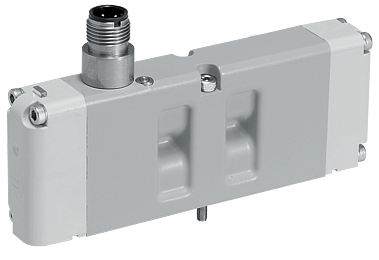




ISO 15407-1 [W66 Series] Spool & Sleeve, Drop Cord Connection
 Installation Instructions
Product Catalog - ISO 15407-1
Installation Instructions
Product Catalog - ISO 15407-1
- Pilot operation provides high shifting force with low power consumption
- Operating pressure from vacuum to 145 psig (9.9 bar)
- Solenoids polarity insensitive with surge suppression and indicator light
- Single sub-base and manifold base mounting
- 4-pin M12 connectors
Directional Control Valves ISO 15407-1 W66 Series Product Overview
The ROSS® ISO 15407-1 valves W66 Series are base mounted spool and sleeve valves that conform to the ISO standards 15407-1 mounting interface. These ISO Size 0 (26mm) and 00 (18mm) valves are available as, 2- and 3-position, 5-ported 4-way valves. Solenoid pilot options include a locking or non-locking override, and either internal or external pilot supply.
Please refer to the side and below for links to easily navigate and download ROSS Controls Directional Control Valves ISO 15407-1 W66 Series catalogs, installation instructions, and technical data. Additionally, you have the option to filter through all available options to discover the Directional Control Valves ISO 15407-1 W66 Series variant that meets your requirements.
Unable to load products. Please try again.
loading...
loading...
Product Overview
The ROSS Controls W66 Series is a line of base-mounted spool and sleeve directional control valves conforming to the ISO 15407-1 mounting interface standard. Available in ISO Size 01 (26 mm) and Size 02 (18 mm), these valves provide 5/2 and 5/3 valve functions for pneumatic automation circuits requiring a standardized compact footprint with individual drop-cord M12 electrical connections.
Spool and sleeve construction forms the core of the W66 design. The precision stainless steel spool travels within an aluminum sleeve with minimal running clearance, generating a fluid-film bearing effect that drastically reduces internal friction without the need for dynamic elastomeric seals on the moving element. This means the valve has no seals to wear out on the primary shifting mechanism, which directly extends service life and reduces unplanned maintenance intervals across high-cycle applications.
Pilot operation delivers high shifting force relative to solenoid power draw. The small solenoid pilot controls a magnified pneumatic force that shifts the main spool, making the W66 well suited to control systems where power consumption per valve station must be minimized. All solenoids are polarity-insensitive with built-in surge suppression and a single-LED indicator light per solenoid that confirms energized status without external metering equipment.
The ISO 15407-1 standard defines the port locations, mounting bolt pattern, orifice dimensions, and pilot passages so that valves from compliant manufacturers are dimensionally interchangeable on the same sub-base or manifold assembly. This allows engineers to specify the W66 with confidence that future service replacements or alternative suppliers will not require mechanical modifications to the manifold or downstream plumbing.
Key Engineering Features
- Spool and Sleeve Construction - No Dynamic Seals to Wear - The primary shifting mechanism uses a precision stainless steel spool inside an aluminum sleeve with no elastomeric dynamic seals on the spool itself, eliminating the most common wear failure mode in directional valves and extending service life over millions of cycles.
- Pilot-Operated for High Shifting Force with Low Power Draw - A small solenoid pilot directs pneumatic pressure to shift the main spool, amplifying force while keeping solenoid power consumption at 5 watts DC per solenoid. This is critical in multi-valve manifold systems where aggregate power budgets are constrained.
- Polarity-Insensitive Solenoids with Surge Suppression - All W66 solenoids accept either polarity of DC supply without damage, simplifying field wiring and eliminating miswiring failures. Integrated surge suppression protects PLC outputs and other control electronics from inductive kickback during solenoid de-energization.
- LED Indicator Light Per Solenoid - A single LED indicator light on each solenoid coil provides immediate energized-state confirmation during commissioning, troubleshooting, and routine inspection, reducing diagnostic time without requiring external test equipment.
- ISO 15407-1 Compliant Mounting Interface - Strict conformance to ISO 15407-1 port locations, bolt pattern, and orifice sizing guarantees dimensional interchangeability with all compliant sub-bases and manifold assemblies, protecting system designs from single-source component dependency.
- ISO Size 01 (26 mm) and Size 02 (18 mm) Availability - Two valve sizes address different flow and space requirements within the same ISO standard family. Size 01 offers Cv 1.1 for medium-flow actuator circuits, while Size 02 with Cv 0.55 targets compact machine sections where valve pitch must be minimized.
- 4-Pin M12 Drop-Cord Electrical Connection - The individual M12 micro connector on each valve allows drop-cord cable runs from overhead cable trays directly to each valve without routing wires through a shared manifold end plate. This simplifies wiring changes when valve arrangements are modified during machine reconfiguration.
- Locking and Non-Locking Manual Override Options - Solenoid pilot valves are available with either flush non-locking or locking manual overrides, enabling forced valve actuation during setup and commissioning without applying electrical power to the solenoid.
- Internal and External Pilot Supply Options - All solenoid pilot configurations are available with either internal or external pilot supply. External pilot allows the valve to be used at sub-30 psig inlet pressures common in vacuum and low-pressure circuits by supplying pilot pressure from a separate regulated source.
- Single Sub-Base and Multi-Station Manifold Mounting - The W66 mounts on single sub-bases with individual port connections or on gang manifold bases that share common supply and exhaust passages. Manifold configurations reduce external plumbing connections and allow zone isolation via intermediate plates.
- Cast Aluminum Body with PBT End Caps - Valve bodies are die-cast aluminum for a favorable strength-to-weight ratio. End caps use polybutylene terephthalate (PBT) thermoplastic, which provides high dimensional stability, resistance to moisture absorption, and compatibility with standard industrial cleaning agents.
- Vacuum to 145 psig Operating Range - The W66 operates across the full range from hard vacuum through 145 psig (9.9 bar), making it directly applicable to vacuum pick-and-place, vacuum forming, and conventional compressed-air actuation circuits within the same valve family.
Technical Specifications
General Specifications
| Parameter | Specification |
| Valve Series | W66 |
| Valve Standard | ISO 15407-1 |
| Valve Type | Directional Control |
| Construction | Spool and Sleeve |
| Actuation | Electrical - Solenoid Pilot Controlled |
| Valve Functions | 5/2 (Single Solenoid, Double Solenoid); 5/3 (Double Solenoid, Closed/Power/Open Center) |
| ISO Sizes Available | Size 02 (18 mm), Size 01 (26 mm) |
| Mounting | Base Mounted - Single Sub-Base or Manifold |
| Operating Pressure | Vacuum to 145 psig (Vacuum to 9.9 bar) |
| Pilot Supply - Size 02 (18 mm) 5/2 | 30 psig (2.07 bar) minimum |
| Pilot Supply - Size 01 (26 mm) 5/2 | 25 psig (1.73 bar) minimum |
| Pilot Supply - 5/3 all sizes | 35 psig (2.41 bar) minimum |
| External Pilot Supply | Must be equal to or greater than inlet pressure |
| Fluid Media | Filtered compressed air |
| Ambient Temperature | 5 to 120 F (-15 to 50 C) |
| Media Temperature | 5 to 120 F (-15 to 50 C) |
| Connection Type | 4-pin M12 micro (drop-cord individual connection) |
| Manual Override | Flush rubber non-locking (standard); locking override available |
| Valve Body Material | Cast Aluminum |
| End Cap Material | Polybutylene Terephthalate (PBT) |
| Fasteners | Zinc Plated Steel |
| Coil Encapsulant | Thermoset Plastic |
| Thread Options | NPT; G (BSPP) |
Temperature Ratings
| Configuration | Ambient Temperature | Media Temperature |
| All Solenoid Pilot Controlled Configurations | 5 to 120 F (-15 to 50 C) | 5 to 120 F (-15 to 50 C) |
Electrical Data (Solenoid Pilot Valves)
All solenoids are rated for continuous duty. Solenoids are polarity insensitive with built-in surge suppression and one LED indicator light per solenoid.
| Voltage | Power Consumption |
| 24 VDC (each solenoid) | 5 watts |
| 110-120 VAC, 50/60 Hz | 1.0 VA inrush; 2.0 VA holding |
| 230-VAC, 60 Hz | Contact ROSS Controls |
Flow Performance Data
Average Cv and weight data per ISO size and actuation type for W66 Series spool and sleeve valves.
| ISO Size | Valve Function | Avg Cv | Weight lb (kg) |
| 02 (18 mm) | 5/2 Single Solenoid Pilot | 0.55 | 0.3 (0.15) |
| 02 (18 mm) | 5/2 Double Solenoid Pilot | 0.55 | 0.4 (0.16) |
| 02 (18 mm) | 5/3 Double Solenoid Pilot | 0.55 | 0.4 (0.16) |
| 01 (26 mm) | 5/2 Single Solenoid Pilot | 1.1 | 0.6 (0.25) |
| 01 (26 mm) | 5/2 Double Solenoid Pilot | 1.1 | 0.6 (0.25) |
| 01 (26 mm) | 5/3 Double Solenoid Pilot | 1.1 | 0.6 (0.25) |
Certifications & Compliance
| Certification/Standard | Detail |
| ISO 15407-1 Compliance | Full conformance to ISO 15407-1 mounting interface standard, ensuring dimensional interchangeability of valve body, port locations, pilot passages, and fastener pattern across compliant manifold systems. |
| CSA Certificate of Compliance | CSA certification confirms compliance with Canadian Standards Association electrical and safety requirements for industrial control equipment. |
| Declaration of Conformity (CE) | CE marking per applicable EU directives, confirming the product meets European health, safety, and environmental requirements for the industrial machinery market. |
| CRN Certification | Canadian Registration Number (CRN) certification for applicable pressure-containing configurations, meeting provincial boiler and pressure vessel regulations for installations in Canadian provinces. |
| EAC Certification | Eurasian Conformity (EAC) mark for distribution and installation in the Eurasian Economic Union member states. |
Typical Applications & Industries
General Industrial Automation and Assembly
- Pick-and-place and transfer systems using pneumatic grippers and rodless cylinders where consistent spool response and no-wear-seal longevity reduce preventive maintenance intervals.
- Conveyor diverters, pallet stops, and escapement mechanisms that demand high cycle rates over extended production runs without valve replacement.
- Clamping and fixturing circuits in welding, assembly, and machining stations where reliable valve function is critical to part quality and cycle time.
- Sorting gates and reject chutes in packaging and material handling lines requiring fast, repeatable actuation in either direction.
Vacuum and Low-Pressure Applications
- Vacuum cup pick-and-place in electronics assembly, solar panel manufacturing, and glass handling where the valve must transition from vacuum to blow-off pressure within the same cycle.
- Vacuum forming and thermoforming equipment where mold cavity evacuation and pressurized part ejection are controlled by the same valve station.
- Leak testing fixtures that cycle between vacuum draw and reference pressure states at high rates, requiring consistent Cv and tight shut-off across millions of cycles.
Automotive Body and Powertrain Manufacturing
- Body-in-white weld fixture actuators controlling clamping cylinders across high-density valve manifolds where compact valve pitch and individual M12 wiring simplify harness routing.
- Powertrain assembly test stands using pneumatic loading and positioning actuators where valve interchangeability across global plants reduces spare parts inventory complexity.
- Sealer and adhesive dispensing equipment using pneumatic needle valves controlled by standardized ISO 15407-1 bases.
Printing, Packaging, and Converting
- Web tensioning and registration systems on printing presses requiring rapid, low-leakage directional control of pneumatic actuators.
- Carton erecting, folding, and gluing stations on packaging lines where individual valve wiring via M12 drop cords simplifies maintenance access without disrupting adjacent valve stations.
- Slitter and rewinder pneumatic braking and tensioning circuits where consistent valve response affects product quality directly.
Ordering and Model Number Configuration
The ROSS W66 Series model number encodes the series designation, revision level, ISO size, interface type, actuation and override option, voltage, and pilot type. The structure below covers both 5/2 (single and double solenoid) and 5/3 (double solenoid) configurations.
|
Model Number Example: W 6 6 7 6 A 0 4 6 1 W
W Series prefix (W = W66 valve family) 66 ISO 15407-1 series designation 7 Configuration: 7 = 5/2 Single Solenoid; 7 = 5/3 Double Solenoid (with position code) 6 Revision Level A indicator A Revision Level 0 ISO Size: 0 = Size 02 (18 mm); 1 = Size 01 (26 mm) 4 Interface code (4 = ISO 15407-1) 61 Actuation/Override Code (see table below) W Voltage: W = 24 VDC; Z = 110-120 VAC 50/60 Hz; Y = 230-VAC 60 Hz
Actuation / Override Codes - 5/2 Single Solenoid Pilot: 61 Non-Locking Override, Internal Pilot 81 Non-Locking Override, External Pilot 71 Locking Override, Internal Pilot 91 Locking Override, External Pilot
Actuation / Override Codes - 5/2 Double Solenoid Pilot: 67 Non-Locking Override, Internal Pilot 87 Non-Locking Override, External Pilot 77 Locking Override, Internal Pilot 97 Locking Override, External Pilot
Center Position Codes - 5/3 Double Solenoid Pilot: 61 Closed Center, Non-Locking, Internal Pilot 63 Power Center, Non-Locking, Internal Pilot 67 Open Center, Non-Locking, Internal Pilot 71 Closed Center, Locking, Internal Pilot 73 Power Center, Locking, Internal Pilot 77 Open Center, Locking, Internal Pilot 81 Closed Center, Non-Locking, External Pilot 91 Closed Center, Locking, External Pilot |
For G (BSPP) thread sub-bases and manifolds, append the G-thread designator when ordering base components. Valve bodies use standard threaded sub-base ports; thread type is specified at the sub-base level, not the valve level.
Voltage suffix W = 24 VDC, Z = 110-120 VAC 50/60 Hz, Y = 230-VAC 60 Hz. For other voltages, contact ROSS Controls.
External pilot supply variants (code 8x or 9x) are required when inlet pressure is below the minimum internal pilot supply threshold or when independent pilot pressure control is needed.
5/3 valves require a minimum pilot supply pressure of 35 psig (2.41 bar) regardless of center position configuration.
Single Sub-Base Part Numbers
| ISO Size | Port Size | NPT Thread Model | G Thread Model |
| 02 (18 mm) | 1/8" | RPL02-01-80 | RPL02-01-70 |
| 01 (26 mm) | 1/4" | RPS5511130P | RPS5511140P |
Interposed Accessories
| ISO Size | Accessory | Model Number |
| 02 (18 mm) | Flow Control (Interposed) | RPS5642P |
| 01 (26 mm) | Flow Control (Interposed) | RPS5542P |
| 02 (18 mm) | Intermediate Supply Module (NPT) | RD02P-01-80 |
| 01 (26 mm) | Intermediate Supply Module (NPT) | RD01P-02-80 |
| 02 (18 mm) | Blank Station | RDX02BLK |
| 01 (26 mm) | Blank Station | RDX01BLK |
Exhaust Silencer Part Numbers
| Port Size | Thread | Avg Cv | Pressure Rating psig (bar) | NPT Model | G Thread Model |
| 1/8" | Male | 1.2 | 0-290 (0-20) | 5500A1003 | D5500A1003 |
| 1/4" | Male | 2.1 | 0-290 (0-20) | 5500A2003 | D5500A2003 |
| 3/8" | Male | 2.7 | 0-290 (0-20) | 5500A3013 | D5500A3013 |
Accessories
Single Sub-Bases
Individual sub-bases provide dedicated port connections for each valve. Available in NPT and G (BSPP) thread types for ISO Size 02 (18 mm) with 1/8" ports and ISO Size 01 (26 mm) with 1/4" ports. Sub-base port sizes are specified at time of ordering to match system piping requirements.
Manifold Bases with Modular Gasket Kits
Multi-station manifold bases share common supply and exhaust passages across all mounted valves, minimizing external plumbing. Modular gasket kits allow individual stations to be isolated or configured for independent pressure zones. Eight standard gasket configurations are available covering open, closed, and mixed supply/exhaust/pilot states per station (RPSHU11P through RPSHU18P).
Interposed Flow Controls
Interposed meter-out flow controls mount between the valve body and sub-base, providing independent exhaust flow adjustment for each actuator port without external needle valves. Size 02: RPS5642P. Size 01: RPS5542P. These eliminate separate in-line flow control components and reduce plumbing connection count.
Intermediate Supply and Exhaust Modules
Intermediate modules inserted between manifold stations create independent supply or exhaust zones without requiring separate manifold assemblies. Available for NPT and G threads in both supply (RPS5626xx/RPS5526xx) and exhaust (RPS5627xx/RPS5527xx) configurations.
Exhaust Silencers
Aluminum exhaust silencers for 1/8", 1/4", and 3/8" port sizes, rated to 290 psig (20 bar). Silencer flow capacity must equal or exceed valve exhaust capacity to avoid back pressure that degrades valve response time. Contaminated silencers should be replaced at regular service intervals.
Warning: Exhaust silencer flow capacity must equal or exceed valve rated exhaust Cv. Blocked or contaminated silencers create back pressure that causes incomplete spool shifting and unpredictable actuator behavior.
Pressure Regulators (Manifold-Mounted)
Manifold-mounted pressure regulators provide independent pressure control per zone or per port on multi-station assemblies. Common pressure (single zone) and independent pressure (per station) configurations are available. Gauge versions cover 2-60 psig and 5-125 psig ranges. Size 02 base: RPS5637 series. Size 01 base: RPS5537 series.
Related Products & Accessories
- ISO 15407-2 W66 Series (Series 241) - The plug-in connection variant of the W66 family, using integrated manifold electrical connections with terminal strip or multi-pin end plates instead of individual M12 drop cords. Shares the same valve body and ISO 15407-2 mounting interface. https://www.rosscontrols.com/en/series/241-iso-15407-2-w66-series
- ISO 5599-1 W60 and W64 Series (Series 242) - Larger ISO 5599-1 base-mounted spool and sleeve (W60) and poppet (W64) valves in ISO Size 1, 2, and 3 for higher flow applications with EN 175301-803 individual electrical connections. https://www.rosscontrols.com/en/series/242-iso-5599-1-w60-w64-series
- ISO 5599-2 W65 Series (Series 243) - ISO 5599-2 spool and sleeve valves with integrated plug-together manifold electrical connections for larger-bore, higher-flow circuit requirements. https://www.rosscontrols.com/en/series/243-iso-5599-2-w65-series
- Exhaust Silencers - Aluminum silencers rated to 290 psig for 1/8", 1/4", and 3/8" port sizes to reduce exhaust noise at valve sub-bases and manifold exhaust ports. https://www.rosscontrols.com/en/series/90-silencers
- Electrical Connectors - M12 and DIN connector assemblies, prewired drop-cord cables, and lighted indicator connectors for ROSS solenoid valves. https://www.rosscontrols.com/en/series/91-electrical-connectors
- Lockout Valves (L-O-X Energy Isolation) - ROSS L-O-X lockout valves for safe energy isolation upstream of W66 manifold assemblies during maintenance operations per OSHA lockout/tagout requirements. https://www.rosscontrols.com/en/series/1287-lockout-valves-15-series
Frequently Asked Questions (FAQ)
Q: What is the key design difference between the ISO 15407-1 W66 Series and the ISO 15407-2 W66 Series?
A: The ISO 15407-1 W66 Series () uses individual 4-pin M12 micro connectors on each valve body, commonly called drop-cord connections, where each valve is independently wired. The ISO 15407-2 W66 Series (Series 241) uses integrated plug-together manifold electrical connections that daisy-chain through the manifold and terminate at end plates with terminal strip or multi-pin interfaces. The ISO 15407-1 configuration is preferred when individual valve wiring flexibility is needed; ISO 15407-2 is preferred when centralized wiring through a single multi-pin connector reduces harness complexity.
Q: What is meant by ISO Size 01 and Size 02 in the W66 designation?
A: Within the ISO 15407-1 standard, the size designation refers to the valve body width, which also determines the mounting pitch when valves are assembled into a manifold. Size 02 is 18 mm wide, while Size 01 is 26 mm wide. The wider Size 01 valve accommodates a larger spool bore, resulting in higher Cv (1.1 vs. 0.55) and a lower minimum pilot pressure requirement (25 psig vs. 30 psig for 5/2 function).
Q: Can W66 Size 01 and Size 02 valves be mixed on the same manifold assembly?
A: No. ISO 15407-1 Size 01 and Size 02 valves have different body widths and bolt patterns and cannot share the same manifold rail. Separate manifold assemblies are required for each size. When both sizes are needed on a machine, designers typically use separate manifold blocks or mount valves on individual sub-bases.
Q: What is the minimum operating pressure for the W66 Series?
A: The W66 Series operates from full vacuum through 145 psig (9.9 bar) inlet pressure. The minimum pilot supply pressure for internal pilot is 30 psig (2.07 bar) for Size 02 and 25 psig (1.73 bar) for Size 01 on 5/2 valves, and 35 psig (2.41 bar) for all 5/3 configurations. For circuits running below these pilot supply thresholds, the external pilot option must be specified with a dedicated regulated pilot supply at or above the minimum.
Q: What are the available 5/3 center position options for W66 double solenoid valves?
A: The W66 Series 5/3 valves are available in three center position configurations: Closed Center (all ports blocked in center), Power Center (supply port open to both actuator ports in center with exhausts closed), and Open Center (supply blocked and both actuator ports connected to exhaust in center). Center position selection depends on the actuator behavior required when both solenoids are de-energized, such as holding position, pressure-equalizing, or free-floating.
Q: Are external pilot supply versions required for vacuum applications?
A: Yes. When the valve inlet is connected to a vacuum source, internal pilot supply is not available because inlet pressure is below atmospheric. External pilot variants (actuation codes 8x and 9x) must be specified, with a separate regulated compressed-air pilot supply at or above the minimum pilot pressure requirement. The pilot supply must be plumbed to the dedicated external pilot port on the sub-base.
Q: What does the surge suppression feature protect against?
A: When a solenoid coil is de-energized, it generates an inductive voltage spike that can damage transistor outputs on PLCs and other solid-state control devices. The built-in surge suppression circuit in every W66 solenoid clamps this spike to a safe level, protecting the driving output regardless of whether the control circuit includes external protection. This eliminates the need for external freewheeling diodes or TVS devices on DC control circuits.
Q: How does the spool and sleeve design eliminate seal wear without creating leakage?
A: The W66 spool runs with a precisely controlled diametral clearance inside the sleeve. This clearance is small enough that internal leakage across the spool lands remains within ISO 15407-1 allowable limits, while still being large enough to prevent metal-to-metal contact during operation. A thin pneumatic film supports the spool during shifting. Because there are no rubber seals on the spool itself, there are no seal extrusion failures, no seal swell issues from incompatible media, and no progressive seal wear that would increase leakage over time.
Q: Can the valve be used with media other than filtered compressed air?
A: The W66 is rated for filtered compressed air only. Nitrogen service is acceptable in many cases but must be confirmed with ROSS Controls for the specific configuration. Lubricated air is not required and is generally not recommended, as oil mist can wash lubricant out of precision spool clearances and promote contamination buildup. If the system uses an in-line lubricator, contact ROSS Controls to confirm compatibility.
Q: What filtration level is recommended upstream of the W66 Series?
A: A minimum 40-micron filter upstream of the valve is recommended for standard service. For precision applications or where extended service intervals are required, 5-micron filtration is preferable. Water separators and coalescing filters should be installed upstream to ensure the air supply is dry, particularly in environments where ambient temperature fluctuations could cause condensation within the supply circuit.
Q: Are CAD models available for the W66 Series?
A: Yes. Two-dimensional drawings and three-dimensional CAD models are available for W66 Series valves, sub-bases, and manifold assemblies through the ROSS Controls website at rosscontrols.com. Models are provided in multiple native CAD formats and STEP/IGES neutral formats to support integration into most mechanical design environments.
Q: What is the standard lead time for W66 Series valves?
A: Standard manufacturing lead time for quantities of 10 or fewer units is typically 3 to 4 weeks for the United States market. Lead times for larger quantities, special configurations, and international orders should be confirmed with ROSS Controls directly. Contact ROSS at (800) 438-7677 or visit rosscontrols.com for current availability.
Q: Are both NPT and G thread sub-bases available?
A: Yes. Sub-bases and manifold accessories are available in both NPT (National Pipe Tapered) and G (BSPP, ISO 228-1) thread forms. The thread type is specified at the sub-base or manifold component level, not at the valve body level, since the valve mounts to the base using the standardized ISO 15407-1 mechanical interface rather than a threaded pipe connection.
Installation & Maintenance Guidelines
- Mount the valve onto a clean, flat sub-base or manifold surface. The ISO 15407-1 mounting face must be free of burrs, nicks, and debris before installing the valve. Inspect the sub-base gasket or O-ring seal for damage and replace if any cuts or compression set is visible.
- Torque valve mounting screws to the fastener torque specification published in the ROSS W66 installation instructions. Under-torquing allows the valve to rock on the sub-base and causes internal leakage between valve and base ports; over-torquing can crack the valve body or distort the sealing faces.
- Supply filtered compressed air meeting a minimum 40-micron filtration requirement to all valve inlets. Particulate contamination that bypasses the filter can lodge in the spool clearance and prevent full valve shifting, causing partial-stroke actuator behavior.
- Do not use PTFE tape on sub-base port threads. Apply a thread sealant appropriate for pneumatic service to NPT port threads; G (BSPP) thread connections rely on face-seal O-rings and do not require thread sealant. Over-applying PTFE tape to NPT ports can shred tape fragments that block spool clearances.
- Wire the M12 drop-cord connector with the correct polarity for DC circuits, although W66 solenoids are polarity insensitive and will operate with either polarity. Use the correct M12 cable assembly rated for the environment: standard PVC jacket for dry indoor use, PUR jacket for applications with exposure to oils or cutting fluids.
- Verify that the solenoid supply voltage matches the valve voltage code before applying power. Applying 120 VAC to a 24 VDC coil or vice versa will immediately damage the solenoid. The LED indicator light illuminates when the solenoid is energized; absence of illumination at an energized output indicates a wiring fault or a failed coil.
- For external pilot supply installations, connect the pilot supply line to the dedicated external pilot port on the sub-base. Pilot pressure must be at or above the minimum value for the valve size (30 psig for Size 02, 25 psig for Size 01 on 5/2 valves; 35 psig for all 5/3 valves). Undersized pilot supply is the most common cause of sluggish or incomplete spool travel in the field.
- Install exhaust silencers only after verifying that the silencer Cv rating equals or exceeds the valve exhaust capacity. Undersized silencers create back pressure on exhaust ports 3 and 5, which opposes the pilot pressure trying to shift the spool and can result in no-shift or half-shift conditions, particularly at low operating pressures.
- When assembling valves onto manifold bases, install all station gaskets before mounting any valves. Confirm that the correct gasket configuration is used for each station by comparing the open/closed port pattern to the circuit design. Incorrectly installed gaskets can cross-connect supply and exhaust passages, creating a short circuit that results in full supply pressure appearing on both actuator ports simultaneously.
- Confirm all mounting screws are fully engaged before applying system pressure. A partially tightened valve will leak at the base interface even at low pressures, and the leak path can cause pressure decay that mimics a cylinder seal failure or circuit leak elsewhere.
- Perform a manual override test on each solenoid pilot before connecting the electrical supply. Press and release the flush rubber non-locking override button while supply pressure is applied. The actuator connected to that valve station should stroke and return on release, confirming correct pneumatic function before any electrical troubleshooting begins.
- Label each M12 drop-cord connector and corresponding valve station with the circuit reference designator during installation. W66 manifolds in dense machine sections can have 20 or more valves with nearly identical appearance; labeling at installation time eliminates reidentification effort during maintenance and accelerates troubleshooting.
- For applications at or near the minimum operating temperature of 5 F (-15 C), verify that the compressed air supply is dried to a dew point below the minimum operating temperature. Residual moisture in the air supply will freeze inside the spool clearance at sub-freezing temperatures and lock the spool in position.
- After initial installation and before machine run-in, cycle each valve a minimum of 10 times under operating pressure and confirm full actuator stroke and return. Spool valves with new gaskets occasionally seat slightly differently in the first few cycles; confirming proper operation before production run-in prevents misattributed startup faults.
Warranty & Global Support
ROSS Controls provides a one-year warranty on all products, covering defects in material and workmanship from date of purchase.
Global technical support is available through ROSS Controls offices in the USA (headquarters in Ferndale, Michigan), Canada, Brazil, Germany, France, United Kingdom, India, China, and Japan.
Contact ROSS Controls USA Customer Service at (800) GET-ROSS (800-438-7677) or Technical Service at (888) TEK-ROSS (888-835-7677). Visit rosscontrols.com for product configuration, CAD model downloads, and distributor locator services.
For complete technical data including dimensional drawings, catalog download, and valve configurator access, visit the ROSS Controls ISO 15407-1 W66 Series product page at rosscontrols.com.
Download Catalog: https://www.rosscontrols.com/en/series/240-iso-15407-1-w66-series
Download Documents
ISO 15407-1 [W66 Series]