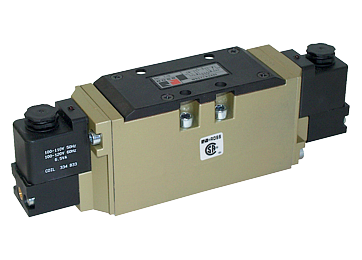




ISO 5599-2 [W65 Series] Spool & Sleeve, Plug-in Connection
 Installation Instructions
Product Catalog - ISO 5599-2
Installation Instructions
Product Catalog - ISO 5599-2
- Pilot operation provides high shifting force with low power consumption
- Optional integrated plug-together manifold electrical connections
- Maximum Inlet pressure: 150 psig (10 bar)
- Automotive connector option mounted on individual conduit cover
- Individual sub-base or manifold base mounting
Directional Control Valves ISO 5599-2 W65 Series Product Overview
The ROSS® ISO 5599-2 valves W65 Series are base mounted spool and sleeve valves that conform to the ISO standards 5599-2 mounting interface. The W65 series has a base electrical connector which eliminates the need to disconnect wires to remove the valve. Manifold bases feature the option for modular plug-together electrical connections terminating at end plates, offering a 25-pin D-sub or 19-pin round interface.
Automotive connector option mounted to individual conduit cover. The ISO Valves W65 Series are adaptable to Serial Bus System. These ISO Size 1, 2, and 3 valves are available as, 2- and 3-position, 5-ported 4-way solenoid pilot or pressure-controlled valves with either internal or external pilot supply.
Please refer to the side and below for links to easily navigate and download ROSS Controls Directional Control Valves ISO 5599-2 W65 Series catalogs, installation instructions, and technical data. Additionally, you have the option to filter through all available options to discover Directional Control Valves ISO 5599-2 W65 Series variant that meets your requirements.
Unable to load products. Please try again.
loading...
loading...
Product Overview
The ROSS Controls W65 Series () is a line of base-mounted spool and sleeve directional control valves conforming to the ISO 5599-2 mounting interface standard. Available in ISO Size 1, 2, and 3 with Cv values from 1.0 to 3.4, these valves serve a broad range of pneumatic circuit flow requirements in general industrial and process automation environments where centralized manifold wiring is the preferred electrical architecture.
The defining characteristic of the ISO 5599-2 standard and the W65 Series is the integrated manifold electrical connection system. Solenoid signals are routed through the manifold body rather than through individual drop-cord cables on each valve. The manifold terminates at end plates offering a 25-pin D-sub or 19-pin round multi-pin interface, reducing the total field wiring connections to a single multi-pin connector per manifold assembly regardless of how many valve stations are present. An automotive connector option is also available, mounted to an individual conduit cover at each valve station for applications requiring valve-level weatherproof wiring.
Serial bus system adaptability is an integral feature of the W65 manifold architecture. Bus adapter modules can be fitted to the manifold electrical system to integrate all valve stations into a fieldbus or industrial Ethernet network, enabling valve control and status feedback over a single communication cable. This reduces I/O hardware, simplifies machine PLC programming, and provides valve-level diagnostics accessible from the control system.
The W65 spool and sleeve construction employs a precision stainless steel spool operating within a cast aluminum valve body on a hydrodynamic film, without elastomeric dynamic seals on the spool element. This eliminates seal wear as a service life determinant, delivering consistent performance over millions of cycles. Pilot operation ensures reliable spool shifting across the full pressure range, and the availability of solenoid pilot, pressure-controlled, and individual sub-base or manifold mounting configurations provides design flexibility for a wide range of machine and system architectures.
Key Engineering Features
- Integrated Plug-Together Manifold Electrical Connections - Solenoid signals are carried through an integrated bus within the manifold body and terminate at end plates with 25-pin D-sub or 19-pin round multi-pin connectors. All valve stations on the manifold connect to the machine control cabinet through a single multi-pin harness, reducing field wiring connectors from one per valve to one per manifold assembly.
- Automotive Connector Option for Individual Valve Wiring - An automotive-grade sealed connector, mounted to an individual conduit cover on each valve station, provides a weatherproof quick-disconnect connection at the valve body. This option is specified for applications where individual valve wiring flexibility is needed while maintaining the IP protection of a sealed automotive-style connector.
- Base Electrical Connector Allowing Valve Removal Without Wire Disconnection - A base-mounted electrical connector option routes solenoid wiring through the sub-base or manifold base rather than the valve body, allowing valve bodies to be removed for service without disconnecting any wiring at the valve. This feature reduces downtime during valve replacement by eliminating the rewiring step.
- Serial Bus System Compatibility - Bus adapter modules integrate into the W65 manifold electrical system to enable fieldbus or industrial Ethernet control of all valve stations through a single communication cable. Serial bus connectivity provides valve control and status feedback, coil diagnostics, and reduced I/O hardware requirements in PLC-controlled machine architectures.
- Spool and Sleeve Construction - No Dynamic Seals to Wear - The stainless steel spool operates within a cast aluminum sleeve on a hydrodynamic film without elastomeric dynamic seals on the spool element, eliminating seal wear, seal extrusion, and chemical compatibility as failure mechanisms. The design provides consistent internal leakage and shifting performance across the full rated service life.
- ISO Size 1, 2, and 3 for Scalable Flow Capacity - Three ISO sizes provide scalable Cv values (Size 1: Cv 1.0, Size 2: Cv 2.3, Size 3: Cv 3.4) within the same standard, allowing engineers to select the appropriate flow capacity for each circuit while using common sub-base and manifold infrastructure.
- 25-pin D-Sub and 19-pin Round Multi-Pin End Plate Options - Manifold end plates with 25-pin D-sub or 19-pin round connector interfaces accommodate up to the corresponding number of solenoid stations per manifold and match standard machine harness interfaces widely used in automotive and general industrial automation.
- Pilot Operation for High Shifting Force at Low Power - Solenoid pilot operation uses a small electrical coil to direct compressed air that shifts the main spool, amplifying electrical input to pneumatic shifting force. This allows reliable actuation across the full 15 to 150 psig operating range at 3.5 watts DC continuous duty.
- Solenoid Pilot and Pressure-Controlled Actuation Options - Both solenoid pilot (electrical) and pressure-controlled (pneumatic pilot) actuation are available in 5/2 and 5/3 functions, providing design flexibility for standard electrical, intrinsically safe, and electromechanically mixed control architectures.
- 5/2 and 5/3 Functions with Full Center Position Selection - W65 valves are available in 5/2 (single and double solenoid) and 5/3 (closed, power, and open center) configurations, covering the full range of double-acting cylinder and rotary actuator control requirements.
- Individual Sub-Base and Multi-Station Manifold Mounting - The W65 mounts on individual sub-bases for standalone installations or on multi-station manifold bases that consolidate supply and exhaust plumbing while the integrated electrical bus consolidates wiring. Both configurations comply with ISO 5599-2 interface specifications.
- Cast Aluminum Valve Body with Stainless Steel Spool - Cast aluminum valve bodies with precision stainless steel spools provide the strength, dimensional precision, and corrosion resistance required for long-term industrial service without unnecessary weight.
Technical Specifications
General Specifications
| Parameter | Specification |
| Valve Series | W65 |
| Valve Standard | ISO 5599-2 |
| Valve Type | Directional Control |
| Construction | Spool and Sleeve |
| Actuation | Electrical - Solenoid Pilot Controlled; Pneumatic - Pressure Controlled |
| Valve Functions | 5/2 Single Solenoid, 5/2 Double Solenoid, 5/3 Double Solenoid (Closed/Power/Open Center), 5/2 Single Pilot (Pneumatic), 5/3 Double Pilot (Pneumatic) |
| ISO Sizes Available | Size 1, Size 2, Size 3 |
| Mounting | Individual Sub-Base or Multi-Station Manifold Base |
| Electrical Connection Options | Integrated plug-together manifold; 25-pin D-sub end plate; 19-pin round end plate; Automotive connector on individual conduit cover; Base electrical connector; Hardwired |
| Serial Bus Compatibility | Adaptable to Serial Bus System via bus adapter module |
| Operating Pressure | 15 to 150 psig (1 to 10 bar) |
| Pilot Supply Minimum - Solenoid Pilot | Equal to or greater than inlet pressure |
| Pilot Supply Minimum - Pressure Controlled | Equal to or greater than inlet pressure |
| Fluid Media | Filtered compressed air |
| Ambient Temperature - Solenoid Pilot | 40 to 120 F (4 to 50 C) |
| Ambient Temperature - Pressure Controlled | 40 to 175 F (4 to 80 C) |
| Media Temperature | 40 to 175 F (4 to 80 C) |
| Manual Override | Non-locking (standard on solenoid models) |
| Valve Body Material | Cast Aluminum |
| Spool/Poppet Material | Stainless Steel |
| Seal Material | Buna-N (Nitrile Rubber) |
| Thread Options | NPT; G (BSPP) |
Temperature Ratings
Ambient temperature limits differ between solenoid pilot and pressure-controlled configurations due to solenoid coil temperature ratings. Media temperature is 40 to 175 F (4 to 80 C) for all configurations.
| Configuration | Ambient Temperature | Media Temperature |
| Solenoid Pilot Controlled (all sizes) | 40 to 120 F (4 to 50 C) | 40 to 175 F (4 to 80 C) |
| Pressure Controlled / Pneumatic Pilot (all sizes) | 40 to 175 F (4 to 80 C) | 40 to 175 F (4 to 80 C) |
Electrical Data (Solenoid Pilot Valves)
All solenoid valves are rated for continuous duty. DC solenoids operate at 3.5 watts nominal at 10 bar. AC solenoids are 6.5 VA holding on 50 or 60 Hz.
| Voltage | Power Consumption |
| 24 VDC | 3.5 watts (at 10 bar) |
| 110/120 VAC, 50/60 Hz | 6.5 VA holding |
| 230/240 VAC, 50/60 Hz | Contact ROSS Controls |
Flow Performance Data
Average Cv, approximate flow capacity, and representative physical dimensions per ISO size for W65 Series solenoid pilot controlled configurations.
| ISO Size | Avg Cv | Flow Nl/min | Length (valve pitch) | Width (solenoid) | Height | Weight lb (kg) |
| 1 | 1.0 | 980 | 1.63 in (41.4 mm) | 4.86 to 6.36 in (123.5 to 161.6 mm) | 2.71 in (68.8 mm) | 0.8 to 1.5 (0.4 to 0.7) |
| 2 | 2.3 | 2,300 | 2.0 in (50.8 mm) | 5.93 to 8.89 in (150.6 to 225.8 mm) | 2.77 in (70.4 mm) | 0.8 to 2.5 (0.4 to 1.2) |
| 3 | 3.4 | 3,300 | 2.54 in (64.5 mm) | 9.76 in (247.9 mm) | 3.18 in (80.8 mm) | 4.0 (1.9) |
Certifications & Compliance
| Certification/Standard | Detail |
| ISO 5599-2 Compliance | Full conformance to ISO 5599-2 mounting interface standard, specifying port locations, bolt pattern, orifice dimensions, and pilot passage geometry for worldwide interchangeability of valves and manifold components. |
| Declaration of Conformity (CE) | CE marking per applicable EU directives confirming compliance with European health, safety, and environmental requirements for the industrial machinery market. |
| CRN Certification | Canadian Registration Number (CRN) certification for applicable pressure-containing configurations, satisfying provincial boiler and pressure vessel regulations across Canadian provinces. |
| EAC Certification | Eurasian Conformity (EAC) mark for distribution and installation in Eurasian Economic Union member states. |
| UL / CSA Listing | UL and CSA listings for solenoid pilot controlled valve configurations, confirming compliance with North American electrical safety standards for industrial control equipment. |
Typical Applications & Industries
Automotive Manufacturing and Assembly
- Body-in-white weld fixture manifolds with high valve station counts where the 25-pin D-sub or 19-pin round end plate interface consolidates harness connections and simplifies fixture wiring qualification.
- Engine and transmission assembly tooling using manifold-mounted W65 valves with automotive connector options that provide weatherproof quick-disconnect connections at each valve station, accelerating tool changeover and reducing rewiring errors.
- Sealer, adhesive, and coating dispensing equipment where serial bus connected W65 manifolds enable recipe-driven valve sequencing and cycle count monitoring from the machine PLC.
- Underbody, chassis, and suspension component assembly lines using pressure-controlled W65 variants in areas where solenoid proximity to weld spatter or high electromagnetic fields makes electrical actuators undesirable.
General Industrial Automation
- Multi-axis Cartesian and SCARA robot pneumatic supply manifolds where centralized wiring through a multi-pin end plate significantly reduces cable management complexity compared to individually wired valve stations.
- High-cycle transfer machine actuator control where spool and sleeve longevity with no dynamic seals on the main spool minimizes unplanned maintenance stops across production-volume manufacturing.
- Pneumatic tooling manifolds on machining centers and machined-component assembly systems, where ISO 5599-2 base compatibility allows valve replacement from multiple suppliers without mechanical modification to the tooling.
- Conveyor accumulation and divert systems with zone control managed by W65 manifolds, where the base electrical connector option allows valve servicing without disturbing manifold wiring during maintenance.
Food, Beverage, and Pharmaceutical Processing
- Filling and capping carousel machines in bottling lines where the compact W65 manifold assembly with multi-pin end plate integration reduces wiring penetrations into splash zones, simplifying IP-rated enclosure design.
- Blister packaging and tablet press pneumatic circuits where ISO 5599-2 manifold interchangeability simplifies spare parts standardization across multiple global production facilities.
- Ingredient metering and dosing systems where serial bus integration enables valve state logging as part of the process batch record for regulatory compliance documentation.
- Clean-in-place (CIP) machine manifolds where the spool and sleeve design with no internal elastomeric seals on the spool provides consistent performance after repeated high-temperature washdown cycles.
Process Industries and Utilities
- Pneumatically actuated process valve control panels using pressure-controlled W65 variants for intrinsically safe area compliance where electrical solenoid components cannot be used.
- Compressed air distribution systems with pneumatically piloted manifold assemblies for zone control in hazardous classified areas where fieldbus or electrical solenoid control is prohibited by area classification.
- Test stand pneumatic control manifolds for burst testing, leak testing, and functional testing equipment where consistent Cv and reliable spool response are critical to test repeatability and result validity.
- Offshore and marine equipment pneumatic control cabinets where the automotive connector option provides sealed individual valve connections with positive mechanical locking to resist vibration-induced loosening.
Ordering and Model Number Configuration
The ROSS W65 Series model number encodes the series designation, valve function, actuation type, ISO size, voltage, and configuration details. The electrical connection type is determined by the manifold base and end plate selection. The valve body model number identifies valve performance parameters independently of the electrical interface configuration.
|
Model Number Example: W 6 5 7 7 A 4 4 0 1 Z
W Series prefix 65 Series designation (W65) 7 Actuation: 7 = Solenoid Pilot; 5 = Pressure Controlled (Pneumatic) 7 Configuration: 6 = 5/2; 7 = 5/3 A Revision Level 4 ISO Size: 1 = Size 1; 2 = Size 2; 3 = Size 3; 4 = Size 3 (alternate) 4 Function/position code 01 Configuration: center position (01=Closed, 02=Power, 03=Open) Z Voltage: W = 24 VDC; Z = 110/120 VAC; Y = 230/240 VAC
Electrical Connection at Manifold Level: Standard: Plug-together manifold bus, 25-pin D-sub end plate Option 1: 19-pin round multi-pin end plate Option 2: Automotive connector on individual conduit cover Option 3: Base electrical connector (valve removable without rewiring) Option 4: Hardwired (direct wire to conduit cover) Serial Bus: Bus adapter module fitted to manifold end plate
Typical Model Examples: W6577A4401Z W65, Solenoid Pilot, Size 3, 5/3 Closed Center, 120 VAC W6557A2411 W65, Pneumatic Pilot, Size 1, 5/3 Double Pilot W6576A2401W W65, Solenoid Pilot, Size 2, 5/2 Double Solenoid, 24 VDC |
The W65 Series uses a minimum operating pressure of 15 psig (1 bar) for solenoid pilot controlled valves at Size 1 and 30 psig (2 bar) for Size 2 and 3. Pressure-controlled valves require pilot pressure equal to or greater than inlet pressure at all sizes.
Voltage codes: W = 24 VDC, Z = 110/120 VAC, Y = 230/240 VAC. For pressure-controlled (pneumatic pilot) valves, no voltage code is used in the model number.
The specific electrical interface at the manifold end plate (25-pin D-sub, 19-pin round, automotive connector, base connector, or hardwired) is selected as a manifold accessory, not as part of the valve body model number.
For serial bus connectivity, specify the compatible bus adapter module for the intended fieldbus or industrial Ethernet protocol. Contact ROSS Controls to confirm available bus adapter options.
Sub-base port sizes for each ISO size: Size 1 accommodates 1/8" to 3/8" ports; Size 2 accommodates 3/8" to 1/2" ports; Size 3 accommodates 1/2" to 3/4" ports.
For G (BSPP) thread sub-bases and manifolds, specify the G-thread component when ordering base assemblies. Valve bodies are common to NPT and G-thread base configurations.
Performance Summary by ISO Size
| ISO Size | Avg Cv | Flow Nl/min | Min Pressure psig (bar) | Max Pressure psig (bar) | Valve Pitch in (mm) | Height in (mm) |
| 1 | 1.0 | 980 | 15 (1.0) | 150 (10) | 1.63 (41.4) | 2.71 (68.8) |
| 2 | 2.3 | 2,300 | 30 (2.0) | 150 (10) | 2.0 (50.8) | 2.77 (70.4) |
| 3 | 3.4 | 3,300 | 30 (2.0) | 150 (10) | 2.54 (64.5) | 3.18 (80.8) |
Accessories
Manifold Bases with Integrated Electrical Bus
Multi-station manifold bases carry the integral electrical bus for plug-together solenoid signal routing and share common supply and exhaust passages across all mounted valve stations. Manifolds are available for Size 1, 2, and 3 W65 valves in configurations from 2 to 24 stations. Common supply and exhaust ports at manifold ends or intermediate stations can be individually plumbed to reduce external piping connections.
25-Pin D-Sub End Plate
Standard multi-pin end plate for W65 manifold assemblies, providing a 25-pin D-sub connector interface that accommodates up to 24 solenoid stations through a single connector. D-sub connectors are widely supported by machine harness manufacturers and PLC I/O connection systems, making this the default end plate selection for general industrial applications.
19-Pin Round Multi-Pin End Plate
An alternative end plate with a 19-pin round connector interface for manifold assemblies requiring a circular multi-pin connection. Round connector versions offer additional mechanical locking and ingress protection compared to D-sub connectors, making them preferred for applications with vibration, contamination, or repeated harness disconnection cycles.
Automotive Connector (Individual Conduit Cover)
A weatherproof automotive-grade sealed connector mounted to an individual conduit cover at each valve station. This option is specified when individual valve-level quick-disconnect wiring is required on a manifold assembly, providing sealed, polarity-keyed connections at each station without the drop-cord cable routing associated with M12 connections.
Base Electrical Connector
The base electrical connector option routes solenoid wiring connections through the sub-base or manifold base rather than through the valve body. Valve bodies can be unbolted and removed for service without disconnecting any wiring, because all electrical connections remain at the base level. This is a significant maintenance time reduction in applications where valves are replaced frequently or where rewiring after valve removal is operationally difficult.
Serial Bus Adapter Modules
Bus adapter modules connect to the W65 manifold electrical bus to enable fieldbus or industrial Ethernet control of all valve stations via a single communication cable. Valve control outputs and solenoid status inputs are accessible from the machine PLC without dedicated discrete I/O channels per valve coil. Contact ROSS Controls for available bus protocols and module compatibility.
Blanking Plates for Unused Manifold Stations
Blanking plates, part 2604H77 series, seal unused manifold stations. When a manifold is specified with spare stations for future expansion, blanking plates maintain the pressure and electrical integrity of the manifold assembly at unused positions without requiring valve installation.
Sub-Base Size Transition Plates
Size transition plates (part 729K86 series) allow manifolds of different ISO sizes to be mechanically joined or mounted adjacent to each other in an assembly, accommodating machine designs that require different flow capacities in different circuit zones on the same structural frame.
Interposed Flow Controls
Interposed meter-out flow controls mount between the W65 valve body and sub-base or manifold station to provide independent exhaust flow restriction for each actuator port. These eliminate external needle valves from the actuator circuit, reducing the number of fittings and potential leak points in the downstream plumbing.
Exhaust Silencers
Exhaust silencers for the port sizes used in W65 sub-base and manifold assemblies reduce exhaust noise and are rated to 290 psig (20 bar). Silencer Cv must equal or exceed the manifold exhaust capacity. Replace contaminated silencers at regular maintenance intervals to prevent back pressure from developing at exhaust ports.
Warning: Silencer Cv must equal or exceed the total exhaust Cv of all valves connected to a common exhaust passage. In a manifold with multiple valves exhausting simultaneously, back pressure from an undersized or contaminated silencer can cause incomplete spool shifting across all stations on that exhaust circuit.
Related Products & Accessories
- ISO 5599-1 W60 and W64 Series (Series 242) - ISO 5599-1 base-mounted spool and sleeve (W60) and poppet (W64) valves in ISO Size 1, 2, and 3 with individual EN 175301-803 DIN connections. The companion standard for applications requiring individual valve wiring or poppet construction for contaminated-air service. https://www.rosscontrols.com/en/series/242-iso-5599-1-w60-w64-series
- ISO 15407-1 W66 Series (Series 240) - Compact ISO 15407-1 spool and sleeve valves in ISO Size 01 (26 mm) and Size 02 (18 mm) with individual 4-pin M12 drop-cord connections for lower-flow applications. https://www.rosscontrols.com/en/series/240-iso-15407-1-w66-series
- ISO 15407-2 W66 Series (Series 241) - ISO 15407-2 spool and sleeve valves in Size 01 and Size 02 with integrated plug-together manifold connections for compact high-density manifold assemblies. https://www.rosscontrols.com/en/series/241-iso-15407-2-w66-series
- Exhaust Silencers - Aluminum exhaust silencers for sub-base and manifold exhaust port sizes used in W65 assemblies, rated to 290 psig. https://www.rosscontrols.com/en/series/90-silencers
- Electrical Connectors - DIN EN 175301-803 and M12 connector assemblies, prewired cables, and lighted indicator connectors compatible with ROSS solenoid valve product lines. https://www.rosscontrols.com/en/series/91-electrical-connectors
- Lockout Valves (L-O-X Energy Isolation) - ROSS L-O-X lockout valves for upstream energy isolation of W65 manifold assemblies during maintenance operations per OSHA lockout/tagout requirements. https://www.rosscontrols.com/en/series/1287-lockout-valves-15-series
Frequently Asked Questions (FAQ)
Q: How does the W65 ISO 5599-2 Series differ from the W60 and W64 ISO 5599-1 Series in electrical connection?
A: Both series use ISO-standard base-mounted spool and sleeve (W65 and W60) or poppet (W64) construction with the same general valve body size classifications (ISO Size 1, 2, 3). The key difference is the electrical connection architecture. ISO 5599-1 W60 and W64 valves use individual EN 175301-803 Form A DIN connectors at each valve body, requiring one cable per valve from the control cabinet. ISO 5599-2 W65 valves use an integrated manifold electrical bus terminating at a single 25-pin D-sub or 19-pin round multi-pin end plate per manifold, reducing field wiring to a single connection regardless of station count. ISO 5599-2 also adds automotive connector and base connector options not available on the ISO 5599-1 products.
Q: What is the operating pressure range for W65 Series valves?
A: W65 Series valves operate from 15 to 150 psig (1 to 10 bar) for Size 1 solenoid pilot valves, and 30 to 150 psig (2 to 10 bar) for Size 2 and Size 3. Pressure-controlled (pneumatic pilot) configurations require pilot pressure equal to or greater than inlet pressure across all sizes. Unlike the W66 Series, the W65 does not support vacuum service because its operating pressure minimum is above atmospheric.
Q: What is the base electrical connector option and when should it be specified?
A: The base electrical connector option routes solenoid coil electrical connections through the sub-base or manifold base body rather than through a connector on the valve body itself. When the valve body is removed from the base for service, the electrical connections at the base remain intact because no connector is attached to the valve body. This eliminates the rewiring step during valve replacement and is most valuable in applications where valves are changed frequently on a running manifold, where access to the valve connector is physically difficult in the installed position, or where eliminating one field wiring connection per service event justifies the upfront cost of the base connector configuration.
Q: What serial bus protocols are supported by the W65 manifold system?
A: The W65 manifold electrical bus is adaptable to serial bus systems through compatible bus adapter modules. Supported protocols depend on the specific adapter module selection. Contact ROSS Controls at (800) 438-7677 or visit rosscontrols.com to confirm currently available fieldbus and industrial Ethernet protocols and compatible bus adapter module part numbers for the intended control architecture.
Q: What center position configurations are available for W65 5/3 double solenoid valves?
A: Three center positions are available: Closed Center (all five ports blocked when both solenoids are de-energized), Power Center (supply port open to both actuator ports with exhausts closed in center), and Open Center (supply blocked and both actuator ports connected to exhaust in center). Center position selection determines actuator behavior when both solenoids are simultaneously de-energized: Closed Center holds position, Power Center equalizes pressure across the actuator, and Open Center allows the actuator to move freely under external load.
Q: What is the recommended compressed air filtration for W65 Series valves?
A: A minimum of 40-micron filtration upstream of the valve supply port is recommended for standard service. The spool and sleeve design is moderately tolerant of contamination due to the clearance-based sealing mechanism, but particulate that accumulates in spool clearances can progressively increase breakout force and internal leakage. Water separators and coalescing filters should be installed upstream to ensure dry air supply, particularly in systems where ambient temperature fluctuations create condensation in supply lines.
Q: Can W65 manifold assemblies be extended with additional stations after initial installation?
A: Field extension of a W65 manifold typically requires disassembling the manifold to insert additional station bodies, replacing the end plate to match the new total station count, and potentially replacing or extending the manifold supply and exhaust manifold rail if a longer section is needed. For applications where future expansion is anticipated, specifying a manifold with additional blank stations at initial installation is more efficient than planning for field extension. Blank stations use ROSS part 2604H77 series blanking plates to seal unused positions.
Q: Is air line lubrication required or recommended for W65 spool and sleeve valves?
A: Air line lubrication is not required for W65 valves under standard operating conditions. The spool operates on a hydrodynamic film in the sleeve clearance without petroleum lubrication. Introducing oil mist to a previously unlubricated system can temporarily wash spool clearances clean and cause a period of increased spool friction during the transition. If a system lubricator is already present, confirm petroleum-based oil compatibility with ROSS Controls before using W65 valves downstream of the lubricator.
Q: What is the temperature limit for W65 solenoid pilot valves?
A: The ambient temperature limit for W65 solenoid pilot valves is 40 to 120 F (4 to 50 C). Media temperature is 40 to 175 F (4 to 80 C) for all configurations. The 120 F ambient limit is set by the solenoid coil thermal rating. Pressure-controlled (pneumatic pilot) W65 valves, which have no solenoid coil, support ambient temperatures up to 175 F (80 C), matching the media temperature limit.
Q: What is the difference between the 25-pin D-sub and 19-pin round end plate options?
A: The 25-pin D-sub end plate provides a rectangular D-sub connector interface that is widely used in industrial machine wiring and supports up to 24 solenoid coil connections per manifold assembly. The 19-pin round end plate provides a circular multi-pin connector with a locking bayonet or threaded coupling that resists vibration-induced disconnection and provides higher ingress protection than an unsealed D-sub connector. The round connector is preferred for mobile equipment, outdoor installations, or anywhere the manifold harness connector is subjected to repeated mating cycles or mechanical stress.
Q: Are blanking plates available for unused manifold stations?
A: Yes. Blanking plates (ROSS part 2604H77 series) seal unused manifold stations pneumatically and electrically. When a manifold is built with extra stations for future expansion, blanking plates maintain manifold pressure integrity at the unused positions and prevent unintended short circuits in the electrical bus at open station locations. Blanking plates must be installed at all unused stations before applying system pressure.
Q: What is the expected service life of the W65 spool and sleeve valve?
A: The W65 spool and sleeve design is rated for tens of millions of cycles when operated with clean filtered air within the rated pressure (15 to 150 psig) and temperature (media to 175 F) envelope. There are no dynamic elastomeric seals on the main spool, so seal wear is not a primary life determinant. Long-term performance depends on maintaining upstream filtration quality. Contamination is the primary mechanism that increases spool breakout force over time. Maintaining recommended 40-micron filtration and periodic drain of the upstream water separator are the most effective maintenance practices for maximizing W65 service life.
Q: Are CAD models available for W65 manifold assemblies?
A: Yes. Two-dimensional drawings and three-dimensional CAD models are available for W65 valve bodies, sub-bases, and manifold components through the ROSS Controls website at rosscontrols.com. For multi-station manifold assemblies with specific station counts and end plate configurations, dimensional drawings can be generated based on the configured assembly. Contact ROSS Controls for configuration-specific drawings and CAD model requests.
Installation & Maintenance Guidelines
- Before mounting any valves onto a new manifold assembly, verify that the manifold mounting surface is clean and free of machining chips, burrs, and any foreign material that could interfere with gasket seating. The ISO 5599-2 mounting face flatness tolerance must be met at every valve station to ensure consistent base-to-valve sealing.
- Install manifold station gaskets at all positions, including blanked stations, before applying any supply pressure. The manifold electrical bus contacts and pneumatic port seals at each station are activated by the clamping force of the valve mounting screws. Missing gaskets at any station create simultaneous pneumatic cross-port leakage and potential electrical short circuits in the bus.
- Torque manifold valve mounting screws to the specification in the ROSS W65 installation instructions. The mounting screw torque determines the gasket compression that seals both the pneumatic ports and the electrical bus contact interfaces. Use a calibrated torque driver and verify torque after all screws are installed, as earlier screws may relax slightly when adjacent screws are tightened.
- When connecting the manifold end plate multi-pin connector to the machine harness, verify that the connector body is fully seated and the mechanical locking mechanism is fully engaged before applying electrical power. Partial connector engagement on a 25-pin D-sub is difficult to detect visually. For round connectors with threaded coupling, verify that the ring is fully tightened by hand.
- For serial bus connected manifold assemblies, configure and verify bus node addresses before entering the manifold into automatic machine control. Confirm that the bus controller is addressing every station in the manifold and that each valve station responds correctly to both energize and de-energize commands. A misconfigured or unresponsive station will remain in its default (de-energized) state during machine operation, which can cause cycle faults that are misdiagnosed as mechanical actuator failures.
- When using the base electrical connector option, route and dress the machine harness wiring to the base connector before installing valve bodies. The wiring at the base connector must be complete and verified before the valve body is installed, since access to the base connector may be difficult with the valve body in place.
- Apply supply pressure to the manifold gradually at initial commissioning. A large manifold assembly with multiple valve stations represents significant volume in the supply passage. Rapid pressurization can cause momentary pressure spikes above the rated maximum if the upstream supply line volume is large and an automatic pressure regulator is not protecting the manifold inlet.
- Perform a manual override test at each valve station before enabling automatic solenoid control. With supply pressure applied, press the manual override at each station while monitoring the corresponding actuator. Confirm full actuator stroke on each actuation and proper return when the override is released. This verifies correct pneumatic routing at every station before introducing electrical faults into troubleshooting.
- Supply filtered air meeting the 40-micron minimum filtration requirement to the manifold supply port. A coalescing filter and automatic drain should be installed upstream to prevent moisture accumulation in the manifold supply passage. Moisture collected in a large manifold supply channel can be carried into multiple valve bores simultaneously during pressure cycling, accelerating sleeve corrosion in high-humidity environments.
- For outdoor or mobile equipment installations, confirm that the manifold end plate connector sealing meets the ingress protection requirement for the installation environment. Standard D-sub connectors without separate sealing boots provide limited ingress protection. Sealed round connectors or fully enclosed end plate assemblies should be specified for outdoor, washdown, or high-humidity applications.
- When blanking plates are installed at unused manifold stations, confirm that they are torqued to the specified value and that both the pneumatic port gasket and the electrical bus contact gasket are correctly positioned. Improperly seated blanking plates at unused stations create the same leakage and short-circuit risk as improperly seated valve bodies.
- Document the manifold assembly configuration including valve model numbers, station assignments, and end plate connector pinout before the machine is placed in service. For manifolds with 12 or more stations, the identity of individual valve stations is difficult to determine from visual inspection of an installed assembly. Configuration records support accurate spare parts ordering and circuit tracing during future maintenance.
- For pressure-controlled (pneumatic pilot) W65 manifolds, ensure that the pilot supply circuit is independent of the main valve supply circuit and is protected from pressure drop during machine cycle transitions. A pressure drop in the pilot supply below the inlet pressure level during a high-demand moment in the machine cycle can cause the valve to fail to shift or to partially return, creating an intermittent fault that is difficult to replicate during maintenance investigation.
- After completing installation and before production run-in, verify that all valve stations on the manifold cycle correctly at the lowest operating pressure expected during normal machine operation. W65 Size 1 solenoid pilot valves operate with a minimum of 15 psig, but pilot response time increases at lower pressures. Confirm that actuator timing at minimum pressure meets the machine cycle time budget before releasing the machine for production.
Warranty & Global Support
ROSS Controls provides a one-year warranty on all products, covering defects in material and workmanship from date of purchase.
Global technical support is available through ROSS Controls offices in the USA (headquarters in Ferndale, Michigan), Canada, Brazil, Germany, France, United Kingdom, India, China, and Japan.
Contact ROSS Controls USA Customer Service at (800) GET-ROSS (800-438-7677) or Technical Service at (888) TEK-ROSS (888-835-7677). Visit rosscontrols.com for product configuration, manifold configuration tools, CAD downloads, and distributor locator services.
For complete technical data including dimensional drawings, manifold assembly configuration guides, bus adapter protocol documentation, and the W65 Series catalog, visit the ROSS Controls ISO 5599-2 W65 Series product page at rosscontrols.com.
Download Catalog: https://www.rosscontrols.com/en/documents/400/iso-5599-2-valves-w65-series
Download Documents
ISO 5599-2 [W65 Series]