



Nuestra Experiencia en la Industria del Aluminio
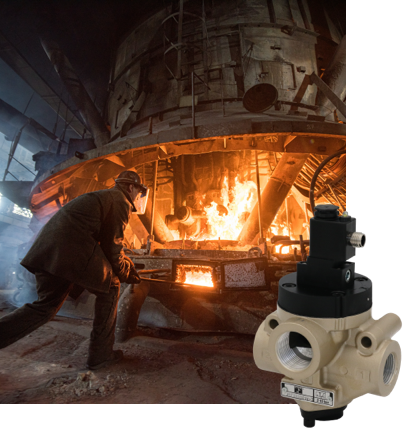
The metals industry runs in some of the harshest environments in heavy manufacturing. Reduction cells, electric arc furnaces, reheat ovens, hot-strip mills, pickle lines, and continuous casters subject pneumatic and hydraulic controls to radiant heat, alumina dust, fluoride-laden potroom atmospheres, mill scale, hydraulic mist, and around-the-clock duty cycles. Unplanned downtime cascades quickly. A single sticking valve on an anode jacking circuit, a leaking exhaust on a coiler clamp, or a missed lockout on a hot-strip pulpit can shut a process line, scrap a heat, or expose your team to hazardous energy. Pneumatic control performance is not a peripheral concern in steel and aluminum production. It directly shapes uptime, energy cost, and worker safety.
ROSS Controls has manufactured pneumatic valves since 1921 and brings over 100 years of fluid power expertise to the metals industry. ROSS poppet valves have been the recognized standard across the global metals industry for decades, specified into aluminum potlines, integrated steelworks, mini-mills, and downstream processing facilities on every continent. The combination of dirt-tolerant poppet construction, control-reliable safety exhaust products, manual and supervisory energy isolation systems, and the ROSS/FLEX custom engineering program gives plant engineers, OEM machine builders, and safety professionals a single source for the components that keep metals operations running safely and continuously.
Why Metals Operations Demand Precision Fluid Power Control
Metals production places demands on pneumatic and hydraulic controls that few other industries match. Component selection cannot be treated as a commodity decision.
Extreme Thermal Loads and Radiant Heat:
Furnace decks, casting floors, hot-strip mill stands, and aluminum potrooms expose pneumatic actuators and valves to ambient temperatures well above the limits of standard elastomers and lubricants. Cylinders mounted near reheat furnaces or above molten metal handling equipment routinely see surface temperatures that destroy nitrile seals, char standard pneumatic tubing, and degrade the close-fit clearances inside spool valves. Your fluid power components must hold their seal integrity, shifting force, and response time across the full thermal range of the surrounding process, including the cool-down and start-up transients where thermal stress is highest. Selection criteria for high-temperature valve service must address body material, seal compound, lubricant, electrical connector rating, and the supporting tubing and fittings as a single integrated package.
Particulate, Fume, and Corrosive Atmospheres:
Aluminum smelter potrooms carry fluoride and alumina particulate. Steel mills generate iron oxide scale, graphite from continuous casters, and acidic fume from pickle lines. Galvanizing and coating lines add zinc dust and chemical vapor. Coke handling, sinter plants, and direct-reduced iron operations contribute additional carbon-bearing dust. These contaminants migrate into compressed air systems through every imperfect seal, every drained condensate point, and every component intake, settling on valve internals and accelerating wear on any sliding surfaces. Pneumatic components selected for the metals industry must tolerate dirty supply air on the inside and resist external corrosion on the outside at the same time, often without scheduled cleaning intervention because the equipment is in a continuous-process zone that does not stop.
Electromagnetic Fields in Aluminum Reduction:
Aluminum smelter potrooms operate under intense direct-current magnetic fields generated by potline busbars. Standard ferrous valve components can experience attraction forces, magnetic latching of internal parts, and unpredictable shifting behavior in this environment. Non-magnetic construction is a hard requirement for valves and accessories installed in or near the reduction cells.
Continuous Operation and Cascading Downtime:
Integrated steel plants and aluminum smelters operate as continuous processes. Aluminum reduction cells cannot be cycled off without losing the cell. Continuous casters cannot stop mid-heat without scrapping the strand. Hot-strip mills lose coils and reheat-furnace temperature whenever the line stops. Any pneumatic component on the critical path must deliver consistent switching across millions of cycles, because the cost of failure is measured in tons of scrap and hours of recovery, not in maintenance labor alone.
Hazardous Energy and Lockout/Tagout Enforcement:
Lockout/tagout (LOTO) under OSHA 29 CFR 1910.147 remains one of the most frequently cited OSHA standards every year. Metals facilities cover vast geographic areas with complex piping, multiple energy sources, and equipment that takes minutes to fully exhaust through a standard ball valve. Inefficient or unreliable energy isolation creates two problems at once. It exposes maintenance workers to stored pneumatic and hydraulic energy if the system is not fully de-energized before access, and it adds long isolation cycles to every intervention, eroding production time across thousands of events per year. As an illustrative comparison, exhausting one cubic foot of compressed air at 100 psig through a fully ported ROSS valve completes in roughly 1.2 seconds, while the same volume through a standard ball valve can take on the order of four minutes. Multiplied across hundreds of LOTO events per shift in a large integrated plant, the time difference becomes a significant production-recovery opportunity.
Energy Cost and Sustainability Pressure:
Compressed air is one of the most expensive utilities in any metals plant. Aluminum smelters and steel mills run large compressed air systems continuously for actuation, instrumentation, and process functions. Even small leakage rates in directional control valves compound across thousands of devices and 8,760 hours of operation per year. Sustainability targets and rising energy costs make compressed air efficiency a quantifiable line item, not a soft objective. Plant engineering teams increasingly include leakage performance, energy-saving capability, and the ability to support zone-based shutdown of idle equipment in their valve specification criteria, alongside the traditional safety and reliability requirements.
ROSS Valve Technology for Metals Industry Conditions
Standard industrial valves are designed to a price point and a duty cycle that the metals industry routinely exceeds. ROSS poppet valves were engineered around the operating realities of steel mills and aluminum smelters, and the design choices made decades ago remain directly relevant to today's plants.
The internal construction of a ROSS poppet valve uses a direct-acting sealing element that lifts off and seats against a metal-bonded elastomer face. There is no sliding seal in the flow path. This single design decision drives a set of characteristics that matter in metals service.

-
Positive sealing with no sliding action.
Spool-and-sleeve valves rely on radial seals that slide against a sleeve bore on every shift. In dust-laden potroom or mill-floor air, abrasive particles act as a lapping compound, progressively widening clearances and creating internal leakage. ROSS poppet valves separate the sealing function from the shifting function. The poppet lifts vertically off the seat, exposes a high-velocity flow path, and reseats with a metal-backed elastomer face. There is nothing to lap, nothing to score.
-
Self-cleaning and dirt tolerant.
The smallest flow-through area in a ROSS poppet valve is across the seal-and-seat region during the initial moments of the shift. Velocity through that section is high enough to expel particulate, scale, and condensate that would otherwise lodge between sliding surfaces. This is the reason ROSS poppet valves continue to shift reliably in environments where spool valves stick or lose response speed.
-
Self-compensating for wear.
As the elastomer seal face burnishes over millions of cycles, the poppet automatically adjusts its stroke to maintain consistent seating pressure. There is no scheduled adjustment, no manual rebuild routine to maintain shift speed across the service life of the valve.
-
High-temperature capability.
ROSS offers 21 Series, 27 Series, 64 Series, and 74 Series poppet valves in low-temperature and high-temperature variants with elastomer compounds and lubricants matched to elevated ambient service. Non-magnetic material configurations are available for valves installed in aluminum potline electromagnetic fields, where standard ferrous internals are unsuitable.
-
Repeatable response across the service life.
Strong shifting forces in both directions, combined with consistent sealing geometry, produce repeatable response times that hold their value as the valve ages. Safety circuits, sequencing circuits, and synchronized actuator pairs all depend on this kind of stable behavior. Drift in valve response time is one of the silent root causes of intermittent quality defects on continuous lines, and it is exactly the failure mode that the ROSS poppet design is engineered to eliminate.
Metals Industry Application Solutions
Pneumatic systems in steel and aluminum plants serve dozens of distinct functions. The five application areas below cover the highest-impact circuits where ROSS technology is most often specified.
Aluminum Smelter Potroom Operations
Primary aluminum reduction lines depend on continuous, repeatable pneumatic control inside an environment most fluid power components are not designed for. Cell-tending equipment, anode handling, alumina feeding, and crust breaking all run on compressed air, often inside the magnetic field of the potline itself.
ROSS 21 Series and 27 Series poppet valves are specified for potroom service in non-magnetic configurations and high-temperature variants. The dirt-tolerant poppet construction handles fluoride-laden alumina dust without progressive performance loss, and the lack of close-fit sliding clearances eliminates the failure mode that magnetic field exposure can introduce in standard ferrous spool internals. ROSS/FLEX repackaging supports the unique mounting footprints, port configurations, and circuit logic that smelter operators have refined over decades of operating experience, including the multi-cylinder sequence requirements that come with newer high-amperage cell designs. Where ROSS air-management products are deployed across the potline supply system, smelter operators have used the resulting compressed-air reduction to support sustainability reporting and to free up compressor capacity for line expansions without adding new compressor capital.
Key Benefits
- Non-magnetic construction options for service inside potline magnetic fields
- High-temperature variants rated for radiant heat near reduction cells
- Dirt-tolerant poppet design maintains response speed in alumina dust
- ROSS/FLEX custom configurations for crust-breaking and feeding circuits
- Long service life under continuous duty without scheduled rebuilds
Typical Applications
- Anode jacking and adjustment
- Crust-breaker and ore-feed actuation
- Cell-tending vehicle pneumatics
- Pot-room door and access actuation
- Overhead crane control and grappling
Primary Steel Production: Furnaces and Continuous Casting
Electric arc furnaces, basic oxygen furnaces, ladle metallurgy stations, and continuous casters apply heat, motion, and force to liquid steel. Pneumatic actuation drives slag doors, lance positioning, ladle slide gates, mold oscillators, tundish covers, and dummy bar handling. Failure modes carry direct safety and scrap consequences.
ROSS poppet valves on these circuits provide the consistent shifting and sealing required for synchronized actuator pairs and timing-critical operations. ROSS air preparation products keep supply air dry and clean enough to protect actuator seals exposed to ambient temperatures that would otherwise drive condensation through standard pneumatic equipment. Bubble-tight shutoff matters in slide-gate and clamp circuits because any internal leakage produces position drift on the holding stroke, and position drift on a ladle slide gate has direct safety implications. Where the layout permits, ROSS DM2 Series C or M35 Series safe exhaust valves are specified upstream of high-energy actuators so that the entire circuit can be reliably and verifiably de-energized for maintenance access.
Key Benefits
- Consistent response time supports synchronized motion on caster equipment
- Bubble-tight shutoff prevents creep on slide-gate and clamp circuits
- High-temperature poppet variants survive radiant load near molten metal
- ROSS/FLEX adapter plates allow drop-in replacement of underperforming legacy valves
Typical Applications
- Electric arc furnace slag-door and lance pneumatics
- Ladle slide-gate cylinder control
- Continuous caster mold oscillator and tundish actuation
- Dummy bar insertion and withdrawal
- Torch cutting and roller-table interlocks
Hot and Cold Rolling Mill Control
Hot-strip mills, plate mills, and cold-rolling tandems use pneumatics for side guides, edger positioning, work-roll changers, scale-breaker spray controls, and coiler clamping. Mill-floor environments combine scale, water mist, hydraulic fluid, and rapid duty cycles that punish standard valves.
ROSS 27 Series, 64 Series, and 74 Series higher-flow poppet valves and 60 Series, 65 Series and 70 Series spool valves on subbase manifolds give mill engineers the flexibility to match valve technology to the contamination profile of each section. Hot-mill stands and coiler areas, where mill scale and water mist saturate the air, are typically configured with poppet construction. Roll shops, lubricant rooms, and instrument-grade circuits in cleaner zones can run on ISO spool manifolds where standardization and density are the priority. Coiler areas and roll-shop circuits often benefit from ROSS DM2 Series C or M35 Series double valves on hazardous motion circuits where personnel access is required, and the SV27 sensing valve adds verifiable de-energization confirmation to the maintenance procedure.
Key Benefits
- Higher-flow 27 Series poppet valves matched to large-bore mill cylinders
- Self-cleaning poppet behavior maintains performance in mill scale and mist
- Category 4 PLe safety exhaust available for hazardous motion circuits
- ISO 5599-1 and ISO 15407-1 manifold options for centralized mill-stand control
Typical Applications
- Hot-strip mill side guides and edger positioning
- Coiler clamp and mandrel control
- Work-roll changer hydraulic-pneumatic interlocks
- Cold-mill threading and tail-out control
- Plate-mill turnover and shear interlock
Thermal Treatment, Galvanizing, and Coating Lines
Continuous annealing, galvanizing, electrolytic cleaning, and coil coating lines run at line speeds where small pneumatic faults compound quickly into strip-quality defects. Air-knife positioning, tension-control assist circuits, accumulator pit functions, and entry/exit shear interlocks are all candidates for ROSS technology.
ROSS poppet valves with appropriate elastomer compounds maintain sealing integrity in zinc-rich, acidic, or solvent-bearing atmospheres. ROSS air preparation products at point-of-use protect downstream actuators from condensate that would otherwise carry process contaminants into the cylinder. Compatibility review at the elastomer level is a standard part of ROSS application engineering for galvanizing and coating customers, because seal swell or premature hardening from process atmosphere exposure is a leading cause of intermittent line stops on these assets.
Key Benefits
- Elastomer compounds compatible with galvanizing and coating-line atmospheres
- Bubble-tight poppet sealing prevents creep on tension-assist circuits
- ROSS/FLEX custom porting matches existing line plumbing without rework
- Air preparation packages designed for harsh industrial supply air
Typical Applications
- Air-knife positioning on galvanizing lines
- Tension-control assist on continuous annealing lines
- Accumulator pit dancer-roll pneumatics
- Entry- and exit-shear interlocks
- Coating-line metering pump control
Environmental Control and Operational Efficiency Systems
Baghouse pulse-jet cleaning, water-treatment dosing, and compressed-air management systems are not glamorous, but they directly affect compliance and operating cost. Baghouse failures trigger emissions excursions. Compressed-air leaks across hundreds of valves quietly absorb a meaningful share of plant electrical demand.
ROSS poppet valves on baghouse pulse circuits deliver the rapid, repeatable, full-bore pulse required to clean filter bags effectively. EnergySaver air-management strategies built around ROSS soft-start, dump, and shutoff valves reduce compressed-air consumption when production zones are idle, supporting plant sustainability targets and reducing utility cost.
Key Benefits
- Rapid full-bore pulse supports effective baghouse filter cleaning
- Near-zero internal leakage protects plant compressed-air efficiency
- Soft-start and shutoff valves enable zone-based air management
- Reliable cycling under high-frequency baghouse duty
Typical Applications
- Baghouse pulse-jet cleaning valves
- Water-treatment chemical dosing actuation
- Compressed-air zone shutoff and demand management
- Dust-collection damper actuation
- Environmental enclosure pressurization
ROSS Controls Product Solutions for the Metals Industry
The ROSS portfolio for metals service spans directional control, safety exhaust, energy isolation, supervisory lockout, and air preparation. The product entries below identify the series most commonly specified into steel and aluminum applications, with the operating rationale that drives the selection.
-
21 Series: Inline Poppet Directional Control Valves
The 21 Series provides general-purpose 2/2, 3/2, and 4/2 directional control across 1/4 inch through 1-1/2 inch port sizes in steel and aluminum facilities. The 21 Series is available in low-temperature and high-temperature configurations with DIN and M12 electrical connections, suiting it to potroom and furnace-area service where ambient conditions exceed standard valve ratings.
-
27 Series: Higher-Flow Inline Poppet Valves
The 27 Series extends poppet valve performance to the larger flow rates required by mill-floor cylinders, slide gates, and roll-changer equipment. Available in 2/2, 3/2, and 4/2 functions across 1/4 inch through 2-1/2 inch port sizes, the 27 Series is the workhorse directional control valve specified into integrated steel plants and primary aluminum facilities. High-temperature, hazardous-location, and CRN-certified variants are available for the demanding installations typical of metals service.
-
DM2 Series C: Control-Reliable Safe Exhaust Double Valve
The DM2 Series C is a redundant, internally monitored safety exhaust valve certified to ISO 13849-1 Category 4 and Performance Level e (PLe). Functional redundancy and self-contained monitoring detect faults, including diminished shifting performance, without depending on external machine control. On detection of asynchronous element behavior, the valve locks itself out and cannot be reset by simply cycling power. This design is appropriate for the high-risk hazardous-motion circuits common on mill-floor presses, coilers, and strapping equipment in metals service.
-
M35 Series: External-Monitored Safe Exhaust Double Valve
The M35 Series is a mid-flow safe exhaust double valve that uses external monitoring to deliver ISO 13849-1 Category 4 and PLe performance with optional integrated soft-start. The M35 platform supports modular port-connection options, including Air Entry assemblies that combine isolation, soft-start, and FRL functions in a single mounted package. The compact form factor and SISTEMA library support make the M35 well suited to mill-floor cells, coiler areas, and strapping stations where space is limited but safety integrity must be demonstrated.
-
SV27 Series: Sensing Valves with Optional Manual Lockout
The SV27 Series single-valve sensing platform provides Safety Category 2 PLc and Category 3 performance with externally monitored response and 99 percent diagnostic coverage. Built on the proven 27 Series poppet base, the SV27 is specified where pressure-state sensing must confirm full de-energization before personnel access. Optional integrated manual lockout (L-O-X) combines isolation and verification in a single component.
-
L-O-X 15 Series: High-Capacity Manual Lockout Valves
The L-O-X 15 Series High Capacity manual lockout valve is typically the first valve in the air supply line to a metals-industry equipment cell. Available with port sizes through 2 inches, the 15 Series delivers padlockable manual energy isolation, full-port exhaust capacity, and an integrated sensing port for pressure verification using a visual pop-up indicator or electrical pressure switch. Yellow body and large red operating handle support the high-visibility lockout point requirement under OSHA 29 CFR 1910.147 and ANSI/ASSE Z244.1. Full-bore exhaust dumps stored compressed-air energy in seconds rather than minutes, materially shortening every LOTO event on the line.
-
ElectroGuard: Single-Point Lockout and Energy Isolation System
The ElectroGuard system provides supervisory Single-Point Lockout (SPLO) capability across electrical, pneumatic, and hydraulic energy sources for large-scale metals processing lines. Dual-channel low-voltage safety switches can be locked at multiple convenient locations around the equipment, eliminating long walks to remote isolation points and reducing the risk of missed lockout sources. ElectroGuard systems are factory-sealed and certified to Category 4 and PLe, making them an appropriate fit for high-throughput steel processing lines, large coil-coating lines, and integrated downstream finishing equipment.
-
FRL Air Preparation: Filter, Regulator, and Lubricator Combinations
Mill-floor and smelter air supply quality is rarely as clean as a valve datasheet assumes. ROSS FRL combination units, including the Mid-Size Series, deliver point-of-use filtration, precision pressure regulation, and lubrication ahead of safety exhaust valves, directional control valves, and actuators. Properly sized FRL packages extend service life across the entire downstream pneumatic circuit and reduce warranty exposure on safety-rated components.
Regulatory Compliance and Safety Standards
Metals manufacturing operates under a layered framework of national and international standards. ROSS engineers products to support compliance, and ROSS safety specialists work with plant teams to translate standards into the actual circuit, valve, and lockout decisions that auditors and risk assessors evaluate.
| Standard | Scope | ROSS Solution |
|---|---|---|
| OSHA 29 CFR 1910.147 | Control of Hazardous Energy (Lockout/Tagout) | L-O-X 15 Series manual lockout valves; ElectroGuard SPLO; SV27 sensing valves |
| OSHA Directive CPL 02-00-147 | Enforcement policy for hazardous energy control | Documentation, audits, and validation services |
| ANSI/ASSE Z244.1 | Lockout/Tagout and alternative methods | L-O-X energy isolation; ElectroGuard supervisory lockout |
| ANSI B11.19 | Performance criteria for safeguarding | DM2 Series C and M35 Series safe exhaust valves |
| ANSI B11.0 / ANSI B11.TR3 | Risk assessment and reduction | Risk assessment services; SISTEMA library support |
| ANSI B11.26 | Functional safety for hydraulic systems | Hydraulic safety circuit design support |
| ANSI/PMMI B155.1 | Safety requirements for packaging machinery | DM2 Series C, M35 Series, ElectroGuard |
| ISO 13849-1 | Safety of machinery, performance levels and categories | DM2 Series C (Cat 4 PLe); M35 Series (Cat 4 PLe); SV27 (Cat 2/3) |
| ISO 4414 | Pneumatic fluid power, general rules | Pressure-rated, performance-tested ROSS valves and FRLs |
| CSA Z142 | Power press machinery safety (Canada) | DM2 Series C and M35 Series safety exhaust |
| EU Machinery Directive 2006/42/EC | CE marking and conformity assessment | TÜV-tested ROSS safety products |
ROSS safety products are designed to meet global standards including CSA, EN, ISO, OSHA, ANSI, and CE. Where required by customer specification or regulatory authority, ROSS products can be tested and certified by TÜV (TÜV Rheinland and TÜV SÜD), BG/DGUV, UL, and CSA. Certification documentation is available for inclusion in plant validation packages.
The control system, not just the electrical portion, must be evaluated when applying ISO 13849-1, ANSI/ASSE Z244.1, and ANSI/PMMI B155.1. Each of these standards explicitly defines output devices, including pneumatic and hydraulic valves, as part of the safety-related control system. Performance level is governed by the weakest link in the chain, which is why control-reliable safety exhaust valves like the DM2 Series C and M35 Series are specified into Category 3 and Category 4 circuits rather than relying on standard directional control valves with external monitoring.
ROSS/FLEX: Custom Solutions for Metals Industry Applications
Standard products cover the majority of metals-industry requirements, but every smelter and steel plant carries circuit-specific constraints that no off-the-shelf valve quite matches. Existing footprints, legacy port patterns, multi-function manifold consolidation, and process-specific sequence logic are recurring themes. ROSS/FLEX is the program that handles these requirements without forcing the long lead time and life-cycle requalification of a full custom development.
ROSS/FLEX repackages proven 21 Series, 27 Series, and other ROSS valve internals into customer-specified manifold blocks, port patterns, and integrated function packages. Because the internal valve components are already qualified, the cycle from concept to production-ready hardware typically runs one to four weeks rather than the multi-month timeline of a clean-sheet design. The program is used heavily across aluminum smelter and integrated steel customers where decades of process refinement have produced highly specific component requirements.
Representative ROSS/FLEX applications in metals service:
- Anode jacking, crust-breaker, and ore-feed valve packages tailored to specific potline equipment vintages and footprints
- Furnace door and slag-door pneumatic packages combining directional control, isolation, and exhaust functions in a single mounted block
- Adapter plates that allow drop-in replacement of underperforming legacy valves from other manufacturers, holding existing pipe runs and electrical interfaces while upgrading to ROSS poppet performance
- Multi-function rolling-mill side-guide blocks consolidating directional control, speed control, and safety exhaust into a single integrated assembly
ROSS/FLEX Benefits:
- Production-ready hardware in one to four weeks rather than months
- Proven valve internals eliminate the need for new life-cycle testing
- Multi-function consolidation reduces piping complexity, leak points, and footprint
- Adapter-plate strategies preserve existing infrastructure during upgrades
- Direct collaboration between mill engineers and ROSS application engineering through the lifecycle of the project
For comprehensive solutions, ROSS Custom Systems builds and tests complete pneumatic and hydraulic packages, manifolds, panels, and skids to customer specifications. On-site testing and installation assistance are available for major commissioning events. ROSS/FLEX engineering capability is described in detail at the ROSS/FLEX program page.
Frequently Asked Questions
-
Q: Why are ROSS poppet valves the standard in steel mills and aluminum smelters?
Answer:
ROSS poppet valves are purpose-built for the contamination, temperature, and duty-cycle profile of metals production. The internal construction produces strong shifting and sealing forces in both directions, delivering high-speed, repeatable performance over millions of cycles. The positive-seal, no-slide-action design is self-cleaning and dirt tolerant, which matters in the dust-laden atmospheres of potrooms and mill floors. Automatic wear compensation maintains seating force and shift speed across the service life of the valve. Spool-and-sleeve valves, by contrast, depend on sliding seals that progressively widen in dusty service and can develop cross-over leakage during safety events. ROSS poppet construction holds near-zero internal leakage throughout the lifecycle, which translates directly into compressed-air efficiency, operational consistency, and reduced rebuild burden.
-
Q: What safety standards do ROSS products help metals facilities comply with?
Answer:
ROSS safety products support compliance with OSHA 29 CFR 1910.147 (Control of Hazardous Energy), ANSI/ASSE Z244.1 (Alternative Methods for Hazardous Energy Control), ANSI B11.19 (Performance Criteria for Safeguarding), ANSI B11.0 and B11.TR3 (risk assessment), ANSI B11.26 (Functional Safety for Hydraulic Systems), ANSI/PMMI B155.1, ISO 13849-1 (Safety of Machinery, Performance Levels and Categories), ISO 4414 (Pneumatic Fluid Power), CSA Z142, and the EU Machinery Directive 2006/42/EC. DM2 Series C and M35 Series safe exhaust valves are third-party certified to Category 4 and Performance Level e (PLe). The SV27 Series is certified for Category 2 and Category 3 applications, providing the right performance level for the outcome of each plant risk assessment.
-
Q: How does ROSS help reduce unplanned downtime in metals manufacturing?
Answer:
ROSS reduces unplanned downtime through four reinforcing mechanisms. First, the inherent reliability of poppet valve construction supports consistent switching across millions of cycles in the contaminated air typical of metals plants. Second, self-monitored DM2 Series C double valves detect diminished shifting performance and other internal faults before they produce a hazardous failure. Third, Single-Point Lockout systems such as ElectroGuard cut multi-source isolation procedures from minutes to seconds, recovering production time across thousands of LOTO events per year. Fourth, the ROSS/FLEX program delivers optimized replacement valve solutions in one to four weeks, allowing plants to upgrade underperforming circuits without waiting through a full custom-engineering lead time.
-
Q: What is ROSS/FLEX and how does it apply to metals operations?
Answer:
ROSS/FLEX is the ROSS custom engineering program that repackages proven poppet valve internals into customer-specified configurations. For metals customers, ROSS/FLEX is most often used to consolidate multiple valve functions into a single body, to create adapter plates that drop into existing pipe runs and electrical interfaces while upgrading the internal valve performance, and to optimize circuit designs for the exact flow rates and response times required by a specific potline or mill stand. Because the internal valve components are already qualified, ROSS/FLEX deliveries typically run one to four weeks rather than the months a clean-sheet custom valve would require, and the program does not force a new life-cycle test cycle.
-
Q: How do ROSS products support energy efficiency and compressed-air cost reduction in metals operations?
Answer:
ROSS poppet valves achieve near-zero internal leakage by design, and the seal integrity is preserved across millions of cycles rather than degrading the way a sliding-spool seal does. In aluminum smelters and integrated steel plants, where compressed-air systems run 8,760 hours a year across thousands of valve points, this leakage characteristic is the single largest lever on the compressed-air utility bill. ROSS soft-start and shutoff products additionally enable zone-based air management, where compressed-air supply to idle equipment is reduced or shut off entirely without disrupting active production. Combined, the leakage profile and zone-management capability allow plants to translate compressed-air savings into measurable sustainability and cost results.
-
Q: What lockout/tagout solutions does ROSS offer for steel mills and aluminum smelters?
Answer:
ROSS offers two primary lockout product families for the metals industry. The L-O-X 15 Series manual lockout valves provide padlockable pneumatic energy isolation with full-bore exhaust capacity, available through 2-inch port sizes for high-capacity supply lines. The yellow body and large red handle support the high-visibility lockout point requirement under OSHA 29 CFR 1910.147 and ANSI/ASSE Z244.1, and an integrated sensing port supports pressure verification before access. For larger and more complex equipment, the ElectroGuard system delivers Single-Point Lockout across electrical, pneumatic, and hydraulic energy sources using dual-channel low-voltage safety switches certified to Category 4 and PLe, with multiple convenient lockout positions around the protected equipment.
-
Q: Can ROSS valves withstand the extreme temperatures and electromagnetic conditions in metals production?
Answer:
Yes. ROSS 21 Series and 27 Series poppet valves are available in low-temperature and high-temperature configurations using elastomer compounds and lubricants matched to elevated ambient service near furnaces, reheat zones, and pot lines. Non-magnetic material configurations are available for valves installed in or near aluminum potline electromagnetic fields, where standard ferrous internals are unsuitable. Hazardous-location variants are available for explosive-atmosphere zones encountered in some downstream processing. Where standard configurations do not match a specific installation, the ROSS/FLEX program supports application-specific material and configuration changes built around the same proven internal valve components.
-
Q: How are ROSS valves selected for the contaminated air typical of metals plants?
Answer:
Valve selection for metals service starts with the contamination, temperature, and duty profile of the specific circuit. ROSS application engineers evaluate the supply-air quality, expected ambient conditions, contaminant types (alumina dust, mill scale, zinc fume, hydraulic mist, and so on), required flow and response time, and applicable safety standard. Poppet valve series, including the 21 Series and 27 Series, are typically specified into directly contaminated environments where the self-cleaning poppet design provides the highest reliability. Spool-and-sleeve technology is recommended where high-density manifolds and fieldbus integration are the dominant requirement and where supply air can be conditioned to a clean, well-regulated state. ROSS FRL combination units are sized into the design at point of use to keep supply-air quality consistent.
-
Q: How do I get started with ROSS Controls for my steel mill or aluminum smelter?
Answer:
ROSS supports metals customers through application engineering review, plant walk-throughs, free safety system assessments, and ROSS/FLEX feasibility evaluations. The starting point is typically a circuit-level review of high-impact applications, including hazardous-motion safety circuits, large LOTO points, anode handling and crust-breaking equipment, mill-stand side guides, and any legacy valves where reliability or rebuild frequency has become a problem. ROSS application engineers and Global Safety Team members are available for on-site engagement, and over 100 authorized distributors worldwide provide local stocking and field service support.
Contact Our Metals Industry Application Engineering Team
ROSS application engineers, Global Safety Team specialists, and metals-industry distributor partners are available to review your aluminum, steel, and downstream processing requirements. Whether you need a standard product specification, a ROSS/FLEX custom configuration for a specific mill stand or potline, a control-reliable safety exhaust circuit on hazardous machinery, or a complete plant safety system assessment, ROSS is ready to engage with your team.