



Nuestras Soluciones de Aplicaciones de Ensamblaje y Prueba
Why Assembly & Test Applications Demand Precision Control
In modern manufacturing, assembly and leak testing operations are critical junctures where product quality is determined and customer satisfaction is built or lost. Whether assembling complex automotive components, testing pressure vessels, or performing precision pick-and-place operations, the pneumatic systems controlling these processes must deliver absolute reliability, repeatability, and speed without compromise.
ROSS Controls brings a proven portfolio of pneumatic valve solutions purpose-built for the challenges of assembly and test applications across diverse manufacturing industries. Our engineered solutions combine precision, reliability, and safety to maximize production efficiency while meeting increasingly stringent regulatory requirements including ANSI B11.19, ISO 13849-1, and industry-specific safety standards.
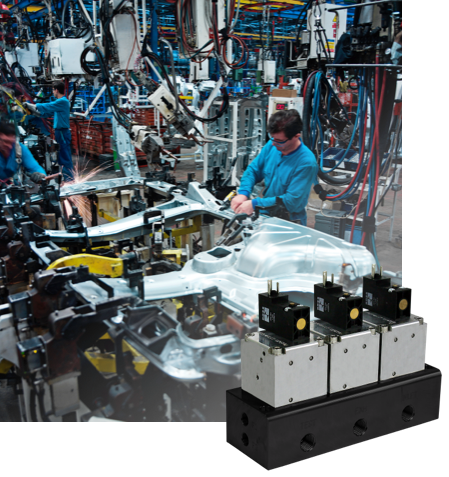
Understanding Assembly & Test Application Challenges
Manufacturing operations face mounting pressure on multiple fronts:
Production Efficiency Demands: Modern production schedules leave no margin for error. Every cycle delay compounds across thousands of units, driving up costs and jeopardizing delivery commitments. Your pneumatic systems must perform flawlessly, cycle after cycle, with virtually zero unplanned downtime.

Quality Assurance Imperatives: Product defects discovered late in assembly or after shipment create cascading costs, including warranty claims, recalls, supply chain disruptions, and damage to brand reputation. Leak testing and quality verification at the point of assembly becomes your first line of defense against these costly scenarios.
Worker Safety Obligations: OSHA regulations, ANSI standards, and the responsibility to protect workers require that machines incorporate fail-safe systems, proper guarding, and controlled management of hazardous energy to prevent injuries.
Regulatory Compliance Complexity: Different industries impose varying safety requirements. Automotive manufacturers answer to different standards than pharmaceutical or food processing operations. Your control systems must demonstrate compliance with applicable standards, documented and auditable for regulatory inspections.
Total Cost of Ownership Optimization: Modern procurement teams evaluate solutions not just on initial capital cost but on complete lifecycle value. Equipment that costs more upfront but delivers years of reliable service with minimal maintenance often represents the superior financial choice.
ROSS Controls Valve Technology: The Right Design for Every Application
ROSS Controls manufactures both poppet valves and spool-and-sleeve valves, giving engineers the flexibility to select the best valve technology for each specific assembly or test application. There is no single "best" valve type. Each design offers distinct advantages that make it the right choice in particular operating environments, duty cycles, and performance requirements. ROSS application engineers work with your team to match the appropriate technology to your exact needs.
Poppet Valve Characteristics
Poppet valves use a direct sealing element that opens and closes against a seat. This construction provides several performance characteristics well suited to specific assembly and test scenarios:
- Near-Zero Internal Leakage: The metal-to-elastomer seat seal creates a bubble-tight shutoff, making poppet valves the preferred choice for leak test circuits, vacuum applications, and anywhere downstream pressure must be held precisely without drift.
- Dirt Tolerance and Self-Cleaning: The poppet geometry creates high flow velocity across the sealing area, helping to expel contaminants. This makes poppet valves well suited to environments with particulate contamination or infrequent cycling where spool valves might stick.
- Wear Compensation: As the poppet seal wears, the element adjusts its stroke to maintain consistent seating force, extending service life in high-cycle assembly applications.
- High-Temperature Capability: ROSS poppet valve designs are available for elevated-temperature environments such as paint baking ovens, steam cleaning zones, and thermal cycling processes.
- Compact Inline Form Factor: Poppet valves are well suited to direct pipe or manifold mounting in tight spaces without requiring a subbase.
ROSS poppet valve series include the 21 Series, 27 Series, Dale Series (CP, CX, LF, LX, LT), 16 Series, W14 Miniature Series, and the W74 ANSI poppet series, among others.
Spool-and-Sleeve Valve Characteristics
Spool-and-sleeve valves use a precision-machined spool that slides within a sleeve to direct airflow through multiple ports. This construction provides a different set of performance characteristics that make it the right choice for many assembly and automation applications:
- Multi-Port Flexibility: Spool valves naturally accommodate 4/2, 5/2, and 5/3 functions with center conditions (exhaust center, pressure center, blocked center), providing versatile circuit options for complex assembly sequences and actuator control.
- ISO Standard Interfaces: ROSS ISO-format spool-and-sleeve valves comply with ISO 5599-1, ISO 5599-2, and ISO 15407-1 standards, enabling drop-in interchangeability with other ISO-compliant valves and manifolds across OEM assembly machine platforms.
- High-Density Manifold Integration: The subbase-mount spool valve format is purpose-built for multi-station manifold assemblies, making it the standard choice for high-axis-count assembly cells, robotic tooling controllers, and automated test fixtures.
- Fieldbus and Serial Bus Compatibility: ROSS ISO spool valve manifolds integrate with TURCK and other serial bus I/O systems, enabling Industry 4.0 connectivity with a single fieldbus cable replacing individual wire runs to each valve.
- Smooth, Low-Noise Operation: The sliding spool creates smooth, consistent flow transitions well suited to applications requiring gradual pressure buildup or controlled actuator motion.
ROSS spool-and-sleeve valve series include the W60, W64, W65, and W66 ISO series, as well as the 95 Series slim-line valves and NAMUR-interface valves.
Selecting the Right Technology
In practice, many assembly and test machines use both valve types. A typical automated assembly cell might use ISO spool valves on a multi-station manifold to control clamping cylinders, while using Dale Series poppet valves in the leak test circuit where bubble-tight shutoff is required. ROSS application engineers are available to review your circuit requirements and recommend the best valve technology for each function.
-
Assembly & Test Application Solutions
Channel Select Leak Test Systems
Leak testing every component represents non-negotiable quality assurance in industries where failure costs are catastrophic. ROSS offers valve solutions that make quality verification an efficient, integrated part of your manufacturing process.
The Dale Series Manifold architecture enables simultaneous testing of multiple parts or multiple chambers within a single complex component. The bubble-tight poppet sealing of the Dale Series is particularly well suited to leak test circuits, where even minimal internal valve leakage would corrupt test results. Parallel testing capability reduces per-unit test time while maintaining absolute quality verification.
Key Benefits:
- Multi-Channel Testing: Test multiple chambers simultaneously in a single component
- Flexible Configuration: ROSS/FLEX customization supports your unique component geometry
- Pressure Decay Testing: Measures actual leak rate per ISO 9409 specifications
- Differential Pressure Methods: Compares test chamber pressure to reference chamber for maximum sensitivity
- Complete Documentation: Automated logging for traceability and SPC (Statistical Process Control) analysis
- Regulatory Compliance: Valve designs support ANSI standards and ISO quality requirements
Typical Applications:
- Automotive transmission housings
- Hydraulic cylinder assemblies
- HVAC component testing
- Fuel system leak verification
- Medical device pressure vessels
-
Bypass Fill & Exhaust Leak Test Solutions
For high-volume production environments, cycle time is a critical competitive factor. The bypass valve configuration transforms test efficiency by enabling simultaneous fill and exhaust phases rather than sequential operation.
A bypass valve serves two critical functions:
- Cycle Time Optimization: By allowing high-flow filling concurrent with exhaust operations, cycle times can be reduced 30 to 50 percent compared to traditional sequential approaches. For production volumes exceeding 500 units daily, this efficiency translates directly to bottom-line impact.
- Contamination Prevention: In casting or metal fabrication processes, loose sand, oxide particles, or manufacturing debris can contaminate test equipment internals, causing premature valve wear and test unreliability. The bypass exhaust valve prevents contamination from entering sensitive gauging equipment, protecting downstream instrumentation and extending service intervals.
Proven Benefits:
- Faster Cycles: 30 to 50 percent reduction in test time per component
- Equipment Protection: Contamination barrier prevents damage to test instrumentation
- Improved Reliability: Valve design handles harsh manufacturing environments
- Pressure Holding Capability: Maintains test pressure without creep, enabling accurate static pressure decay measurements
-
Vacuum Pick & Place Systems: Precision Automation
When product geometry, fragility, or precision requirements make mechanical gripping inadequate, pneumatic vacuum systems deliver unmatched advantages.
Applications where vacuum automation excels:
- Delicate Components: Plastic housings, finished surfaces, or precision optics that mechanical jaws would damage
- Complex Geometry: Components with protrusions or internal features that confound gripper design
- Variable Geometry: Assembly lines handling multiple part families with irregular shapes
- Clean Room Requirements: Pharmaceutical, medical device, or electronics manufacturing where particle generation must be minimized
ROSS Vacuum Solutions Deliver:
- Lower Initial Cost: Vacuum systems eliminate expensive gripper tooling required for each part variant
- Force Density Advantage: Vacuum delivers force directly proportional to evacuated area, enabling powerful holding on large surfaces with gentle handling on small areas
- Proximity Mounting: Vacuum components can be installed directly on the pick arm, minimizing system complexity and space requirements
- Minimal Programming: Vacuum actuators operate through simple on/off solenoid control
- Environmental Tolerance: Vacuum systems operate reliably in dusty, wet, or temperature-variable manufacturing environments
Typical Vacuum Automation Applications:
- Automotive interior component assembly (dash panels, headliners)
- Glass or plastic sheet handling
- Semiconductor wafer placement
- Medical device component transfer
- Packaging material handling
-
Featured Solution: Dale CX Valve Manifold for Leak Testing
The Proven Choice for Production Leak Testing
The Dale CX Valve Manifold represents a proven solution for automated, production-scale leak testing across diverse component geometries. The poppet construction of the Dale Series is specifically chosen for this application because leak-tight shutoff is a non-negotiable requirement. Other ROSS valve technologies are available for the fill, exhaust, and channel routing functions within the same test system where absolute shutoff is less critical.
Advanced Leak Test Methods
Modern leak testing utilizes three primary methodologies, each suited to different application requirements:
- Flow Test (Bubble Detection): The traditional approach submerges pressurized components in water and observes bubble generation at leak sites. Simple and visual, but limited to relatively large leaks and requiring manual or automated bubble detection equipment.
- Pressure Decay Test: Pressurizes the component to a known level, seals the test chamber, and measures how rapidly pressure falls. Any pressure drop indicates a leak; the rate of decay correlates to leak size. This automated, highly sensitive method produces quantitative data suitable for SPC analysis and traceability documentation.
- Differential Pressure Test: Compares test chamber pressure to a reference chamber, amplifying sensitivity to pressure differences. Ideal for low-pressure systems or components with minimal test volume. Suitable for high-reliability applications like aerospace or medical devices.
Dale CX Manifold Advantages:
- Flexible Configuration: Supports all three test methods through modular valve designs
- Rapid Cycle Times: 2 to 10 second test cycles typical, enabling high-volume production testing
- Complete Automation: Integrates with PLC control for fully automated test sequences
- Data Management: Digital pressure transducers provide quantitative leak rate measurements
- Traceability: Pass/fail and actual leak rate data logged for every component
Regulatory Compliance & Safety Standards
Assembly and test operations must comply with multiple, sometimes overlapping regulatory frameworks. ROSS products are designed and documented to help you navigate this complex landscape with confidence.
-
ANSI B11.19 -
Machines Tool Safety -
ISO 13849-1:
Safety-Related Control Systems -
ISO 4414: Pneumatic Fluid Power
Systems Safety
ANSI B11.19: Machine Safety
ANSI B11.19 provides the umbrella standard for safety of machinery, defining risk reduction methodologies and the application of risk reduction devices. Assembly machinery must systematically identify potential hazards and implement proportionate control measures to reduce risk to acceptable levels.
How ROSS Solutions Support ANSI B11.19 Compliance:
- Controlled Motion: Valve selection and speed control enables precise cylinder motion, reducing unintended rapid-motion hazards
- Pressure Relief: Built-in relief systems prevent over-pressurization that could create hazardous conditions
- Fail-Safe Behavior: Valves designed to move to a safe position upon air loss, power loss, or internal faults, preventing uncontrolled motion
- Documentation Support: Complete technical documentation supports hazard analysis and control effectiveness demonstration

ROSS Controls Product Solutions for Assembly & Test
The following ROSS product series address the key functional requirements of assembly and test applications. The portfolio spans both poppet valve and spool-and-sleeve valve technologies, safety and energy isolation products, and air preparation. The appropriate selection depends on your specific circuit requirements, duty cycle, and performance targets.
-
Safety & Energy Isolation
Dale Series (CP, CX, LF, LX): Leak-Tight Poppet Valve Manifolds
The Dale Series is the primary recommendation for leak test and vacuum circuit applications where bubble-tight shutoff is required. The metal-to-elastomer poppet sealing interface creates virtually leak-proof performance essential for channel select leak testing, bypass fill/exhaust, and vacuum circuits. Available in multiple sub-series to match flow, duty cycle, and pressure requirements. Use where zero internal leakage is the critical requirement.
EEZ-ON Soft Start Valve: 27 Series
The EEZ-ON Soft Start Valve provides controlled pressurization of assembly machine pneumatic circuits at startup, preventing cylinder runout, tooling damage, and workpiece ejection. A standard safety and cycle-protection feature for virtually all pneumatic assembly machines. Safety Category 1, PLc.
L-O-X Lockout Valve: 15 Series
The L-O-X Lockout Valve provides manual pneumatic energy isolation and Lockout/Tagout (LOTO) compliance at assembly cells, test benches, and robotic work envelopes. Features a padlockable handle for OSHA/ANSI Z244.1 compliance and an integrated soft-start/exhaust function for safe re-pressurization after maintenance.
e L-O-X Electrical Isolation Device Series
The e L-O-X simultaneously isolates both electrical and pneumatic energy sources at a single lockout point, eliminating the need for separate devices. Directly applicable to CNC assembly cells, robotic work cells, and any electrically driven pneumatic equipment.
ElectroGuard Plus Energy Isolation System
The ElectroGuard Plus provides supervisory, multi-zone, remotely controlled energy isolation for complex assembly lines. Supports individual zone lockout without shutting down the entire line and integrates with safety PLCs and GuardLogix controllers. Ideal for large automated assembly systems where personnel need access to one zone while adjacent zones remain in production.
DM2 Series C: Safe Exhaust Double Valve
The DM2 Series C provides control-reliable, monitored pneumatic safety exhaust on powered fixtures, presses, clamping systems, and assembly automation. Redundant and self-monitored to ISO 13849-1 Category 4, PLe. Used where a hazardous pneumatic cylinder or actuator must be reliably de-energized.
M35 Series: Safe Exhaust Double Valve
The M35 Series is a mid-flow, control-reliable safety exhaust valve for assembly automation, test rigs, and robotic end-effectors. Safety Category 4, PLe with external monitoring. The compact form factor makes it well suited for machine-mounted or fixture-integrated installations where space is limited but safety circuit integrity is required.
M35 Series: Safe Air Entry Assembly
The M35 Series provides safe, controlled pressurization of assembly machines and test equipment after LOTO release. Combines isolation and soft-start exhaust functions, preventing pressure shock on downstream tooling and cylinders during startup.
SV27 Series: Sensing Valves / Safe Air Entry
The SV27 Sensing Valve provides pressure-sensing confirmation that a system is fully de-energized before personnel access, a critical function in assembly and test maintenance procedures. Provides audible and tactile confirmation that downstream pressure is exhausted.
RSe Series: Safe Pressure Select Valves
The RSe Series enables dual-pressure pneumatic operation in assembly and test applications, allowing switchover between full work pressure and a reduced safe approach pressure. Provides a lower force setting for manual part loading and unloading, then returns to full pressure for the automated cycle. Relevant to assembly presses, clamping fixtures, and ergonomic tool circuits.
-
Directional Control Valves: Poppet Series
21 Series: Inline Poppet Valves
The 21 Series provides general-purpose directional control for cylinders, actuators, and pneumatic circuits throughout assembly lines. Available in 2/2, 3/2, and 4/2 functions with solenoid, manual, mechanical, and pilot operators. The bubble-tight poppet design is well suited to applications requiring low internal leakage. Available in standard, high-temperature, and low-temperature variants.
27 Series: Inline Poppet Valves
The 27 Series provides broader flow capacity directional control for assembly cylinder circuits, larger actuators, and general pneumatic control. Available in 2/2, 3/2, 4/2, and 4/3 functions with solenoid, manual, mechanical, pilot, and hand-lever operators. Higher flow rates make these well suited for larger bore cylinders common in automotive assembly fixtures. Also available in the EEZ-ON soft-start configuration.
16 Series: Compact Inline Poppet Valves
The 16 Series is designed for space-constrained assembly equipment, small-bore cylinder control, electronics assembly, and precision automation. The compact, lightweight design is suited for machine-integrated mounting where footprint minimization is critical.
Miniature Series: M10, M72, W14
The Miniature Series provides sub-miniature directional control for small-scale assembly, electronics, medical device manufacturing, and precision test equipment. Flows suited for small-bore cylinders, pneumatic grippers, and pick-and-place heads where space and weight are at a premium.
-
Directional Control Valves: Spool-and-Sleeve Series
W65 Series: ISO 5599-2 Spool-and-Sleeve Valves
The W65 Series provides ISO 5599-2 standard spool-and-sleeve valve interfaces for OEM assembly machine builders requiring interchangeable, industry-standard manifold connections. Well suited to multi-station manifold assemblies with 4/2 and 5/2 function requirements. Multiple operator configurations including solenoid and pilot.
W66 Series: ISO 15407-1 and ISO 15407-2 Spool-and-Sleeve Valves
The W66 Series provides compact ISO 15407-1 and ISO 15407-2 spool-and-sleeve valve interfaces for high-density manifold assemblies on modern assembly machines. Available in drop-cord and plug-in connection styles. Compatible with serial bus communication modules for smart factory integration.
W60 / W64 Series: ISO 5599-1 Spool-and-Sleeve Valves
The W60 and W64 Series provide full-size ISO 5599-1 standard interfaces for higher-flow industrial assembly automation applications. The W64 platform is unique in offering both spool-and-sleeve and poppet valve constructions within the same ISO 5599-1 subbase footprint, giving engineers design flexibility when mixing circuit requirements on a common manifold.
95 Series: Slim-Line Spool-and-Sleeve Valves
The 95 Series enables high-density valve placement on assembly machines, test rigs, and manifold systems requiring slim profiles. Available in NAMUR interface for direct actuator mounting. Compatible with serial bus I/O systems for Industry 4.0 assembly machines.
-
Multi-Station Manifolds
PACK Series: Multi-Station Valve Manifolds
The PACK Series provides pre-assembled multi-station valve manifolds with 2 to 12 or more stations for multi-actuator assembly cells. Reduces installation time, plumbing complexity, and leak points. Ideal for assembly fixtures with many pneumatic cylinders. Available with serial bus I/O integration via TURCK for PLC and Industry 4.0 connectivity.
-
Precision Pressure & Flow Control
Proportional Pressure Control Valves: Industry 4.0 Series
The Proportional Pressure Control Valve series provides digitally controlled, variable pressure output for test rigs, force-controlled assembly, servo-pneumatic systems, and adaptive clamping. Precise electronic pressure control via analog or digital command signal integrates with PLCs, HMIs, and SCADA systems. Paired with the Diagnostics Tablet and Diagnostics Test Unit for field commissioning and troubleshooting of test rigs.
Series 19 & 11: Flow Control Valves
Series 19 and 11 Flow Control Valves provide cylinder speed regulation for assembly actuators, controlling extension and retraction speed of clamps, slides, and presses. Needle valve and check valve combinations provide meter-in or meter-out cylinder speed control, essential for smooth, repeatable motion in assembly fixtures.
-
Air Preparation (FRL)
MD3 / MD4 Series: Filters, Regulators, Lubricators
The MD3 and MD4 FRL Series provides point-of-use and zone air preparation for assembly machines, test benches, and pneumatic tool stations. Filters remove particulates and moisture, precision regulators maintain accurate supply pressure critical for consistent clamping force and test pressure delivery, lubricators extend valve and cylinder life in high-cycle environments, and combination FRL units provide space-saving assemblies at machine entry points.
-
Industry 4.0 Connectivity
TURCK Serial Bus I/O Integration
ROSS base-mounted valve manifolds integrated with TURCK serial bus I/O modules enable multi-axis pneumatic control via a single fieldbus connection supporting DeviceNet, Profibus, EtherNet/IP, and other protocols. Reduces wiring complexity and supports remote diagnostics and PLC integration for smart assembly lines and automated test systems.

ROSS/FLEX® - Customized Solutions for Your Unique Applications
Standard products provide excellent solutions for common applications, but assembly and test operations often present unique requirements that demand customization.
ROSS/FLEX combines your application expertise and manufacturing knowledge with ROSS engineering capabilities and proven valve internals to deliver customized solutions without the time and cost burden of complete redesign. ROSS/FLEX solutions are available in both poppet and spool-and-sleeve configurations depending on the functional requirements of your application.
Typical ROSS/FLEX Applications:
- Multi-Port Manifold Configurations: Consolidate multiple valve functions into a single, compact manifold saving space and reducing leak points
- Custom Flow Ratings: Optimize for your specific cycle time and actuator requirements
- Integrated Pressure Relief: Combine main function with integral relief in a single valve body
- Special Porting: Accommodate your specific plumbing configuration without complex hose routing
- Control Interfaces: Integrate with your preferred control platform (12VDC, 24VDC, 4-20mA)
ROSS/FLEX Benefits:
- Rapid Development: Custom solutions delivered in weeks rather than months
- Cost Efficiency: Leverage proven valve internals, customizing only what is necessary
- Quality Assurance: Same rigorous testing and certification as standard products
- Continuous Improvement: As your process evolves, ROSS engineers support optimization initiatives

ROSS Systems & Assembly Expertise
For comprehensive solutions integrating manifolds, actuators, controls, and custom packaging, ROSS Systems delivers complete assemblies built and tested to your exact specifications.
Complete Systems Include:
- Custom Manifold Blocks: Aluminum manifolds designed for your specific application
- Integrated Valves: All required control, safety, and specialty functions incorporated into a single manifold
- Actuator Sizing: Pneumatic cylinders and motors selected and installed for your load and speed requirements
- Control Panel Assembly: Electrical control systems integrated with pneumatic logic for complete functionality
- Pre-Assembly Testing: Every system pressure-tested and function-verified before shipment
System Development Process:
- Application Analysis: ROSS engineers evaluate your requirements, constraints, and performance targets
- Conceptual Design: Preliminary system design reviewed and approved
- Detailed Engineering: CAD designs created, calculations verified, component selections optimized
- Prototype Fabrication: Test manifold built to validate design
- Performance Testing: Comprehensive testing confirms system meets all performance targets
- Production Engineering: Design refined for manufacturing efficiency and reliability
- Production Build: Systems manufactured to exact specifications with documented quality control
- Final Testing: 100 percent function testing before shipment

Safety Specialists: Your Partner in Machine Safety Excellence
ROSS Controls employs a dedicated Global Safety Team comprised of industry specialists with extensive experience across pneumatic, hydraulic, and electrical safety applications. This team participates on industry standards committees (ANSI, ISO, PMMI) that establish policies and best practices guiding machine safety throughout the global manufacturing community.
Safety Services Available:
- Machine Risk Assessment: Systematic hazard identification and risk evaluation per ANSI B11.0 and ISO 12100
- Control System Design: Design and documentation of safety control systems meeting ISO 13849-1 performance levels
- Safety Training: Comprehensive courses on machine guarding, hazard recognition, and safety system principles, including TUV certified CFSE training
- Regulatory Compliance Support: Guidance on meeting OSHA, ANSI, state, and international safety requirements
- Conformity Audits: Independent evaluation of safety system design and implementation
- Validation Services: Testing and documentation proving safety systems perform as designed

Educational Resources & White Papers
ROSS Controls provides complimentary educational resources enabling you to maximize safety and efficiency in your assembly and test operations:
Featured White Papers:
- Pneumatic Safety Systems and Cylinder Speed Control: Advanced safety circuit design for precision control applications
- Monitored Redundant Valves: Design and implementation of dual-channel safety systems for hazardous motion prevention
- Internal vs. External Monitoring: Best practices for safety valve monitoring in mechanical power press applications
Frequently Asked Questions
-
Q: When should I specify a poppet valve versus a spool-and-sleeve valve for an assembly application?
Answer:
Both valve types are valid choices and ROSS manufactures and supports both. Poppet valves are typically preferred when near-zero internal leakage is required, such as in leak test circuits, vacuum systems, or high-temperature environments where spool clearances could be affected. Spool-and-sleeve valves are typically preferred for multi-port manifold applications, ISO-standard interchangeable platforms, high-density multi-axis control, and fieldbus-integrated assembly machines. Many assembly systems use both technologies in different parts of the same circuit. ROSS application engineers can help you determine the right choice for each function in your system.
-
Q: What is the difference between pneumatic and hydraulic solutions for assembly applications?
Answer:
Pneumatic systems using compressed air offer several advantages for assembly applications including cleaner operation that reduces contamination concerns in food and pharmaceutical environments, lower equipment and operating cost, faster response times enabling higher cycle rates, and inherent safety through lower stored energy. Hydraulic systems using pressurized oil provide higher force density in compact packages, suitable for heavy load applications. ROSS offers both, selecting based on your specific requirements. For most assembly and light test applications, pneumatics deliver superior value.
-
Q: What cycle time reductions can we expect from ROSS bypass fill solutions?
Answer:
Actual time savings depend on your specific test parameters, but typical improvements range from 30 to 50 percent reduction in test duration. A process testing at 100 PSI with 10-second cycles might be reduced to 5 to 7 seconds through optimized fill and exhaust sequences. For high-volume operations testing 500 or more units daily, this translates to 40 to 80 additional units per shift, or an equivalent reduction in labor hours.
-
Q: How does ROSS support compliance with ANSI B11.19 and ISO 13849-1?
Answer:
ROSS engineers work with your team throughout the design process to identify hazards, select the most appropriate fluid power safety function, and specify control components meeting your required performance level. For assembly machinery, this typically means Category 3 or 4 control systems. ROSS provides complete documentation of component specifications, testing, and certification to support your conformity audit. ROSS can also facilitate plant audits and provide technical assistance if regulatory questions arise.
-
Q: What is ROSS/FLEX and when would we choose custom solutions?
Answer:
ROSS/FLEX represents semi-custom solutions leveraging proven valve internals, both poppet and spool-and-sleeve designs, with customization of manifold configuration, porting, and control interfaces. Choose ROSS/FLEX when standard products do not quite fit your unique requirements including multi-port manifolds, special flow ratings, integrated relief functions, or custom porting configurations. Development time is typically 4 to 6 weeks versus 3 to 6 months for complete custom design.
-
Q: How long do ROSS valves typically operate before service is required?
Answer:
ROSS valve reliability varies by product type, application, and environment. In typical assembly operations with reasonable contamination control and proper air preparation, MTBF (Mean Time Between Failures) for poppet valve series exceeds 50,000 operating hours. Spool-and-sleeve valves in clean, well-regulated air systems deliver comparable service life. Both valve types benefit from proper air filtration. A 3-micron coalescing filter with regular cartridge changes is standard practice.
-
Q: What air quality and pressure requirements should our facility meet?
Answer:
ROSS pneumatic components operate reliably with compressed air meeting ISO 8573-1 Class 2:4:2, specifying 2-micron particles, 4 percent water content, and minimal oil. For assembly operations with precision requirements, Class 1:4:1 air quality provides additional assurance. Pressure should be stable within plus or minus 5 PSI of nominal design pressure. Filtration, air drying (refrigerant or desiccant), and pressure regulation are essential infrastructure. ROSS technical staff can audit your air system and recommend improvements.
-
Q: Can ROSS solutions integrate with our existing control system?
Answer:
Yes. ROSS valves work with any PLC, motion controller, or automation platform. ROSS supports integration with Allen-Bradley, Siemens, Beckhoff, and other major platforms. For safety-critical applications, DM2 double valves integrate with GuardLogix safety controllers for certified safety functions. ROSS can provide CAD files, electrical interface documentation, and PLC programming examples.
-
Q: What is your lead time for standard products versus ROSS/FLEX custom solutions?
Answer:
Standard products typically ship within 2 to 4 weeks depending on distributor inventory. ROSS/FLEX custom solutions require 4 to 6 weeks for design, manufacturing, and testing. Rush expediting may be available. ROSS maintains strategic inventory of popular configurations to minimize lead times. Contact your ROSS distributor or sales team with your timeline requirements.
-
Q: How do you support customers in regulated industries like pharmaceuticals or medical devices?
Answer:
ROSS maintains ISO 9001 certified manufacturing with complete traceability and documentation capabilities. ROSS provides 3.1 material certifications, test reports, and validation protocol support enabling qualification under FDA or European medical device regulations. A dedicated compliance specialist can guide your qualification process.
Contact Our Expert Team
ROSS employs a powerful team of application engineers, safety specialists, and technical experts ready to help you find the perfect solution for your assembly and test requirements. Whether you need a standard product, custom solution, safety system design, or technical guidance, we're here to partner with your success.