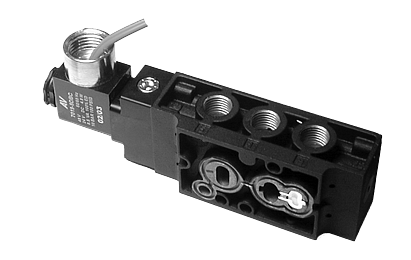




NAMUR Valves (Automatic Valve D20 Series) For General Automation, Explosion Proof, CSA/FM, ATEX, Intrinsically Safe Applications
- Compact Design - Balanced spool construction, compact size, low profile and high performance
- Solenoid Pilot - Pilot uses full air line pressure to shift the valve; Solenoid guaranteed against burnout
- Weather-Proof Coil - Hermetically sealed as an integral water tight molded unit; robust enclosures to function in rugged environments
- Tapered Tee-Seal - Bidirectional tapered Tee-Seal eliminates sticking problems
- Tested Tough - Proven reliable according to SAE specifications: rust & water injected every 864,000 cycles for 20-million cycle
- Manual Override - Allows the solenoid valve to be used manually in case of electrical failure, or for quick cycle testing
- External Pilot Supply - Easily field convertible to external pilot supply
- Automatic Valve Namur Valves [https://www.automaticvalve.com/categories/116-namur-valves ]
Valves
NAMUR interface valves are designed to easily mount directly to pneumatic valve actuators, and are used as pilot valves to control the actuator in many flow processes. The balanced spool construction allows ports to be plugged for 2 way or 3 way function, or restricted for inexpensive cylinder exhaust speed control. A wide variety of options and operators available.
Tapered Tee-Seal ........ Eats Dirt
Bidirectional tapered Tee-Seal eliminates sticking problems.
- Flexes to clean spool
- Mechanically Locked
- No Spiral Twist
No Extrusion - Air Line Sediment is Wiped Away
- Tested tough and proven reliable according to SAE specifications: Rust and water injected every 864,000 cycles for 20 million cycles.
Solenoid ... Guaranteed Against Burnout
Three-way pilot uses full air line pressure to shift the valve. The pilot is internally supplied when the pressure at port one is 35 to 150 PSIG (240 to 1030 kPa). The coil is hermetically sealed as an integral watertight molded unit. Intrinsically-safe and explosion-proof versions available. Push Non-Locking Override is standard. (Extended Turn and Turn-Locking available).
Unable to load products. Please try again.
loading...
loading...
Product Overview
The ROSS Controls Automatic Valve D20 Series NAMUR interface valves are balanced spool directional control valves designed for direct mounting to pneumatic valve actuators in applications ranging from general industrial automation through the most demanding classified hazardous locations. Mounting per the VDI/VDE 3845 NAMUR interface standard, the D20 Series is available in 3/2, 5/2, and 5/3 valve functions in a compact low-profile body with a maximum Cv of 1.8. A full range of solenoid coil certifications includes general automation (weather-proof), CSA/FM explosion-proof, ATEX certified, and intrinsically safe options, allowing the same valve body and mounting interface to be specified across both unclassified and classified areas throughout a facility.
The balanced spool construction of the D20 Series is engineered for long service life and consistent actuation in contaminated environments. The patented bidirectional Tapered Tee-Seal eliminates sticking problems by flexing to clean the spool on every stroke, wiping away air line sediment and particulate buildup that accumulates in the seal zone during valve operation. The seal is mechanically locked against rotation, has no spiral twist tendency, and does not extrude under operating pressure, maintaining predictable compression and consistent sealing performance across the rated 20-million cycle validated life.
The solenoid pilot uses full air line pressure to shift the main spool, generating maximum available actuation force from the available supply pressure. The pilot coil is hermetically sealed as an integral watertight molded unit, providing weather-proof protection against moisture ingress in outdoor and humid industrial environments without requiring a separate coil housing. Explosion-proof and intrinsically safe coil versions are available in the same physical footprint, providing a path from general automation to hazardous area certification by coil substitution rather than complete valve replacement.
SAE specification testing validates the D20 Series design: rust and water are injected into the air supply every 864,000 cycles across a 20-million cycle test program. This accelerated contamination test protocol directly measures valve robustness under real-world conditions where air quality is less than ideal. The standard push, non-locking manual override is included on all solenoid models, and extended turn-locking and turn-locking override options are available for applications requiring manual position hold capability. External pilot supply conversion is field-accomplished without valve replacement.
Key Engineering Features
- Patented Tapered Tee-Seal Technology - Bidirectional tapered Tee-Seal flexes on each stroke to wipe air line sediment away from the spool sealing zone. Mechanically locked against rotation, free from spiral twist, and resistant to extrusion under operating pressure. Self-cleaning action prevents the progressive contamination buildup that causes sticking in conventional spool valve designs, delivering consistent performance across the full rated 20-million cycle service life.
- Full Line Pressure Solenoid Pilot - The three-way solenoid pilot draws from full line pressure at port 1 to generate maximum spool shift force. This design ensures positive actuation across the full operating pressure range, from minimum to maximum, without relying on amplified pilot stages or separate boosters. Pilot supply is internally connected when port 1 pressure is within 35 to 150 psig.
- Hermetically Sealed Weather-Proof Coil - Standard weather-proof coil is hermetically sealed as an integral watertight molded unit, eliminating moisture ingress paths present in conventional coil-plus-enclosure assemblies. This construction makes the general automation version suitable for outdoor installations, humid environments, and periodic washdown exposure without additional coil protection.
- Explosion-Proof Coil Option (CSA/FM) - CSA and FM certified explosion-proof coil for Class I, Division 1, Groups A, B, C, D; Class II, Division 1, Groups E, F, G; and Class III hazardous locations. The robust explosion-proof housing contains any internal electrical fault, preventing ignition of surrounding classified atmospheres.
- ATEX Certified Coil Option - ATEX certified coil for European Zone 1 and Zone 2 hazardous area classifications. Certification per ATEX Directive 2014/34/EU with complete declaration of conformity documentation. Compatible with the same D20 valve body as all other coil options.
- Intrinsically Safe Coil Option - Intrinsically safe coil limits electrical and thermal energy to levels incapable of causing ignition under normal or fault conditions. Requires use with a compatible IS barrier in the control circuit. The intrinsically safe D20 Series provides the highest level of hazardous area electrical protection for Division 1 and Zone 0/Zone 1 installations where energy-limited circuits are required.
- SAE-Validated 20-Million Cycle Service Life - Proven reliable per SAE specifications: rust and water injected every 864,000 cycles for 20 million cycles of validated operation. This aggressive accelerated life test directly validates performance in contaminated air service, providing confidence in long-term reliability under realistic industrial compressed air conditions.
- 5/3 Function Availability - The D20 Series offers 5/3 closed center, 5/3 open center, and 5/3 power center valve functions in addition to 3/2 and 5/2 functions. This makes the D20 the appropriate selection for applications requiring a defined center position when de-energized, including locked-position actuator holding, free-floating actuator center, or pressurized center for applications where actuator stiffness in the center position is required.
- Balanced Spool for Convertible Port Functions - The balanced spool construction allows ports to be plugged for 2-way or 3-way function, or restricted with needle plugs for inexpensive cylinder exhaust speed control directly at the NAMUR interface without additional speed control accessories.
- External Pilot Supply Field Convertible - The D20 Series is easily field-convertible from internal pilot supply to external pilot supply, accommodating applications where supply pressure is below the internal pilot minimum of 35 psig or where separate pilot supply source is required for sequence logic.
- Manual Override Options - Standard push non-locking override for commissioning and troubleshooting. Extended turn-locking override available for applications requiring the valve to be held in the actuated position manually during maintenance or emergency operation. No override option available for installations where accidental manual actuation is a safety concern.
Technical Specifications
General Specifications
| Parameter | Specification |
| Valve Functions | 3/2 Normally Closed; 5/2 (single solenoid spring return, double solenoid); 5/3 (closed center, open center, power center) |
| Construction | Balanced spool with patented Tapered Tee-Seal |
| Actuation | Solenoid Pilot Controlled (electrical) |
| Port Size | 1/4" NPT (fixed) |
| Mounting Standard | Direct mount; NAMUR Interface per VDI/VDE 3845 |
| Maximum Cv - 3/2 Valve | 1.8 (1,770 l/min) |
| Maximum Cv - 5/2 Valve | 1.8 (1,770 l/min) |
| Maximum Cv - 5/3 Valve | 1.4 (1,381 l/min) |
| Operating Pressure - 3/2 D20 Series | 35 to 150 psig (2.4 to 10.3 bar) |
| Operating Pressure - 5/2 Valve | 35 to 150 psig (2.4 to 10.3 bar) |
| Operating Pressure - 5/3 Valve | 50 to 150 psig (3.4 to 10.3 bar) |
| External Pilot Supply Pressure | 35 to 150 psig (2.4 to 10.3 bar) for 3/2 and 5/2; 50 to 150 psig (3.4 to 10.3 bar) for 5/3 |
| Ambient Temperature | 20 to 123 F (-29 to 50 C) |
| Flow Media | Filtered compressed air |
| Valve Body Material | Bar stock aluminum |
| Solenoid Body Material | Polyamid 66 |
| Spool Material | Aluminum |
| Seal Material | Buna-N |
| Manual Override | Push, non-locking (standard); push turn-locking; extended turn-locking; no override |
| Pilot Type | Internal (standard); external (field-convertible) |
| Duty Rating | 100% continuous duty |
| Enclosure Rating | IP65 per IEC 60529 |
| Validated Cycle Life | 20 million cycles per SAE contamination test protocol |
| Body Size - D20 Series | 1-1/4" body height (Model D2003/D2013) |
Temperature Ratings
The D20 Series ambient temperature range of -20 to 123 F (-29 to 50 C) is broader than many comparable NAMUR valves, reflecting the Tee-Seal design's performance at lower temperatures. For media temperatures below 40 F (4 C), compressed air must be free of water vapor.
| Configuration | Ambient Temperature | Media Temperature |
| General Automation (Weather-Proof Coil) | 20 to 123 F (-29 to 50 C) | N/A - same as ambient for air service |
| Explosion-Proof CSA/FM (High-Temp Conduit Coil Option) | 0 to 180 F (-18 to 82 C) | N/A - same as ambient for air service |
| All Other Coil Types | 20 to 123 F (-29 to 50 C) | N/A - same as ambient for air service |
Important: For media temperatures below 40 F (4 C), compressed air must be free of water vapor to prevent ice formation inside the valve. Dry the compressed air supply to a dew point below the minimum expected operating temperature before commissioning in cold-environment service.
Electrical Data (Solenoid Pilot Valves)
Standard weather-proof (general automation) coils are available in 2.5-watt and 0.7-watt DC options. The 0.7-watt low-power option requires the extended turn-locking manual override. Explosion-proof, ATEX, and intrinsically safe coils are rated at distinct power levels per their respective certification requirements. All coil types are rated for 100% continuous duty.
| Voltage | Power Consumption |
| 24 VDC (Standard Weather-Proof, 2.5W) | 2.5 watts |
| 24 VDC (Standard Weather-Proof, Low Power) | 0.7 watts (requires extended turn-locking override) |
| 12 VDC | Available; consult ROSS Controls |
| 120 VAC, 60 Hz | Available; consult ROSS Controls |
| 240 VAC, 60 Hz | Available; consult ROSS Controls |
| 24 VDC (Explosion-Proof CSA/FM) | Per CSA/FM coil specification; consult ROSS Controls |
| 24 VDC (Intrinsically Safe) | Energy-limited per IS certification; consult ROSS Controls |
Electrical Connection Options
| Connection Type | Coil Code |
| DIN EN 175301-803 Form B (Standard) | Default (leave blank in model number) |
| 1/2" Conduit with 30" Leads | Option code C |
| 1/2" Conduit - High Temperature (0 to 180 F) | Option code CT |
| Molded Coil with 18" Flying Leads (2.5W) | Option code G with L |
| Molded Coil with 18" Flying Leads (0.7W, 24 VDC only) | Option code G with LL |
Flow Performance Data
Flow performance data for D20 Series 3/2, 5/2, and 5/3 valve configurations. Both D2003 (1-1/4" body height) and D2013 (1" body height) models are available. Cv and weight data shown for standard D20 3/2 and 5/2 configurations. 5/3 Cv is slightly lower due to center position flow path geometry.
| Function | Port 1 | Port 3 | Cv (l/min) | Weight lb (kg) | Body Height |
| 3/2 NC (D20 Series) | 1/4" | 1/4" | 1.8 (1,770) | 0.70 (0.32) | 1-1/4" (D2003) |
| 5/2 Single Solenoid (D20 Series) | 1/4" | 1.8 (1,770) | 0.70 (0.32) | 1-1/4" (D2003) | |
| 5/2 Double Solenoid (D20 Series) | 1/4" | 1.8 (1,770) | 0.75 (0.34) | 1-1/4" (D2003) | |
| 5/3 (Double Solenoid) | 1/4" | 1.4 (1,381) | N/A - consult catalog | 1-1/4" (D2003) |
Certifications & Compliance
| Certification/Standard | Detail |
| CSA/FM Explosion-Proof | CSA and FM approved explosion-proof coils for Class I, Division 1, Groups A, B, C, D; Class II, Division 1, Groups E, F, G; Class III. Suitable for Class I, Division 2 non-incendive service. |
| ATEX Certification | ATEX certified coils for European Zone 1 and Zone 2 hazardous area classifications per ATEX Directive 2014/34/EU. Complete declaration of conformity documentation available. |
| Intrinsically Safe | Intrinsically safe coils energy-limited to prevent ignition under normal or fault conditions. Requires compatible IS barrier in the control circuit. Suitable for Division 1 and Zone 0/1 applications where the highest level of electrical hazardous protection is required. |
| Functional Safety - SIL 2 | Certified by SGS-TUV Saar in accordance with IEC 61508 Safety Integrity Level 2 (SIL 2) in singular application with HFT = 0. Redundant applications (HFT >= 1) achieve SIL 3 and PL e per EN ISO 13849-1. |
| IP65 Enclosure Rating | IP65 per IEC 60529 for all coil types. Dust-tight and protected against low-pressure water jets. |
| SAE Durability Validation | Proven reliable per SAE test protocol: rust and water injected every 864,000 cycles for 20 million cycles. Validates performance under accelerated contamination conditions representative of industrial compressed air service. |
Typical Applications & Industries
General Industrial Automation
- Pneumatic valve actuator pilots in manufacturing, automotive, paper, printing, and general industrial processes where the standard weather-proof coil provides adequate environmental protection and rapid actuator response is the primary requirement.
- High-cycle actuator control in packaging, material handling, and conveying systems where the SAE-validated 20-million cycle life provides confidence in extended service intervals without scheduled valve replacement.
- Cylinder exhaust speed control using the balanced spool's port restriction capability, which allows needle plugs to be installed directly at the NAMUR interface for adjustable actuator stroke speed without separate speed control accessory valves.
- Multi-valve panel and valve island assemblies where the compact D20 body profile and low-power 0.7-watt coil option minimize total installation footprint and solenoid heat load in densely packed control panels.
Oil and Gas Production, Midstream, and Downstream
- Process isolation valve and control valve actuator pilots in Class I, Division 1 classified locations at wellheads, compressor stations, and processing facilities. CSA/FM explosion-proof coils are certified for Groups A, B, C, D, covering methane, propane, hydrogen sulfide, and hydrogen atmospheres.
- Offshore platform pneumatic actuator controls where the hermetically sealed weather-proof coil resists salt spray and humidity without additional coil enclosure protection, and explosion-proof or ATEX versions serve Zone 1 classified areas.
- Pipeline emergency shutdown (ESD) and automated block valve actuation where SIL 2 certified valve function supports integration into safety instrumented systems per IEC 61511.
- Tank farm loading rack automation and product transfer valve actuation in classified hazardous areas requiring both CSA/FM approval and fast, positive actuation.
Chemical and Petrochemical Processing
- Reactor and vessel automated valve pilots in solvent-classified areas where intrinsically safe coil options provide energy-limited electrical circuits for the highest available level of hazardous area protection in Zone 0 or Division 1 applications.
- Continuous process automated ball valve and butterfly valve controls in petrochemical units where the 5/3 closed center configuration provides a defined safe position when both solenoids are de-energized, maintaining actuator and process valve position during power loss.
- Chemical storage transfer valve automation in outdoor facilities where ATEX certified coils meet European area classification requirements and the IP65 coil rating handles outdoor moisture and precipitation.
- Batch process sequencing in specialty chemical and pharmaceutical manufacturing where multiple valve functions (3/2, 5/2, 5/3) in a single certified valve family simplify specification and procurement.
Water Treatment and Environmental Infrastructure
- Water distribution automated gate valve and butterfly valve actuator pilots where the weather-proof coil and IP65 rating handle outdoor and wet vault installations without additional protective enclosures.
- Wastewater treatment digester gas handling valve controls where methane and hydrogen sulfide create Class I, Division 1 or Zone 1 classified atmospheres requiring explosion-proof or ATEX certified pilot valves.
- Stormwater management automated valve controls where valves are exposed to outdoor temperature extremes, the -29 C (-20 F) minimum temperature rating covers cold climate installations without supplemental heating.
Mining, Power Generation, and Heavy Industry
- Underground mining pneumatic valve actuator pilots where CSA/FM Group A approval covers methane classified atmospheres and the validated contaminated-air durability handles the heavily loaded compressed air typical of underground mining systems.
- Power plant auxiliary valve automation for boiler feedwater, cooling water, and steam valve actuation where continuous duty rating and long validated cycle life meet the high-availability requirements of power generation infrastructure.
- Dust collection system valve automation in Class II combustible dust environments where the explosion-proof coil's Group E, F, G rating covers metallic, carbonaceous, and agricultural dust classifications.
- Mill and plant-wide pneumatic valve controls where a single valve family covers both unclassified general automation (weather-proof coil) and classified process areas (explosion-proof or intrinsically safe coil) by coil substitution on the same body.
Food and Beverage Processing
- Automated process valve pilots in food processing facilities where periodic high-pressure washdown is routine. The weather-proof hermetically sealed coil and IP65 rating provide water ingress resistance compatible with washdown protocols.
- Grain handling and milling valve automation in Class II, Division 1 combustible dust environments requiring explosion-proof coils rated for Groups E, F, G (metallic dust, coal dust, grain dust).
- Brewing, dairy, and beverage processing valve controls where the compact D20 body profile and low-power coil option minimize control panel space requirements in equipment with dense solenoid valve populations.
Ordering and Model Number Configuration
The D20 Series model number encodes the valve function, port size, body height, actuation location, solenoid options, and pilot type into a structured configurator format. The examples below show representative 3/2 and 5/2 model numbers. Refer to the complete D20 Series catalog or contact ROSS Controls for model number assistance.
|
3/2 NC Model Number Example: D2003GAWR-DB
D20 Series designation (D20 Series NAMUR Valve)
03 Port size code (03 = 1/4" port, 1-1/4" body height) 13 = 1/4" port, 1" body height
G Coil option code (Leave blank) = DIN EN 175301-803 Form B C = 1/2" Conduit, 30" leads CT = 1/2" Conduit, High Temp (0 to 180 F) G = Molded Coil, 18" Flying Leads (2.5W) G + L = Molded Coil, 18" Flying Leads (0.7W, with LL option) D = Dustproof for vented ports
A Actuation and solenoid location AWR = Single Solenoid, Right (3/2 or 5/2) CWR = Single Solenoid, Left (5/2) BWW = Double Solenoid (5/2) BWDW = Double Solenoid (5/3)
DB Voltage suffix DB = 24 VDC DA = 12 VDC AA = 120 VAC, 60 Hz AB = 240 VAC, 60 Hz
5/2 Double Solenoid Example: D2003ABWW-DB 5/3 Closed Center Example: D2003CBWDW-DB
Pilot Type: Internal pilot = Leave blank (default) External pilot = Add B after solenoid location code
Manual Override: Push Non-Locking = Leave blank (standard) Push Turn-Locking = Add 1 Extended Turn-Locking = Add 2 No Override = Add 4
Body Material: Bar Stock Aluminum = Leave blank (standard) 303 Stainless Steel = Add S 316 Stainless Steel = Add SS
Transition Plate (D2003 Model Only): Add P suffix for installations where sealing face extends beyond mounting surface |
Voltage codes: DB = 24 VDC, DA = 12 VDC, AA = 120 VAC/60 Hz, AB = 240 VAC/60 Hz. Specify the voltage code matching your control system supply.
For hazardous location applications, specify the coil type required by the site electrical area classification: explosion-proof CSA/FM for NEC Class I, Division 1; ATEX certified for European Zone 1/Zone 2; intrinsically safe (with appropriate IS barrier) for the highest degree of protection in Division 1 and Zone 0/1.
The 0.7-watt low-power coil option (molded 18" leads) is available only with 24 VDC and requires the extended turn-locking manual override (option 2). This option reduces solenoid heat load significantly in densely packed valve arrays.
The transition plate (suffix P on D2003 models only) is designed for situations where the valve sealing face extends beyond the actuator mounting surface, preventing proper O-ring compression without the transition plate.
Stainless steel body options (S = 303 SS, SS = 316 SS) are available for corrosive atmosphere or aggressive washdown applications where aluminum body corrosion is a service life concern.
D20 Series Valve Function and Configuration Options
| Function | Series | Body Height | Actuation Code | Pilot |
| 3/2 Normally Closed | D20 | 1-1/4" (D2003) or 1" (D2013) | AWR (right), CWR (left) | Internal or External |
| 5/2 Single Solenoid | D20 | 1-1/4" (D2003) or 1" (D2013) | AWR (right), CWR (left) | Internal or External |
| 5/2 Double Solenoid | D20 | 1-1/4" (D2003) or 1" (D2013) | BWW | Internal or External |
| 5/3 Closed Center | D20 | 1-1/4" (D2003) | BWDW + C | Internal or External |
| 5/3 Open Center | D20 | 1-1/4" (D2003) | BWDW + D | Internal or External |
| 5/3 Power Center | D20 | 1-1/4" (D2003) | BWDW + E | Internal or External |
Accessories
Speed Control Module (A7106-554)
Mounts between the D20 directional control valve and the pneumatic actuator at the NAMUR pad. Functions as a flow control for both cylinder ports simultaneously. Turn the tapered needles clockwise to decrease actuator stroke speed; counterclockwise to increase speed. Compact module with O-ring sealed air passages, compatible with D20 NAMUR interface.
| Operating Pressure psig (bar) | Operating Temperature F (C) | Weight lb (kg) | Model |
| 35 to 150 (2 to 10) | 0 to 125 (-18 to 52) | 0.16 (0.07) | A7106-554 |
Exhaust Silencers
Sintered bronze threaded exhaust silencers for noise reduction at valve exhaust ports. Available for 1/4" NPT male thread.
| Port Size | Thread Type | Material | Cv (l/min) | Model | Max Pressure psig (bar) |
| 1/4" | Male NPT | Sintered Bronze | 0.7 (600) | 266B-2 | 0 to 300 (0 to 20) |
Warning: Silencer flow capacity must equal or exceed the valve exhaust Cv. Contaminated silencers restrict exhaust flow and reduce spool shifting force, causing sluggish or incomplete actuation.
Quick Exhaust, Shuttle, and Check Valves (MQ2 Series)
MQ2 Series quick exhaust valves mount at the NAMUR interface to bypass the directional control valve exhaust path on the exhaust stroke, increasing maximum exhaust flow and improving actuator return speed in applications where return stroke speed is the cycle time bottleneck. Contact ROSS Controls for model selection based on actuator port size and required Cv.
Related Products & Accessories
- ROSS NAMUR 95 & 34 Series Valves - ROSS 95 Series (spool, Cv 1.3, 5/2 function) and 34 Series (ball-poppet, Cv 0.25, 3/2 NC) for general industrial NAMUR applications without hazardous location coil certification requirements. https://www.rosscontrols.com/en/series/247-namur-valves-ross-95-34-series
- 27 Series Hazardous Location Valves - Inline explosion-proof and ATEX certified poppet valves in port sizes up to 2-1/2" for large-flow hazardous location inline pneumatic applications. https://www.rosscontrols.com/en/series/1309-hazardous-location-valves-27-series
- 21 Series Hazardous Location Valves - Inline explosion-proof and ATEX certified poppet valves for low-temperature hazardous location applications down to -4 F (-20 C). https://www.rosscontrols.com/en/series/2828-hazardous-location-valves-21-series
- L-O-X Lockout Valves - Pneumatic energy isolation lockout valves for OSHA lockout/tagout compliance. Install upstream of NAMUR valve assemblies to safely depressurize and lock-out actuated process valves during maintenance. https://www.rosscontrols.com/en/series/1287-lockout-valves-15-series
- Exhaust Silencers - Aluminum and sintered bronze exhaust silencers for noise reduction at valve exhaust ports, rated to 300 psig. https://www.rosscontrols.com/en/series/90-silencers
Frequently Asked Questions (FAQ)
Q: What valve functions are available in the D20 Series that are not available in the ROSS 95 or 34 Series?
A: The D20 Series offers 5/3 closed center, 5/3 open center, and 5/3 power center configurations in addition to 3/2 and 5/2 functions. The 95 Series provides 5/2 only and the 34 Series provides 3/2 only. The 5/3 function is the appropriate selection when a defined actuator position is required on de-energization of both solenoids: closed center locks the actuator in place, open center allows the actuator to float freely, and power center applies supply pressure to both actuator ports simultaneously.
Q: What is the Tapered Tee-Seal and how does it prevent sticking?
A: The Tapered Tee-Seal is a patented seal geometry used in the D20 Series balanced spool. The tee cross-section tapers bidirectionally so the seal flexes on each spool stroke, wiping the spool surface and mechanically removing sediment that accumulates in the seal zone during valve operation. Unlike conventional O-ring seals that can pack contamination in the seal groove over time and increase breakaway friction, the Tee-Seal actively cleans itself on every cycle. The seal is mechanically locked against rotation, which prevents the spiral twist that causes conventional O-ring seals to extrude under pressure, and the tee geometry resists extrusion by distributing pressure load across the full seal contact width.
Q: What is the minimum operating pressure for the D20 Series?
A: For 3/2 and 5/2 D20 Series valves with internal pilot supply, the minimum inlet pressure at port 1 is 35 psig (2.4 bar). For 5/3 valves, the minimum is 50 psig (3.4 bar) due to the higher differential force required to shift the spool against pressure in the actuator ports during center-position transitions. If supply pressure is below 35 psig for 3/2 or 5/2 applications, convert to external pilot supply from a stable regulated source within the operating range.
Q: What certifications are available for hazardous location applications?
A: The D20 Series is available with CSA/FM explosion-proof coils (Class I, Division 1, Groups A, B, C, D; Class II, Groups E, F, G; Class III), ATEX certified coils (Zone 1 and Zone 2), and intrinsically safe coils (Division 1, Groups A through G). All three coil types use the same D20 valve body and NAMUR interface, so the hazardous area coil version is dimensionally identical to the general automation version. SIL 2 certification (IEC 61508) is also available for safety instrumented system applications.
Q: What is the SIL 2 certification for, and when is it required?
A: The D20 Series SIL 2 certification (SGS-TUV Saar, per IEC 61508) qualifies the valve as a final element in a Safety Instrumented System (SIS) designed to IEC 61511. SIL 2 is required when the Safety Integrity Level assessment for the safety function specifies SIL 2 performance from the final element. In a redundant (1oo2) architecture with HFT >= 1, the D20 Series achieves SIL 3 and PL e. Specify SIL 2 for critical process safety shutoff or emergency shutdown applications where a functional safety risk assessment has determined SIL 2 or higher is required.
Q: When should I use external pilot supply instead of internal pilot?
A: Use external pilot supply when (1) supply pressure at port 1 may fall below the minimum internal pilot pressure during system operation (below 35 psig for 3/2 and 5/2, below 50 psig for 5/3), (2) the process requires the valve to shift under zero or negative supply pressure conditions, or (3) the application uses a separate dedicated pilot air supply circuit for control integrity isolation. External pilot supply conversion is field-accomplished without valve replacement. External pilot supply pressure must itself remain within the operating pressure range.
Q: What are the manual override options and when should I specify each?
A: Push non-locking (standard): valve shifts while button is depressed, auto-returns on release. Use for commissioning and troubleshooting. Push turn-locking: momentarily depress, then rotate to lock in the actuated position. Use where manual position hold is needed during maintenance. Extended turn-locking: an extended actuator for the same function with greater mechanical advantage, suited for higher-pressure applications where manual force is needed. No override (option 4): specify when accidental manual actuation is a safety concern, such as ESD valve applications where unintended manual operation could trigger a shutdown.
Q: How is the D20 Series different from the D06 Series?
A: The D20 Series operates at 35 to 150 psig (2.4 to 10.3 bar) minimum pressure and delivers a maximum Cv of 1.8. The D06 Series 3/2 valve operates at 0 to 150 psig (zero minimum pressure), making it suitable for very low-pressure applications, but delivers a much lower maximum Cv of 0.06 (59 l/min). Specify the D06 for low-pressure or zero-differential pressure applications; specify the D20 for standard industrial pressure ranges requiring the higher Cv of 1.8.
Q: Can the D20 valve body ports be plugged to change function?
A: Yes. The balanced spool construction allows ports to be plugged to convert the 5/2 valve to 2-way or 3-way function. Port 4 or port 2 can be plugged to create directional or blocking function without valve replacement. Additionally, the exhaust ports can be fitted with needle plugs for adjustable exhaust speed control directly at the NAMUR interface, replacing a separate speed control accessory. Contact ROSS Controls for the appropriate port plug specifications and conversion procedure documentation.
Q: What are the body material options and when should I specify stainless steel?
A: Standard body material is bar stock aluminum, which is appropriate for most industrial environments. 303 stainless steel and 316 stainless steel body options are available for installations in corrosive chemical atmospheres, marine environments, or aggressive washdown processes where aluminum corrosion is a service life concern. 316 stainless provides superior corrosion resistance to chloride-bearing environments (salt spray, seawater, certain acid mist) compared to 303 stainless. Specify stainless when the installation environment or cleaning chemicals are aggressive enough to attack or stain aluminum over the expected service life.
Q: What compressed air quality is required for the D20 Series?
A: The D20 Series requires filtered compressed air. Install an upstream inline filter-regulator at the actuator supply connection. The Tapered Tee-Seal self-cleaning design provides significant tolerance to minor particulate contamination, as demonstrated by the SAE test protocol validation (rust and water injection every 864,000 cycles for 20 million cycles). However, gross liquid water ingestion, heavy oil carryover from unfiltered compressor discharge, or large particulate contamination will still reduce valve service life. For media temperatures below 40 F (4 C), the air must be dried to a dew point below the minimum operating temperature to prevent ice formation inside the valve.
Q: Are CAD models available for the D20 Series?
A: Yes. Downloadable CAD models are available for D20 Series NAMUR valve configurations through the ROSS Controls website and the automaticvalve.com website (Automatic Valve Industrial). Contact ROSS Controls at (800) 438-7677 or visit rosscontrols.com to access CAD model downloads for your specific D20 configuration.
Q: What is the validated service life for the D20 Series?
A: The D20 Series is validated to 20 million cycles per the SAE contamination test protocol, which subjects the valve to rust and water injection into the air supply every 864,000 cycles throughout the 20-million cycle test. This is a more demanding validation than simple dry-cycle endurance testing because it directly measures the valve's ability to maintain function under the gradual contamination buildup representative of real industrial service. The 20-million cycle validated life corresponds to roughly 11 years of continuous operation at 60 cycles per minute.
Installation & Maintenance Guidelines
- Before mounting, verify that the actuator interface conforms to VDI/VDE 3845 NAMUR dimensions for 1/4" porting. Confirm the body height variant (D2003 = 1-1/4" body height or D2013 = 1" body height) matches the actuator NAMUR interface depth. Mismatched body heights can prevent proper O-ring compression or cause valve interference with the actuator body.
- Inspect all interface O-rings before assembly. Replace any O-rings that are cut, nicked, deformed, or show signs of prior compression damage. Lightly lubricate O-rings with a compatible lubricant before installation to prevent displacement and tearing during fastener tightening.
- Align all NAMUR interface air passages on the valve face with the corresponding passages on the actuator before inserting the 5 mm mounting fasteners. Misaligned passages result in incorrect valve function or no actuation. Confirm port alignment by visual inspection before tightening.
- Torque the 5 mm mounting fasteners to the specification in the D20 installation instructions. Undertightening causes interface O-ring air leakage. Overtightening can crack the valve body boss or permanently deform the O-rings, requiring O-ring replacement.
- For hazardous location coil options (explosion-proof CSA/FM or ATEX), install all electrical conduit and conduit sealing fittings per the applicable hazardous location electrical code before energizing. In NEC Class I, Division 1, install conduit sealing fittings (EYS type) within 18 inches of the conduit entry into the explosion-proof coil housing.
- Confirm solenoid voltage matches the control panel supply voltage before connecting electrical leads. Voltage mismatch causes immediate coil burnout. Verify the voltage code (DB = 24 VDC, AA = 120 VAC) on the coil label against the control system output voltage before wiring.
- For intrinsically safe coil installations, connect the coil leads through the specified IS barrier device mounted in the safe area (non-classified zone). Verify the IS barrier entity parameters (maximum voltage, current, and power) are compatible with the IS coil specifications before energizing.
- Verify supply pressure at port 1 is within the operating range before energizing: 35 to 150 psig for 3/2 and 5/2 functions; 50 to 150 psig for 5/3 functions. Energizing the solenoid with sub-minimum supply pressure will result in failed or partial actuation.
- Perform a pre-startup commissioning test using the manual override button before energizing the solenoid circuit. Depress the override and confirm the downstream actuator responds correctly. Release and confirm the actuator returns to the default position (spring return) or holds (double solenoid or turn-locking override). This mechanical test verifies valve function and actuator response before exposing the coil and control circuit to electrical stress.
- Do not restrict valve exhaust ports with undersized silencers. For 5/2 and 5/3 valves, exhaust alternates between ports 3 and 5 depending on valve position. Both exhaust ports must be verified for adequate flow capacity equal to or greater than the valve exhaust Cv.
- For installations below 40 F (4 C): supply dry compressed air with system dew point at least 10 F below the minimum expected operating temperature. Verify dew point with an in-line dew point transmitter if possible. Moisture in compressed air at sub-freezing temperatures freezes inside the spool bore and prevents valve actuation.
- After installation and during initial system startup, cycle the valve at operating pressure several times to seat the Tee-Seal and confirm repeatability of actuator response before returning the system to continuous production operation. Document actuator response times during commissioning as a baseline for future troubleshooting reference.
Warranty & Global Support
ROSS Controls provides a one-year warranty on all products, covering defects in material and workmanship from the date of purchase.
Global technical support is available through ROSS Controls offices in the USA (headquarters in Ferndale, Michigan), Canada, Brazil, Germany, France, United Kingdom, India, China, and Japan. The Automatic Valve product line is also supported through automaticvalve.com.
For hazardous location applications, request CSA/FM approval certificates, ATEX declarations of conformity, and IEC 61508 SIL 2 certification documentation from ROSS Controls at the time of product order for facility safety file and regulatory submission requirements.
Contact ROSS Controls USA at (800) 438-7677 or visit rosscontrols.com and automaticvalve.com for product configuration, hazardous location application support, SIL documentation, distributor locator, and technical service.
Download Catalog: https://www.rosscontrols.com/en/series/3012-namur-valves-automatic-valve-d20-series
Download Documents
NAMUR Valves (Automatic Valve D20 Series)