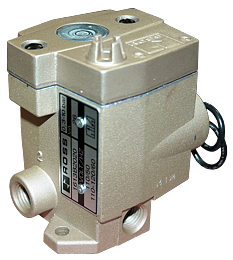




Inline Solenoid Poppet Valve [16 Series] 3/2 & 4/2 Functions, Inline & Manifold Mount
![Inline Solenoid Poppet Valve [16 Series]](https://ross-admin-global-us-east.s3.us-east-2.amazonaws.com/production/uploads/series_image/image/137/16_Series_Compact_Valves.png)
 Product Catalog
- Poppet construction for near zero leakage & high dirt tolerance
- Self-cleaning
- Wear compensating
- Repeatability throughout the life of the valve
- 3-way 2-position Normally Closed or Normally Open, and 4-way 2-position valves
- Inline or manifold mounting
loading...
loading...
Product Overview
The ROSS Controls is a family of compact inline solenoid poppet valves within the proven 16 Series platform, designed for precise pneumatic directional control in space-constrained industrial applications. Featuring ROSS's proprietary PACER pilot valve technology, the 16 Series delivers exceptional actuation reliability in a compact footprint suited for pilot control circuits, small cylinder actuation, and pneumatic logic applications.
Available in 3-way 2-position normally closed (NC), 3-way 2-position normally open (NO), and 4-way 2-position (4/2) configurations, these valves accommodate both inline and manifold mounting to match diverse installation requirements. Port sizes of 1/8 inch and 1/4 inch in NPT and G (BSPP) threads cover the most common small-bore pneumatic applications.
At the core of the 16 Series design is a poppet construction that delivers near-zero internal leakage, high dirt tolerance, and consistent performance over millions of operating cycles. The spring-loaded poppet mechanism is self-cleaning and wear-compensating, ensuring that shift timing and flow characteristics remain stable throughout the service life of the valve without the need for periodic recalibration.
With a flow capacity of 0.3 Cv (300 Nl/min) and an operating pressure range of 5 to 150 psig for 3/2 valves, the series is well matched to pilot signal generation, single-acting cylinder control, and double-acting cylinder control in high-cycle automation systems. Solenoid coils are rated for continuous duty, and both 24 VDC and 110-120 VAC options are standard, with hardwired and EN 175301-803 Form C connector configurations available.
Key Engineering Features
- PACER Pilot Valve Technology - ROSS's proprietary PACER design provides outstanding actuation reliability in a compact footprint. Validated across millions of cycles in demanding industrial environments, PACER technology ensures consistent shift performance over the full service life of the valve.
- Poppet Construction for Near-Zero Leakage - The positive sealing action of the poppet design prevents virtually all internal leakage, maintaining system pressure integrity and reducing compressed air consumption compared to spool valve designs.
- Self-Cleaning Operation - High-velocity airflow across the poppet seats sweeps away particulate contamination during each actuation cycle, making the 16 Series highly tolerant of dirty or dusty industrial environments.
- Wear-Compensating Poppet Design - The spring-loaded poppet automatically compensates for seal wear as the valve ages, maintaining consistent sealing force and flow characteristics without adjustment throughout the operational life of the valve.
- Repeatable Performance Throughout Service Life - Shift timing and flow capacity remain consistent over millions of cycles, ensuring predictable machine operation and simplifying troubleshooting in high-cycle automation systems.
- Inline and Manifold Mounting Flexibility - Direct threaded port connections support inline installation in existing piping systems, while manifold mounting options allow compact multi-valve arrays with shared supply and exhaust galleries, reducing piping complexity and installation labor.
- 3/2 and 4/2 Valve Functions - 3-way 2-position normally closed and normally open configurations support single-acting cylinder control and pilot signal circuits, while the 4-way 2-position configuration provides bidirectional control of double-acting cylinders from a single valve.
- Flush Non-Locking Manual Override - A flush-mounted rubber non-locking manual override is standard on all models, enabling valve actuation during commissioning, system testing, and troubleshooting without requiring electrical power or control system access.
- Continuous-Duty Solenoid Coils - All solenoid coils are rated for continuous duty, eliminating concerns about thermal overload in applications that require sustained energization for extended periods.
- Compact Dimensions - The small physical envelope of the 16 Series allows integration into space-constrained panel and machine designs. The 1/4 inch port inline model measures approximately 1.4 lb (0.6 kg) and delivers full directional control functionality within a minimal footprint.
Technical Specifications
General Specifications
| Parameter | Specification |
| Valve Functions | 3/2 Normally Closed, 3/2 Normally Open, 4/2 |
| Construction | Poppet |
| Actuation | Solenoid (direct acting) |
| Pilot Technology | PACER pilot valve |
| Port Sizes | 1/8", 1/4" |
| Thread Types | NPT; G (BSPP) - add D prefix to model number |
| Maximum Flow | 0.3 Cv (300 Nl/min) |
| Operating Pressure - 3/2 Valves | 5 to 150 psig (0.3 to 10 bar) |
| Operating Pressure - 4/2 Valves | 30 to 150 psig (2 to 10 bar) |
| Flow Media | Filtered air (5-micron filtration recommended) |
| Mounting | Inline (any orientation); Manifold |
| Valve Body Material | Cast aluminum |
| Poppet Material | Acetal |
| Seal Material | Buna-N (Nitrile Rubber) |
| Manual Override | Flush rubber button, non-locking (standard) |
| Duty Rating | Continuous duty |
Temperature Ratings
The Series 16 Series valves are rated for standard indoor industrial temperature environments. Ambient and media temperature limits apply to all valve configurations.
| Configuration | Ambient Temperature | Media Temperature |
| All 16 Series Solenoid Models | 40 to 120 F (4 to 50 C) | 40 to 175 F (4 to 80 C) |
Important: The 16 Series is not rated for low-temperature or high-temperature service outside the specified ranges. For ambient temperatures below 40 F (4 C) or above 120 F (50 C), or media temperatures above 175 F (80 C), consult the ROSS 21 Series for appropriate seal and body options.
Electrical Data (Solenoid Pilot Valves)
All solenoid coils are rated for continuous duty. Standard voltage offerings are 24 VDC and 110-120 VAC, 50/60 Hz. For other voltages, consult ROSS Controls.
| Voltage | Power Consumption |
| 24 VDC | 14 watts |
| 110-120 VAC, 50/60 Hz | 87 VA inrush, 30 VA holding |
Electrical Connection Options
| Connection Type | Coil Code |
| Hardwired, 1/2" conduit port | Standard |
| EN 175301-803 Form C connector (optional) | Optional |
Flow Performance Data
Flow and response time data for 3/2 and 4/2 solenoid controlled 16 Series valves. All values shown at standard conditions with filtered air supply.
| Port Size | Function | Cv | M (ms) | F | Weight lb (kg) |
| 1/8" | 3/2 NC | 0.3 | 5 | 2.90 | 1.4 (0.6) |
| 1/4" | 3/2 NC | 0.3 | 5 | 2.90 | 1.4 (0.6) |
| 1/8" | 3/2 NO | 0.3 | 5 | 2.90 | 1.4 (0.6) |
| 1/4" | 3/2 NO | 0.3 | 5 | 2.90 | 1.4 (0.6) |
| 1/4" | 4/2 | 0.3 | 5 | 2.90 | 2.4 (1.1) |
Response Time Formula: Response Time (msec) = M + (F x V), where M is the fixed valve actuation constant in milliseconds, F is the volume-dependent fill/exhaust constant, and V is the downstream volume in cubic inches. This formula calculates the average time to pressurize a volume to 90% of supply pressure or exhaust it to 10% of supply pressure. For a 1/4 inch port 3/2 valve with V = 2 cubic inches: Response Time = 5 + (2.90 x 2) = 10.8 milliseconds.
Certifications & Compliance
| Certification/Standard | Detail |
| ISO 9001 | ROSS Controls maintains ISO 9001 quality management system certification, ensuring consistent manufacturing processes, product traceability, and quality assurance for all 16 Series valves. |
| Declaration of Conformity | The 16 Series carries a ROSS Declaration of Conformity and Certificate of Compliance, supporting regulatory requirements for use in controlled industrial environments and international markets. |
| Continuous Duty Solenoids | All solenoid coils are rated and tested for continuous duty energization, confirming thermal stability for applications requiring sustained valve actuation. |
Typical Applications & Industries
Pilot Control and Pneumatic Logic Circuits
- Pilot signal generation for larger main valves or actuators, where compact size and reliable actuation are critical and the 0.3 Cv flow capacity meets pilot flow requirements.
- Pneumatic logic and sequencing circuits in automated manufacturing systems where multiple valves must be coordinated in a small control panel enclosure.
- Safety interlock and permission circuits where a compact, reliable directional valve is required to confirm machine status before enabling downstream motion.
- Timed sequence control circuits in combination with LOGICAIR adaptors for delayed actuation and de-actuation sequences up to 3 seconds for 3/2 and 4/2 valves.
Single-Acting Cylinder Control (3/2 Valves)
- Work-holding clamps and locating pins on assembly fixtures and machine tooling where normally closed configurations provide fail-safe retraction on power loss.
- Ejector systems in injection molding, stamping, and assembly processes where spring-return cylinders are cycled rapidly and consistently.
- Locating pins, stop gates, and indexing devices in conveyor and transfer automation requiring compact valve mounting in tight machine frames.
- Vacuum switching and pressure switching applications where the low minimum operating pressure of 5 psig for 3/2 valves supports low-differential applications.
Double-Acting Cylinder Control (4/2 Valves)
- Material transfer and pusher mechanisms in packaging and assembly lines where bidirectional cylinder control is required from a single compact valve.
- Pick-and-place automation and part transfer systems where space-constrained machine frames require minimal valve envelope.
- Reciprocating actuator control in food and beverage packaging, labeling, and case erecting equipment with high cycle rates and continuous duty requirements.
- Fixture positioning and part clamping on machine tools and assembly cells where double-acting cylinders provide both extend and retract powered motion.
General Industrial Automation
- Automotive assembly and body shop automation where reliable high-cycle performance and dirt tolerance reduce unplanned maintenance intervals.
- Electronics and semiconductor manufacturing for clean, precise directional air control in assembly and test systems with limited installation space.
- Packaging machinery including box formers, product orienters, and label applicators benefiting from the self-cleaning poppet design in dusty or debris-laden environments.
- Manifold valve stations in multi-actuator systems where the 16 Series manifold configuration consolidates multiple valve positions with a common supply and exhaust gallery.
Ordering and Model Number Configuration
The ROSS 16 Series uses a structured model number system encoding valve function, port size, mounting type, and voltage. The D prefix denotes G (BSPP) threads. Insert the voltage code in place of the ** suffix: W for 24 VDC, Z for 110-120 VAC 50/60 Hz.
|
Model Number Structure: 1613 B 1020 **
16 Series (16 Series Compact Poppet Valve)
13 Function/Configuration Code 13 = 3/2 Normally Closed (NC) 14 = 3/2 Normally Open (NO) 16 = 4/2
B Revision Level
10 Port Size Code 10 = 1/8" port, inline mounting 20 = 1/4" port, inline mounting 23 = 1/4" port, manifold mounting
20 Configuration/Position Code
** Voltage Code (replace with W = 24 VDC; Z = 110-120 VAC, 50/60 Hz)
For G (BSPP) threads, add D prefix: e.g., D1613B1020W
Example: 1616C2322W = 4/2 valve, 1/4" port, manifold mount, 24 VDC, NPT threads |
Voltage codes: W = 24 VDC; Z = 110-120 VAC, 50/60 Hz. For other voltages, consult ROSS Controls.
For G (BSPP) port threads, add a D prefix to the model number, e.g., D1613B1020W.
3/2 valve port sizes are 1/8 inch and 1/4 inch. 4/2 valve port size is 1/4 inch with 1/2 inch exhaust.
Manifold mount variants require separate manifold station components: 256B91 for 3/2 valve stations, 257B91 for 4/2 valve stations.
For other voltages beyond the standard 24 VDC and 110-120 VAC offerings, contact ROSS Controls directly.
3/2 Valves - Inline Mount (Spring Return)
| 0 | 1 | 2 | 3 | 4 | 5 | 6 | 7 |
| 1/8" | 3/2 NC | 1613B1020** | D1613B1020** | 0.3 | 5 | 2.90 | 1.4 (0.6) |
| 1/4" | 3/2 NC | 1613B2020** | D1613B2020** | 0.3 | 5 | 2.90 | 1.4 (0.6) |
| 1/8" | 3/2 NO | 1614B1020** | D1614B1020** | 0.3 | 5 | 2.90 | 1.4 (0.6) |
| 1/4" | 3/2 NO | 1614B2020** | D1614B2020** | 0.3 | 5 | 2.90 | 1.4 (0.6) |
3/2 Valves - Manifold Mount (Spring Return)
| 0 | 1 | 2 | 3 | 4 | 5 | 6 | 7 |
| 1/4" | 3/2 NC | 1613C2322** | D1613C2322** | 0.3 | 5 | 2.90 | 2.4 (1.1) |
| 1/4" | 3/2 NO | 1614B2322** | D1614B2322** | 0.3 | 5 | 2.90 | 2.4 (1.1) |
4/2 Valves - Inline and Manifold Mount (Spring Return)
| 0 | 1 | 2 | 3 | 4 | 5 | 6 | 7 | 8 |
| 1/4" | Inline | 1616C2020** | D1616C2020** | 0.3 | 0.3 | 5 | 2.90 | 2.4 (1.1) |
| 1/4" | Manifold | 1616C2322** | D1616C2322** | 0.3 | 0.3 | 5 | 2.90 | 2.4 (1.1) |
Accessories
Exhaust Silencers
Aluminum exhaust silencers are available for 1/8 inch and 1/4 inch port sizes to reduce exhaust noise to acceptable industrial levels. Silencers thread directly into exhaust ports and are rated to 290 psig (20 bar).
| Port Size | Thread | Avg. Cv (Nl/min) | Model (NPT) | Model (G) |
| 1/8" | Male | 1.2 | 5500A1003 | D5500A1003 |
| 1/4" | Male | 2.1 | 5500A2003 | D5500A2003 |
Warning: Exhaust silencers must have flow capacities equal to or greater than the exhaust capacity of the valve. Contaminated or restricted silencers can create back pressure that affects valve shifting and performance.
Manual Override Kits
Field-replaceable manual override kits are available in flush button and extended button styles with locking and non-locking configurations to suit various maintenance and commissioning requirements.
| Button Type | Locking Type | Kit Number |
| Flush Button | Non-Locking | 790K87 |
| Flush Button | Locking | 792K87 |
| Extended Button | Non-Locking | 791K87 |
| Extended Button with Palm | Non-Locking | 984H87 |
Indicator Light Kits
Indicator light kits provide visual solenoid-energized status indication, simplifying troubleshooting and verification during commissioning and maintenance.
| Voltage | Kit Number |
| 24 VDC | 862K87-W |
| 110-120 VAC, 50/60 Hz | 862K87-Z |
Manifold Stations
Dedicated manifold base stations accept multiple 16 Series valves in a linear array with common supply and exhaust galleries. Manifold stations are sold separately from the valve and must be specified when ordering manifold-mount valve configurations.
| Valve Type | Manifold Station Model |
| 3/2 Valves | 256B91 |
| 4/2 Valves | 257B91 |
Related Products & Accessories
- 27 Series Classic Standard Temperature Poppet Valves - Higher-flow inline poppet valves with port sizes from 1/4 inch to 2-1/2 inch and Cv ratings up to 70 for applications requiring greater flow capacity than the 16 Series. https://www.rosscontrols.com/en/series/230-standard-temperatures-classic-27-series
- 21 Series Classic Low/High Temperature Poppet Valves - Inline poppet valves with metal internals and extended temperature range options from -40 F to 300 F, for applications outside the 40 F to 120 F ambient range of the 16 Series. https://www.rosscontrols.com/en/series/231-lowhigh-temperatures-classic-21-series
- 2759 Series Low/High Temperature DIN and M12 Connection Valves - 21 Series platform valves with quick-disconnect DIN and M12 electrical connections and TUV SIL 2 certification for extreme temperature and safety-critical applications. https://www.rosscontrols.com/en/series/2759-lowhigh-temperatures-din-m12-connection-21-series
- 95 Series Inline Directional Control Valves - Spool construction directional control valves in compact inline and manifold configurations for applications where spool design or 5/3 center position functionality is preferred. https://www.rosscontrols.com/en/series/95-series
- Exhaust Silencers - Aluminum silencers rated to 290 psig for 1/8 inch and 1/4 inch port sizes to reduce exhaust noise on 16 Series valve installations. https://www.rosscontrols.com/en/series/90-silencers
- Lockout Valves (Energy Isolation) - L-O-X lockout valves for safe energy isolation during maintenance per OSHA lockout/tagout requirements, complementing 16 Series control valve installations. https://www.rosscontrols.com/en/series/1287-lockout-valves-15-series
Frequently Asked Questions (FAQ)
Q: What is the PACER pilot valve technology used in the 16 Series?
A: PACER is ROSS Controls' proprietary pilot valve design that powers the 16 Series compact valve family. The PACER design minimizes the valve's physical footprint while delivering consistent and reliable actuation performance. The compact pilot mechanism has been validated across millions of operating cycles in demanding industrial environments, providing assured performance throughout the valve's service life without the need for recalibration or adjustment.
Q: What valve functions are available in the series 16 Series?
A: The Series 16 Series is available in three valve functions: 3/2 single solenoid normally closed (NC), 3/2 single solenoid normally open (NO), and 4/2 single solenoid spring return. The 3/2 NC and NO variants are available with 1/8 inch and 1/4 inch port sizes. The 4/2 configuration is available with 1/4 inch inlet and outlet ports and a 1/2 inch exhaust port.
Q: What is the minimum operating pressure for 16 Series valves?
A: The minimum operating pressure depends on the valve function. For 3/2 normally closed and normally open valves, the minimum operating pressure is 5 psig (0.3 bar), which is notably low and supports low-differential and near-atmospheric pilot control applications. For 4/2 valves, the minimum operating pressure is 30 psig (2 bar). The maximum operating pressure is 150 psig (10 bar) for all 16 Series functions.
Q: What is the flow capacity of the 16 Series valve?
A: All 16 Series valve configurations have a flow capacity of 0.3 Cv, which is equivalent to 300 Nl/min (normalized liters per minute). This flow capacity is consistent across 3/2 NC, 3/2 NO, and both flow directions of the 4/2 valve. The 0.3 Cv rating suits pilot signal generation, small single-acting cylinder control, and low-flow pneumatic logic applications.
Q: How do I calculate valve response time?
A: Use the formula: Response Time (msec) = M + (F x V), where M is the fixed valve actuation constant (5 milliseconds for all 16 Series configurations), F is the volume-dependent constant (2.90 for all 16 Series configurations), and V is the downstream volume to be pressurized or exhausted in cubic inches. This formula calculates the time to pressurize a volume to 90% of supply pressure or exhaust it to 10% of supply pressure. For example, controlling a 2 cubic inch volume: Response Time = 5 + (2.90 x 2) = 10.8 milliseconds.
Q: What mounting configurations are available for the 16 Series?
A: The 16 Series supports two mounting configurations. Inline mounting uses direct threaded port connections (1/8 inch or 1/4 inch NPT or G threads) and allows installation directly into existing piping without specialized mounting hardware. Manifold mounting uses dedicated manifold base stations (256B91 for 3/2 valves, 257B91 for 4/2 valves) that create multi-valve arrays with a common supply gallery and shared exhaust. Manifold mounting is ideal for panel-mounted multi-actuator systems.
Q: What are the temperature limits for the 16 Series?
A: The 16 Series is rated for an ambient temperature range of 40 F to 120 F (4 C to 50 C) and a media (air) temperature range of 40 F to 175 F (4 to 80 C). For applications requiring operation outside these ranges, such as cold storage below 40 F or high-temperature environments above 120 F ambient, ROSS recommends the 21 Series with Buna-N or Fluorocarbon seal options rated to -40 F and 300 F respectively.
Q: What voltage options are available for the solenoid coils?
A: Standard voltage options are 24 VDC and 110-120 VAC at 50/60 Hz. The 24 VDC coil consumes 14 watts and is suited for PLC-controlled systems and low-voltage control panels. The 110-120 VAC coil has an inrush of 87 VA and a holding power of 30 VA, suitable for North American industrial control systems. For other voltages not listed in the standard catalog, contact ROSS Controls directly.
Q: How do I order a 16 Series valve with G (BSPP) threads instead of NPT?
A: To order G (BSPP) port threads, add a D prefix to the standard model number. For example, a 3/2 NC inline mount valve with 1/4 inch NPT ports at 24 VDC is model 1613B2020W. The same valve with G threads is ordered as D1613B2020W. This prefix change applies to all 16 Series valve model numbers.
Q: Does the 16 Series require air line lubrication?
A: The 16 Series valve does not require inline lubrication for operation. The Acetal poppet and Buna-N seal construction provides adequate lubrication through the material properties themselves. If lubrication is already present in the compressed air system, petroleum-based lubricants compatible with Buna-N seals at ISO 32 viscosity or lighter are acceptable. Avoid lubricants with phosphate-type additives or those incompatible with Buna-N elastomers.
Q: Can the 16 Series be used for vacuum service?
A: The standard 16 is not specifically designed or rated for vacuum service. The 3/2 valve minimum operating pressure of 5 psig reflects positive pressure operation. For applications requiring vacuum or near-vacuum pneumatic control, ROSS offers specialized vacuum valve variants within the 21 Series product family. Contact ROSS Controls for specific guidance on vacuum applications.
Q: Are CAD models available for the 16 Series valves?
A: Yes, dimensional drawings and CAD models are available for 16 Series variants through the ROSS Controls website at rosscontrols.com and through authorized ROSS distributors. These resources support machine design integration, installation planning, and equipment layout verification.
Q: What filtration is recommended for the 16 Series?
A: ROSS recommends 5-micron filtration on the compressed air supply to maximize valve service life and maintain consistent poppet sealing. While the poppet construction is inherently self-cleaning and tolerant of particulate contamination, supplying properly filtered air extends maintenance intervals and reduces the risk of poppet seat damage from hard particle contamination.
Installation & Maintenance Guidelines
- Mount the 16 Series valve in any orientation. Unlike some valve designs that require specific orientation, the 16 Series poppet construction functions correctly in any mounting angle, providing full flexibility for machine layout and piping design.
- Supply filtered compressed air with a minimum of 5-micron filtration to protect the poppet seats and internal components. Filtered air extends valve service life and maintains consistent sealing performance over time.
- Observe the minimum operating pressure for each valve function. For 3/2 valves, supply pressure must not fall below 5 psig (0.3 bar). For 4/2 valves, supply pressure must not fall below 30 psig (2 bar). Operation below minimum pressure may result in incomplete or erratic valve shifting.
- Do not restrict supply lines or exhaust ports. Undersized supply lines reduce available pressure at the valve and may prevent full actuation. Restricted exhaust ports or contaminated silencers create back pressure that can interfere with valve shifting and reduce spring return speed.
- For manifold mounting, ensure the manifold station (256B91 for 3/2 valves, 257B91 for 4/2 valves) is properly installed and that all port gaskets are seated before torquing the valve to the manifold base. Inspect for leaks after applying system pressure.
- Connect the electrical supply matching the solenoid coil voltage rating. Ensure the supply voltage and frequency match the coil specification before energizing. Applying incorrect voltage can damage the solenoid coil.
- Use the flush non-locking manual override only for commissioning, testing, and troubleshooting purposes. Do not attempt to use the manual override as a routine operational control mechanism, as repeated manual actuation without proper pilot pressure can cause incomplete shifting.
- When installing in dusty or contaminated environments, consider adding exhaust silencers sized to at least match the Cv of the valve's exhaust port (5500A1003 for 1/8 inch, 5500A2003 for 1/4 inch). Monitor silencers periodically and replace when contaminated.
- For manifold-mounted valve arrays, ensure the common supply gallery is adequately sized to supply all valve stations simultaneously at the required pressure without unacceptable pressure drop.
- Do not use the 16 Series with compressed media other than filtered air. These valves are not designed for corrosive gases, aggressive chemicals, or liquid service. For non-air media, contact ROSS Controls for appropriate product recommendations.
- Verify ambient temperature at the valve installation location is within 40 F to 120 F (4 C to 50 C). Solenoid coil thermal performance and Buna-N seal flexibility are both dependent on staying within the rated ambient temperature range.
- Confirm that the media (air) temperature entering the valve does not exceed 175 F (80 C). Heated compressed air from high-temperature process equipment or long runs through hot environments can raise media temperature above the valve's rated limit.
- When replacing valves or performing maintenance, verify that the replacement model number matches the original specification including port size, valve function, thread type, and voltage code before installation.
- Install the valve so that the electrical conduit port or connector is accessible for wiring and future maintenance. Avoid installations that trap the conduit port against structural members or that require disconnecting the entire piping system to access the solenoid coil.
Warranty & Global Support
ROSS Controls provides a one-year warranty on all products covering defects in material and workmanship from the date of purchase.
Global technical support is available through ROSS Controls offices in the USA (headquarters in Ferndale, Michigan), Canada, Brazil, Germany, France, United Kingdom, India, China, and Japan.
Contact ROSS Controls USA at (800) 438-7677 or visit rosscontrols.com for product configuration, technical support, distributor locator, and CAD model access.
For complete technical data, dimensional drawings, catalog downloads, and the 16 Series product catalog, visit the ROSS Controls product page at rosscontrols.com/en/series/248-inline-solenoid-poppet-valve-16-series.
Download Catalog: https://www.rosscontrols.com/en/documents/10/16-series-compact-valves
Download Documents
Inline Solenoid Poppet Valve [16 Series]