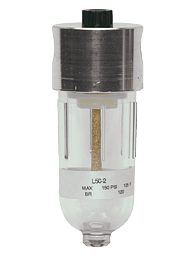




Miniature Series Port Sizes 1/8" & 1/4"; Flow to 25 scfm (708 l/min)
 Product Catalog
- Inline mounting
- High-strength polycarbonate plastic bowl, or aluminum bowl
- Low-flow models are designed to deliver oil in extremely low-flow less than 1 scfm (0.5 l/s) situations
- Wick-feed design in both high-flow and low-flow lubricators
- Internal tamper-resistant adjustment
Lubricators Miniature Series Product Overview
The Miniature Series Lubricators are designed for inline mounting, offering a compact solution for lubrication. You can choose between a high-strength polycarbonate plastic bowl or an aluminum bowl, depending on your requirements. These lubricators include low-flow models, which are specifically designed to deliver oil in extremely low-flow situations, less than 1 scfm (0.5 l/s).
For consistent and reliable lubrication, both high-flow and low-flow lubricators feature a wick-feed design. Additionally, these lubricators come with an internal tamper-resistant adjustment, ensuring secure and precise control of lubrication levels.
Please refer to the side and below for Lubricators Miniature Series catalogs, installation instructions, and technical data. Additionally, you have the option to filter through all available Integrated Lubricators Miniature Series variant that meets your requirements.
Unable to load products. Please try again.
loading...
loading...
Product Overview
The ROSS Controls Miniature Series is a line of compact inline wick-feed lubricators designed for 1/8 and 1/4 inch port applications in pneumatic systems where space is limited and tamper-proof oil delivery is required. Unlike the Bantam modular series, Miniature Series lubricators are configured for direct inline pipe connection, integrating into existing plumbing without requiring a full modular FRL station.
A defining characteristic of the Miniature Series is its internal tamper-proof oil adjustment. The oil delivery rate is set internally at the factory or during installation and cannot be altered without disassembly, making these lubricators well suited for installations where consistent lubrication must be maintained regardless of operator interaction. This prevents accidental misadjustment in high-uptime production environments.
The Miniature Series offers both high-flow and low-flow models. High-flow models support minimum flow rates of 2 scfm (0.94 l/s) for 1/8 inch ports and 6 scfm (2.8 l/s) for 1/4 inch ports. Low-flow models are engineered for air circuits operating below 1 scfm (0.5 l/s), providing reliable lubrication in slow-cycle, low-consumption pneumatic systems where standard lubricators fail to deliver oil at low flow rates.
The aluminum body construction provides a higher structural rigidity than acetal bodies, supporting maximum operating pressures of 150 psig (10 bar) with polycarbonate bowls and 200 psig (14 bar) with aluminum bowls. Nitrile seals provide petroleum oil compatibility across the full rated temperature range.
Key Engineering Features
- Inline Mounting - Designed for direct inline pipe connection rather than modular rail mounting. Integrates into existing 1/8 or 1/4 inch pneumatic plumbing without requiring companion filter or regulator units.
- Internal Tamper-Proof Adjustment - Oil delivery rate is set internally, preventing field adjustment without disassembly. Ensures consistent lubrication delivery is maintained in high-uptime production environments regardless of operator access.
- High-Flow and Low-Flow Models - High-flow variants support flow rates above 2 to 6 scfm minimum; low-flow variants are specifically engineered for air circuits operating below 1 scfm (0.5 l/s), where standard lubricators cannot reliably deliver oil.
- Wick-Feed Lubrication Mechanism - Wick-feed design delivers continuous, controlled oil introduction into the compressed air stream. Provides steady lubrication without the pulse delivery associated with sight-feed designs.
- Polycarbonate or Aluminum Bowl - 2-oz (60-ml) high-strength polycarbonate bowl for standard applications to 150 psig (10 bar) and 125 F (52 C). Aluminum bowl extends pressure to 200 psig (14 bar) and temperature to 150 F (66 C).
- Quick-Fill Cap Option - Available on all Miniature Series models. Allows pressurized oil reservoir refilling without removing the bowl, reducing downtime in continuous production systems.
- Aluminum Body Construction - Provides superior strength and rigidity compared to acetal bodies. Compatible with NPT and G (BSPP) thread standards. Supports higher installation torque without thread damage.
- Nitrile Seals - Standard nitrile seals maintain elasticity and sealing performance with petroleum-based lubricating oils across the full rated temperature range.
Technical Specifications
General Specifications
| Parameter | Specification |
| Series | Miniature |
| Lubrication Type | Wick-Feed |
| Port Sizes | 1/8 and 1/4 inch NPTF; 1/8 and 1/4 inch G (BSPP) |
| Maximum Flow | 25 scfm (708 l/min) |
| Minimum Flow (High-Flow, 1/8 port) | 2 scfm (0.94 l/s) at 91 psig (6.3 bar) inlet |
| Minimum Flow (High-Flow, 1/4 port) | 6 scfm (2.8 l/s) at 91 psig (6.3 bar) inlet |
| Minimum Flow (Low-Flow models) | 1 scfm (0.47 l/s) |
| Operating Pressure (Polycarbonate Bowl) | Maximum 150 psig (10 bar) |
| Operating Pressure (Metal Bowl) | Maximum 200 psig (14 bar) |
| Fluid Media | Compressed air |
| Ambient/Media Temperature (Polycarbonate Bowl) | 40 to 125 F (4 to 52 C) |
| Ambient/Media Temperature (Metal Bowl) | 40 to 150 F (4 to 66 C) |
| Bowl Capacity | 2 oz (60 ml) |
| Mounting | Inline |
| Body Material | Aluminum |
| Bowl Material | Polycarbonate or Aluminum |
| Seal Material | Nitrile |
| Oil Adjustment | Internal, tamper-proof |
| Fill Method | Fill port (standard) or Quick-fill cap (optional) |
Certifications & Compliance
Typical Applications & Industries
Slow-Cycle Pneumatic Systems and Intermittent-Duty Equipment
- Gate and door actuators in industrial facilities with cycle rates below one cycle per minute, where standard high-flow lubricators fail to deliver oil at the low air consumption rates characteristic of slow-moving actuators.
- Pneumatic valve actuators on oil and gas wellhead equipment or remote pipeline stations, where infrequent actuation cycles require a low-flow lubricator to prevent dry-running without flooding components with excess oil.
- Safety valve testing equipment and periodic-cycle pneumatic testing rigs, where test cycles occur minutes or hours apart and a conventional lubricator would not deliver oil at these low flow rates.
Precision Pneumatic Tools and Instrumentation
- Small pneumatic torque wrenches, riveters, and grinders in aircraft maintenance depots or precision manufacturing, where tamper-proof internal adjustment prevents operators from altering lubricant delivery once the maintenance specification is set.
- Pneumatic bench-top assembly tools on electronics assembly lines, where 1/8 inch supply lines are standard and consistent oil delivery from an inline unit protects tool vanes without requiring a modular FRL station.
- Calibration equipment and pneumatic test instruments in metrology labs, where the low-flow model delivers trace quantities of oil at sub-scfm flow rates to maintain instrument pneumatic seals.
Pharmaceutical and Sterile Manufacturing
- Pneumatic stopper insertion and vial filling equipment in pharmaceutical facilities, where tamper-proof internal adjustment prevents personnel from altering lubrication settings between validated production runs.
- Clean room pneumatic actuators in sterile compounding environments, where inline mounting in a minimal-profile housing reduces the risk of particle-trapping surfaces near ISO-classified clean zones.
- Blister pack sealing and tablet press pneumatic actuators, where controlled, repeatable lubrication is required to maintain consistent actuator performance across multi-shift production campaigns.
Packaging and Converting Machinery
- Small-bore pneumatic actuators on form-fill-seal packaging machines, where 1/4 inch air supply lines feed multiple micro-cylinders requiring consistent lubrication without excess oil carryover to product contact surfaces.
- Pneumatic label applicators and inkjet systems on secondary packaging lines, where inline Miniature Series lubricators fit in tight machine frames and maintain air motor and actuator performance over extended run times.
- Pouch sealing and carton folding pneumatic actuators, where polycarbonate bowl visibility allows quick oil level checks during changeovers without interrupting downstream production.
Medical Device and Life Sciences Equipment
- Pneumatic pipetting robots and liquid handling systems in clinical laboratory automation, where low-flow lubrication at sub-scfm consumption rates is required for syringe actuators and valve stems.
- Diagnostic imaging equipment pneumatic positioning systems, where internal tamper-proof adjustment maintains consistent lubrication in devices that are serviced infrequently and must operate reliably for years between maintenance cycles.
- Sterilization equipment pneumatic door seals and clamps, where the Miniature Series inline mounting integrates directly into autoclave or ETO sterilizer air circuits without specialized mounting hardware.
Marine and Offshore Applications
- Pneumatic valve actuators on marine vessels and offshore platforms operating at flow conditions below 1 scfm, where low-flow lubricators ensure seawater-resistant actuator seals receive lubrication during infrequent cycling in salt air environments.
- Ballast control pneumatic systems with slow-cycle actuators, where the aluminum bowl option accommodates the temperature range of 40 to 150 F encountered in machinery space environments.
- Pneumatic deck equipment controls on commercial vessels, where inline mounting in tight bulkhead spaces and tamper-proof adjustment reduce maintenance intervention in hard-to-reach pneumatic circuits.
Ordering and Model Number Configuration
Select port size, thread type, flow model (high-flow or low-flow), bowl material (polycarbonate or aluminum), and fill method (fill port or quick-fill cap) to configure the correct Miniature Series lubricator model number.
|
Model Number Structure: 5 1 1 1 B 1 0 1 0
5 1 1 1 Product/Series Code (5111 = Miniature, Polycarbonate Bowl; 5112 = Miniature, Metal/Aluminum Bowl)
B Series Revision
1 Port Size Code (1 = 1/8 inch; 2 = 1/4 inch)
0 Fill Type (0 = Fill Port; 1 = Quick-Fill Cap)
1 0 Flow/Adjustment Code (10 = High-Flow; 12 = Low-Flow)
Prefix C = G (BSPP) threads |
NPT models have no prefix. G (BSPP) models are prefixed with C (e.g., C5111B1010).
Low-flow models (code 12) are specifically designed for air systems operating below 1 scfm (0.5 l/s). For applications above 2 scfm on 1/8 ports and 6 scfm on 1/4 ports, select high-flow models (code 10).
Both high-flow and low-flow models are available with fill port or quick-fill cap. Quick-fill cap allows pressurized oil refilling without bowl removal.
Accessories
Miniature Series Filters
Inline 5-micron ROSS Miniature Series filters are compatible with Miniature Series lubricators. Available with polycarbonate or aluminum bowls, automatic or manual drain. Can be joined with pipe nipples upstream of the lubricator.
Miniature Series Regulators
Inline piston-type and diaphragm-type regulators for the Miniature Series provide pressure reduction upstream of the lubricator. Includes integral pressure gauge port.
Related Products & Accessories
- 104 Bantam Series Lubricators - Modular wick-feed lubricators for 1/8 and 1/4 inch ports with external adjustment and tube fitting options. Flow to 27 scfm. https://www.rosscontrols.com/en/series/104-bantam-series
- 106 Mid-Size Series Lubricators - Modular sight-feed lubricators for 1/4 to 1/2 inch ports with external tamper-resistant adjustment. Flow to 110 scfm. https://www.rosscontrols.com/en/series/106-mid-size-series
- MD3 Series Lubricators - Modular sight-feed lubricators with transparent dome for 1/4 to 1/2 inch ports. Flow to 150 scfm. Extended bowl option. https://www.rosscontrols.com/en/series/107-md3-series
- 108 Full-Size Series Lubricators - Modular or inline sight-feed and wick-feed lubricators for 1/4 to 3/4 inch ports. Flow to 140 scfm. https://www.rosscontrols.com/en/series/108-full-size-series
Frequently Asked Questions (FAQ)
Q: What is a low-flow lubricator and when is it needed?
A: A low-flow lubricator is specifically designed to deliver oil at air flow rates below 1 scfm (0.5 l/s). Standard lubricators require a minimum of 2 to 6 scfm to generate the pressure differential needed to draw oil from the reservoir into the airstream. When actuator cycle rates or continuous flow rates fall below this minimum, a standard lubricator provides no lubrication. The Miniature Series low-flow models (code 12) are engineered with modified internal geometry to deliver oil at these very low flow rates.
Q: Can I adjust the oil delivery rate on a Miniature Series lubricator?
A: No. The Miniature Series uses internal tamper-proof adjustment, which means the oil delivery rate is set during manufacture or initial installation and cannot be changed without disassembling the unit. This is a design feature that ensures consistent lubrication is maintained in production environments. If your application requires field-adjustable oil delivery, consider the Bantam Series (104) with external adjustment or the Mid-Size Series (106) with external tamper-resistant adjustment.
Q: What is the maximum flow for the Miniature Series?
A: The maximum flow for the Miniature Series is 25 scfm (708 l/min). This is the total capacity of the lubricator body at rated inlet pressure. Applications approaching this flow level should verify that pressure drop across the lubricator does not reduce downstream pressure below the minimum required for connected actuators.
Q: What is the difference between the high-flow and low-flow Miniature Series models?
A: High-flow models are rated for minimum flow of 2 scfm (0.94 l/s) on 1/8 inch ports and 6 scfm (2.8 l/s) on 1/4 inch ports at 91 psig (6.3 bar) inlet. Low-flow models are designed for systems where air consumption falls below 1 scfm (0.5 l/s). Using a high-flow model in a very low-flow application will result in inadequate lubrication. Using a low-flow model in a high-flow application will over-lubricate, causing oil accumulation downstream.
Q: What bowl material should I select?
A: Use polycarbonate bowls for standard industrial environments with operating pressures up to 150 psig (10 bar) and temperatures up to 125 F (52 C). Select aluminum metal bowls for applications with pressures up to 200 psig (14 bar), temperatures up to 150 F (66 C), or environments where chemical vapors, solvents, or cleaning agents may contact the bowl exterior. Polycarbonate is susceptible to crazing and failure when exposed to many industrial chemicals.
Q: Are G (BSPP) thread models available for the Miniature Series?
A: Yes. G thread models are available for all Miniature Series lubricators with 1/8 and 1/4 inch port sizes. Add a C prefix to the model number (e.g., C5111B1010 for 1/8 G thread, high-flow, polycarbonate bowl, fill port).
Q: What is the maximum operating temperature for polycarbonate bowl models?
A: Polycarbonate bowl models are rated for ambient and media temperatures of 40 to 125 F (4 to 52 C). Exceeding 125 F with polycarbonate bowls can cause bowl deformation or stress cracking. For higher temperature applications, specify the aluminum metal bowl (rated to 150 F / 66 C).
Q: How does the quick-fill cap work?
A: The quick-fill cap replaces the standard fill port plug with a spring-loaded check valve fitting. When a dispensing nozzle is inserted, the check valve opens and oil flows into the reservoir against system pressure. When the nozzle is removed, the check valve closes, maintaining system pressure. This allows oil refilling without stopping the air supply or removing the bowl.
Q: Is the Miniature Series suitable for outdoor or washdown applications?
A: The Miniature Series is not specifically rated for washdown or outdoor exposure. For outdoor installations, protect the unit from direct weather exposure. For washdown environments, consider using the aluminum bowl option and verify that cleaning chemicals are compatible with acetal or aluminum construction. Consult ROSS Controls technical support for guidance on harsh-environment installations.
Q: What oil type is recommended for the Miniature Series?
A: Use petroleum-based oil with ISO 32 viscosity or lighter and an aniline point between 180 F and 220 F. Do not use synthetic oils, phosphate-ester fluids, or oil additives that are incompatible with nitrile seals. Standard pneumatic tool oil meeting these specifications is appropriate for most Miniature Series applications.
Q: How often should the oil reservoir be refilled?
A: Oil consumption depends on lubricator adjustment, system flow rate, and cycle frequency. As a starting estimate, plan for periodic inspection at one-week intervals during initial installation to characterize consumption rate in your specific application. Once the consumption rate is understood, establish a scheduled refill interval. Use the quick-fill cap option to minimize downtime during oil replenishment.
Q: Can the Miniature Series be used in a vertical mounting orientation?
A: The standard recommended mounting orientation places the bowl downward. Verify with the ROSS FRL installation instructions whether alternative orientations are permissible for specific Miniature Series variants. Incorrect orientation may affect wick oil exposure and oil delivery rate.
Installation & Maintenance Guidelines
- Install the lubricator downstream of the filter and regulator in the air treatment sequence so that clean, pressure-regulated air enters the lubricator from the inlet port.
- Mount with the bowl in the downward vertical orientation for correct wick immersion in the oil reservoir.
- Verify system is depressurized before removing the bowl for oil filling on standard fill port models.
- Use only petroleum-based lubricant with ISO 32 viscosity or lighter and an aniline point between 180 F and 220 F. Incompatible lubricants will degrade nitrile seals.
- For low-flow applications, confirm that the low-flow model (code 12) is selected. Installing a high-flow model in a sub-1-scfm application will result in no lubrication delivery.
- Do not exceed the maximum operating pressure for the selected bowl type: 150 psig for polycarbonate, 200 psig for aluminum.
- Avoid installing polycarbonate bowl models where chemical vapors, solvents, or cleaning agents may contact the bowl surface.
- Inspect bowl O-ring seal and bowl ring for damage before reinstalling the bowl after oil refilling. Replace damaged seals with ROSS-specified replacement parts.
- After installation, run the system for one production shift and inspect downstream actuators and exhaust ports for signs of over-lubrication (oil accumulation) or under-lubrication (dry actuator sounds or increased resistance).
Warranty & Global Support
ROSS Controls provides a one-year warranty on all products, covering defects in material and workmanship from date of purchase.
Global technical support is available through ROSS offices in the USA (headquarters in Ferndale, Michigan), Canada, Brazil, Germany, France, United Kingdom, India, China, and Japan.
Contact ROSS Controls USA at (800) 438-7677 or (248) 764-1800, or visit rosscontrols.com for product configuration, technical support, and distributor locator services.
Download Catalog: https://www.rosscontrols.com/en/documents/198/ROSS_FRL_Combination_Units_Filter_Regulator_Lubricator.pdf
Download Documents
Miniature Series