




Pneumatic Solutions for the Packaging Industry
Packaging lines run on speed, repeatability, and uptime. A single fill, form, seal, or palletizing cell may execute hundreds of pneumatic cycles per minute, and any drop in valve response time, any cycle of internal leakage, and any uncontrolled energy source compounds across millions of units shipped per year. Machine builders and end users in vacuum packaging, thermoforming, blow molding, molded pulp, and end-of-line case packing operate under three simultaneous pressures: ANSI/PMMI B155.1-2023 compliance for safeguarding and energy isolation, OSHA 29 CFR 1910.147 enforcement on lockout/tagout (LOTO), and the production targets that determine whether the line meets its overall equipment effectiveness (OEE) goal. The pneumatic valves controlling vacuum, mold actuation, blow pressure, case erection, and end-effector tooling are not commodity components. They determine whether the line passes a PMMI-aligned safety audit and whether the cycle time on the spec sheet is the cycle time on the floor.
ROSS Controls has manufactured precision pneumatic valves since 1921 and brings decades of field-proven experience to the packaging industry through both standard product lines and the ROSS/FLEX custom engineering program. ROSS poppet valve architecture, third-party-certified DM2C safe exhaust double valves, L-O-X energy isolation valves, Dale Series base-mounted poppet manifolds for vacuum and leak-tight applications, and ISO-standard W65 and W66 spool-and-sleeve valves for high-density automation manifolds are deployed across packaging OEMs and packaging end users worldwide. ROSS Global Safety Industry Specialists serve on the ANSI, ISO, and PMMI committees that write the standards governing this industry, and the company's product roadmap is aligned with the current revisions of ANSI/PMMI B155.1-2023, ANSI/ASSE Z244.1-2024, and ISO 13849-1:2023.
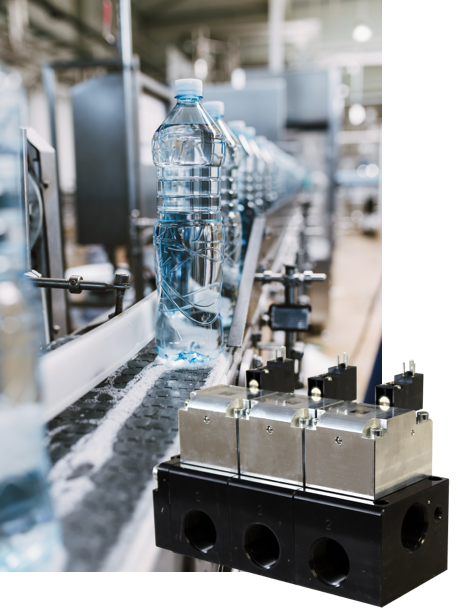
Why Packaging Operations Demand Precision Fluid Power Control
Packaging machinery combines high cycle rates, mixed contamination, frequent operator interventions, and aggressive OEE targets in a single operating envelope. Five operating realities determine valve selection on a packaging line.
High-cycle duty across multi-axis pneumatic systems.
A typical case-packing cell may include 12 to 30 pneumatic actuators driven through a single manifold, cycling 30 to 60 times per minute. A single station can execute well over 10 million cycles per year. Sliding-seal designs degrade predictably under this duty, producing the slow internal leakage that increases cycle time and air consumption before any visible failure.
Frequent operator access for jam clearance, changeover, and product switchover.
Packaging lines stop and restart far more often than upstream process equipment. Each operator entry is a regulated event under OSHA 29 CFR 1910.147 and ANSI/ASSE Z244.1-2024. The pneumatic energy isolation device must dump downstream pressure quickly, lock in the off position, and provide visible verification that energy is dissipated. Slow exhaust paths and ambiguous lockout indicators add seconds to every intervention and minutes to every changeover.
Mixed contamination from product, environment, and ambient air.
Vacuum packaging pulls film aerosol and ink mist through the vacuum circuit. Thermoforming generates plastic particulate. Molded pulp aspirates fiber and water vapor. Blow molding handles colorant and resin dust. End-of-line case packing operates downstream of dusty cardboard handling. Spool clearances are vulnerable to silting in any of these conditions. Poppet valves with self-cleaning seal geometry tolerate the same load without performance loss.
Vacuum-circuit open-center exposure on standard 3/2 valves.
The two-station 2-way DALE Poppet Series CP manifold eliminates the open-center exposure entirely. A brief open-center condition during valve shifting exposes the vacuum pump to atmosphere. On valves ported above one inch, this may collapse pump vacuum, wastes energy, and stretches cycle time by several hundred milliseconds. The ROSS DALE Poppet series is a proven solution for this issue.
Audit-ready compliance under ANSI/PMMI B155.1-2023.
PMMI's C-Type standard for packaging and processing machinery requires that energy isolation devices be lockable only in the off position, that they provide a full-size exhaust port with capacity equal to or greater than the supply port, and that they include a visible pressure indicator. Most vented ball valves used as a low-cost lockout device do not meet these requirements. Purpose-engineered energy isolation valves like the ROSS L-O-X 15 Series do.
These five realities determine what a packaging-line valve must do. The remainder of this page explains how ROSS valve architecture answers each one.

ROSS Valve Technology for Packaging Conditions
ROSS manufactures both poppet valves and ISO spool-and-sleeve valves, and the right technology depends on the function and the contamination level of the specific circuit on the packaging machine. ROSS application engineers match the valve technology to the function rather than forcing a single architecture across the line.
The ROSS poppet valve is the foundation product for vacuum, leak-tight, and high-cycle directional control on packaging equipment. In a poppet valve, the sealing element is pressed against a seat and lifts straight off the seat to allow flow. There is no extended sliding contact between seal and seat, so stiction does not develop, wear does not progress through abrasion, and the sealing pressure that the valve produces on its first cycle is the sealing pressure it produces millions of cycles later. The piston, exhaust, and inlet poppet surface areas are sized so that pilot pressure and spring force generate consistent shifting force in both directions across the operating pressure range, which is what makes high-speed, repeatable operation possible at the cycle rates packaging machines require.
Two characteristics of the poppet design matter on a packaging line. First, the metal-to-elastomer interface produces near-zero internal leakage, the prerequisite for vacuum holding, leak-test integrity, and pressure-decay verification. Second, the highest fluid velocity in the valve occurs at the moment the poppet first lifts, when the throat area is smallest. That high-velocity flow scrubs the seat clean of any contaminant that settled during the off cycle. In an environment loaded with film aerosol, plastic particulate, or fiber, this self-cleaning behavior is the difference between a valve that holds cycle time for years and one that drifts within months. The poppet design is also self-compensating, adjusting stroke length as the seal burnishes so response time and sealing pressure remain consistent over valve life.
The Dale Series is the highest-performance member of the ROSS poppet family for packaging vacuum and leak-tight applications. Dale Series valves deliver flow rates up to Cv 100, support bi-directional flow, and accept vacuum, pressure, or gas on any port at any time. They are rated for 20 million cycles, and the manifold configurations eliminate intermediate piping so the valve can be mounted close to the actuator and the dead volume between valve and load is minimized. Dale Series CP and LF sub-series are the standard pressure variants. Dale Series CX and LX are the leak-tight, low-pressure, vacuum-rated variants used where bubble-tight shutoff is required.
ROSS ISO spool-and-sleeve valves are the right choice for the high-density automation manifolds that drive multi-axis systems on case packers, palletizers, robotic end-effectors, and changeover-heavy filling lines. Spool-and-sleeve valves natively support 4/2, 5/2, and 5/3 functions, mount to standard ISO interfaces (ISO 5599-1, ISO 5599-2, ISO 15407-1, ISO 15407-2), and accept serial bus I/O so a 12-station manifold connects to the PLC over a single fieldbus cable. The W65, W66, W64, and W60 series are the appropriate selections, with the W66 ISO 15407 platform fitting the highest-density layouts.
For applications in elevated-temperature zones (heat sealing, shrink tunnels) or chilled environments (refrigerated case packing, frozen-food filling), ROSS valves are specified with elastomer compounds matched to the operating temperature.
Packaging Industry Application Solutions
ROSS products are organized around the discrete control functions of a modern packaging line. Each application area has specific performance requirements and a specific ROSS solution.
Vacuum Packaging
Vacuum packaging removes atmospheric air from a product cavity and seals the package while the cavity is held under vacuum. To maintain throughput, OEMs use larger valves (1 inch through 2-1/2 inch port sizes) so that high-flow paths can pull the cavity down quickly. The control problem with a standard 3/2 valve at this scale is the open-center transient during shift, when both the vacuum port and the atmospheric vent are momentarily connected. The vacuum pump sees atmosphere for a few milliseconds, pump vacuum collapses, and the next cycle starts from a degraded baseline.
The ROSS solution is the two-station 2-way Dale Poppet Series CP manifold. Two independent 2/2 valves are configured so that one valve is open whenever the other is closed, and the manifold geometry never connects the vacuum port to atmosphere through the pump. Vacuum is applied and vented through dedicated paths, the pump stays at design vacuum, cycle time tightens, and energy consumption per cycle drops measurably.
Key Benefits
- No open-center exposure of the vacuum pump to atmosphere
- High Cv flow paths support 1 inch through 2-1/2 inch ported applications
- Bi-directional flow accepts vacuum, pressure, or gas on any port
- 20-million-cycle rated life under packaging duty
- Bubble-tight poppet shutoff preserves vacuum hold during the seal cycle
Typical Applications
- Form-fill-seal vacuum chambers
- Roll-stock thermoform-fill-seal vacuum stations
- Modified atmosphere packaging (MAP) cavities
- Vacuum chamber sealers for protein and dairy
- Vacuum table feeders and pick-and-place vacuum cups
Thermoforming
Thermoforming heats a thin plastic sheet, draws it into a mold under vacuum (and sometimes assist air), trims the formed parts, and indexes the next sheet. These machines are high-volume, low-margin, and machine speed is the difference between profit and loss. Two pneumatic functions dominate the cycle: the vacuum pull on the mold (form) and the air-blow release that ejects the part from the mold cavity.
ROSS Dale Series valves on a manifold deliver the high Cv flow and instantaneous shifting that thermoforming cycle times require, and the self-cleaning poppet design tolerates the fine plastic dust generated during trimming and singulation. Form vacuum, knockoff air, and assist plug actuation can be combined on a single Dale CP or CX manifold mounted close to the mold, minimizing dead volume and tightening cycle time. For mold-clamp and take-off automation, ISO W66 spool-and-sleeve valves on a serial bus manifold provide the multi-axis directional control required.
Key Benefits
- Cv up to 100 per Dale Series valve for fast vacuum pull and air release
- Self-cleaning poppet design tolerates plastic particulate and trim dust
- Manifold mounting reduces dead volume between valve and mold
- ISO 15407 spool valves support multi-station mold-clamp and take-off automation
- Serial bus I/O integration reduces wiring complexity on multi-axis cells
Typical Applications
- Roll-stock thermoforming for clamshell and tray packaging
- Cut-sheet thermoforming for industrial packaging
- Pressure-form thermoforming for rigid containers
- Inline thermoform-fill-seal systems
- Automated trim, stack, and counting downstream of the mold
Blow Molding
Blow molding produces hollow plastic containers and bottles through extrusion blow molding (EBM), injection blow molding (IBM), stretch blow molding (SBM), and reheat-and-blow processes. Each variant relies on precisely timed pneumatic actuation to clamp, blow, cool, and eject. SBM lines alone account for thousands of new system deployments per year worldwide, and the cycle-to-cycle consistency required to hold bottle wall thickness, weight, and base geometry within specification is a direct function of valve repeatability.
ROSS poppet valves provide the bi-directional flow, positive sealing, and wear-compensating performance these applications require. For blow-air control, ROSS Dale Series CX manifolds deliver leak-tight shutoff that holds blow pressure throughout the cooling phase without drift. For mold clamp, blow-pin actuation, and part takeout, ISO W65 and W66 spool-and-sleeve valves on a multi-station manifold with serial bus I/O provide the multi-axis control logic the cycle requires.
Key Benefits
- Repeatable bi-directional shifting holds blow pressure without drift
- Bubble-tight poppet shutoff prevents pressure decay during cooling
- Wear-compensating poppet design preserves cycle consistency over millions of strokes
- ISO spool valves on serial bus manifolds simplify multi-axis blow-pin and clamp control
- Compatible with PET, HDPE, and PP container production
Typical Applications
- Stretch blow molding (SBM) for PET beverage bottles
- Extrusion blow molding for HDPE household containers
- Injection blow molding for pharmaceutical and personal-care containers
- Reheat-and-blow systems for two-stage PET bottle production
- Inline blow-fill-cap systems
Molded Pulp and Sustainable Packaging
The shift toward sustainable packaging materials has driven rapid growth in molded pulp packaging for consumer goods, electronics, and protective packaging. Molded pulp lines pull a fiber-and-water slurry into a mold under vacuum, thermoform the wet web, transfer it to a hot drying mold, and demold the finished part. The pneumatic challenges are aggressive: high vacuum demand on the suction tooling, heavy particulate and water vapor in the vacuum air stream, and short, repetitive cycles that demand fast valve response.
ROSS Dale Series vacuum valves are matched to molded pulp duty. The high Cv flow paths handle the vacuum demand without bottlenecking the suction stage, the poppet design tolerates the particulate and water vapor without performance loss, and the 20-million-cycle rated life delivers the service interval molded pulp producers require to hold cost targets.
Key Benefits
- High Cv flow supports rapid vacuum draw on molded-pulp tooling
- Poppet design tolerates fiber, water vapor, and ambient particulate
- Bi-directional flow supports vacuum, pressure, and ambient venting on the same valve
- 20-million-cycle rated life matches molded pulp duty cycles
- Bubble-tight shutoff during transfer holds the wet web in position
Typical Applications
- Wet-web pickup tooling on molded pulp formers
- Wet-mold to dry-mold transfer manipulators
- Hot-press molded pulp dewatering stations
- Demold ejection of finished molded pulp parts
- Inline trim and stack of molded pulp components
End-of-Line Case Packing and Palletizing
End-of-line packaging integrates case erection, product loading, top sealing, palletizing, and stretch-wrap into a single high-rate cell. These cells are pneumatic-actuator-dense, jam-prone during case-supply or product-flow disturbances and frequently accessed by operators for jam clearance and changeover. Each operator entry is a regulated event, and the speed of the energy isolation step directly determines line OEE.
The proven configuration on these cells is a safety PLC like the Rockwell Automation GuardLogix, controlling the electrical safety circuit, paired with a ROSS DM2C Series safe-exhaust double valve handling pneumatic energy isolation. This configuration on integrated case packing and palletizing systems, replacing traditional lockout for routine, repetitive tasks with single-point lockout (SPLO) under ANSI/ASSE Z244.1-2024. When the safety controller sees a safety event (light-curtain trip, guard-door open, jam-clear request), it removes power from the DM2C solenoid coils, the valve exhausts downstream pneumatic energy in milliseconds, and the integral monitoring confirms the safety function. The DM2C provides diagnostic feedback through a pressure switch that meets the diminished-performance monitoring requirements of ANSI/PMMI B155.1-2023.
Key Benefits
- DM2C Category 4 PLe certified to ISO 13849-1:2023 for highest functional safety integrity
- SPLO configuration reduces routine lockout time by minutes per intervention
- W66 ISO 15407 spool-valve manifolds drive multi-axis case-packing and palletizer automation
- Compatible with PMMI-aligned audit documentation
Typical Applications
- Integrated case packers and case erectors
- Robotic palletizing and de-palletizing cells
- Top-load and side-load case packing
- Stretch-wrap and shrink-wrap end-of-line systems
- Bottle, can, and pouch end-of-line consolidation
ROSS Controls Product Solutions for Packaging
The following ROSS product series are matched to the discrete control functions of a packaging line. Each entry explains the product's role on packaging equipment and links to the published series page on rosscontrols.com.
-
Dale Series CP and LF: Standard-Pressure Base-Mounted Poppet Valves
The Dale Series CP and LF are base-mounted poppet valves engineered for standard-pressure packaging applications. The two-station 2-way CP configuration is the ROSS solution for vacuum packaging open-center elimination, and CP and LF manifolds are the high-Cv directional control choice for thermoforming and blow molding mold actuation.
-
Dale Series CX and LX: Leak-Tight Vacuum and Low-Pressure Poppet Valves
The Dale Series CX and LX are the leak-tight, low-pressure, vacuum-rated members of the Dale family. Bubble-tight poppet shutoff makes them the correct selection for vacuum hold during seal cycles, leak-test circuits inline with packaging, and low-pressure assist-air control where pressure decay would corrupt the process.
-
Dale Series CP and CX Manifolds: Multi-Station Packaging Manifolds
The Dale CP and CX manifold platform consolidates multiple Dale valves on a shared body, eliminating intermediate piping and dead volume between the valve and the actuator. Manifold mounting tightens cycle time on vacuum, thermoform, and blow-mold applications and reduces fitting count and leak-point exposure across the machine.
-
DM2C Series Safe-Exhaust Double Valve: Category 4 PLe Pneumatic Energy Isolation
The DM2C Series is a redundant, internally monitored safe-exhaust double valve certified to ISO 13849-1:2023 Category 4, Performance Level e (PLe), and SIL 3. It blocks supply and rapidly exhausts downstream pneumatic energy when the safety circuit commands a stop. Dynamic monitoring of the dual valve elements detects asynchronous shifting on every cycle, dynamic memory prevents self-reset after a fault, and integral diagnostic feedback meets the diminished-performance monitoring requirements of ANSI/PMMI B155.1-2023.
-
DM2C Safe-Exhaust Valve, Explosion Proof: Hazardous-Location Packaging
The explosion-proof variant of the DM2C delivers the same Category 4 PLe safe-exhaust function in a housing rated for hazardous-location packaging environments such as solvent-based aerosol filling, flammable-liquid filling, and certain food and pharmaceutical processing zones with regulated atmospheres.
-
L-O-X 15 Series Lockout and Exhaust Valve: OSHA- and PMMI-Compliant Energy Isolation
The L-O-X 15 Series is a manually operated three-position lockout valve that blocks supply, exhausts downstream pneumatic pressure through a full-size exhaust port, and accepts up to four padlocks in the lockout position. It dumps one cubic foot of 100 psi compressed air in 1.2 seconds (versus over four minutes for many vented ball valves), is lockable only in the off position, and includes a visible pressure indicator. The L-O-X 15 Series complies with the energy-isolation device requirements of OSHA 29 CFR 1910.147 and ANSI/PMMI B155.1-2023, where many vented ball valves do not.
-
L-O-X with EEZ-ON Soft Start, 15 Series: Lockout with Controlled Re-Energization
The L-O-X with EEZ-ON Soft Start combines the L-O-X energy isolation function with a soft-start valve that gradually re-pressurizes the downstream system on release. This eliminates the actuator slam and pressure spike that occur when a fully exhausted system is re-energized at full plant pressure, and it is the recommended configuration for packaging machines with large air volumes downstream of the lockout.
-
EEZ-ON 27 Series Soft-Start Valve: Controlled Machine Startup
The 27 Series Soft Start EEZ-ON is a stand-alone soft-start valve for controlled pressurization of packaging-machine pneumatic circuits at startup. It prevents cylinder runout, tooling slam, and ejected workpieces during the air-on transient and is rated to Safety Category 1, PLc under ISO 13849-1.
-
W65 Series ISO 5599-2 Spool-and-Sleeve Valves: Plug-In Manifold Automation
The W65 Series provides ISO 5599-2 standard spool-and-sleeve valves with plug-in connections, the appropriate selection for OEM packaging machine builders requiring interchangeable, industry-standard manifold connections. The W65 supports 4/2 and 5/2 functions and mounts directly to multi-station manifold sub-bases on case packers, palletizers, and filling-line automation.
-
W66 Series ISO 15407-1 and ISO 15407-2 Spool-and-Sleeve Valves: High-Density Manifolds
The W66 Series provides compact ISO 15407-1 (drop-cord connection) and ISO 15407-2 (plug-in connection) spool-and-sleeve valves for high-density manifold assemblies on modern packaging cells. The W66 platform is the standard selection for multi-axis case-packing, palletizing, and end-effector control where station count and panel space drive the design.
-
PACK Series Multi-Station Valve Manifolds: Pre-Assembled Multi-Axis Control
The PACK Series provides pre-assembled multi-station valve manifolds with two through twelve or more stations for multi-actuator packaging cells. PACK manifolds reduce installation time, plumbing complexity, and leak-point count on cells that otherwise would require individually piped valves at each station.
-
Serial Bus with TURCK Modular I/O: Industry 4.0 Connectivity
The ROSS Serial Bus product integrates ROSS ISO valve manifolds with TURCK modular I/O for fieldbus connectivity (DeviceNet, Profibus, EtherNet/IP, and other protocols). A 12-station packaging-cell manifold connects to the line PLC over a single fieldbus cable, replacing dozens of individual wire runs and supporting the diagnostic visibility and remote configuration that Industry 4.0 packaging operations require.
-
MD3 and MD4 Series FRLs: Air Preparation for Packaging Equipment
The MD3 and MD4 Series Filters, Regulators, and Lubricators provide point-of-use air preparation for packaging machines and zones. The MD3 covers 1/4 inch through 1/2 inch ports with flow to 110 scfm. The MD4 covers 3/8 inch through 3/4 inch ports with flow to 205 scfm. Filtration removes the particulate and moisture that degrade valve performance, precision regulators hold supply pressure within specification across cycle-to-cycle demand variation, and lubrication extends valve and cylinder service life on high-cycle packaging duty.
Regulatory Compliance and Safety Standards
Packaging machinery is governed by a layered framework of federal regulations, consensus standards, and international harmonized standards. The standards in the table below are the C-Type and B-Type standards that apply directly to pneumatic control of safeguarding, energy isolation, and safety-related control functions on packaging equipment.
| Standard | Scope | ROSS Solution |
|---|---|---|
| ANSI/PMMI B155.1-2023 | U.S. consensus C-Type safety standard for packaging and processing machinery, including risk assessment, energy isolation, and safety-related control systems | DM2C safe-exhaust double valve and L-O-X 15 Series lockout valve meet the energy isolation, full-size exhaust, lockable-off, and visible-pressure-indicator requirements |
| OSHA 29 CFR 1910.147 | U.S. federal Control of Hazardous Energy (lockout/tagout) standard | L-O-X 15 and 27 Series lockout valves are purpose-engineered energy isolation devices providing positive isolation, exhaust, and padlock-rated lockout |
| ANSI/ASSE Z244.1-2024 | U.S. consensus standard for the control of hazardous energy (lockout, tagout, and alternative methods including SPLO) | DM2C safe-exhaust valves enable single-point lockout for routine, repetitive packaging tasks under the alternative methods provisions |
| ISO 13849-1:2023 | International standard defining performance levels and categories for safety-related parts of control systems | DM2C is third-party certified to Category 4, Performance Level e (PLe), and SIL 3, the highest functional safety ratings available for pneumatic safety valves |
| ISO 12100:2010 | International machinery safety risk-assessment methodology underlying both ISO and ANSI machine safety standards | ROSS Global Safety Industry Specialists support customer risk assessments under ISO 12100 methodology |
| ANSI B11.0-2023 | U.S. consensus standard for safety of machinery, defining the risk-assessment process for industrial machines | ROSS supports customer risk assessment, conformity audit, and safety system validation aligned with ANSI B11.0 |
| ISO 4414 | International standard for pneumatic fluid power system safety, including pressure containment, component reliability, and control system integrity | ROSS valves are rated, tested, and documented to support ISO 4414 system-level compliance |
The C-Type standard for packaging is ANSI/PMMI B155.1-2023, and it cannot be reduced through risk assessment alone. The valve-level requirements it specifies (full-size exhaust, lockable-off, visible pressure indication, control reliability for hazardous energy) are met by the ROSS L-O-X 15 Series and DM2C Series. ANSI/ASSE Z244.1-2024 permits alternative lockout methods, including SPLO, for routine and repetitive production tasks integral to packaging operations such as jam clearing, product changeover, and infeed adjustment. SPLO implementations using the DM2C as the pneumatic energy isolation device, paired with a Rockwell Automation GuardLogix or equivalent safety PLC for the electrical safety circuit, can reduce routine lockout time by minutes per incident and add measurable shift output without compromising safety integrity.
ROSS provides documentation packages for each safety product series sufficient to support regulatory audits and third-party safety integrity assessments. DM2C valves carry DGUV (formerly BG), CE, CSA/UL, and EAC marks. SISTEMA libraries are published for download to simplify safety system performance-level calculations under ISO 13849-1:2023.
ROSS/FLEX: Custom Solutions for Packaging Applications
Standard ROSS products fit most packaging applications, but every line has at least a few machines with non-standard manifold configurations, retrofit constraints from a previous-generation OEM platform, integrated function requirements a catalog product does not match exactly, or competitor-replacement adapter needs that justify a custom approach. The ROSS/FLEX program addresses these applications by repackaging the same proven internal valve components used in standard ROSS products into a custom external configuration built to the machine's specific requirements.
The ROSS/FLEX engineering team develops custom valve assemblies in days or a few weeks rather than months. Because the internal components are already qualified through ROSS production testing, the custom assembly inherits the life-cycle and performance data of the standard product, with no new component qualification or extended sample-and-test cycle required. ROSS/FLEX solutions are available in both poppet and spool-and-sleeve configurations and are compatible with any incumbent valve brand on the line.
Four ROSS/FLEX configurations are common in packaging.
- The first is custom multi-station vacuum manifolds for high-rate vacuum packaging cells, where the standard CP or CX manifold needs additional station count, mixed flow ratings per station, or non-standard porting to fit the cell's pneumatic backbone.
- The second is integrated valve assemblies that combine multiple functions (form vacuum, knockoff air, assist plug, and seal-clamp control) on a single body for a thermoforming station, reducing field connections and tightening dead volume.
- The third is competitor-replacement adapter plates that allow a ROSS valve or manifold to drop into the footprint of an underperforming or end-of-life valve from another manufacturer, eliminating the need to re-pipe the machine when upgrading.
- The fourth is custom L-O-X energy isolation packages with integrated soft-start, pressure indication, and full-flow exhaust sized to the specific packaging machine's downstream volume, delivering ANSI/PMMI B155.1-2023-compliant energy isolation in a single drop-in assembly.
ROSS/FLEX program benefits for packaging
- Custom configurations delivered in days or a few weeks, not months
- Proven internal components inherit standard product life-cycle and certification data
- No new component qualification or extended sample testing
- Competitor-replacement adapters protect existing piping and panel layouts
- Integrated function combinations reduce field connections and leak-point count
Frequently Asked Questions
-
Q: What safety standards apply to packaging machinery pneumatics?
Answer:
The governing C-Type safety standard for packaging and processing machinery in North America is ANSI/PMMI B155.1-2023, published by PMMI (The Association for Packaging and Processing Technologies). It guides suppliers and end users through a formal risk assessment and defines requirements for safeguarding, energy isolation, and safety-related control systems. OSHA 29 CFR 1910.147 is the U.S. federal Control of Hazardous Energy (lockout/tagout) regulation that applies to all packaging operations. ANSI/ASSE Z244.1-2024 covers lockout, tagout, and alternative methods including single-point lockout. ISO 13849-1:2023 defines performance levels for safety-related parts of control systems. ANSI B11.0-2023 provides the underlying risk-assessment methodology. ROSS products are third-party certified to meet or exceed these requirements.
-
Q: What does ANSI/PMMI B155.1-2023 require of a pneumatic energy isolation valve?
Answer:
ANSI/PMMI B155.1-2023 requires that safety shut-off and exhaust valves be lockable only in the off position, that they include a full-size exhaust port with capacity equal to or greater than the supply port, and that they include a visible pressure indicator so personnel can confirm energy is dissipated before access. Most vented ball valves used as a low-cost lockout device do not satisfy all three requirements. The ROSS L-O-X 15 Series is purpose-engineered to comply with all three: it is lockable only in the off position, accepts padlocks and hasps, exhausts through a full-flow port that dumps one cubic foot of 100 psi air in 1.2 seconds, and includes a visible pressure indicator that confirms downstream energy dissipation before any personnel access.
-
Q: What is the difference between traditional lockout/tagout and alternative single-point lockout for packaging?
Answer:
Traditional lockout/tagout (LOTO) under OSHA 29 CFR 1910.147 requires complete de-energization of all energy sources and physical locking before any maintenance access. Alternative lockout under ANSI/ASSE Z244.1-2024 permits the use of control-reliable safety components and a single-point lockout (SPLO) device to isolate hazardous energy faster for routine, repetitive production tasks such as jam clearing, infeed adjustment, and product changeover. On a packaging line, an SPLO configuration typically combines a safety PLC for the electrical safety circuit with a ROSS DM2C Series safe-exhaust double valve for pneumatic energy isolation. Documented packaging-line implementations show lockout time reductions of multiple minutes per incident, which over a shift can return the equivalent of an entire additional production run while maintaining the highest level of safety integrity.
-
Q: Why is the two-station 2-way Dale CP manifold preferred for vacuum packaging over a single 3/2 valve?
Answer:
When a single 3/2 poppet valve is used to apply and vent vacuum on a packaging cavity, the brief open-center transient during shift exposes the vacuum pump to atmosphere through the valve. On systems with valves ported above one inch, this transient collapses pump vacuum momentarily, wastes pump energy, and stretches cycle time on the next stroke. The two-station 2-way Dale CP manifold uses two independent 2/2 valves arranged so that one is always closed when the other is open, and the manifold geometry never connects the vacuum port to atmosphere through the pump. The result is preserved pump vacuum, tighter cycle time, and lower energy per cycle. The Dale Series additionally provides Cv up to 100 per valve, bi-directional flow, and a 20-million-cycle rated life, which match the duty profile of high-rate vacuum packaging cells.
-
Q: What certifications do ROSS DM2C safe-exhaust valves carry for packaging applications?
Answer:
ROSS DM2C Series safe-exhaust double valves are third-party certified to ISO 13849-1:2023 Category 4, Performance Level e (PLe), and SIL 3, which are the highest functional safety ratings available for pneumatic safety valves. They carry DGUV (formerly BG) certification, CE marking, CSA/UL certification, and EAC declarations. SISTEMA libraries are published for download to support safety system performance-level calculations under ISO 13849-1:2023. The DM2C uses redundant internal valve elements with crossflow paths and dynamic monitoring that detects asynchronous valve element movement on every cycle, with dynamic memory that prevents the valve from self-resetting after a fault is detected. The DM2C Explosion Proof variant is available for hazardous-location packaging applications such as solvent-based aerosol filling and certain regulated-atmosphere processing zones.
-
Q: Which ROSS valves are best for high-density manifold automation on case packers and palletizers?
Answer:
The ROSS W66 Series ISO 15407-1 and ISO 15407-2 spool-and-sleeve valves are the standard selection for high-density manifold automation on modern packaging cells. The W66 platform is engineered for compact station spacing and supports both drop-cord (15407-1) and plug-in (15407-2) connection styles. The W65 Series ISO 5599-2 valves cover the full-size ISO 5599-2 footprint where flow capacity and standardized interchangeability matter more than minimum station spacing. Both platforms accept the ROSS Serial Bus integration with TURCK modular I/O, allowing a 12-station case-packer or palletizer manifold to connect to the line PLC over a single fieldbus cable. The PACK Series provides pre-assembled multi-station manifolds for applications where a packaged, ready-to-install manifold reduces installation time and field plumbing.
-
Q: Can ROSS create custom pneumatic valve solutions for unique packaging machine requirements?
Answer:
Yes. The ROSS/FLEX program enables custom engineering by repackaging proven internal poppet and spool-and-sleeve components into custom external configurations: combining multiple valve functions into a single body, creating adapter plates to replace underperforming valves from other manufacturers, building complete air distribution systems for a specific packaging cell, and configuring custom port locations and flow ratings. Because ROSS/FLEX uses internal components already qualified through standard product testing, life-cycle re-testing is not required, and delivery is measured in days or a few weeks rather than months. ROSS/FLEX solutions are compatible with any incumbent valve brand on the line, so the program can be used both for new packaging machine designs and for in-service line upgrades and competitor replacements.
-
Q: How do ROSS solutions help packaging operations reduce energy and air consumption?
Answer:
ROSS poppet valves eliminate the open-center vacuum waste common in standard 3/2 valve installations through the two-station 2-way Dale CP manifold approach, preserving pump vacuum across cycles. The L-O-X 15 Series exhausts one cubic foot of 100 psi air in 1.2 seconds versus several minutes for many vented ball valves. Dale Series valves deliver Cv up to 100 with bi-directional flow, allowing supply circuits to be sized for actual demand rather than oversized to compensate for valve restriction. MD3 and MD4 FRLs hold supply pressure within specification, preventing the over-pressurization that drives air consumption without improving cycle time. Combined with reduced downtime from SPLO implementations, the total operating cost impact on a high-cycle packaging line is substantial.
Contact Our Packaging Application Engineering Team
ROSS application engineers and Global Safety Industry Specialists work with packaging OEMs, contract packagers, and end users to specify pneumatic valves and safety systems for vacuum packaging, thermoforming, blow molding, molded pulp, and end-of-line case packing and palletizing under ANSI/PMMI B155.1-2023, OSHA 29 CFR 1910.147, ANSI/ASSE Z244.1-2024, and ISO 13849-1:2023. Whether your project is a new machine specification, an SPLO upgrade, a competitor-replacement program, or a ROSS/FLEX custom assembly, our team can review your circuit, recommend the matched product configuration, and provide the documentation required for regulatory audit or third-party safety integrity assessment.