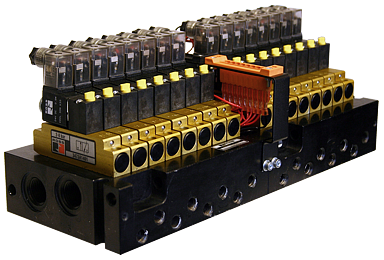




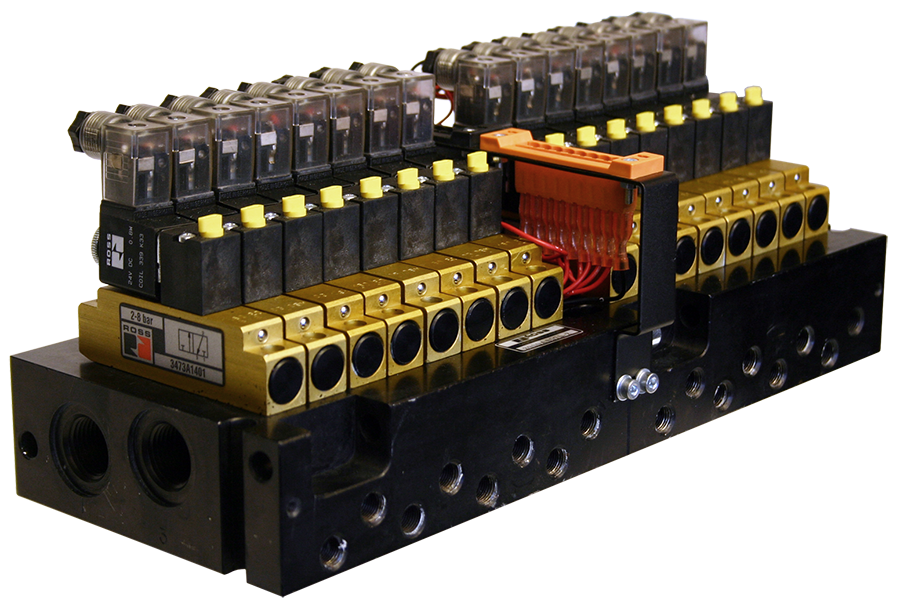
Pack Series Valve Manifolds Multi Station Valves Manifolds
 Product Catalog
- Individual Valve Shut-off (automatic): increases uptime for continuous processing
- Sure-Shifting and Self-Cleaning: reliable performance in extreme conditions (dirt tolerant, high humidity, cold, heat, dust, debris returned from the field actuator, etc...)
- Positive Sealing and Self-Compensating for Wear: perpendicular poppet face seals
- Quick Electrical Disconnect w/Indicator Light: allows immediate troubleshooting of component/system issues in the field
- Consistent Actuation over the Life of the Valve: strong shifting forces
Pack Series Multi Station Valves Manifolds Product Overview
ROSS® solenoid pilot valves provide reliable pilot control for various process valves: butterfly, knife gate, ball, mixing, diverters and other pneumatically actuated devices.
Please refer to the side and below for links to easily navigate and download ROSS Controls ck Series Multi Station Valves Manifolds catalogs, installation instructions, and technical data. Additionally, you have the option to filter through all available options to discover ck Series Multi Station Valves Manifolds variant that meets your requirements.
loading...
loading...
Product Overview
The ROSS Controls Pack Series, is a family of compact multi-station solenoid pilot valve manifold assemblies designed specifically to provide reliable pilot control for pneumatically actuated process valves including butterfly valves, knife gate valves, ball valves, mixing valves, diverter valves, and other field-mounted actuated devices. Pack Series manifolds are available in 4-station and 16-station configurations, with 3/2 and 5/2 solenoid pilot functions supporting both single-acting and double-acting process valve actuators from a single compact manifold body.
What distinguishes the Pack Series from general-purpose valve manifolds is its automatic individual station shut-off mechanism. When any valve station is physically removed from the manifold for service or replacement, an internal mechanism immediately isolates that station's supply and exhaust ports, preventing air loss and maintaining operating pressure across all remaining active stations. This design allows maintenance technicians to swap out a faulty valve station during production without shutting down the system or interrupting other process valve operations, directly reducing unplanned downtime.
Pack Series valves are built on ROSS's Dale Series poppet platform, using perpendicular face seal geometry and acetal-and-stainless-steel poppet construction that provides positive sealing, automatic wear compensation, and exceptional contamination tolerance. The Sure-Shifting self-cleaning mechanism maintains consistent actuation force in extreme operating conditions including high humidity, temperature extremes, dust, particulate contamination, and debris returned from field-mounted actuators through the exhaust circuit.
Each station uses a quick-disconnect DIN EN 175301-803 electrical connector with an integrated indicator light that provides immediate visual confirmation of solenoid energization status. This design allows operators and maintenance technicians to identify valve state from a normal working distance without instruments, accelerating troubleshooting during process upsets. Pack Series manifolds are specified in process industries including packaging, automotive, food and beverage, material handling, water treatment, and general industrial pneumatic control.
Key Engineering Features
- Automatic Individual Station Shut-off - When a valve station is removed from the manifold body for service or replacement, an internal isolation mechanism automatically seals that station's supply and exhaust ports, preventing air loss to the atmosphere and maintaining system pressure at all remaining active stations. This is the Pack Series' defining differentiator, enabling live-system maintenance without production shutdown.
- Sure-Shifting Self-Cleaning Poppet - High-velocity air across the poppet seat during each shift cycle sweeps particulate contamination, condensate, and debris from the sealing area. Combined with strong shifting forces generated by the solenoid actuator, the valve delivers consistent shift performance in dirty, humid, cold, and thermally cycling environments that cause conventional spool manifolds to stick or respond erratically.
- Perpendicular Poppet Face Seals with Wear Compensation - Positive sealing at the work port is maintained by perpendicular poppet face seals that automatically compensate for seal wear over the service life. This eliminates the seat leakage that develops in worn spool manifolds and removes the need for periodic seal preload adjustment.
- Quick Electrical Disconnect with Integrated Indicator Light - Each station features a DIN EN 175301-803 Form A or Form C quick-disconnect coil connector with an integrated solenoid energization indicator light. The indicator allows immediate visual field diagnosis of valve state without requiring a multimeter or PLC monitoring, reducing troubleshooting time during process upsets.
- Consistent Actuation Over Valve Life - Strong solenoid shifting forces maintain full valve travel throughout the service life, preventing the partial shifts, slow response, and unpredictable actuation that result from weakened spring or pilot forces in aged valve assemblies. Process valve actuators receive consistent, full-stroke pilot signals for the life of the manifold.
- Compact High-Density Station Layout - The Pack Series manifold packs up to 16 valve stations into a single assembly, minimizing the panel space, mounting hardware, and pneumatic supply tubing required compared to individually mounted pilot valves. The compact footprint suits retrofit installations in existing panels or skids where space is constrained.
- 3/2 Single Solenoid Function for Single-Acting Actuators - Three-way two-position spring-return function provides normally closed pilot output for single-acting process valve actuators. On de-energization, the spring return drives the actuator to its fail-safe position (typically closed), providing inherent fail-safe behavior for butterfly valve, damper, and diverter applications without additional logic.
- 5/2 Single Solenoid Function for Double-Acting Actuators - Five-way two-position spring-return function provides pilot supply and exhaust control for double-acting pneumatic process valve actuators. The spring-return configuration provides a defined fail-safe position on solenoid de-energization, while the 5/2 function delivers the separate supply and exhaust paths required by double-acting actuator designs.
- NPT Thread Connections - All manifold supply, exhaust, and work-port connections use NPT threads standard, compatible with North American pneumatic fittings, tubing assemblies, and piping systems without adapters or thread conversions.
- Flying Leads Wiring Option - Certain Pack Series configurations are available with flying leads wiring in addition to the standard DIN quick-disconnect connector, providing direct wire termination suitable for installations where connector bodies conflict with panel layout requirements or where flying lead termination to terminal blocks is preferred.
Technical Specifications
General Specifications
| Parameter | Specification |
| Valve Functions Available | 3/2 Single Solenoid (normally closed, spring return); 5/2 Single Solenoid (normally closed, spring return) |
| Construction | Poppet (Dale Series platform) |
| Default Position | Normally Closed |
| Return | Spring |
| Actuation | Electrical (Solenoid Pilot) |
| Mounting | Base Mount |
| Number of Stations | 4 or 16 (standard catalog) |
| Average Cv per Station | 0.5 |
| Inlet Pipe Size | 3/8" NPT (5/2 function); 1/2" NPT (3/2 function, 16-station) |
| Outlet Pipe Size | 1/4" NPT (5/2 function); 1/8" NPT (3/2 function, 16-station) |
| Exhaust Pipe Size | 3/8" NPT (5/2 function); 1/2" NPT (3/2 function, 16-station) |
| Thread Type | NPT |
| Operating Pressure | 30 to 150 psig (2 to 10 bar) |
| Duty Rating | Continuous Duty |
| Fluid Media | Filtered Air |
| Valve Body Material | Cast Aluminum |
| Poppet/Spool Material | Acetal and Stainless Steel |
| Seal Material | Buna-N |
| Individual Station Shut-off | Automatic (activates on valve removal from manifold) |
Temperature Ratings
Temperature ratings apply to all Pack Series manifold configurations. Operating below 39 F (4 C) ambient requires compressed air dried to a dew point below ambient to prevent condensate freezing inside the valve.
| Configuration | Ambient Temperature | Media Temperature |
| All Pack Series Configurations - Ambient | 39 to 122 F (4 to 50 C) | 39 to 175 F (4 to 80 C) |
| 3/2 Single Solenoid - 16 Station, 1/2" Inlet | 39 to 122 F (4 to 50 C) | 39 to 175 F (4 to 80 C) |
| 5/2 Single Solenoid - 4 Station, 3/8" Inlet | 39 to 122 F (4 to 50 C) | 39 to 175 F (4 to 80 C) |
| 5/2 Single Solenoid - 16 Station, 3/8" Inlet | 39 to 122 F (4 to 50 C) | 39 to 175 F (4 to 80 C) |
Important: Media temperatures above 122 F (50 C) approaching the 175 F (80 C) upper limit may exceed solenoid coil ambient limits in enclosed installations. Verify coil surface temperature in installed conditions to confirm operation within continuous duty limits.
Electrical Data (Solenoid Pilot Valves)
All solenoid coils are rated for continuous duty. Power consumption varies by configuration.
| Voltage | Power Consumption |
| 24 VDC - 3/2 function (Flying Leads, 16-station) | 0.8 watts |
| 24 VDC - 5/2 function (Form A connector) | 2.1 watts |
| 110/120 VAC, 50/60 Hz | Consult ROSS for VAC Pack Series configurations |
Electrical Connection Options
| Connection Type | Coil Code |
| EN 175301-803 Form A with integrated indicator light (standard on 5/2 function) | Form A |
| EN 175301-803 Form C with integrated indicator light (standard on 3/2 function) | Form C |
| Flying Leads direct wire termination (available on 3/2 16-station configuration) | Flying Leads |
Flow Performance Data
Pack Series Cv of 0.5 per station applies to all standard 3/2 and 5/2 configurations. This Cv is sized for pilot control of pneumatic process valve actuators rather than large-bore cylinder applications.
| Model | Function | Stations | Inlet | Outlet | Exhaust | Avg Cv | Voltage | Power (W) | Connection |
| 3900A0713-1W | 3/2 Single Solenoid | 4 | 1/2" NPT | 1/8" NPT | 1/2" NPT | 0.5 | 24 VDC | 0.8 | Form C |
| 3900A0713-2W | 3/2 Single Solenoid | 16 | 1/2" NPT | 1/8" NPT | 1/2" NPT | 0.5 | 24 VDC | 0.8 | Form C + Flying Leads |
| 3900A1052-1W | 5/2 Single Solenoid | 4 | 3/8" NPT | 1/4" NPT | 3/8" NPT | 0.5 | 24 VDC | 2.1 | Form A |
| 3900A1052-2W | 5/2 Single Solenoid | 8 | 3/8" NPT | 1/4" NPT | 3/8" NPT | 0.5 | 24 VDC | 2.1 | Form A |
| 3900A1052-3W | 5/2 Single Solenoid | 12 | 3/8" NPT | 1/4" NPT | 3/8" NPT | 0.5 | 24 VDC | 2.1 | Form A |
| 3900A1052-4W | 5/2 Single Solenoid | 16 | 3/8" NPT | 1/4" NPT | 3/8" NPT | 0.5 | 24 VDC | 2.1 | Form A |
Certifications & Compliance
| Certification/Standard | Detail |
| Solenoid Enclosure Rating | IP65 per IEC 60529 applies to all solenoid coil assemblies, providing dust-tight protection and resistance to low-pressure water jets. |
| Electrical Connection Standard | EN 175301-803 Form A and Form C international DIN connector standard, providing quick-disconnect coil replacement without hardwired connections. |
| Continuous Duty Solenoid Rating | All solenoid coils are rated for continuous energization, supporting sustained-actuation circuits where valves remain energized for extended periods during process valve hold operations. |
| CE Declaration of Conformity | Available for applicable configurations; contact ROSS Controls for specific certification documentation for your application and jurisdiction requirements. |
Typical Applications & Industries
Process Valve Automation
- Butterfly valve pilot control in water treatment plants, HVAC air handling units, and chemical process facilities where Pack Series 3/2 spring-return stations provide fail-safe close on power loss or E-stop without additional spring return actuator hardware.
- Knife gate valve pilot control in pulp and paper mills, mining slurry systems, and wastewater treatment where process conditions return debris through the actuator exhaust circuit, exploiting the Pack Series self-cleaning poppet to maintain reliable actuation in contaminated exhaust environments.
- Ball valve and plug valve pilot control in oil and gas transmission, refinery, and petrochemical facilities where the automatic station shut-off feature allows field valve replacement without isolating the entire pilot supply manifold during maintenance.
- Mixing valve and diverter valve control in food processing, beverage production, and pharmaceutical manufacturing where coordinated multi-valve sequencing from a single compact manifold reduces PLC wiring complexity and panel footprint.
- Pneumatic actuator pilot control on modulating control valve assemblies where the consistent actuation force of the Pack Series poppet design provides repeatable positioner pilot signals without performance variation over the valve service life.
Packaging Machinery and Material Handling
- Bag filling, cartoning, and case erecting equipment where multiple pneumatic actuators require coordinated pilot control from a centralized manifold, reducing distributed tubing runs and the associated leak points across the machine.
- Conveyor transfer gates, sorting diverters, and accumulation lane controls in distribution centers and warehouse automation where the Pack Series 5/2 double-acting function provides positive actuation in both directions for gate cylinders that must hold position under load.
- Palletizer layer separators, sheet inserters, and stretch wrapping clamp arms where high cycle rates in humid environments exploit the self-cleaning Sure-Shift mechanism to maintain consistent actuation without manual valve cleaning intervals.
- Bulk bag fill spouts, fill weight diverter gates, and product transfer slide gates in agricultural, chemical, and mineral processing where contamination returned from the actuator cycle is managed by the self-cleaning poppet construction.
Automotive and Heavy Manufacturing
- Assembly line pneumatic tool manifolds and fixture controls where the compact 16-station Pack Series allows high-density valve mounting on machine columns or within panel boxes where individual valve installations would not fit.
- Welding fixture clamp and unclamp control where the fail-safe spring return of 3/2 stations ensures clamps release on any E-stop condition, meeting safety requirements for operator access to fixture zones.
- Paint booth air intake and exhaust damper control where the Pack Series 3/2 function drives single-acting damper actuators with spring-return to open or closed positions defined by the fail-safe requirement of the ventilation system.
- Engine test cell valve control for coolant flow, fuel supply, air intake, and exhaust divert systems where the individual station shut-off feature allows technicians to swap failed pilot valves between test runs without interrupting adjacent test channels.
Food and Beverage Processing
- Clean-in-place (CIP) system valve control where Pack Series manifolds pilot multiple process isolation and divert valves in sequence, with the individual station shut-off feature allowing valve replacement during scheduled CIP intervals without full system depressurization.
- Pasteurizer and heat exchanger flow divert valve control where the consistent spring-return actuation of Pack Series 3/2 stations ensures process fluid diversion to safe drain paths on temperature exceedance without dependence on powered valve actuation.
- Tank farm inlet and outlet valve control in breweries, dairies, and juice processing facilities where centralized manifold pilot supply reduces the number of field-mounted solenoid enclosures that require cleaning and inspection.
- Filling machine valve pilot control for liquid, semi-liquid, and powder products where the compact manifold station density allows integration within the filling head assembly without extending machine envelope dimensions.
Water and Wastewater Treatment
- Filter backwash valve sequencing in municipal water treatment plants where 16-station Pack Series manifolds pilot backwash isolation, air scour, and drain valves in timed sequence programs from a single manifold in the filter control panel.
- Sludge handling butterfly and knife gate valve control in dewatering systems where contaminated process environments are common, and where the automatic station shut-off feature allows field valve service without complete system drainage.
- Aeration basin air distribution valve control in biological treatment systems where the self-cleaning poppet mechanism tolerates humidity and biofilm aerosol condensation in the exhaust circuit without fouling the pilot valve internals.
- Chemical dosing system divert valve control where multiple Pack Series stations independently pilot chemical injection isolation valves in water treatment skids, with indicator lights providing operator confirmation of injection valve state during dosing sequences.
Ordering and Model Number Configuration
Pack Series manifold assemblies use a structured model number that encodes the manifold configuration, function, station count, and voltage. Standard catalog model numbers are shown below. Contact ROSS Controls for non-standard configurations.
|
Pack Series Model Number: 3900A1052-4W
3900 Series Identifier (Pack Series base number)
A Revision Level
10 Function/Configuration Code 07 = 3/2 Single Solenoid, 1/2" inlet x 1/8" outlet 10 = 5/2 Single Solenoid, 3/8" inlet x 1/4" outlet
5 Inlet/Outlet Port Size Code
2 Configuration/Return Code (2 = Spring Return, NC)
Separator
4 Station Count Code 1 = 4 stations 2 = 16 stations (3/2 function) or 8 stations (5/2 function) 3 = 12 stations (5/2 function) 4 = 16 stations (5/2 function)
W Voltage Code (W = 24 VDC)
Example: 3900A0713-2W = 3/2 Single Solenoid, 16 stations, 24 VDC Example: 3900A1052-1W = 5/2 Single Solenoid, 4 stations, 24 VDC |
Standard Pack Series catalog configurations are available in 24 VDC solenoid voltage. Contact ROSS Controls (1-800-GET-ROSS) for availability of AC voltage configurations.
3/2 Single Solenoid manifolds use a 1/2" NPT inlet, 1/8" NPT outlet, and 1/2" NPT exhaust. These are sized for small single-acting actuators and process valve pilots where low flow rates are appropriate.
5/2 Single Solenoid manifolds use a 3/8" NPT inlet, 1/4" NPT outlet, and 3/8" NPT exhaust. The larger outlet port serves double-acting actuators requiring supply and exhaust control on both actuator ports.
The 16-station 3/2 function configuration (3900A0713-2W) ships with flying leads wiring in addition to the Form C connector, providing direct wire termination flexibility for high-density panel installations.
For station counts, port sizes, or voltage options not listed in the standard catalog, contact ROSS Controls application engineering at 1-888-TEK-ROSS with your application requirements.
Pack Series Standard Catalog Model Numbers
| Model Number | Function | Stations | Inlet Size | Outlet Size | Exhaust Size | Avg Cv | Voltage | Power |
| 3900A0713-1W | 3/2 Single Solenoid | 4 | 1/2" NPT | 1/8" NPT | 1/2" NPT | 0.5 | 24 VDC | 0.8 W |
| 3900A0713-2W | 3/2 Single Solenoid | 16 | 1/2" NPT | 1/8" NPT | 1/2" NPT | 0.5 | 24 VDC | 0.8 W |
| 3900A1052-1W | 5/2 Single Solenoid | 4 | 3/8" NPT | 1/4" NPT | 3/8" NPT | 0.5 | 24 VDC | 2.1 W |
| 3900A1052-2W | 5/2 Single Solenoid | 8 | 3/8" NPT | 1/4" NPT | 3/8" NPT | 0.5 | 24 VDC | 2.1 W |
| 3900A1052-3W | 5/2 Single Solenoid | 12 | 3/8" NPT | 1/4" NPT | 3/8" NPT | 0.5 | 24 VDC | 2.1 W |
| 3900A1052-4W | 5/2 Single Solenoid | 16 | 3/8" NPT | 1/4" NPT | 3/8" NPT | 0.5 | 24 VDC | 2.1 W |
Accessories
Air Supply Filtration
Filtered compressed air is required for reliable Pack Series operation. Supply the manifold through a minimum 5-micron particulate filter positioned upstream of the manifold inlet connection. In process environments with oil-contaminated compressed air, add a coalescing filter element downstream of the particulate filter to prevent oil film accumulation on poppet seats. ROSS Controls offers modular filter and regulator assemblies compatible with 3/8" and 1/2" NPT supply connections.
Pressure Regulators
A separate pilot supply pressure regulator set to the manifold operating range (30 to 150 psig / 2 to 10 bar) is recommended when the facility supply pressure exceeds 150 psig. Operating the Pack Series above 150 psig may shorten solenoid and seal service life. Regulators with integrated gauges allow visual supply pressure verification during commissioning and troubleshooting.
Warning: Do not exceed 150 psig (10 bar) operating pressure on Pack Series manifolds. Pressure above this limit may cause permanent seal deformation and will void the product warranty.
Exhaust Silencers
Exhaust noise from Pack Series manifolds can be reduced by installing exhaust silencers at the manifold exhaust port connections. Select silencers rated for the full manifold exhaust flow capacity to prevent backpressure that would impair valve shifting speed. Contaminated silencers must be replaced; blocked exhaust flow is a common cause of slow or incomplete valve actuation in process environments with particulate-laden exhaust air.
Related Products & Accessories
- CP & CX Valve Series Multi-Station Manifolds (Series 253) - General-purpose and leak-tight multi-station manifold assemblies with port sizes from 1/4" to 2-1/2" and Cv values up to 108, for direct cylinder actuation and high-flow applications beyond the Pack Series pilot range. https://www.rosscontrols.com/en/series/253-cp-cx-valve-series
- Dale LX Series Low-Pressure Manifolds - Low-pressure and vacuum inline poppet valve manifolds from the same Dale Series platform as the Pack Series, for applications requiring operation below 30 psig. https://www.rosscontrols.com/en/documents/6382/dale-cx-lx-lt-series-valves-manifolds
- 21 Series Inline Poppet Directional Control Valves - Standalone inline poppet directional control valves for standard and extreme temperature applications, TUV SIL 2 certified, for individual pilot supply control where manifold installation is not practical. https://www.rosscontrols.com/en/series/231-low-high-temperatures-classic-21-series
- 27 Series Standard Temperature Inline Poppet Valves - High-flow inline poppet valves with port sizes up to 2-1/2" for applications requiring Cv values beyond the Pack Series 0.5 Cv station capacity. https://www.rosscontrols.com/en/series/230-standard-temperatures-classic-27-series
- Electrical Connectors (Series 91) - DIN EN 175301-803 Form A and Form C connectors, lighted connector assemblies, and prewired leads for all ROSS solenoid valve series. https://www.rosscontrols.com/en/series/91-electrical-connectors
- Lockout Valves (L-O-X, Series 1287) - Energy isolation lockout valves for safe pneumatic system shutdown during Pack Series manifold maintenance, per OSHA lockout/tagout requirements. https://www.rosscontrols.com/en/series/1287-lockout-valves-15-series
- Exhaust Silencers (Series 90) - Aluminum exhaust silencers rated to 290 psig for noise reduction at manifold exhaust ports, compatible with 3/8" and 1/2" exhaust connections. https://www.rosscontrols.com/en/series/90-silencers
Frequently Asked Questions (FAQ)
Q: What is the automatic individual station shut-off feature and why does it matter?
A: When a valve station is physically pulled out of the Pack Series manifold body during maintenance, an internal mechanism automatically closes the supply and exhaust ports for that station, preventing compressed air from escaping to atmosphere and keeping the remaining stations fully pressurized. This means that in a process plant running 12 or 16 pilot valves from a single manifold, a faulty station can be swapped out while the other process valves continue operating without interruption. In continuous processing operations where a system shutdown would trigger a costly production loss, this feature directly translates to measurable uptime improvement.
Q: What process valve types can the Pack Series control?
A: The Pack Series is designed to provide pilot air for any pneumatically actuated process valve. Typical applications include butterfly valves, knife gate valves, ball valves, mixing valves, and diverter valves in single-acting (3/2 function) or double-acting (5/2 function) configurations. The 0.5 Cv per station is sized for process valve actuator volumes rather than large-bore cylinder applications. For cylinders or actuators requiring faster response or higher fill volumes, the CP or CX Series manifolds with larger Cv values are the appropriate choice.
Q: What is the operating pressure range?
A: Pack Series manifolds operate from 30 to 150 psig (2 to 10 bar). This is the full range for the solenoid pilot function, the actuator work ports, and the manifold supply. Operating below 30 psig may result in incomplete valve shifting. Operating above 150 psig exceeds the pressure rating and may damage seals.
Q: How many stations are available in standard configurations?
A: Standard catalog configurations are available in 4 and 16 stations for the 3/2 Single Solenoid function, and in 4, 8, 12, and 16 stations for the 5/2 Single Solenoid function. For non-standard station counts, contact ROSS Controls application engineering at 1-888-TEK-ROSS.
Q: What is the Cv value per station?
A: The average Cv per station is 0.5 for all standard Pack Series configurations. This value applies to both the 3/2 and 5/2 function configurations. The Pack Series is optimized for pilot supply to process valve actuators, which typically require low flow volumes at moderate pressures. It is not intended for direct actuation of large-bore cylinders where higher Cv values are needed.
Q: What electrical connection options are available?
A: Standard Pack Series configurations use DIN EN 175301-803 Form A connectors (5/2 function) or Form C connectors (3/2 function) with integrated solenoid status indicator lights. The 16-station 3/2 configuration (model 3900A0713-2W) also ships with flying leads in addition to the Form C connector. All configurations are rated for continuous duty at 24 VDC. Contact ROSS Controls for AC voltage availability.
Q: Can stations be mixed between 3/2 and 5/2 functions on the same manifold?
A: No. Standard Pack Series manifold assemblies use a single valve function across all stations, because the manifold body internal passage design is specific to either 3/2 or 5/2 function. For installations requiring both functions, specify separate manifolds for each function and mount them in adjacent positions within the panel. Contact ROSS Controls application engineering to confirm if custom mixed-function assemblies are available for your specific station count.
Q: What is the minimum operating pressure?
A: The minimum operating pressure is 30 psig (2 bar) on the supply side. This minimum must be maintained throughout the full actuation cycle, including transient pressure drops during simultaneous actuation of multiple stations. If supply pressure drops below 30 psig at the manifold inlet, some stations may fail to shift or shift incompletely. Verify supply line sizing using the total simultaneous flow demand from all stations.
Q: Are these manifolds suitable for food and beverage applications?
A: Pack Series manifolds are used in food and beverage processing to pilot process valves in clean-in-place systems, product divert valves, and tank farm isolation valves. The manifold body is cast aluminum with Buna-N seals and acetal-and-stainless-steel poppet construction. The compressed air supply to the manifold does not contact process fluids in a correctly installed pilot valve application. For applications where air from the pilot system could contact food-grade process media (for example, through actuator stem seal leakage into a product line), verify that the specific actuator and valve assembly are rated for food contact and that the air supply quality meets the applicable food safety standard.
Q: How do the indicator lights help with troubleshooting?
A: Each station's DIN EN 175301-803 connector includes an integrated LED or incandescent indicator that illuminates when the solenoid coil is energized. During a process upset or actuated valve failure, a technician walking the manifold can immediately identify which stations are energized without a multimeter or PLC monitoring screen. This is particularly valuable in process plants where a single manifold controls 12 or 16 valves across multiple process zones, as the visual indication narrows the fault location to a specific station in seconds.
Q: What filtration is required upstream of the Pack Series manifold?
A: Supply filtered air through a minimum 5-micron particulate filter upstream of the manifold inlet connection. In systems with oil-contaminated compressed air, add a coalescing filter downstream of the particulate filter. Oil contamination on poppet seats is a leading cause of seat leakage and reduced service life in poppet valve manifolds. Drying the compressed air to a dew point below the minimum ambient temperature is required for installations where the manifold will be exposed to temperatures below 39 F (4 C).
Q: How is a failed valve station replaced under the automatic shut-off feature?
A: Disconnect the solenoid coil connector from the failed station and unscrew or latch-release the valve cartridge from the manifold body (the specific removal mechanism is described in the Pack Series installation instructions). As the cartridge clears the manifold body, the internal isolation seal engages, blocking air flow at that station. Install the replacement cartridge in the manifold seat until it seats and locks. Reconnect the coil connector. The station is immediately back in service. No system shutdown, supply isolation, or exhausting of adjacent stations is required.
Q: What happens to connected process valves if a Pack Series station fails energized?
A: If a solenoid coil fails in the energized state (open circuit failure mode), the station output will go to the de-energized (normally closed spring-return) position, because solenoid power is lost. The process valve driven by that station will move to its fail-safe position. If the valve cartridge fails mechanically in the energized position, the process valve will remain in the actuated position until the cartridge is replaced. In safety-critical process valve applications, specify a redundant pilot supply architecture and consult ROSS Controls application engineering for guidance on fail-safe pilot system design.
Installation & Maintenance Guidelines
- Mount the Pack Series manifold on a rigid, flat surface using the base-mount through-hole pattern. The cast aluminum manifold body is susceptible to stress loading from irregular mounting surfaces; confirm that all mounting feet contact the surface before final fastener torque to prevent manifold body distortion.
- Supply filtered, dry compressed air to the manifold inlet. Install a 5-micron particulate filter upstream of the manifold supply connection. In systems with oil contamination in the compressed air, add a coalescing filter downstream of the particulate filter to protect poppet seat surfaces.
- Verify that supply pressure at the manifold inlet remains within the 30 to 150 psig (2 to 10 bar) operating range throughout all operating modes, including the worst-case condition of simultaneous actuation of all stations. Undersized supply tubing is the most frequent cause of erratic manifold performance in field installations.
- Connect all unused work-port (outlet) connections with NPT pipe plugs or fitting caps before commissioning to prevent air loss and foreign material ingress at open ports. Unplugged outlets on unused stations will vent the supply circuit to atmosphere when those stations are energized.
- Ensure that the exhaust port connections are not restricted, blocked, or plumbed to back-pressure sources. Exhaust restriction impairs the spring-return force of the valve cartridge, resulting in slow return, incomplete return, or valve sticking in the energized position after the solenoid is de-energized.
- Install exhaust silencers sized for the total manifold exhaust capacity if acoustic noise from exhaust discharge exceeds allowable limits for the installation environment. Contaminated silencers increase backpressure; inspect and replace silencers at scheduled maintenance intervals rather than only when failures occur.
- Operate each solenoid station through at least 10 complete energize and de-energize cycles at full supply pressure after initial manifold installation to seat poppet cartridges, verify that all stations shift fully in both directions, and confirm that indicator lights function correctly before placing the manifold into production service.
- Label each station on the manifold body and on the wiring harness with the process valve it controls and the corresponding PLC output address. Multi-station manifolds serving process valves in different plant areas or process systems are impossible to troubleshoot accurately if station assignments are not documented and marked at the manifold.
- Route wiring to each solenoid connector without creating strain on the connector body. Excess wire tension transmitted to the DIN connector can cause intermittent electrical contact, particularly in environments with vibration from adjacent machinery. Use cable clamps or cable ties to provide strain relief within 150 mm (6 inches) of each connector.
- For installations in environments below 39 F (4 C), verify that the compressed air supply is dried to a dew point below the minimum expected ambient temperature. Moisture freezing inside Pack Series valve passages is a common cause of stuck valves and incomplete shifting in cold storage and outdoor cold-climate installations.
- When replacing an individual station using the automatic shut-off feature, verify that the replacement valve cartridge part number matches the manifold configuration before installation. Installing a 3/2 function cartridge in a manifold body configured for 5/2 function, or vice versa, will result in incorrect process valve actuation and may damage the manifold body seating surface.
- After replacing a valve station in service under the automatic shut-off feature, cycle the station 5 times and verify correct process valve actuation before returning to automated control. Confirm that the replacement station's solenoid indicator light matches the expected energization state from the PLC output during the test cycles.
- Do not overtighten NPT pipe thread connections at the manifold inlet, outlet, and exhaust ports. The manifold body is cast aluminum; thread galling and body cracking from excessive torque are common field damage modes. Apply PTFE tape or approved thread sealant and tighten to snug plus 1.5 to 2 turns maximum for NPT connections in aluminum.
- In process plants with vibration from compressors, agitators, or heavy machinery transmitted through the mounting structure, install vibration isolation mounts under the manifold mounting base. Continuous vibration can loosen DIN connector engagement, cause fretting of electrical contacts, and accelerate poppet cartridge seal wear.
Warranty & Global Support
ROSS Controls provides a one-year warranty on all Pack Series manifold assemblies, covering defects in materials and workmanship from the date of purchase under normal operating conditions as described in the product specifications.
Technical service for Pack Series application and installation questions is available at 1-888-TEK-ROSS. Customer service for ordering, pricing, lead time, and distributor information is available at 1-800-GET-ROSS.
ROSS Controls maintains global technical support through offices in the USA (headquarters in Ferndale, Michigan), Canada, Brazil, Germany, France, United Kingdom, India, China, and Japan, supporting international process plant installations.
For complete dimensional drawings, flow performance data, installation instructions, and product certifications for Pack Series manifolds, visit the ROSS Controls product page at rosscontrols.com/en/series/254-pack-series or contact ROSS Controls directly.
Download Catalog: https://www.rosscontrols.com/en/documents/6/39-series-pack-valves
Download Documents
Pack Series Valve Manifolds