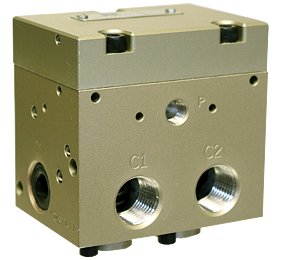




27 Series Pilot Operated Check Valves Safety Category. 1 PL c, Inline Mounted, with & without Pressure Relief
 Product Catalog
Installation Instructions
Product Catalog
Installation Instructions
- Poppet construction for near zero leakage
- Manual or remote trapped pressure release when pressure is removed from the Blowdown Signal Port (BP)
- Inline Mounting
27 Series Pilot Operated Check Valves Product Overview
Pilot Operated Check valves are used for load holding or cylinder position holding applications, designed to trap pressure in order to hold a cylinder in place when a safety event occurs. Pilot Operated Check valves can be used wherever a high-flow or remotely controlled checking function is needed. Can be used in a circuit to provide automatic stopping of a cylinder in the event of the loss of electrical or pneumatic power
Please refer to the side and below for links to easily navigate and download ROSS Controls 27 Series Pilot Operated Check Valves catalogs, installation instructions, and technical data. Additionally, you have the option to filter through all available options to 27 Series Pilot Operated Check Valves variant that meets your requirements.
loading...
loading...
Product Overview
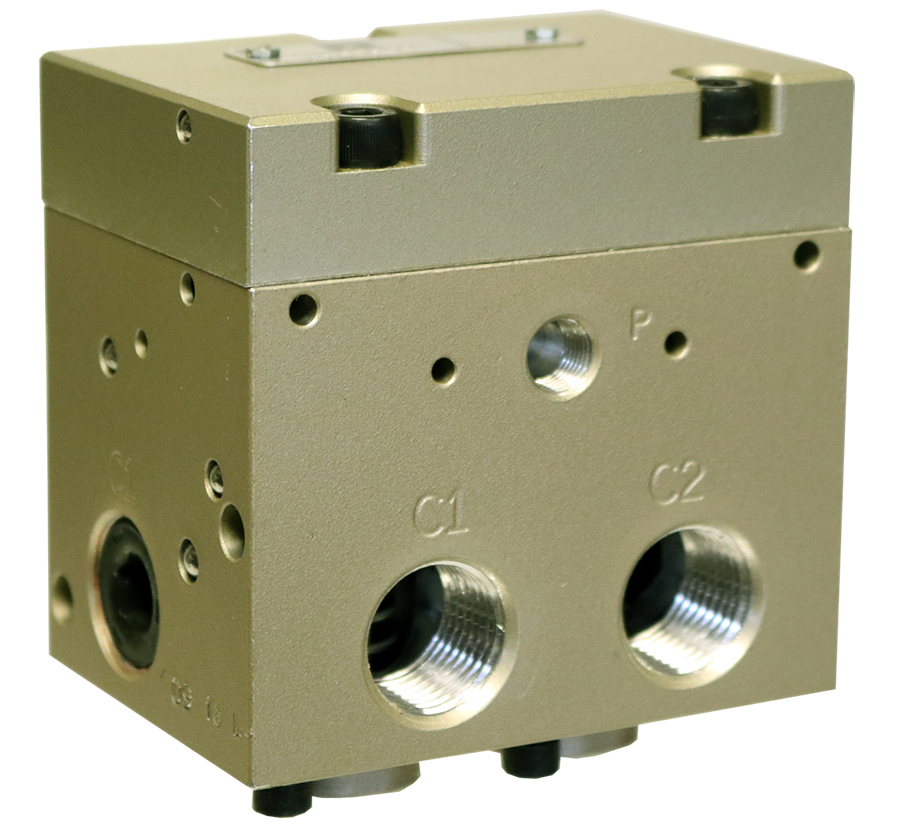
The ROSS Controls 27 Series Pilot Operated Check Valves are inline-mounted poppet valves designed for load holding and cylinder position holding applications in pneumatic safety circuits. These valves trap pressure in a cylinder or actuator to maintain position when a safety event occurs, including loss of electrical or pneumatic power. Pilot operated check valves can be used wherever a high-flow or remotely controlled checking function is needed, automatically stopping a cylinder in the event of control power loss.
The 27 Series uses a 2/2 pneumatic pilot operated check function. Air flows freely from port 1 to port 2 under normal supply conditions. When supply is removed, the poppet closes and traps pressure on the cylinder side (port 2), preventing return flow and maintaining cylinder position. To allow reverse flow from port 2 to port 1, a pneumatic pilot signal must be applied at the pilot port. This controlled release allows the cylinder to return to its home position in a deliberate, safe manner.
Two configurations are available: without pressure relief and with manual pressure relief. The manual or remote trapped pressure release variant incorporates a blowdown signal port (BP). When pressure is removed from the blowdown signal port, trapped cylinder pressure is released, enabling controlled lowering of loads or cylinder retraction without re-energizing the main control circuit. This feature is critical for lockout/tagout and maintenance procedures on vertically loaded cylinders.
Built on ROSS poppet technology, the cast aluminum valve body houses acetal and stainless steel poppet elements with Buna-N seals. The design delivers near-zero internal leakage, fast response, and high flow capacity relative to valve size. Operating pressure range is 30 to 150 psig (2 to 10 bar) with a temperature range of 40 to 175 F (4 to 80 C).
Key Engineering Features
- Poppet Construction for Near-Zero Leakage - Direct-seat poppet design provides near-zero internal leakage under load holding conditions, ensuring cylinder pressure is maintained without continuous air supply and without measurable cylinder drift over time.
- Inline Mounting - Inline body design installs directly in the pneumatic line between the directional control valve and the cylinder port, minimizing the volume of air between the valve and actuator and reducing response time.
- Manual or Remote Blowdown Pressure Release - The optional blowdown signal port (BP) allows trapped cylinder pressure to be released manually or remotely by removing pressure from the BP port. This enables safe lowering of gravity loads, cylinder retraction, and LOTO compliance without re-energizing the control valve.
- High Flow Capacity - Port sizes from 1/4" to 3/4" with flow up to 9.2 Cv (9,053 Nl/min) in the 3/4" body size, supporting high-flow cylinder circuits that require rapid extend and retract cycle times while still holding position safely.
- Category 1 PL c Safety Rating - Rated Safety Category 1, Performance Level c (PL c) per ISO 13849-1 and SIL 2 per IEC 61508/61511, based on the inherent reliability of the poppet design. Supports integration into safety circuits as a Category 1 safety function component.
- Automatic Stop on Power Loss - When electrical or pneumatic control power is lost, the pilot signal is removed and the poppet closes, automatically stopping cylinder motion and trapping pressure. No fail-safe spring or additional mechanism is required.
- Cast Aluminum Body - Lightweight cast aluminum construction provides corrosion resistance, strength, and low weight for panel and inline installations. The aluminum body dissipates heat effectively in high-cycle applications.
- ROSS Poppet Technology - Dirt-tolerant, wear-compensating poppet seats deliver consistent sealing performance across millions of cycles with minimal maintenance, reducing unplanned downtime in production environments.
- EAC Declaration of Conformity - EAC conformity declaration is included, supporting market access in the Eurasian Economic Union.
- SISTEMA Library Available - Downloadable SISTEMA library files support ISO 13849-1 safety function calculations to simplify safety circuit documentation and performance level verification.
Technical Specifications
General Specifications
| Parameter | Specification |
| Series | 27 |
| Valve Function | 2/2 Pneumatic Pilot Operated Check (PO Check) |
| Default State | Normally Closed (check active) |
| Construction | Poppet |
| Actuation | Pneumatic (pilot signal removes check function) |
| Mounting | Inline |
| Port Sizes Available | 1/4", 3/8", 1/2", 3/4" |
| Thread Types | NPT and G (BSPP) |
| Pressure Release Options | Without pressure release; Manual blowdown via BP port |
| Operating Pressure | 30 to 150 psig (2 to 10 bar) |
| Flow Media | Filtered Air |
| Valve Body Material | Cast Aluminum |
| Poppet Material | Acetal and Stainless Steel |
| Seal Material | Buna-N |
Temperature Ratings
Temperature ratings apply equally to ambient and media conditions for all 27 Series PO Check Valve variants.
| Configuration | Ambient Temperature | Media Temperature |
| All 27 Series PO Check Valve Variants (Buna-N seals) | 40 to 175 F (4 to 80 C) | 40 to 175 F (4 to 80 C) |
Flow Performance Data
Flow performance data for representative 27 Series port sizes. Both configurations (without pressure release and with manual blowdown) share the same flow data. All flow values are for the 1-2 (free-flow) direction; pilot-opened reverse flow capacity is equivalent.
| Model | Port Size | Ports 1-2 Flow | Length | Width | Height | Weight | Pressure Release |
| 2751A2908 | 1/4" NPT | 2.2 Cv (2,165 Nl/min) | 1.99 in (50.4 mm) | 1.50 in (38.1 mm) | 3.67 in (93.7 mm) | 2.3 lb (1.0 kg) | Not Included |
| 2751A3908 | 3/8" NPT | 2.9 Cv (2,854 Nl/min) | 1.99 in (50.4 mm) | 1.50 in (38.1 mm) | 3.69 in (93.7 mm) | 2.3 lb (1.0 kg) | Not Included |
| 2751A5919 | 3/4" NPT | 9.2 Cv (9,053 Nl/min) | 4.30 in (109.2 mm) | 2.20 in (55.9 mm) | 4.17 in (105.9 mm) | 2.9 lb (1.3 kg) | Manual Pressure Relief |
Certifications & Compliance
| Certification/Standard | Detail |
| Safety Category / PL Rating | Category 1, Performance Level c (PL c) per ISO 13849-1, reflecting the inherent reliability of the poppet construction for single-channel load holding applications. |
| Safety Integrity Level | SIL 2 per IEC 61508 and IEC 61511, based on the statistical B10D durability data and failure mode analysis of the 27 Series poppet design. |
| B10D Value | 20,000,000 cycles, providing the statistical basis for safety lifetime calculations in SISTEMA and other functional safety tools. |
| EAC Declaration | Yes - EAC conformity declaration included, supporting market access in the Eurasian Economic Union (Russia, Kazakhstan, Belarus, and partner states). |
| DGUV Certification | No - the 27 Series base PO Check Valve does not carry DGUV certification. For DGUV-required applications, refer to the SV27 Series with integrated DPST switch. |
| CE Certification | No CE marking on the 27 Series base product. For CE-marked load holding valves with switch feedback, refer to the SV27 Series. |
| CSA/UL Certification | No - not applicable for the 27 Series base pilot operated check valve. |
Typical Applications & Industries
Vertical Cylinder Load Holding
- Vertically mounted cylinders holding a gravity load such as die sets, press platens, lift tables, and work positioners where the 27 Series traps pneumatic energy to prevent uncontrolled descent when control air is removed.
- Clamp and fixture cylinders in welding, assembly, and machining operations that must maintain grip position during brief production interruptions, emergency stops, or operator access to the work zone.
- Pneumatic actuators on tilt tables, lift mechanisms, and industrial robots where cylinder position must be maintained in a safe state following an emergency stop command or control power loss.
Horizontal and Multi-Axis Cylinder Applications
- Horizontal cylinder circuits in forming presses, transfer mechanisms, and slide units where position drift due to seal leakage in the directional control valve would cause workpiece misregistration or machine damage.
- Multi-axis pneumatic positioning systems where each axis requires independent load holding to maintain workpiece position while other axes are in motion.
- Pneumatic clamping in body-in-white fixtures, assembly jigs, and test fixtures where clamping force must be sustained during the production dwell period without continuous air consumption.
Automated Manufacturing and Material Handling
- Packaging machinery including palletizers, case erectors, and stretch wrappers where stop-and-hold functions require reliable cylinder position maintenance between machine cycles.
- Material handling equipment including conveyors, diverters, stops, and gates where pneumatic actuators must hold position during queue buildups or machine stops without creeping under backpressure.
- Stamping and metal forming presses requiring anti-drift functions on binder cylinders and cushion cylinders where position accuracy directly affects part quality.
- Automotive assembly lines where dozens of pneumatic cylinders per station must hold position reliably during the body weld cycle, model changeover, or emergency stop events.
Safety Circuits and Energy Isolation
- Category 1 safety functions per ISO 13849-1 where the inherent reliability of the poppet check valve provides a passive safe-stop mechanism that does not require a control signal to hold position.
- LOTO-compatible circuits using the manual blowdown (BP port) variant, enabling controlled pressure release and cylinder retraction during lockout/tagout procedures without re-energizing the control circuit.
- Emergency stop circuits in pneumatic press lines, conveyor systems, and industrial robots where the 27 Series provides an automatic safe state upon removal of the pilot signal.
- Remote energy isolation for hard-to-reach or elevated cylinder installations where the blowdown port is connected to a ground-level manual control or solenoid valve for safe remote pressure release.
Ordering and Model Number Configuration
The 27 Series Pilot Operated Check Valve model number encodes the series, body size, port size, thread type, and pressure release option. Contact ROSS Controls at (800) 438-7677 or visit rosscontrols.com for the full configurator and current pricing.
|
27 Series PO Check Valve Model Number Structure:
2751 A 2 9 0 8 | | | Pressure Release / Port Option Code | Thread/Seal Code: 0 = Standard (NPT, Buna-N) | Pilot Port Configuration Code Port/Body Size Code: 2 = 1/4", 3 = 3/8", 5 = 3/4" Revision Level Series: 27 Series PO Check Valve
Prefix D (e.g., D2751A2908) = G (BSPP) thread variant |
Port/body size codes: 2 = 1/4" ports, 3 = 3/8" ports, 5 = 1/2" to 3/4" ports. Contact ROSS for the complete size matrix.
Thread type: Standard models use NPT threads. Add prefix 'D' for G (BSPP) thread variants.
Pressure release option: Models ending in '08' do not include a pressure release port. Models ending in '19' include the manual blowdown (BP) pressure release port.
All 27 Series PO Check Valve variants operate on filtered compressed air (Buna-N seals) rated for 30 to 150 psig (2 to 10 bar).
The 27 Series is available in sizes from 1/4" to 3/4" port. For applications requiring higher flow or monitored position feedback, refer to the SV27 Series.
27 Series PO Check Valve Example Model Numbers
| Model Number | Port Size | Thread | Pressure Release | Flow (Cv) |
| 2751A2908 | 1/4" | NPT | Not Included | 2.2 |
| 2751A3908 | 3/8" | NPT | Not Included | 2.9 |
| 2751A5919 | 3/4" | NPT | Manual (BP Port) | 9.2 |
| D2751A2908 | 1/4" | G (BSPP) | Not Included | 2.2 |
| D2751A3908 | 3/8" | G (BSPP) | Not Included | 2.9 |
Accessories
Exhaust Silencers
ROSS aluminum exhaust silencers are available for all 27 Series port sizes. Install silencers on exhaust ports to reduce pneumatic noise in high-cycle applications. Verify silencer flow capacity equals or exceeds the circuit exhaust flow requirements to avoid restricting blowdown or reverse pilot-opened flow.
Pressure Verification Accessories
Optional pressure verification port accessories are available for select 27 Series variants, including visual pressure indicators (pop-up pin confirmation) and electrical pressure switches preset at 5 psi falling edge. These provide additional confirmation that cylinder pressure has been released before operator access, supporting Category 2 application requirements when combined with control monitoring.
Related Products & Accessories
- 19 Series Pilot Operated Check Valves (1304) - Compact right-angle pilot operated check valves for Category 1 PL c load holding in small-bore, panel-mounted circuits with banjo or push-to-connect fittings. https://www.rosscontrols.com/en/series/1304-19-series-pilot-operated-check-valves
- SV27 Series PO Check Valves for External Monitoring (1306) - Pilot operated check valves with integrated DPST safety switch enabling Category 2 PL c load holding with position feedback and DGUV/CE certification. https://www.rosscontrols.com/en/series/1306-sv27-series-pilot-operated-check-valves-for-external-monitoring
- SV27 Series PO Redundant Check Valves (1307) - Redundant dual-channel pilot operated check valve assembly with DPST switch for Category 3 PL e load holding with external monitoring. https://www.rosscontrols.com/en/series/1307-sv27-series-pilot-operated-redundant-check-valves
- CC4 Series Double Valve (1303) - 4/3 closed-center double safety directional valve for bidirectional safe cylinder control and Category 4 PL e load holding. https://www.rosscontrols.com/en/series/1303-cc4-series-double-valve
- L-O-X Lockout Valves (Energy Isolation) - Lockout valves for safe energy isolation during maintenance per OSHA lockout/tagout requirements, complementing the load holding function of PO check valves. https://www.rosscontrols.com/en/series/1287-lockout-valves-15-series
Frequently Asked Questions (FAQ)
Q: What is the function of the 27 Series Pilot Operated Check Valve?
A: The 27 Series is a 2/2 normally closed pilot operated check valve. Air flows freely from port 1 to port 2 under normal supply conditions. When the supply signal is removed, the poppet closes and traps pressure on the cylinder side (port 2), holding the cylinder in position. To allow reverse flow (cylinder return), a pneumatic pilot signal must be applied. Without the pilot, the valve stays closed, providing passive load holding.
Q: What is the blowdown (BP) port and when should it be specified?
A: The blowdown signal port (BP) is a controlled pressure release mechanism available on select 27 Series variants. When pressure is removed from the BP port, the trapped cylinder pressure is released, allowing the cylinder to retract. Specify the BP port variant when: (1) the application requires manual or remote pressure release for LOTO procedures; (2) the load must be lowered in a controlled manner without re-energizing the control circuit; or (3) a remote safety valve or lockout mechanism is needed to release cylinder energy from a safe distance.
Q: What safety category and PL does the 27 Series achieve?
A: The 27 Series is rated Safety Category 1, Performance Level c (PL c) per ISO 13849-1 and SIL 2 per IEC 61508/61511. This rating is based on the inherent reliability of the poppet construction and the B10D value of 20,000,000 cycles. No external monitoring is integrated into the 27 Series base valve. For applications requiring Category 2 or higher with position feedback, specify the SV27 Series with DPST switch.
Q: What is the maximum operating pressure?
A: The 27 Series PO Check Valve is rated for 30 to 150 psig (2 to 10 bar) operating pressure. The minimum pressure requirement of 30 psig ensures reliable poppet actuation in both the check and pilot-opened directions. Do not operate below 30 psig, as insufficient pressure may result in incomplete or slow poppet shifting.
Q: What are the available port sizes?
A: The 27 Series is available in 1/4", 3/8", 1/2", and 3/4" port sizes with NPT or G (BSPP) thread options. The 3/4" port variant achieves a flow of 9.2 Cv (9,053 Nl/min). For larger port sizes or higher flow requirements, contact ROSS Controls.
Q: Can the 27 Series be used for both horizontal and vertical cylinder applications?
A: Yes. The 27 Series is suitable for both horizontal and vertical cylinder applications. For vertical cylinders holding gravity loads, the blowdown (BP port) pressure release variant is strongly recommended to enable safe lowering of the load during lockout/tagout without re-energizing the control circuit. For horizontal cylinders, either configuration may be used depending on whether remote pressure release is required.
Q: Does the 27 Series include CE or DGUV certification?
A: No. The 27 Series base PO Check Valve carries an EAC declaration of conformity but does not include CE or DGUV certification. For applications requiring CE marking or DGUV certification on the load-holding valve, specify the SV27 Series, which integrates a safety-rated DPST switch and carries CE, DGUV, and CSA/UL certification.
Q: What seal material is used in the 27 Series?
A: The 27 Series uses Buna-N seals as standard. The operating temperature range of 40 to 175 F (4 to 80 C) for both ambient and media conditions is based on this seal material. For applications outside this temperature range, contact ROSS Controls for alternative seal materials or product recommendations.
Q: How is the 27 Series installed in a load-holding circuit?
A: Install the 27 Series with port 1 connected to the directional control valve outlet (supply/exhaust circuit) and port 2 connected to the cylinder port. Connect the pilot port to the signal that commands cylinder return. When the directional control valve de-energizes, the pilot signal is removed, the poppet closes, and cylinder pressure is trapped, holding position. For BP port variants, connect the BP port to a manual or remote pressure release valve.
Q: What is the B10D value for the 27 Series?
A: The 27 Series has a B10D value of 20,000,000 cycles. This represents the number of cycles at which 10 percent of the population is statistically expected to experience a dangerous failure. This value is used in SISTEMA and similar tools to calculate MTTFD and validate safety performance level claims for Category 1 PL c applications.
Q: How does the 27 Series compare to the 19 Series PO Check Valve?
A: The 27 Series uses a cast aluminum inline body with higher flow capacity (up to 9.2 Cv vs. 1.3 Cv for the 19 Series) and a larger port size range (up to 3/4" vs. 3/8" for the 19 Series). The 27 Series also offers an optional blowdown pressure release port. The 19 Series uses a compact right-angle nickel-plated brass and aluminum body suited for panel mounting, push-to-connect fittings, and small-bore circuits. Both carry Category 1 PL c ratings.
Q: Is the 27 Series suitable for automatic stopping of a cylinder on power loss?
A: Yes. This is the primary safety function of the 27 Series. When electrical or pneumatic control power is lost, the pilot signal is removed automatically. The poppet closes under back pressure from the cylinder, trapping pressure and stopping cylinder motion without any active command. This passive fail-safe behavior is the basis for the Category 1 PL c safety rating.
Installation & Maintenance Guidelines
- Mount the 27 Series inline with port 1 connected to the directional control valve side and port 2 connected to the cylinder or actuator port. Reverse mounting will result in free flow in the unintended direction, eliminating the load-holding function.
- Position the valve as close to the cylinder port as possible to minimize the volume of trapped air between the valve seat and the cylinder. Larger trapped volumes allow greater cylinder drift before the pressure drop equalizes.
- Connect the pilot port to a pressure source that is reliably removed when load holding is required. For internal pilot configurations, this is typically the supply pressure line to the directional control valve. The poppet will not close if pilot pressure remains present at the pilot port.
- For BP port variants, connect the blowdown signal port to a manually operated valve or remote-controlled valve that is normally pressurized during machine operation. Removing pressure from the BP port releases trapped cylinder pressure in a controlled manner.
- Supply filtered compressed air at a minimum of 5-micron particle filtration. Contamination on the poppet seat will cause reduced load-holding performance and potential seat damage.
- Verify operating pressure is within the 30 to 150 psig (2 to 10 bar) range. Do not operate below 30 psig, as this may result in slow or incomplete poppet opening during the supply direction, causing slow cylinder extension.
- Ensure ambient and media temperature at the installation location is within 40 to 175 F (4 to 80 C). Buna-N seals may lose flexibility and leak-tightness outside this range.
- For vertical cylinder applications with gravity loads, confirm that the load-holding pressure required does not exceed the cylinder's effective bore area and available supply pressure. The 27 Series holds at supply pressure or residual trapped pressure, whichever is higher at time of closing.
- After installation, verify load-holding performance by pressurizing the cylinder, removing the control signal (and pilot pressure), and confirming that the cylinder holds position with no audible leakage. Any leak-by from port 2 indicates a seating problem.
- Perform a functional test of the pilot release: apply pilot pressure and confirm that the reverse direction opens as designed. Confirm pressure re-traps when pilot is removed. For BP port variants, test the blowdown function by depressurizing the BP port and confirming controlled pressure release.
- Inspect the valve at regular maintenance intervals for external seal integrity and body corrosion. Replace seals or the complete valve at first sign of external leakage to maintain load-holding reliability.
- For applications requiring Category 2 or higher safety performance with monitored position feedback, specify the SV27 Series with integrated DPST switch rather than the 27 Series base valve.
Warranty & Global Support
ROSS Controls provides a one-year warranty on all products, covering defects in material and workmanship from the date of purchase.
Global technical support is available through ROSS offices in the USA (headquarters in Ferndale, Michigan), Canada, Brazil, Germany, France, United Kingdom, India, China, and Japan.
Contact ROSS Controls USA at +1-248-764-1800 or toll-free at (800) 438-7677, or visit rosscontrols.com for product configuration, technical support, and distributor locator services.
For complete technical data, dimensional drawings, SISTEMA library files, and valve configurator access, visit the ROSS Controls 27 Series PO Check Valve product page at rosscontrols.com or contact ROSS at (800) 438-7677.
Download Catalog: https://www.rosscontrols.com/en/series/1305-27-series-pilot-operated-check-valves
Download Documents
27 Series Pilot Operated Check Valves