



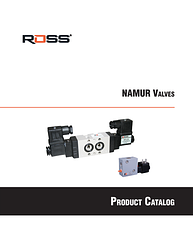
Download ROSS NAMUR 95 & 34 Series Directional Control Valves Catalog
What's Inside This Catalog
This comprehensive technical catalog provides complete documentation for ROSS Controls' NAMUR interface directional control valves, including the high-flow 95 Series and the compact 34 Series. Engineers, automation specialists, and maintenance professionals will find detailed specifications, dimensional drawings, performance data, and application guidelines to facilitate proper valve selection and implementation for pneumatic actuator control systems.
The catalog serves as an essential reference for designing and specifying NAMUR-compliant valve solutions in process automation, manufacturing, and industrial control applications where reliable, standardized actuator interfaces are required.
NAMUR 95 Series Valves
High-Flow Spool Valve Technology
The NAMUR 95 Series represents ROSS Controls' premium line of directional control valves designed for demanding pneumatic actuator applications. These compact, in-line ported valves feature resilient spool and sleeve construction that delivers exceptional durability and long service life in both lubricated and non-lubricated air service.
Key Features of 95 Series Valves:
- 5/2-Way Configuration: Provides complete directional control for double-acting pneumatic actuators with separate inlet, outlet, and exhaust ports
- High Flow Capacity: Average Cv of 1.3 enables rapid actuator response and efficient operation of larger actuators
- Fast Response Times: Solenoid pilot actuation ensures quick shifting for precise control applications
- Dual Voltage Options: Available in both 24 VDC and 110/120 VAC configurations to match various control system requirements
- Pressure Range: Operates reliably across 22.5 to 150 psig (1.5 to 10 bar), accommodating diverse system pressures
- Manual Override: Pushbutton, non-locking override allows manual operation during electrical failure or testing
- Compact Dimensions: Length options from 6.08 to 8.88 inches (154.5 to 225.5 mm) depending on configuration
- Lightweight Aluminum Construction: Valve body material minimizes weight while maintaining strength
- Corrosion-Resistant Internals: Stainless steel spool and Buna-N seals ensure long-term reliability
Technical Specifications Covered in Catalog:
The catalog provides detailed specifications for all 95 Series variants, including single solenoid (spring return) and double solenoid (detented) configurations. Complete dimensional drawings illustrate mounting interfaces, port locations, and envelope dimensions. Performance curves show flow characteristics across operating pressure ranges. Electrical specifications detail power consumption (2.5 watts DC, 5.5 VA AC), coil resistance, and connection types (EN 175301-803 Industrial Form B).
Application Guidelines:
The 95 Series excels in applications requiring high flow rates and fast response, including:
- Large rotary valve actuators in process control
- Automated ball valves and butterfly valves in water treatment
- Double-acting pneumatic cylinders in manufacturing automation
- Remote actuator control in oil and gas facilities
- Packaging machinery requiring rapid cycle times
NAMUR 34 Series Valves
Ball-Poppet Design for Demanding Environments
The NAMUR 34 Series introduces ROSS Controls' innovative ball-poppet technology, offering superior performance in harsh industrial environments where washdown procedures, contamination, and corrosive atmospheres present challenges for conventional spool valves.
Distinguishing Features of 34 Series Valves:
- Patented Ball-Poppet Internals: Virtually eliminates internal leakage through positive sealing technology
- Self-Cleaning Valve Seats: Maintains seal integrity throughout the valve's operational life without maintenance
- Duck-Bill Protected Exhaust: Unique exhaust port design prevents ingress of washdown fluids and contaminants
- Corrosion-Resistant Coating: Epoxy powder coat finish protects against chemical exposure and moisture
- Low Wattage Operation: Energy-efficient design consumes only 0.7 watts on DC power
- Faster, More Precise Shifting: Ball-poppet mechanism provides superior repeatability compared to spool designs
- 3/2 and 5/2 Configurations: Available in both normally closed 3/2 and 5/2 functions for versatile applications
- Compact Profile: Ultra-compact 2.18-inch (55.4 mm) length saves valuable installation space
- Operating Pressure: Reliable operation up to 116 psig (8 bar) for standard pneumatic systems
- Extended Temperature Range: Functions reliably from 4 to 122°F (-10 to 50°C)
Technical Documentation in Catalog:
The catalog provides comprehensive coverage of 34 Series specifications, including multiple connection options (EN 175301-803 Form A, M12 connector), thread types (NPT), and voltage variants (24 VDC, 110/120 VAC). Cross-sectional drawings illustrate the ball-poppet mechanism and exhaust protection features. Comparative performance data demonstrates advantages over traditional spool valves in contaminated environments.
Ideal Applications:
The 34 Series is specifically engineered for:
- Food and beverage processing with frequent washdown cycles
- Pharmaceutical manufacturing requiring sanitary conditions
- Chemical processing with corrosive atmospheres
- Outdoor installations exposed to weather and debris
- Marine and offshore applications in saltwater environments
- Wastewater treatment facilities with high contamination potential
NAMUR Interface Standards Compliance
VDI/VDE 3847 Standardization for Universal Compatibility
Both the ROSS 95 and 34 Series valves are manufactured to strict NAMUR interface standards as defined by VDI/VDE 3847, ensuring universal compatibility with pneumatic actuators from any manufacturer complying with this international specification.
Benefits of NAMUR Standardization:
The NAMUR (User Association of Automation Technology in Process Industries) interface standard revolutionizes valve-to-actuator mounting by establishing uniform dimensional requirements, port configurations, and fastening patterns. This standardization delivers significant advantages:
Simplified Installation and Replacement:
Direct mounting to actuator interfaces eliminates external tubing, brackets, and fittings. The standardized bolt pattern and port alignment enable quick installation and replacement without custom adapters or specialized tools. Maintenance personnel can swap valves in minutes rather than hours, dramatically reducing downtime during repairs or upgrades.
Reduced System Costs:
By eliminating piping runs, compression fittings, and support hardware between valve and actuator, NAMUR interfaces cut material costs and labor hours. The compact, integrated design also reduces the physical footprint of automated valve assemblies, saving valuable floor space in crowded industrial facilities.
Enhanced System Reliability:
Fewer connections mean fewer potential leak paths and failure points. The direct-mount configuration provides rigid support and protection from vibration, thermal cycling, and mechanical impacts. Enclosed air passages within the interface prevent contamination ingress that can degrade performance in traditional piped installations.
Universal Interchangeability:
Engineers can specify valves based on performance requirements rather than brand compatibility. Standardized interfaces enable multi-vendor sourcing strategies, competitive bidding, and simplified spare parts inventory. Actuators can be retrofitted with upgraded valve technology without mechanical modifications.
Catalog Coverage of Interface Standards:
The catalog includes detailed interface dimensional drawings conforming to VDI/VDE 3847 specifications for ¼-inch NAMUR interfaces. Port location diagrams show the standardized air duct positions (supply, exhaust) and bolt hole patterns. Mounting torque specifications and O-ring groove dimensions ensure proper sealing and secure attachment. Material specifications for interface components guarantee compatibility with a wide range of actuator body materials.
Product Selection and Sizing
Choosing the Right NAMUR Valve for Your Application
The catalog provides comprehensive selection guidance to ensure engineers specify the optimal valve configuration for specific application requirements. Key selection criteria include:
Flow Capacity Requirements:
- 95 Series (Cv 1.3): Suitable for larger actuators (>80 square inches piston area), high-speed cycling applications, and systems requiring maximum flow
- 34 Series (Cv 0.25): Ideal for compact actuators (<40 square inches), space-constrained installations, and applications where energy efficiency is prioritized
Valve Function Selection:
- 5/2 Single Solenoid (Spring Return): Provides fail-safe positioning when power is lost; actuator returns to default position via spring force
- 5/2 Double Solenoid (Detented): Maintains last position during power loss; enables energy-efficient operation by eliminating continuous power consumption
- 3/2 Normally Closed: Specialized function for specific actuator configurations and control schemes
Voltage and Power Considerations:
- 24 VDC Options: Integration with modern PLCs, distributed I/O systems, and low-voltage safety circuits
- 110/120 VAC Options: Direct connection to industrial AC power distribution without transformers
Environmental Factors:
- Standard 95 Series: General industrial environments with filtered air and moderate contamination
- 34 Series with Protective Features: Washdown areas, outdoor installations, corrosive atmospheres, marine environments
Performance Calculations:
The catalog includes formulas and tables for calculating actuator cycling times based on valve flow capacity, air pressure, actuator volume, and tubing lengths. Engineers can predict system response times and verify that selected valves meet speed requirements for process control loops, safety systems, and production machinery.
Technical Specifications Summary
Complete Performance Data for Both Series
The catalog consolidates critical technical specifications for rapid comparison and verification:
Physical Characteristics:
- Body Material: Aluminum alloy for corrosion resistance and weight reduction
- Spool/Poppet Material: Stainless steel for wear resistance and long service life
- Seal Material: Buna-N (Nitrile) elastomers for broad chemical compatibility
- Port Size: Fixed ¼-inch NPT or G thread connections
- Weight: 0.8 to 1.04 lb (0.36 to 0.47 kg) depending on configuration
Operating Parameters:
- Inlet Pressure Range: 22.5 to 150 psig (1.5 to 10 bar) for 95 Series; up to 116 psig (8 bar) for 34 Series
- Ambient Temperature: 41 to 140°F (5 to 60°C) for 95 Series; 4 to 122°F (-10 to 50°C) for 34 Series
- Media Temperature: Matches ambient ranges for both series
- Fluid Media: Filtered compressed air (lubricated or non-lubricated service)
Electrical Specifications:
- 24 VDC Models: 2.5 watts (95 Series), 0.7 watts (34 Series) continuous duty
- 110/120 VAC Models: 5.5 VA holding on 50/60 Hz operation
- Duty Rating: 100% continuous duty cycle for all configurations
- Connection Types: EN 175301-803 Industrial Form B (95 Series), EN 175301-803 Form A or M12 connector (34 Series)
- Pilot Supply: Internal pilot configuration uses line pressure; field convertible to external pilot if required
Performance Metrics:
- Average Flow Coefficient (Cv): 1.3 for 95 Series; 0.25 for 34 Series
- Response Time: Fast shifting enabled by solenoid pilot actuation
- Cycle Life: Millions of cycles with proper air filtration and maintenance
Installation and Maintenance Information
Proper Integration for Optimal Performance
The catalog includes detailed installation instructions, maintenance schedules, and troubleshooting guidance to ensure long-term reliability and performance:
Installation Requirements:
Air Quality Specifications:
Proper air preparation is critical for valve longevity. The catalog specifies filtration requirements (40-micron maximum particle size), recommended lubrication practices for lube service applications, and moisture removal guidelines to prevent corrosion and seal degradation.
Mounting Procedures:
Step-by-step instructions cover O-ring installation on valve interface surfaces, proper alignment with actuator NAMUR mounting flanges, fastener torque specifications to prevent over-tightening, and verification of air passage alignment. Detailed drawings illustrate correct orientation and positioning.
Electrical Connections:
Wiring diagrams show proper connection of solenoid coils, including polarity requirements for DC models, grounding practices, and integration with various industrial connector types. The catalog addresses voltage tolerance ranges, surge protection recommendations, and coil protection against reverse polarity.
System Integration:
Guidelines for integrating NAMUR valves with control systems include response time considerations for PLC programming, exhaust silencing options for noise reduction, and position sensing integration for closed-loop control applications.
Maintenance and Service:
Preventive Maintenance Schedule:
The catalog recommends inspection intervals based on operating hours and cycle counts, including visual inspection of external surfaces for damage or contamination, verification of electrical connections and indicator lights, manual override testing to confirm mechanical operation, and monitoring of exhaust air for abnormal noise or flow patterns.
Service Procedures:
When maintenance is required, detailed procedures cover safe depressurization and lockout/tagout protocols, disassembly and reassembly sequences with torque specifications, replacement part identification and ordering information, and testing procedures before return to service.
Troubleshooting Guide:
Common issues are systematically addressed with diagnostic steps and corrective actions, including valve fails to shift (check power supply, verify pressure at pilot port), slow or erratic operation (inspect for contamination, verify adequate flow capacity), and excessive internal leakage (inspect seals and seating surfaces).
Application Examples and Case Studies
Proven Performance Across Industries
The catalog demonstrates real-world applications where ROSS NAMUR valves provide reliable control:
Process Automation:
In chemical processing plants, ROSS 95 Series valves control large automated ball valves and butterfly valves that regulate product flows through reactors, distillation columns, and storage transfer systems. The high flow capacity enables rapid valve stroking to respond quickly to process upsets and maintain product quality. The NAMUR interface simplifies installation on actuators from multiple manufacturers, providing flexibility in valve selection.
Water and Wastewater Treatment:
Municipal water treatment facilities rely on ROSS 34 Series valves to control actuated valves in harsh environments with frequent washdown protocols. The duck-bill protected exhaust ports prevent water ingress during cleaning operations, while the corrosion-resistant epoxy coating withstands exposure to chlorine compounds and other treatment chemicals. The ball-poppet design ensures zero internal leakage, critical for maintaining process integrity.
Manufacturing and Packaging:
High-speed packaging lines utilize ROSS 95 Series double solenoid valves for rapid cycling of product handling mechanisms, material feed systems, and quality control gates. Fast response times synchronized with PLC control enable precise timing for product placement and handling. The continuous duty rating supports millions of cycles without performance degradation.
Oil and Gas Production:
Offshore platforms and remote well sites depend on ROSS NAMUR valves for automated control of process valves in hazardous locations. The explosion-proof configurations available through ROSS Controls' D20 Series NAMUR valves provide safe operation in classified areas. The robust construction withstands vibration, temperature extremes, and harsh weather conditions.
Food and Beverage Processing:
Dairy processing plants and beverage bottling facilities implement ROSS 34 Series valves on CIP (clean-in-place) systems and sanitary process valves. The self-cleaning ball-poppet internals maintain hygienic operation without buildup of product residues. The epoxy powder coat finish complies with food-grade material requirements and resists chemical cleaning agents.
Product Configurator and Ordering
How to Specify ROSS NAMUR Valves
The catalog includes a comprehensive model number decoder and configuration matrix to simplify valve selection and ordering:
Model Number Structure:
ROSS NAMUR valve model numbers follow a systematic format that conveys critical specifications:
- Series Designation: 95 or 34 prefix indicates valve family
- Function Code: Identifies valve function (5/2 single solenoid, 5/2 double solenoid, 3/2)
- Voltage Code: Specifies electrical configuration (W = 24 VDC, Z = 110/120 VAC)
- Thread Type: Indicates port connections (NPT, G thread)
- Connection Type: Defines electrical connector style
Example Model Numbers Explained:
- 9576K2902W: 95 Series, 5/2 double solenoid, 24 VDC, NPT threads, Industrial Form B connector
- 3473D1900Z: 34 Series, 3/2 single solenoid, 110/120 VAC, NPT threads, Form A connector
Configuration Selection Tools:
The catalog provides selection matrices organized by application requirements:
- By Actuator Size: Flow capacity recommendations based on piston area
- By Valve Function: Single vs. double solenoid selection based on fail-safe requirements
- By Environment: Standard vs. harsh environment recommendations
- By Control Voltage: DC vs. AC options aligned with control system architecture
Accessories and Options:
Complementary products detailed in the catalog include:
- Manual Override Extensions: For valves mounted in difficult-to-reach locations
- Position Indicators: Visual confirmation of valve state
- Explosion-Proof Enclosures: For hazardous location installations
- Mounting Brackets and Hardware: Fastener kits for secure installation
- Exhaust Silencers: Noise reduction devices for quiet operation requirements
Certifications and Compliance
Quality Standards and Regulatory Approvals
ROSS Controls manufactures NAMUR valves to international quality standards and obtains relevant industry certifications:
International Standards Compliance:
- VDI/VDE 3847: NAMUR interface dimensional standards for universal actuator compatibility
- ISO 9001: Quality management system certification ensuring consistent manufacturing processes
- CE Marking: European conformity for pressure equipment and electromagnetic compatibility
- RoHS Compliance: Restriction of hazardous substances in electrical components
Industry-Specific Approvals:
- CSA/UL: North American safety certifications for electrical components
- ATEX/IECEx: Explosion protection certifications for hazardous location applications (when specified)
- FM Approved: Factory Mutual approvals for fire protection and safety applications
Performance Testing:
All ROSS NAMUR valves undergo rigorous factory testing including:
- Pressure Testing: Verification of structural integrity at maximum rated pressure
- Leak Testing: Confirmation of seal integrity and internal leakage limits
- Electrical Testing: Coil resistance, insulation resistance, and dielectric strength verification
- Functional Testing: Operational verification across full pressure and voltage ranges
- Endurance Testing: Cycle testing to validate long-term reliability
The catalog documents testing methodologies and acceptance criteria, providing engineers with confidence in product quality and performance.
Comparison with Alternative Valve Technologies
Why NAMUR Interface Valves Excel
The catalog provides objective comparisons between NAMUR interface valves and alternative valve mounting approaches:
NAMUR vs. Manifold-Mounted Valves:
Manifold-mounted valve systems require extensive piping from centralized valve banks to distributed actuators. NAMUR direct mounting eliminates piping costs, pressure drops, and leak points. Response times improve dramatically when valves are co-located with actuators rather than remotely piped. Troubleshooting is simplified since each actuator has a dedicated, identifiable valve.
NAMUR vs. Solenoid Valves with Bracket Mounting:
Traditional bracket-mounted solenoid valves connected via tubing require custom brackets, support hardware, and flexible or rigid piping. NAMUR standardization eliminates these custom components, reducing bill-of-material complexity. The direct mounting provides superior vibration resistance compared to bracket-mounted alternatives.
NAMUR vs. Integrated Actuator Electronics:
Some actuator manufacturers offer integrated electronic controls within actuator housings. While compact, these integrated solutions create vendor lock-in and complicate obsolescence management. NAMUR valves provide flexibility to upgrade valve technology independently from actuators, extending system life and reducing total cost of ownership.
Sustainability and Total Cost of Ownership
Long-Term Value and Environmental Responsibility
The catalog addresses lifecycle considerations and environmental impact:
Energy Efficiency:
Low wattage consumption reduces electrical operating costs over millions of cycles. The 34 Series' 0.7-watt DC consumption represents significant energy savings compared to traditional higher-power solenoids. Double solenoid detented configurations eliminate continuous power consumption by maintaining position without current, further reducing energy usage.
Extended Service Life:
Durable construction materials and proven seal technology deliver years of maintenance-free operation. The 34 Series' self-cleaning ball-poppet design extends service intervals by preventing performance degradation from contamination. Stainless steel internals resist corrosion and wear, maintaining consistent performance throughout the product lifecycle.
Reduced Maintenance Costs:
Standardized NAMUR interfaces simplify spare parts inventory management across diverse actuator populations. Quick replacement capabilities minimize production downtime during repairs. Diagnostic features enable predictive maintenance approaches that prevent unexpected failures.
Environmental Considerations:
Aluminum valve bodies are fully recyclable at end-of-life. RoHS compliance eliminates hazardous materials from the waste stream. Reliable sealing prevents fugitive emissions in process applications. Energy efficiency reduces carbon footprint over operational lifetime.
Technical Support and Resources
Expert Assistance for Valve Selection and Application
ROSS Controls provides comprehensive support services to ensure successful valve implementation:
Engineering Support:
Experienced application engineers assist with:
- Valve selection and sizing calculations
- Custom configuration development for unique requirements
- Integration guidance for specific control systems
- Troubleshooting and problem resolution
Training and Education:
Technical training programs cover:
- NAMUR interface standards and specifications
- Installation best practices and common pitfalls
- Maintenance procedures and service techniques
- System design optimization for reliability and performance
Online Resources:
The ROSS Controls website offers:
- Interactive product selectors for rapid configuration
- CAD models in multiple formats (STEP, IGES, Solidworks)
- 3D PDF viewers for dimensional verification
- Installation video tutorials and animated assemblies
Global Distribution Network:
Authorized distributors worldwide provide:
- Local inventory for quick delivery
- Application expertise for regional industries
- After-sales support and warranty service
- Emergency replacement parts availability
Download Your Catalog Now
Instant Access to Complete NAMUR Valve Documentation
This comprehensive PDF catalog delivers all the technical information engineers need to specify, install, and maintain ROSS NAMUR 95 and 34 Series directional control valves. Download your copy today to access:
- Complete specifications for all valve configurations
- Dimensional drawings and interface details
- Performance curves and flow capacity data
- Installation instructions and maintenance guidelines
- Application examples and selection tools
- Model number decoder and ordering information
- CAD file references and technical support contacts
File Format: PDF (English)
File Size: Approximately 2-4 MB
Pages: Comprehensive multi-page technical catalog
Languages Available: English (additional languages available through regional ROSS Controls offices)
Related Documentation
Additional Resources for NAMUR Valve Applications
Complement this catalog with other ROSS Controls technical documentation:
Installation Instructions: Step-by-step guides specific to each model number with detailed assembly drawings and torque specifications
Technical Data Sheets: Single-page quick reference documents for individual valve models with key specifications and dimensions
Application White Papers: In-depth technical papers addressing NAMUR valve applications in specific industries and processes
Pneumatic Controls Catalog: Complete ROSS Controls product portfolio including safety valves, air preparation equipment, and complementary pneumatic components
Safety System Documentation: Information on integrating NAMUR valves with control-reliable safety systems for machine guarding and hazardous motion control
Frequently Asked Questions
Q: What is the NAMUR interface standard?
A: NAMUR (User Association of Automation Technology in Process Industries) defines standardized mounting interfaces (VDI/VDE 3847) for direct mounting of directional control valves to pneumatic actuators. The standard specifies dimensional requirements, port locations, and fastening patterns for universal compatibility across manufacturers.
Q: Can ROSS NAMUR valves be used with actuators from other manufacturers?
A: Yes. The standardized NAMUR interface ensures compatibility with any pneumatic actuator that complies with VDI/VDE 3847 specifications. This universality enables multi-vendor sourcing and simplifies retrofit applications.
Q: What is the difference between the 95 Series and 34 Series?
A: The 95 Series features spool valve construction with higher flow capacity (Cv 1.3), suited for larger actuators and high-speed applications. The 34 Series uses ball-poppet technology with protected exhaust ports, ideal for harsh environments, washdown areas, and applications requiring zero internal leakage. The 34 Series is more compact and energy-efficient.
Q: Are explosion-proof versions available?
A: Yes. ROSS Controls offers NAMUR valves with various explosion-proof certifications (ATEX, CSA, FM) through the D20 Series and other specialized product lines. Contact ROSS Controls for hazardous location applications requiring certified equipment.
Q: How do I calculate the correct valve size for my actuator?
A: The catalog provides sizing guidelines based on actuator piston area, required stroke speed, and system pressure. For the 95 Series (Cv 1.3), actuators above 80 square inches typically perform optimally. The 34 Series (Cv 0.25) serves compact actuators under 40 square inches. Contact ROSS application engineers for detailed sizing calculations.
Q: What maintenance is required for NAMUR valves?
A: ROSS NAMUR valves require minimal maintenance when proper air preparation (filtration, pressure regulation, lubrication if specified) is provided. Periodic visual inspections, manual override testing, and verification of electrical connections constitute standard preventive maintenance. The 34 Series ball-poppet design is self-cleaning and extends service intervals.
Q: Can these valves operate in outdoor installations?
A: The 34 Series with epoxy powder coat and duck-bill protected exhaust is specifically designed for outdoor installations and harsh environments. The 95 Series can be used outdoors when protected from direct weather exposure. Both series tolerate specified temperature ranges; consult catalog for ambient temperature limits.
Q: What electrical connections are available?
A: Multiple options are available: EN 175301-803 Industrial Form A and Form B connectors (DIN connectors), M12 circular connectors for industrial networking, and conduit-ready configurations. The catalog details connector types for each model number.
Conclusion
The ROSS NAMUR 95 & 34 Series Directional Control Valves catalog represents a comprehensive technical resource for engineers and automation professionals specifying pneumatic actuator control solutions. By combining detailed technical specifications, application guidelines, and practical installation instructions, this catalog enables confident product selection and successful system integration.
Whether your application demands high flow capacity for rapid cycling, corrosion resistance for harsh environments, or energy-efficient operation for sustainability goals, the ROSS NAMUR valve family delivers proven performance backed by decades of engineering excellence and manufacturing quality.
Download the complete catalog today to access the full depth of technical information and begin your valve selection process with confidence. For additional assistance, contact ROSS Controls technical support or authorized distributors who can provide application-specific guidance and recommendations tailored to your unique requirements.