




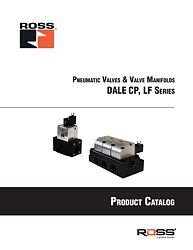
ROSS Dale Series Directional Control Valves: CP & LF Product Catalog
Overview of ROSS Dale Series Base-Mounted Poppet Valves
The ROSS Dale Series CP (Standard Pressure) and LF (Low Flow) directional control valves represent industry-leading pneumatic poppet valve technology designed for high-performance applications across manufacturing, assembly, test systems, and process automation. This comprehensive catalog provides complete technical specifications, dimensional data, installation instructions, and selection criteria for engineers, maintenance professionals, and system integrators requiring reliable, high-flow directional control solutions.
Dale Series CP & LF: Core Features and Engineering Advantages
Advanced Poppet Valve Technology
The Dale Series CP and LF valves utilize ROSS's proven poppet valve design, delivering significant performance advantages over traditional spool or diaphragm valves. The poppet construction features carefully calculated surface areas on the piston poppet, exhaust poppet, and inlet poppet, producing powerful shifting and sealing forces in both flow directions. This engineering approach ensures:
Positive Sealing Performance: Unlike sliding seal designs, ROSS poppet valves achieve bubble-tight sealing without sliding action, preventing seal damage and premature wear. The metal-to-elastomer sealing interface creates virtually leak-proof performance essential for vacuum applications, leak testing systems, and process control where even minor leakage compromises system performance.
Self-Cleaning and Dirt Tolerant Operation: The poppet design creates high velocity flow across the seal and seat during valve actuation, automatically purging contaminants, debris, and particulates from the sealing surfaces. This self-cleaning characteristic makes Dale Series valves ideal for harsh industrial environments including steel mills, pulp and paper processing, industrial minerals handling, and applications with contaminated air supplies.
Repeatability Over Valve Life: The poppet valve's self-compensating design automatically adjusts stroke length as seals experience normal burnishing wear. This unique feature maintains consistent valve performance, response time, and flow characteristics throughout the valve's operational life, often exceeding 20 million cycles in standard applications.
High-Speed Shifting: Optimized poppet surface areas generate strong actuation forces, enabling rapid valve transitions. This high-speed shifting capability reduces cycle times in assembly operations, pick-and-place systems, material handling equipment, and automation processes where milliseconds impact productivity.
Port Pressure Independence
A revolutionary design feature of Dale Series CP and LF valves is their port pressure independence, allowing pressure or vacuum to be applied to any port at any time without affecting valve operation. This capability provides unprecedented design flexibility for engineers configuring complex pneumatic circuits, enabling:
- Multi-pressure level applications on common manifolds
- Vacuum and positive pressure on the same valve system
- Simplified circuit design eliminating check valves and complex piping
- Bi-directional flow capability for versatile system configurations
Dale Series CP Valves: Standard Pressure Applications
Technical Specifications and Port Size Range
The Dale Series CP (Standard Pressure) valves are engineered for general industrial pneumatic applications operating from vacuum through 145 psig (10 bar). The CP Series provides exceptional flow capacity in a compact base-mounted package.
2-Way Valve Configurations:
- Port Sizes: 3/8" through 2-1/2" (NPT or G thread options)
- Flow Capacity (Cv Range): 3.5 to 108
- Functions Available: Normally Closed (NC) and Normally Open (NO)
- Actuation Options: Single solenoid pilot or remote pressure control
- Return Mechanism: Spring-assisted air return for reliable fail-safe operation
3-Way Valve Configurations:
- Port Sizes: 1/2" through 1" (NPT or G thread options)
- Flow Capacity (Cv Range): 3.2 to 12.3
- Functions: 3/2 normally closed configurations
- Applications: Directional control, exhaust management, circuit switching
CP Series Applications and Industry Uses
The Dale Series CP valves excel in diverse industrial applications:
- Assembly and Test Systems: High-speed actuation for pick-and-place operations, part positioning, clamping fixtures, and automated assembly stations
- Material Handling: Pneumatic conveying, diverter gates, product sorting, and transfer mechanisms
- Packaging Equipment: Form-fill-seal machinery, carton forming, product ejection, and labeling systems
- General Automation: Machine tool air circuits, actuator control, pneumatic logic, and process sequencing
- Steel and Metal Processing: Stamping press auxiliary functions, coil handling, material positioning (non-safety applications)
Construction and Materials
Valve Body: Cast aluminum construction provides corrosion resistance, light weight, and excellent heat dissipation
Poppet/Spool Materials: Acetal and stainless steel components ensure durability and chemical compatibility
Seal Materials: Buna-N (Nitrile) elastomer seals standard, providing excellent performance with filtered compressed air and compatibility with petroleum-based lubricants
Connection Options: EN 175301-803 Form A or Form C electrical connections for easy solenoid integration
Operating Parameters
- Operating Pressure Range: Vacuum to 145 psig (vacuum to 10 bar)
- Minimum Pilot Supply: Equal to or greater than inlet pressure for reliable actuation
- Fluid Media: Filtered compressed air (40-micron filtration recommended)
- Ambient Temperature Range: 40°F to 120°F (4°C to 50°C)
- Media Temperature Range: 40°F to 175°F (4°C to 80°C)
- Duty Rating: Continuous duty for extended operation without thermal degradation
Electrical Specifications
Standard Voltage Options:
- 24 VDC (most common in modern automation systems)
- 110/120 VAC, 50/60 Hz (legacy systems and North American industrial standard)
Power Consumption:
- Small valve solenoids (1/2" to 1"): 1.5 watts nominal
- Large valve solenoids (1-1/4" to 2-1/2"): 5.8 watts nominal, 6.5 watts maximum
Pilot Configuration:
- Internal pilot supply (standard): Uses main inlet pressure for pilot actuation
- External pilot supply (convertible): Field-convertible by removing port X-1 plug and connecting independent pilot air supply
Dale Series LF Valves: Low Flow and Compact Applications
LF Series Design Philosophy
The Dale Series LF (Low Flow) valves provide the same advanced poppet technology as CP Series valves but optimized for applications requiring more compact dimensions and moderate flow rates. The LF Series maintains all core Dale Series benefits—positive sealing, self-cleaning operation, dirt tolerance, and repeatability—in a smaller footprint ideal for space-constrained installations.
LF Technical Specifications
2-Way Valve Configurations:
- Port Sizes: 3/8" through 1" (NPT or G thread options)
- Flow Capacity (Cv Range): 3.6 to 62.7
- Compact Dimensions: Significantly smaller than CP Series equivalents
- Weight Advantage: 1.5 to 10 lbs depending on valve size
- Mounting: Base-mounted configuration with through-hole manifold capability
3-Way Valve Configurations:
- Port Sizes: 1/2" through 1"
- Functions: Directional control with integrated exhaust
- Exhaust Port: Integrated muffler ports reduce noise
LF Series Typical Applications
- OEM Equipment: Space-efficient pneumatic control for compact machinery
- Medical Equipment: Clean, reliable valve operation for medical device manufacturing
- Laboratory Automation: Precise pneumatic control for analytical instruments
- Food and Beverage: Compact valves for packaging and filling equipment
- Electronics Manufacturing: Pick-and-place systems, component testing, and precision assembly
Performance Characteristics
- Response Time: Rapid actuation suitable for high-cycle operations
- Minimum Operating Pressure: 30 psig (2 bar) for standard configurations
- Maximum Operating Pressure: 145 psig (10 bar)
- Cycle Life: 20+ million cycles under normal operating conditions
- Manual Override: Locking or non-locking manual actuation options
Manifold Configurations and Custom Assemblies
Inline and Manifold Mounting Flexibility
One of the most significant advantages of Dale Series CP and LF valves is their versatile mounting capability. Engineers can specify:
Individual Valve Installation:
- Standalone base-mounted valves with threaded port connections
- Direct piping to actuators, process equipment, or distribution systems
- Ideal for retrofit applications and distributed control architectures
Manifold Base Assemblies:
- Multiple valves configured on common manifold bases
- Through-hole porting eliminates external piping and fittings
- Reduces potential leak paths and improves system energy efficiency
- Compact installation saves valuable machine space
- Pre-plumbed assemblies reduce installation time and labor costs
Custom Manifold Solutions
ROSS Controls provides custom manifold assemblies tailored to specific application requirements. Engineers can specify:
- Mixed Function Manifolds: Combine normally open, normally closed, 2-way, and 3-way valves on a single manifold base
- Station Count: From single-station to 10+ station manifolds
- Pressure Zones: Multiple pressure levels on common manifolds leveraging port pressure independence
- Electrical Integration: Grouped or individual solenoid connections with customer-specified connector configurations
Manifold Applications and Benefits
Channel Select Leak Testing: Dale manifolds enable simultaneous testing of multiple parts or multiple chambers within single parts. Eliminating inter-valve piping reduces system volume, improving leak test sensitivity and reducing cycle time.
Bypass Fill and Exhaust: High-flow CP Series valves on manifolds provide rapid cylinder filling and exhaust while protecting sensitive downstream equipment from contamination. This configuration is common in foundry applications where sand and metal particulates threaten precision leak test equipment.
Vacuum Pick and Place: Manifold-mounted Dale valves control multiple vacuum grippers from a centralized supply, reducing plumbing complexity and providing independent control of each pick point for flexible material handling systems.
Vacuum and Specialized Applications
Dale Series Performance in Vacuum Systems
The Dale Series CP and LF valves' positive sealing and port pressure independence make them exceptional choices for vacuum applications. The poppet design maintains sealing integrity under vacuum conditions where spool valves may experience leakage due to seal geometry limitations.
Vacuum Application Advantages:
- Operating range from full vacuum (29.9" Hg) to 145 psig
- Bi-directional flow allows vacuum on any port
- Self-cleaning operation prevents vacuum circuit contamination
- Rapid switching for quick vacuum generation and release
Common Vacuum Applications:
- Pick-and-place systems in electronics and light assembly
- Vacuum forming in plastics and packaging
- Material transport in pharmaceutical and food processing
- Part holding during machining and assembly operations
- Vacuum test and verification systems
Leak Test and Quality Control Applications
Dale Series LT (Leak Test) configurations provide additional features optimized for precision leak testing:
- Bubble-Tight Sealing: Exceeds standard industrial leak rates
- Sensor Ports: Integrated pressure verification ports for switch or transducer mounting
- Low Internal Volume: Minimizes dead space for sensitive leak detection
- Rapid Response: Quick pressurization and de-pressurization for high-throughput testing
Installation Guidelines and Best Practices
Pre-Installation Requirements
Air Line Preparation:
Prior to valve installation in new or existing pneumatic systems, compressed air lines must be thoroughly purged of all contaminants including pipe scale, cutting oils, welding debris, and particulate matter. Even with Dale Series' exceptional dirt tolerance, proper air preparation extends valve life and maintains peak performance.
Filtration Requirements:
Install a high-quality air filter in the inlet line close to the valve. ROSS recommends 40-micron filtration with automatic drain for industrial applications. In particularly contaminated environments or critical applications, consider 5-micron filtration with coalescent technology to remove oil aerosols.
Air Quality Standards:
Follow ISO 8573-1 air quality recommendations:
- Particle size: Class 6 or better (40-micron maximum)
- Pressure dew point: Class 4 or better (-40°C under pressure)
- Oil content: Class 5 or better (25 mg/m³ maximum)
Installation Best Practices
Valve Inlet Configuration (Port 1):
Ensure supply lines are adequately sized and do not restrict airflow due to crimps, sharp bends, or undersized fittings. Supply line restrictions cause:
- Reduced valve actuation force
- Slower response times
- Inconsistent cylinder operation
- Reduced flow capacity below published Cv ratings
Minimum recommended supply line size equals valve port size. For long supply runs (>20 feet), increase line size one increment to compensate for pressure drop.
Valve Outlet Configuration (Port 2):
Position valves as close as practical to controlled actuators or equipment. This minimizes volume between valve and actuator, improving:
- System response time
- Pressure rise/decay rates
- Energy efficiency
- Control precision
Outlet lines must be adequately sized and free of crimps, sharp bends, and restrictions. Use flexible hose or tube to accommodate vibration and movement in automated equipment.
Valve Exhaust Management (Port 3):
Do not restrict airflow from exhaust ports, as exhaust restriction adversely affects valve operation, causing:
- Slower valve response
- Incomplete poppet shifting
- Reduced flow capacity
- Potential valve malfunction
Noise Control: To reduce exhaust noise without restricting flow, install efficient ROSS silencers. ROSS silencers reduce exhaust noise by 25 dB while maintaining minimal back pressure, preserving valve performance.
Electrical Installation
Voltage Verification:
Solenoid voltage and frequency ratings are marked on pilot housings. Electrical supply must precisely match these ratings. Incorrect voltage causes:
- Under-voltage: Weak or failed actuation, coil overheating, shortened coil life
- Over-voltage: Excessive coil current, rapid coil failure, potential fire hazard
Power Supply Capacity:
Ensure power supplies can deliver maximum rated wattage for all solenoids. Consider:
- Inrush current during solenoid energization
- Simultaneous actuation of multiple valves
- Power supply voltage regulation under load
- Wire gauge and voltage drop over distance
Electrical Protection:
Implement proper circuit protection:
- Fuse or circuit breaker sizing per electrical code
- Surge suppression for inductive load protection
- Proper grounding to prevent electrical noise and ensure safety
Conduit and Connection:
Use appropriate conduit and connectors meeting industrial standards (IP65/IP67 for wet environments). Ensure DIN connectors are fully seated and locked to prevent intermittent connections.
Maintenance and Service
Preventive Maintenance Schedule
Routine Inspections (Quarterly):
- Verify valve response and actuation
- Check for air leakage at ports and connections
- Inspect electrical connections for tightness and corrosion
- Monitor exhaust ports for contamination or blockage
- Verify system pressure and pilot supply adequacy
Annual Service:
- Replace air filters and drain moisture
- Inspect valve body for damage or wear
- Test manual overrides for proper operation
- Document valve performance for trend analysis
- Review system modifications affecting valve operation
Valve Reconditioning
Dale Series CP and LF valves feature serviceable construction allowing complete reconditioning. ROSS offers comprehensive valve body kits including:
- Replacement poppets and seals
- Spindles and springs
- Gaskets and O-rings
- Detailed reconditioning instructions
Reconditioning Benefits:
- Restore like-new performance
- Cost-effective alternative to replacement
- Minimize downtime with advance kit stocking
- Extend valve service life beyond 20 million cycles
When to Recondition:
- Noticeable response time degradation
- Increased air leakage
- Inconsistent actuator performance
- After 5-10 years of continuous service (depending on cycle rate)
Technical Specifications Summary
Dale Series CP Specifications
| Parameter | Specification |
| Valve Type | Base-mounted poppet directional control |
| Port Sizes (2-way) | 3/8" to 2-1/2" |
| Port Sizes (3-way) | 1/2" to 1" |
| Flow Capacity (Cv) | 3.5 to 108 |
| Operating Pressure | Vacuum to 145 psig (10 bar) |
| Fluid Media | Filtered compressed air |
| Ambient Temperature | 40°F to 120°F (4°C to 50°C) |
| Media Temperature | 40°F to 175°F (4°C to 80°C) |
| Voltage Options | 24 VDC, 110/120 VAC 50/60 Hz |
| Power Consumption | 1.5 to 6.5 watts |
| Mounting | Base-mounted with manifold capability |
| Thread Types | NPT or G (BSPP) |
| Construction | Cast aluminum body, acetal/stainless poppets |
| Seals | Buna-N (Nitrile) |
| Manual Override | Locking or non-locking |
| Duty Rating | Continuous duty |
| Cycle Life | 20+ million cycles |
Dale Series LF Specifications
| Parameter | Specification |
| Valve Type | Compact base-mounted poppet control |
| Port Sizes (2-way) | 3/8" to 1" |
| Port Sizes (3-way) | 1/2" to 1" |
| Flow Capacity (Cv) | 3.6 to 62.7 |
| Operating Pressure | Vacuum to 145 psig (10 bar) |
| Minimum Operating Pressure | 30 psig (2 bar) standard |
| Weight Range | 1.5 to 10 lbs |
| Compact Design | Reduced footprint vs. CP Series |
Catalog Contents Overview
This comprehensive technical catalog includes:
Section 1: Product Overview and Selection
- Dale Series valve family introduction
- Technology advantages and competitive differentiators
- Application selection criteria
- CP vs. LF series comparison
Section 2: CP Series 2-Way Valves
- Complete model number matrix
- Port size specifications (3/8" through 2-1/2")
- Normally closed and normally open configurations
- Dimensional drawings with envelope dimensions
- Cv ratings for all port sizes
- Weight specifications
- Mounting hole patterns
Section 3: CP Series 3-Way Valves
- Model identification system
- Port configurations and flow paths
- Application examples
- Dimensional data
Section 4: LF Series Valves
- Complete LF product range
- Compact design specifications
- Installation dimensions
- Performance data
Section 5: Manifold Assemblies
- Manifold base configurations
- Station count options (single to 10+ stations)
- Custom manifold configurator guide
- Manifold dimensional drawings
- Electrical connection options
- Port plate specifications
Section 6: Accessories and Options
- Manual override variations
- Electrical connector types
- Mufflers and silencers
- Pressure switches and sensors
- Mounting hardware
- Reconditioning kits
Section 7: Technical Data
- Flow curves and Cv calculations
- Response time data
- Power consumption charts
- Temperature derating curves
- Material compatibility tables
Section 8: Installation Instructions
- Step-by-step installation procedures
- Torque specifications
- Air line sizing guidelines
- Electrical connection procedures
- System commissioning checklist
Section 9: Maintenance and Service
- Troubleshooting guide
- Preventive maintenance schedules
- Reconditioning procedures
- Parts identification diagrams
- Service kit ordering information
Section 10: Application Examples
- Typical circuit diagrams
- Multi-valve system configurations
- Vacuum system layouts
- Leak test system designs
- Problem-solving application notes
Why Choose ROSS Dale Series Valves
Industry-Leading Performance
ROSS Controls has manufactured pneumatic valves since 1921 and acquired Dale Industrial in 2009 to expand poppet valve capabilities into high-flow, leak test, and process applications. The Dale Series represents over a century of valve engineering expertise focused on:
- Reliability in harsh environments
- Exceptional dirt tolerance
- Long service life exceeding competitive products
- Consistent performance over millions of cycles
Application Engineering Support
ROSS provides comprehensive application engineering assistance including:
- Custom manifold design and configuration
- System flow analysis and optimization
- Valve selection for specific application requirements
- Integration with control systems and automation platforms
- On-site technical support and training
Global Availability and Support
With facilities in North America, Europe, Asia, and South America, ROSS provides local support with global resources:
- Fast delivery from regional distribution centers
- Local application engineers speaking native languages
- Worldwide service network for maintenance and repairs
- 24/7 technical support for critical applications
Quality and Standards Compliance
Dale Series valves meet international quality and safety standards:
- ISO 9001 certified manufacturing
- CE marking for European Union compliance
- RoHS compliant materials and construction
- Designed and manufactured to exceed ANSI, ISO, and industry-specific standards
Industries Served
Dale Series CP and LF valves provide reliable pneumatic control across diverse industries:
Automotive Manufacturing
High-speed assembly lines, welding fixtures, paint systems, parts testing, final assembly automation
Packaging and Labeling
Form-fill-seal machinery, carton erectors, case packers, palletizers, shrink wrap equipment, labeling systems
Food and Beverage Processing
Filling equipment, capping machines, conveyor systems, packaging lines, quality control testing
Pharmaceutical and Medical Device
Clean room automation, tablet pressing, packaging, sterilization equipment, assembly automation
Electronics Manufacturing
PCB handling, component placement, testing equipment, clean room systems, semiconductor processing
Steel and Metal Processing
Coil handling, stamping press auxiliary circuits, material positioning, parts transfer, testing equipment
Pulp and Paper
Process control, material handling, testing systems, packaging equipment, quality control automation
Plastics and Rubber
Injection molding auxiliaries, blow molding systems, thermoforming equipment, material handling
Environmental and Safety Considerations
Energy Efficiency
Dale Series valves contribute to sustainable manufacturing:
- Low Power Consumption: Minimal electrical energy usage (1.5-6.5 watts)
- Efficient Flow Design: High Cv ratings minimize pressure drop and compressed air consumption
- Leak-Tight Construction: Virtually zero internal leakage conserves compressed air
- Manifold Integration: Eliminates piping reducing system volume and air waste
Safety Features
- Manual Override: Allows safe manual actuation during maintenance or emergency situations
- Positive Sealing: Prevents unintended actuator motion due to valve leakage
- Fail-Safe Options: Spring return configurations provide predictable failure mode
- Lockout Compatibility: Facilitates proper lockout/tagout procedures during maintenance
Important Safety Note: Dale Series CP, CX, LF, and LX valves are not designed as control valves for air clutch/brake mechanisms on mechanical power presses and must not be installed for such safety-critical applications. Only double valves conforming to OSHA standards (such as ROSS DM2 Series) should be used for press safety control.
Ordering Information
Model Number Structure
Dale Series valves use a systematic model numbering system encoding:
- Valve series (CP or LF)
- Port size
- Thread type (N=NPT, D=G/BSPP)
- Mounting configuration (B=Base mount)
- Function (2-way NC, 2-way NO, 3-way NC)
- Pilot type
- Station count (for manifolds)
- Voltage designation
- Connection type
Example: CP16DB67101W
- CP = CP Series
- 16 = 1" port size
- D = G/BSPP threads
- B = Base mounted
- 6 = Function code
- 7 = Pilot configuration
- 101 = Single station
- W = 24 VDC
How to Order
- Identify Application Requirements: Operating pressure, flow rate, cycle time, environment
- Select Valve Series: CP (standard pressure, high flow) or LF (compact, moderate flow)
- Determine Port Size: Based on required Cv and actuator requirements
- Choose Configuration: 2-way NC, 2-way NO, or 3-way NC
- Specify Electrical: Voltage (24 VDC or 110/120 VAC) and connection type
- Select Manifold Option: Individual valve or manifold assembly with station count
Contact ROSS Controls or authorized distributors for:
- Application engineering assistance
- Custom manifold quotes
- Delivery information
- Pricing and lead times
Technical Resources and Support
Download Additional Resources
- Installation Instructions: Detailed step-by-step procedures (Document SS050)
- Maintenance Manual: Service procedures and reconditioning guidelines
- CAD Models: 3D models in STEP, IGES, and SolidWorks formats
- Electrical Schematics: Control circuit examples and wiring diagrams
- Flow Data: Detailed Cv curves and sizing calculations
Application Engineering Contact
ROSS Controls Application Engineering Team:
- Phone: (800) 438-7677 (North America)
- Email: applications@rosscontrols.com
- Website: www.rosscontrols.com
- Technical Support: Available 24/7 for critical applications
Training and Education
ROSS offers comprehensive pneumatic valve training:
- On-site training programs
- Webinar series on valve technology
- Maintenance certification programs
- Application engineering workshops
Conclusion
The ROSS Dale Series CP and LF directional control valves deliver unmatched performance, reliability, and versatility for pneumatic control applications. This comprehensive catalog provides the technical specifications, dimensional data, and application guidance engineers need to select, install, and maintain these industry-leading poppet valves.
From compact LF Series valves for space-constrained OEM equipment to high-flow CP Series manifolds handling demanding industrial automation, the Dale Series family offers solutions for virtually any pneumatic directional control requirement. The combination of positive sealing, self-cleaning operation, dirt tolerance, and exceptional cycle life makes Dale Series valves the preferred choice for engineers who demand reliable performance in challenging applications.
Download this complete catalog to access detailed specifications, dimensional drawings, model selection matrices, and application examples. ROSS Controls' application engineering team stands ready to assist with valve selection, custom manifold design, and system optimization for your specific requirements.
Experience the ROSS Difference: Over a century of pneumatic valve innovation, proven poppet valve technology, and unwavering commitment to customer success.