




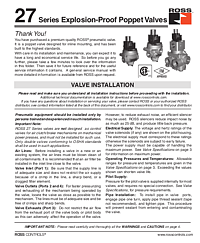
27 Series Explosion-Proof Poppet Valves Installation & Operating Instructions
Overview
ROSS Controls, founded in 1921 with over 100 years of leadership in fluid power, offers the 27 Series Explosion-Proof Poppet Valves as premium-quality directional control valves with encapsulated solenoids rated for use in hazardous classified electrical locations. Built with poppet internals for positive sealing and reliable actuation, the 27 Series is designed for inline mounting and provides valve functions in 2/2, 3/2, and 4/2-way configurations, both normally closed and normally open.
The 27 Series carries explosion-proof approvals per CSA and FM certification, covering Class I Division 1 Groups A, B, C, and D; Class II Groups E, F, and G; Class III; and Class I Division 2. The Ex m II T4 encapsulation method seals solenoid windings in a compound that prevents ignition of surrounding explosive atmospheres. Specifications conform to multiple CSA and FM standards including CLASS 2258 02, FM CLASS 3600, 3611, 3615, and 3810.
IMPORTANT: 27 Series valves are not designed as control valves for air clutch/brake mechanisms on mechanical power presses. Only double valves conforming to OSHA standards shall be used in such applications. For support, contact ROSS at 1-800-GET-ROSS or www.rosscontrols.com.
Key Features
Comprehensive Explosion-Proof Approvals
CSA certificate specifications: Class I, Division 1, Groups A, B, C, and D; Class II, Groups E, F, and G; Class III; Class I, Division 2, Groups A, B, C, D. FM certificate specifications: Explosion-proof Class I, Division 1, Groups A, B, C, D, T4, Ta=60°C; Encapsulation/explosion-proof Class I, Zone 1, AEx m II T4, Ta=60°C; Dust-ignition-proof for Class II/III, Division 1, Groups E, F, G, T4, Ta=60°C; Nonincendive Class I, Division 2, Groups A, B, C, D, T4, Ta=60°C; Suitable Class II, III, Division 2 E, F, G, T4, Ta=60°C. Applicable standards include C22.2 No. 0-10, CSA C22.2 No. 25-1966, CSA C22.2 No. 142-M1987, C22.2 No. 213-M1987, CAN/CSA E79-0-95, and CAN/CSA E79-18-95.
Poppet Internal Design for Positive Sealing
The 27 Series uses poppet internals, providing a positive seal in both energized and de-energized states. Poppet designs are inherently less sensitive to contamination than spool valves, making them well-suited to environments where air quality may be marginal. Pilot pressure is supplied internally for most valve configurations, eliminating the need for external pilot lines and simplifying installation in hazardous classified areas.
Multiple Port and Configuration Options
The 27 Series provides two outlet ports (Ports 2 and 4) and an exhaust port (Port 3), enabling 4-way directional control in the standard configuration. Pilot pressure is supplied internally for most configurations. Solenoid voltage and hertz ratings are shown on the pilot housing. ROSS silencers reduce exhaust noise by up to 25 dB with minimal back pressure.
Technical Specifications
- Construction: Poppet
- Mounting Type: In-line
- CSA Certificate Classification: Class I Div 1 Groups A, B, C, D; Class II Groups E, F, G; Class III; Class I Div 2 Groups A, B, C, D
- FM Certificate Classification: Explosion-proof Class I Div 1 Groups A, B, C, D, T4, Ta=60°C; AEx m II T4; Dust-ignition-proof Class II/III Div 1 Groups E, F, G T4, Ta=60°C; Nonincendive Class I Div 2 ABCD T4; Suitable Class II/III Div 2 EFG T4
- Hazardous Location Classification: Ex m II T4 and Division 1
- CSA Standard: CLASS 2258 02
- FM Standards: CLASS 3600, 3611, 3615, 3810
- Pilot Supply: Internal (most configurations)
- Noise Reduction with ROSS Silencer: Up to 25 dB
- Applicable Standards: C22.2 No. 0-10; CSA C22.2 No. 25-1966; CSA C22.2 No. 142-M1987; C22.2 No. 213-M1987; CAN/CSA E79-0-95; CAN/CSA E79-18-95
Applications
Chemical Processing and Petrochemical Plants
Chemical processing facilities and petrochemical plants operate in Class I Division 1 explosive atmospheres where standard pneumatic solenoid valves are prohibited. The 27 Series explosion-proof valves provide reliable directional control for pneumatic actuators, isolators, dampers, and process control equipment in these environments, meeting the full requirements of the National Electrical Code for Class I Group A through D areas.
Paint Spray Booths and Finishing Lines
Paint spray booths and solvent-based finishing lines are classified as Class I Division 1 or Division 2 locations due to flammable solvent vapors. The 27 Series explosion-proof poppet valves control pneumatic air movers, agitators, spray guns, and conveyor drives in these environments where ignition-capable electrical devices are prohibited. The Ex m II T4 rating confirms suitability for these conditions.
Safety and Compliance Standards
Pneumatic equipment must be installed and serviced by trained personnel. The voltage and hertz ratings on the pilot housing must match the electrical supply. Do not restrict exhaust ports. Before service, turn off electrical power, shut off air supply, exhaust system pressure, and lock out all power sources per OSHA 1910.147 and EN 1037. Use a 5-micron rated air filter close to the valve. Contact ROSS for detailed service manual.
Installation and Setup Guide
Installation Procedure
- Step 1: Blow air lines clean before installing.
- Step 2: Install a 5-micron rated filter upstream of the valve.
- Step 3: Install in-line with adequate inlet (Port 1) and outlet (Ports 2 and 4) line sizes.
- Step 4: Do not restrict exhaust (Port 3); ROSS silencer reduces noise up to 25 dB.
- Step 5: For pipe: engage one turn, apply sealant (not tape), tighten.
- Step 6: Verify electrical supply matches voltage and hertz rating on pilot housing.
- Step 7: Pilot pressure is supplied internally for most configurations — no external pilot line required.
- Step 8: Test operation and verify positive seating in both states.
Why Choose ROSS Controls
ROSS Controls, founded in 1921 with over 100 years of leadership in fluid power, leads the industry in explosion-proof pneumatic valve technology. The 27 Series poppet valves provide industry-proven reliability in the most hazardous environments. Contact ROSS at 1-800-GET-ROSS or www.rosscontrols.com.
Download This Document
PDF download: https://ross-admin-global-us-east.s3.amazonaws.com/production/uploads/document_language_file/file/21/ROSS_27_Series_Explosion_Proof_Valves_SS309.pdf
Related Products and Resources
- 21 Series Explosion-Proof Poppet Valves (SS308)
- DM2® Series C Explosion Proof Control Reliable Double Valves
- 27 Series PO Check Valves (SS161)
- ROSS Machine Safety Product Catalog — www.rosscontrols.com
Frequently Asked Questions
Q: Can 27 Series valves be used for press clutch/brake control?
A: No. 27 Series valves must not be used as control valves for air clutch/brake mechanisms on mechanical power presses. Only OSHA-compliant double valves may be used for those applications.
Q: What hazardous location classifications are covered?
A: Class I Division 1 Groups A, B, C, D; Class II Groups E, F, G; Class III; Class I Division 2 Groups A, B, C, D under CSA and FM certifications.
Q: Is external pilot supply required?
A: No. Pilot pressure is supplied internally for most 27 Series valve configurations.
Q: What noise reduction does a ROSS silencer provide?
A: ROSS silencers reduce impact noise by up to 25 dB while producing little back pressure.
Q: What is the Ex designation?
A: Ex m II T4 — encapsulation method protection, Group II (surface industries), Temperature Class T4 (max surface temperature 135°C).
Q: Can the valve operate without lubrication?
A: The 27 Series valve itself does not require air line lubrication, though compatible oils may be used for other mechanisms in the system.
Q: How do I select the correct solenoid voltage?
A: The voltage and hertz rating is shown on the pilot housing. Match the electrical supply to these ratings.
Q: What filter rating is required upstream?
A: A 5-micron rated air filter is strongly recommended, installed close to the valve.