




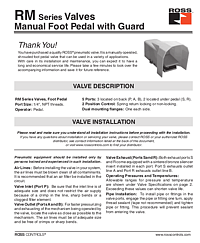
ROSS RM Series Valves — Manual Foot Pedal with Guard: Installation and Operating Instructions
Overview
The ROSS® RM Series Valves are manually operated, shrouded foot pedal valves designed for pneumatic circuit control in applications where the operator requires both hands free. The protective guard shields the pedal from accidental actuation, improving operator safety without sacrificing ease of use.
The RM Series valve uses poppet construction and features 5 ports: three located on the back (P, A, B) and two exhaust ports located under the pedal (S and R). Both exhaust ports come equipped with sintered bronze silencer inserts. The valve supports 5/2 and 3/2 operating configurations and is available in locking and non-locking models.
ROSS Controls has been a leader in fluid power engineering since 1921. The RM Series continues that tradition of reliable, long-service-life pneumatic valves. Read all installation instructions before proceeding.
Key Features
Valve Configuration and Port Layout
The RM Series valve provides versatile circuit configuration. In standard 5/2 operation (non-actuated), air flows from Port P to Port B while Line A exhausts through Port S. When actuated, air flows from Port P to Port A while Line B exhausts through Port R.
- Port size: 1/4 inch NPT threads
- Number of ports: 5 (P, A, B on back; S, R under pedal)
- 2-position control: spring return (locking or non-locking)
- Dual mounting flanges: one each side
- Built-in sintered bronze silencer inserts in exhaust ports S and R
- Configurable for 5/2 or 3/2 operation
- Construction: Poppet
- Mounting type: Line mounting
3/2 Operation Configuration
The RM Series can be configured for 3/2 operation by plugging one outlet port. For normally closed 3/2 operation, install a 1/4-inch pipe plug into Port B and connect outlet Port A to the downstream device. For normally open 3/2 operation, install a 1/4-inch NPT pipe plug into Port A and connect outlet Port B to the downstream device.
Locking vs. Non-Locking Operation
Locking models hold the valve in the actuated position after the pedal is depressed and released. This is useful in applications requiring sustained air supply. Non-locking models return to the unactuated position when pedal force is removed. Both configurations use spring-return mechanisms.
Technical Specifications
- Construction: Poppet
- Mounting type: Line mounting
- Inlet pressure: 0 to 120 psig (0 to 8.2 bar)
- Temperature range: 23° to 140°F (-5° to 60°C)
- Flow media: Filtered air
- Port threads: NPT
- Port size: 1/4 inch
- Lubrication: Not required
- Exhaust silencers: Sintered bronze, factory-installed in Ports S and R
- Configuration: 5/2 standard; convertible to 3/2
Dimensional Reference (inches / mm)
- Overall height: 9.65 in (245 mm)
- Guard height: 7.87 in (200 mm)
- Pedal height: 6.69 in (170 mm)
- Overall width: 5.31 in (134.8 mm)
- Mounting width: 3.43 in (87 mm)
- Mounting height: 1.61 in (41 mm)
- Depth: 5.39 in (137 mm)
- Port center spacing: 2.87 in (73 mm)
- Port thread: 3-PT 1/4 inch NPT
Applications
Two-Hand-Free Operations
The RM Series foot pedal valve is designed for applications where both hands must remain on the workpiece or tooling. Common uses include pneumatic presses, stamping machines, welding positioners, assembly fixtures, and hydraulic bending machines where foot-actuated cycle initiation is required.
Safety-Critical Locking Applications
Locking RM Series valves are used where the operator must initiate a cycle and then move away before the machine completes its stroke. The locking feature keeps the valve actuated after foot removal, enabling safe operator positioning before the pneumatic cycle executes.
Safety and Compliance Standards
Before servicing or disassembling the valve, shut off all energy sources, exhaust the pneumatic system, and lock out all power sources per OSHA 1910.147 and EN 1037. Only qualified persons trained in pneumatic equipment should install or service these valves.
ROSS does not recommend disassembling the Series RM4F valves for repair. If repair is necessary beyond cleaning, contact ROSS or an authorized ROSS distributor. Do not restrict the exhaust ports — sintered bronze silencers are factory-installed and should not be removed unless replacement is required.
Installation and Setup Guide
Pre-Installation Air Line Preparation
Before installing the valve, blow all air lines clean of contaminants. Install an air filter as close to the valve as possible. Ensure the inlet line (Port P) is of adequate size and free of crimps, sharp bends, or clogged filter elements. A 5-micron air filter is recommended.
Port Connection and Pipe Installation
Engage pipe or fitting one turn, apply thread sealant (tape not recommended), then tighten. This prevents sealant from entering the valve. Connect Port P to the compressed air supply, Ports A and B to the actuator or downstream device, and verify that exhaust Ports S and R are unobstructed.
Maintenance and Lubrication
The RM Series valve does not require air line lubrication. If lubricated air is supplied for other downstream mechanisms, use only petroleum-base oils with oxidation inhibitors, aniline point between 180°F (82°C) and 220°F (104°C), ISO 32 or lighter viscosity. Avoid oils with phosphate additives. To clean the valve, use a good commercial solvent — not chlorinated solvents or abrasives. Lubricate all sliding surfaces with Mobilgrease 28 before reassembly.
Why Choose ROSS Controls
ROSS Controls has over 100 years of experience in fluid power, and the RM Series foot pedal valve reflects that expertise. With a rugged poppet construction, built-in exhaust silencers, locking and non-locking configurations, and a protective guard, the RM Series provides the safety and reliability required in demanding industrial environments.
For technical assistance, call ROSS at 1-800-GET-ROSS or visit www.rosscontrols.com. ROSS offers a global network of authorized distributors and a dedicated technical services team.
Download This Document
The official PDF installation and operating instructions for the ROSS RM Series Manual Foot Pedal with Guard (Form SS107) can be downloaded here:
PDF Download: https://ross-admin-global-us-east.s3.amazonaws.com/production/uploads/document_language_file/file/30/ROSS_RM4F_Series_Manual_Foot_Pedal_with_Guard_Installation_Instructions_SS107.pdf
Full document library: https://www.rosscontrols.com/en/documents
Related Products and Resources
- ROSS 11 Series and 12 Series Mechanical & Manual Valves (SS105)
- ROSS 31 Series and 36 Series Manual Valves (SS104)
- ROSS 18 & 19 Series Air Flow Control Valves (SS110)
- ROSS L-O-X® Energy Isolation Valves
- ROSS Silencers
- 1-800-GET-ROSS | www.rosscontrols.com
Frequently Asked Questions
Q: What is the maximum inlet pressure for the RM Series valve?
A: The RM Series valve is rated for inlet pressures from 0 to 120 psig (0 to 8.2 bar). Operating above this pressure can shorten valve life.
Q: What is the operating temperature range?
A: The RM Series valve operates from 23° to 140°F (-5° to 60°C) ambient and media temperature.
Q: How many ports does the RM Series valve have?
A: The RM Series has 5 ports: P (inlet), A and B (outlets) on the back, and S and R (exhaust) under the pedal. Both exhaust ports have factory-installed sintered bronze silencer inserts.
Q: Can the RM Series valve be configured for 3/2 operation?
A: Yes. For normally closed 3/2 operation, install a 1/4-inch pipe plug in Port B and use Port A as the outlet. For normally open 3/2 operation, plug Port A and use Port B as the outlet.
Q: What is the difference between locking and non-locking models?
A: Locking models hold the valve actuated after the pedal is released, suitable for applications where the operator must step away before the machine cycle completes. Non-locking models spring-return to the unactuated state when pedal force is removed.
Q: Does the RM Series valve require lubrication?
A: No. The RM Series valve does not require air line lubrication. If lubricated air is used for other mechanisms, use compatible petroleum-base oils with ISO 32 or lighter viscosity.
Q: Can the RM Series valve be disassembled for repair?
A: ROSS does not recommend disassembling the Series RM4F valves for repair. Contact ROSS or an authorized distributor for service support.
Q: What thread type are the RM Series ports?
A: All ports use 1/4-inch NPT (National Pipe Taper) threads.