




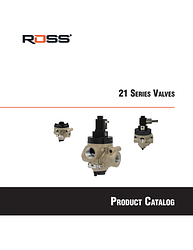
ROSS 21 Series Directional Control Valves Catalog: Complete Technical Specifications & Product Selection Guide
Overview of ROSS 21 Series Inline Poppet Directional Control Valves
The ROSS 21 Series represents a comprehensive line of inline poppet directional control valves engineered for demanding pneumatic control applications across industrial automation, manufacturing, and process control environments. These high-performance valves feature innovative poppet design technology that delivers exceptional flow capacity, reliability, and operational consistency in compressed air systems.
Built with precision-engineered perpendicular poppet face seals, the 21 Series valves create optimal sealing surfaces that ensure positive shut-off while enabling high-flow performance. The differential piston design generates overwhelming shifting forces that provide no-stick operation throughout the valve's service life, making these directional control valves ideal for applications requiring fast, consistent response times and dependable operation in challenging industrial environments.
The 21 Series product family encompasses both solenoid pilot-controlled and pressure-controlled actuation options, providing system designers with flexible solutions for diverse pneumatic circuit requirements. Available in valve functions including 2-way 2-position, 3-way 2-position, and 4-way 2-position configurations with normally closed and normally open variations, the series accommodates inlet port sizes ranging from 1/4 inch through 2 inches, delivering maximum flow coefficients up to 33 Cv (32,000 Nl/min).
Key Features and Engineering Advantages
Perpendicular Poppet Face Seal Technology
The cornerstone of ROSS 21 Series valve performance lies in the perpendicular poppet face seal design. Unlike traditional spool valve configurations that rely on close-tolerance sliding fits, ROSS poppet valves employ face seals positioned at 90-degree angles to the flow path. This engineering approach creates high-flow passages while maintaining positive sealing with no sliding action, preventing seal wear and contamination-related failures that compromise conventional valve designs.
Differential Piston Design for Superior Response
Surface areas of the piston poppet, exhaust poppet, and inlet poppet are precisely calculated to generate strong shifting and sealing forces in both directions. This differential area design produces overwhelming actuating forces that ensure rapid valve response regardless of pressure differentials, contaminants, or minor seal wear. The result is consistent switching performance that maintains fast response times throughout the valve's operational lifetime.
Self-Cleaning and Dirt Tolerance
High-velocity airflow across the poppet seats creates a natural cleaning action that continuously removes particulate contamination during valve operation. The smallest flow-through area is strategically positioned across the poppet seal and seat interface, where air velocity reaches maximum levels sufficient to blow out dirt, scale, and foreign matter. This self-cleaning characteristic makes ROSS 21 Series valves exceptionally tolerant of real-world compressed air system conditions.
Self-Compensating Wear Compensation
The superior internal guidance system incorporates self-compensating seal technology that automatically adjusts for normal wear. As valve seals experience burnishing during operation, the poppet stroke length automatically changes to maintain optimal sealing force. This self-compensation extends valve service life and maintains consistent performance without requiring frequent maintenance or adjustment.
Valve Functions and Configurations
2-Way 2-Position Directional Control Valves
The 21 Series 2/2 valves control pneumatic flow between two ports with two switching positions, available in both normally closed and normally open configurations. These valves function as on/off control elements in pneumatic circuits, blocking or allowing airflow to downstream components. Body sizes range from 3/8 inch to 1-1/4 inch, with port sizes from 1/4 inch to 1-1/2 inches, providing flow coefficients from 1.6 Cv (1,600 Nl/min) to 33 Cv (32,000 Nl/min).
Average response constants demonstrate the valves' exceptional speed, with M values ranging from 10 to 26 milliseconds and F values from 0.13 to 0.96, enabling rapid filling and exhausting of pneumatic volumes. This performance makes 2/2 valves ideal for applications requiring fast cycling, including automated assembly systems, testing equipment, and material handling operations.
3-Way 2-Position Directional Control Valves
The 3/2 valve configuration adds an exhaust port to the inlet and outlet ports, enabling control of single-acting cylinders and other pneumatic actuators requiring both supply and exhaust functions. Available in normally closed and normally open versions across body sizes from 3/8 inch to 1-1/4 inch, these valves deliver flow coefficients up to 33 Cv (32,000 Nl/min) with separate flow ratings for inlet-to-outlet and outlet-to-exhaust paths.
The three-port design allows these directional control valves to alternate between pressurizing an actuator and venting it to atmosphere, making them essential components in pneumatic positioning systems, clamping applications, and process control circuits requiring both extension and retraction control.
Solenoid Pilot Controlled Actuation
ROSS 21 Series solenoid pilot-controlled valves utilize quick-disconnect coils with DIN EN 175301-803 electrical connections in Form A, Form B, and M12 configurations, plus 1/2-inch conduit options. These valves operate with DC voltages (12V, 24V) consuming 4.5 to 4.8 watts, or AC voltages (120V, 240V at 60 Hz) consuming 6.5 to 6.8 VA, with all solenoids rated for continuous duty.
Manual override capability via non-locking push button enables valve testing and emergency operation without electrical power. The IP 65 enclosure rating provides protection against dust ingress and water jets, ensuring reliable operation in industrial environments subject to washdown procedures, coolant exposure, and airborne contamination.
Pressure Controlled Actuation
Pressure-controlled 21 Series valves provide pilot-actuated shifting using pneumatic signals rather than electrical solenoids. These valves excel in applications requiring explosion-proof operation, electrical isolation, or integration with purely pneumatic control circuits. The 1/4-inch signal port accepts pilot air pressure to shift the valve, with pilot supply pressure requirements matching or exceeding inlet pressure while meeting minimum operating pressure specifications.
4-Way 2-Position Directional Control Valves
The 4/2 valve function controls double-acting cylinders and other pneumatic actuators requiring alternating pressure application to two work ports. With one inlet port, two outlet ports, and one exhaust port, these valves direct compressed air to one actuator port while simultaneously exhausting the opposite port. Available across body sizes from 3/8 inch to 1-1/4 inch with flow coefficients reaching 28 Cv (28,000 Nl/min), 4/2 valves enable precise bidirectional control for applications including automated machinery, robotic systems, and press automation.
Technical Specifications and Operating Parameters
Operating Conditions and Environment
ROSS 21 Series valves operate with filtered compressed air at pressures from 30 to 150 psig (2 to 10 bar). Temperature ranges accommodate diverse industrial environments, with standard solenoid pilot-controlled valves handling ambient temperatures from 0° to 122°F (-17° to 50°C) and media temperatures matching ambient conditions. High-temperature variants extend ranges to 0° to 180°F (-17° to 82°C) ambient with media temperatures up to 300°F (150°C), while low-temperature options operate from -40° to 122°F (-40° to 50°C) ambient with media temperatures down to -40°F (-40°C).
For sub-freezing applications below 40°F (4°C), compressed air must be free of water vapor to prevent ice formation that could interfere with valve operation. Pressure-controlled valves offer similar temperature ranges optimized for pneumatic actuation applications.
Construction Materials and Seal Options
Valve bodies are manufactured from cast aluminum alloy, providing an optimal balance of strength, weight, and corrosion resistance for industrial pneumatic applications. Poppet components combine aluminum and stainless steel construction for durability and wear resistance at sealing interfaces.
Two seal material options accommodate different media and temperature requirements. Fluorocarbon seals offer superior chemical resistance and high-temperature capability up to 300°F (150°C), making them ideal for applications involving exposure to petroleum products, solvents, or elevated temperatures. Buna-N (nitrile) seals provide excellent performance in standard compressed air systems at moderate temperatures while offering cost-effective operation.
Safety Integrity Level Certification and Functional Safety
SIL 2 Certification for Safety-Critical Applications
The ROSS 21 Series holds Safety Integrity Level 2 (SIL 2) certification from TÜV Rheinland in accordance with IEC 61508 and IEC 61511 international safety standards. This certification validates the valves' reliability and performance characteristics for use in safety-related control systems protecting personnel and equipment from hazardous pneumatic energy.
In singular application configurations with Hardware Fault Tolerance (HFT) = 0, the valves achieve SIL 2 and EN ISO 13849-1 Performance Level c with application-specific diagnosis. When deployed in redundant valve arrangements with HFT ≥ 1, the system architecture can achieve SIL 3 and Performance Level e, providing the highest levels of functional safety for critical applications including press safety systems, machine safeguarding circuits, and emergency stop functions.
Compliance and Industry Standards
ROSS 21 Series valves meet multiple international standards and hold relevant certifications for global industrial applications. The product line includes Declarations of Conformity and Certificates of Compliance documenting adherence to applicable safety and performance standards. Electrical connections conform to DIN EN 175301-803 specifications for industrial environments, ensuring compatibility with standard automation system wiring practices.
Model Number Configuration and Ordering Information
Comprehensive Configurator System
The ROSS 21 Series employs a systematic model number structure enabling precise specification of valve characteristics. The configurator begins with series designation (21), followed by revision level (7), actuation type (1 for solenoid controlled, 5 for pressure controlled), and valve function codes (1-6 indicating 2/2 NC, 2/2 NO, 3/2 NC, 3/2 NO, or 4/2).
Port thread options include standard NPT threads or G (ISO/BSPP) threads specified with "D" suffix. Body size and port size codes correspond to physical dimensions and flow capacity, with separate codes for internal pilot supply and external pilot supply configurations. Electrical specifications include current type (H for 12V DC, W for 24V DC, Z for 120V AC, Y for 240V AC), valve seal materials (1 for Fluorocarbon, 2 for Buna-N), temperature range, and coil type selection.
Example Model Numbers
Model number 2171B3001W–1 specifies a Series 21, revision 7, solenoid controlled (1), 2/2 normally closed valve (1), NPT threads, body size 3/8 inch with 1/4-inch ports, internal pilot supply (200), 24V DC voltage (W), Fluorocarbon seals (1), standard temperature range, and DIN EN 175301-803 Form A coil (1).
Flow Performance and Response Time Characteristics
Flow Coefficient (Cv) Values
Flow coefficients quantify the volumetric flow capacity at specified pressure drops, enabling accurate sizing of valves for pneumatic system requirements. The 21 Series provides flow ratings in both Cv (imperial) and Nl/min (normal liters per minute at standard conditions). Smallest valves with 1/4-inch ports deliver 1.6 to 2.2 Cv (1,600 to 2,200 Nl/min), while mid-range 3/4-inch body valves achieve 6.3 to 8.3 Cv (6,200 to 8,200 Nl/min). Large 1-1/4 inch body valves with 1-1/2 inch ports reach maximum flow capacity of 33 Cv (32,000 Nl/min).
Response Time Calculations
Valve response time represents the average duration required to fill a pneumatic volume to 90% of supply pressure or exhaust it to 10% of supply pressure. The calculation formula Response Time (msec) = M + (F × V) incorporates two valve-specific constants and the volume (V) in cubic inches being controlled.
The M constant represents the inherent valve switching time independent of volume, ranging from 10 milliseconds for small valves to 99 milliseconds for large 4/2 configurations. The F constant quantifies the flow-dependent filling or exhausting rate, with values from 0.12 to 2.30 depending on valve size, function, and flow direction. These published constants enable precise calculation of actual response times for specific applications, facilitating optimal valve selection for speed-critical operations.
Dimensional Information and CAD Resources
Precise Dimensional Data
The catalog provides detailed dimensional drawings for all valve body sizes in both inch and millimeter units. Dimensions include overall length, width, height, port locations, mounting hole positions, and electrical connection placement. These specifications enable accurate system design, manifold integration, and installation planning.
Body size 3/8 valves measure approximately 5.90 to 6.61 inches (150 to 168 mm) in length depending on function, while 3/4 body valves range from 6.89 to 7.69 inches (175 to 195 mm). Large 1-1/4 body configurations extend 10.33 to 10.67 inches (263 to 271 mm). Port thread sizes and locations are precisely documented to ensure proper piping and manifold connections.
Downloadable CAD Models
ROSS provides downloadable CAD models for the 21 Series valves, streamlining design integration and reducing engineering time. These three-dimensional models are available in standard CAD formats compatible with leading mechanical design software platforms. Engineers can import these models directly into system layouts for interference checking, assembly visualization, and documentation generation.
Accessories and System Components
Electrical Connectors and Cable Assemblies
The catalog details prewired electrical connectors and cable assemblies compatible with DIN EN 175301-803 Form A and Form B coil interfaces. Connector options include cable grip styles and 1/2-inch NPT conduit fittings, with and without integrated indicator lights. Prewired cables with molded connectors are available in 6.5-foot (2-meter) lengths with flying leads for system integration.
Lighted connectors incorporate LED indicators powered by 24V DC, 120V AC, or 230V AC for visual verification of solenoid energization. Maximum cord diameters range from 6 to 10 mm depending on connector style. Solenoid connector pinout diagrams clarify wiring polarity and ground connections for proper electrical installation.
Exhaust Silencers
Pneumatic exhaust noise reduction is achieved through aluminum silencer fittings available for 1/2-inch, 1-inch, and 1-1/2-inch port sizes. These silencers attach to valve exhaust ports via male NPT or R/Rp (ISO) threads, with flow capacities matched to valve exhaust performance. Maximum operating pressure rating of 290 psig (20 bar) accommodates high-pressure pneumatic systems.
Flow coefficients for silencers range from 6.8 Cv (6,700 Nl/min) for 1/2-inch units to 39 Cv (38,000 Nl/min) for 1-1/2-inch configurations. Compact designs measuring 3.6 to 5.7 inches (9 to 14 cm) in length enable installation in space-constrained applications while providing effective acoustic attenuation.
Application Industries and Use Cases
Manufacturing and Assembly Automation
ROSS 21 Series directional control valves serve critical roles in automated manufacturing systems requiring high-speed pneumatic actuation. The valves' fast response times and consistent switching performance enable precise control of robotic pick-and-place operations, component assembly stations, and automated testing equipment. Self-cleaning poppet design ensures reliable operation despite manufacturing environment contaminants.
Press and Metal Forming Operations
Safety-critical press applications utilize ROSS 21 Series valves configured in redundant architectures to achieve required Performance Levels. The SIL-rated valves control clutch-brake mechanisms in mechanical power presses, providing dual-channel control with monitoring capability. High shifting forces and overwhelming actuation ensure positive valve response even when contaminated, critical for personnel safety in press operations.
Packaging Machinery
High-cycle packaging applications leverage the 21 Series' exceptional durability and response speed. Valves control functions including product clamping, positioning, forming, and sealing across diverse packaging formats. The self-compensating seal technology maintains performance through millions of cycles without requiring frequent maintenance, minimizing production downtime.
Automotive Industry Applications
Automotive manufacturing environments utilize 21 Series valves throughout body assembly, powertrain production, and final assembly operations. The valves' ability to withstand harsh conditions including coolant exposure, temperature extremes, and vibration makes them ideal for automotive applications. Multiple seal material options accommodate exposure to various fluids and cleaning agents common in automotive plants.
Installation, Maintenance, and Safety Considerations
Pre-Installation Requirements
Proper system design includes filtration of compressed air supply to remove particulate contamination, moisture, and scale that can affect valve performance. While ROSS poppet valves demonstrate superior dirt tolerance compared to spool-type valves, optimal performance requires installation of 5-micron rated filtration upstream of the valve.
Air supply lines must provide unrestricted flow to prevent pressure drop below minimum operating requirements. Similarly, exhaust ports must not be restricted beyond the flow capacity of appropriately-sized silencers to prevent backpressure buildup that adversely affects valve response.
Lubrication Considerations
Standard ROSS 21 Series valves operate effectively with or without compressed air lubrication. When lubrication is employed, only compatible lubricants should be used, typically petroleum-based oils with oxidation inhibitors, aniline points between 180°F and 220°F (82°C to 104°C), and ISO 32 or lighter viscosity. Lubricants containing phosphate-type additives must be avoided as they can harm elastomeric components and lead to premature seal failure.
Safety and Service Guidelines
All service and maintenance operations must be performed only after shutting down the pneumatic system, exhausting all pressure, and implementing lockout/tagout procedures per OSHA 1910.147 and EN 1037 standards. Installation and service should be conducted only by personnel with appropriate training and experience with pneumatic equipment.
ROSS 21 Series valves should be operated within published specification limits using only genuine ROSS replacement components to maintain performance and safety certifications. Overhauled or serviced valves must undergo functional testing prior to reinstallation and return to service.
Warranty and Global Support
Standard Warranty Coverage
ROSS Controls provides comprehensive warranty coverage for the 21 Series valve family, warranting products to be free from defects in materials and workmanship for one year from the date of purchase. Warranty obligations include repair, replacement, or refund of purchase price for products determined by ROSS to be defective.
Warranty protection is void if products have been subject to misuse, misapplication, improper maintenance, modification, or tampering. Products requiring warranty service must be returned freight prepaid to a ROSS location.
Global Technical Support
ROSS Controls maintains a worldwide network of technical support resources across the Americas, Europe, and Asia-Pacific regions. Engineers and application specialists provide assistance with valve selection, system design, troubleshooting, and custom solutions. Regional offices in the United States, Canada, Brazil, Germany, France, United Kingdom, India, China, and Japan ensure responsive local support complemented by centralized expertise.
Why Choose ROSS 21 Series Directional Control Valves
Proven Reliability in Demanding Applications
Decades of field experience across diverse industries demonstrate the 21 Series' exceptional reliability and longevity. The poppet design architecture eliminates common failure modes associated with spool valves, including sticking due to contamination, seal wear from sliding action, and performance degradation from manufacturing tolerances.
Superior Performance Characteristics
Combination of high flow capacity, fast response times, and consistent operation throughout the valve lifecycle distinguishes ROSS 21 Series products in industrial pneumatic control applications. Self-cleaning capability and dirt tolerance reduce maintenance requirements while maintaining precise pneumatic control even in challenging environments.
Comprehensive Product Range
The extensive selection of valve functions, body sizes, port sizes, actuation options, and accessory components enables system designers to specify optimal solutions for virtually any pneumatic control requirement. Standardized interfaces and configurations simplify integration into new and existing pneumatic systems.