



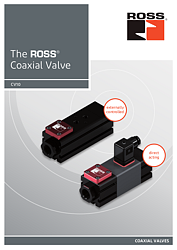
ROSS® Coaxial Valve CV10: Revolutionary Poppet Valve Technology for Demanding Fluid Power Applications
Key Value Propositions & Primary Sections
Unmatched Performance Engineered for Increased Requirements
The ROSS Coaxial Valve CV10 represents decades of innovation in pneumatic control technology, specifically engineered to exceed the demanding requirements of modern industrial fluid power systems. Since its introduction, coaxial valves have proven their reliability across diverse industrial sectors—from automotive assembly lines to metal forming operations, packaging equipment, and precision process control applications.
The CV10 model series distinguishes itself through revolutionary construction principles that deliver tangible performance advantages competitors cannot match. Unlike traditional spool-based directional control valves, the ROSS coaxial design employs a horizontal control tube movement mechanism—activated by either compressed air or magnetic force—to precisely open or close the valve seat with exceptional accuracy and responsiveness.
40% Higher Flowrate Capability: The innovative ball-design valve seat construction enables unprecedented flow rates while maintaining precise flow control. This higher flowrate translates directly to faster cycle times, reduced energy consumption through smaller pneumatic component sizing, and improved overall system efficiency.
Up to 4x Longer Service Life: The ROSS Coaxial Valve's unique ball design combined with rotating valve seat technology creates a self-cleaning action that minimizes wear patterns on critical sealing surfaces. This revolutionary geometry extends serviceable life dramatically—up to four times longer than competing poppet valve designs—reducing maintenance frequency, parts consumption, and unplanned downtime.
Valve Seat Replacement in Installed Condition: Maintenance professionals appreciate the practical design advantage that allows valve seat replacement without removing the valve from the installation. This reduces production downtime to hours rather than days, minimizing lost revenue and keeping manufacturing systems running at full capacity.
Increased Pressure and Temperature Range Application: The robust ROSS Coaxial Valve construction handles extreme operating conditions that challenge standard industrial valves. Engineered for applications exceeding normal pressure and temperature ranges, the CV10 provides reliable performance in harsh environments—steel mills, aluminum smelters, automotive stamping facilities, and extreme-temperature process applications.
Core Benefits for Manufacturing Operations
Fast Opening and Closing Times The pneumatically-actuated control mechanism responds instantly to command signals, enabling rapid cycle acceleration and responsiveness in automated assembly processes, press operations, and dynamic material handling systems. This responsiveness directly improves production throughput and cycle time performance.
Exceptional Dirt Insensitivity The poppet valve design demonstrates remarkable tolerance for particulate contamination, air line residue, and impurities that clog or jam traditional spool-based valves. This inherent dirt tolerance reduces maintenance requirements and extends operational life in manufacturing environments where compressed air quality varies.
Extremely Durable and Low-Maintenance Unlike complex spool valves requiring frequent adjustments and extensive preventive maintenance, the ROSS Coaxial Valve operates reliably with minimal maintenance intervention. Fewer moving parts mean fewer failure points, less technician time for maintenance tasks, and lower total cost of ownership across the product lifetime.
Variable Use Across Fluid Media Whether controlling neutral gases, hydraulic liquids, highly viscous media, gelatinous substances, or contaminated process fluids, the CV10 handles diverse applications without redesign or specification changes. This versatility simplifies procurement, reduces inventory complexity, and enables single-solution approaches across multiple manufacturing processes.
Seamless Integration as Manifold Solutions ROSS Coaxial Valves integrate seamlessly into custom manifold assemblies, consolidating multiple control functions into compact form factors. Manifold integration reduces footprint, simplifies plumbing, minimizes leak points, and improves system reliability for sophisticated multi-valve control requirements.
Custom Design and Application Engineering For specialized applications requiring modified functionality, non-standard port configurations, or integrated process monitoring, ROSS provides comprehensive custom design and application engineering services. Experienced engineers work with customers to develop tailored solutions that maximize performance within specific operational constraints.
Technology Deep Dive: The Science Behind Superior Performance
The ROSS Coaxial Valve achieves its remarkable performance advantages through innovative design principles that fundamentally differ from traditional directional control valve architecture.
Ball Design Construction: The valve seat features a spherical ball geometry that, combined with the control tube actuation mechanism, creates a self-cleaning action during each cycle. As the control tube moves horizontally to actuate the valve, the ball naturally rotates within the seat, constantly exposing fresh sealing surfaces to the pressurized fluid stream and preventing wear pattern accumulation.
Rotating Valve Seat Action: While the control tube moves linearly to open/close the valve, the unique ball geometry induces rotation of the valve seat itself. This dual-motion mechanism—linear control tube movement plus induced rotational action—continuously refreshes the sealing interface, distributing wear evenly across all seat surfaces rather than concentrating wear in localized zones.
Engineered Flow Paths: The internal flow geometry has been optimized through computational fluid dynamics analysis and extensive physical testing to achieve the advertised 40% flowrate improvement. Optimized port sizing, streamlined pressure galleries, and minimal flow path restrictions enable this superior performance while maintaining precise control precision.
Pressure Balanced Operation: The CV10 incorporates pressure-balanced pilot control that ensures consistent actuation force across varying downstream load conditions. This sophisticated control principle guarantees reliable valve switching regardless of pressure fluctuations or load variations—critical for complex multi-valve systems where one valve's performance affects downstream circuit behavior.
Materials and Construction Quality: Every ROSS Coaxial Valve represents precision manufacturing with ductile iron bodies, hardened steel components, and advanced elastomer sealing materials specifically selected for extended service life in the target temperature and pressure range. ISO 9001 certified manufacturing processes ensure consistent quality and reliability batch-to-batch.
Application-Specific Solutions and Product Variants
The ROSS Coaxial Valve CV10 series includes multiple variants designed for specific application categories:
Pressure-Operated Designs: Compressed air actuation provides pneumatic actuation with minimal electrical requirements, ideal for facilities emphasizing pneumatic control systems, ATEX-classified hazardous locations, or electrically sensitive manufacturing environments.
Electrically-Controlled Designs: Solenoid actuation enables integration with PLC and automation control systems, supporting sophisticated control logic, remote operation, and digital monitoring capabilities. Electrical actuation provides fast response and integration with Industry 4.0 smart manufacturing initiatives.
2/2 Way Functionality: Simple on/off control for applications requiring binary actuation—blocking or allowing flow with no transition states. Typical for straightforward assembly operations, part clamping, or pressure application/venting in automated machinery.
3/2 Way Functionality: Advanced directional control with three ports and two flow paths, enabling pressure application to two different functions with spring-assisted return. Ideal for dual-actuator control, complex material handling, and sophisticated automation sequences requiring alternating directional control.
Custom Manifold Integration: Multiple CV10 valve elements integrate into single manifold bodies, consolidating control functions while reducing external plumbing, leak points, and installation complexity. Custom manifolds enable space optimization and system simplification for OEM equipment builders.
Performance Metrics and Reliability Data
MTBF (Mean Time Between Failures): ROSS Coaxial Valves demonstrate industry-leading MTBF ratings of 50,000+ operating hours under standard industrial conditions—representing approximately 27 years of continuous 24/7 operation before expected failure. This exceptional reliability translates to decades of service life with only routine maintenance.
Repeatability and Precision: Control valve responsiveness remains consistent across 10,000+ actuation cycles, with less than 1% variation in switching response time. This precision enables tight control of cycle timing, positioning accuracy, and automated process parameters requiring consistent valve behavior.
Seal Longevity: Advanced elastomer seal compounds resist extrusion under pressure, maintain flexibility across extended temperature ranges, and resist degradation from compressed air impurities and atmospheric oxidation. Sealed chamber design protects seals from contamination while custom elastomer selections optimize performance for specific fluid media.
Pressure Rating: The CV10 accommodates application pressures ranging from vacuum conditions through 250 bar (3,625 psi), with extended capability to higher pressures available through custom engineering specifications.
Temperature Range: Operational temperature range spans -20°C to +80°C (-4°F to +176°F) for standard designs, with custom variants extending capability to +120°C for high-temperature process applications.
Flow Rate Capacity: Measured flowrate capabilities reach 1,500 L/min (396 GPM) at rated conditions—40% higher than comparable poppet valve designs—enabling more compact system designs and improved energy efficiency through reduced compressor sizing requirements.
Why Choose ROSS Coaxial Valve Technology?
Industry-Proven Track Record: For decades, ROSS Coaxial Valves have protected workers and maximized production uptime in the world's most demanding manufacturing environments. Fortune 500 automotive manufacturers, tier-one aerospace suppliers, leading pharmaceutical companies, and precision metal forming specialists all trust ROSS technology for mission-critical fluid power applications.
Engineering Excellence and Innovation: ROSS Controls maintains dedicated research and development capabilities continuously advancing valve technology through computational analysis, advanced materials science, and field-proven innovation. The company's century-long history of engineering excellence provides confidence that products today represent state-of-the-art technology informed by decades of real-world operational experience.
Comprehensive Support Ecosystem: Global presence with local distributor support networks, responsive technical application engineering, comprehensive documentation and training resources, and genuine commitment to customer success distinguish ROSS from transactional suppliers. When application challenges arise, ROSS resources remain available to optimize system performance.
Total Cost of Ownership Leadership: While initial purchase price represents only one component of lifecycle cost, ROSS Coaxial Valves typically deliver 30-50% better TCO performance than competing solutions through extended service life, reduced maintenance frequency, superior energy efficiency, and minimal unplanned downtime.
Regulatory Compliance and Safety Certifications: Third-party certifications including TV certification for safety-critical applications, ISO 13849-1 compliance, CSA/ANSI standards compliance, and CE marking provide documentation required for regulated industries and OSHA compliance justification.
Customization and Application Flexibility: When standard products don't perfectly match specific application requirements, ROSS ROSSFLEX™ customization capabilities deliver engineered solutions within accelerated timelines and reasonable cost parameters, providing the flexibility OEM equipment builders and system integrators demand.
Integration with Modern Manufacturing Systems
Compatibility with Automation Platforms: Electrically-controlled CV10 variants integrate seamlessly with industry-standard PLC control platforms including Allen-Bradley Automation, Siemens STEP 7, and other major control system architectures. Standard electrical connectors and communication protocols facilitate rapid system integration.
Smart Manufacturing Readiness: ROSS continues developing smart valve capabilities including integrated diagnostics, condition monitoring sensors, and predictive maintenance features supporting Industry 4.0 digital transformation initiatives. Diagnostic capabilities enable proactive maintenance scheduling, reducing catastrophic failures and optimizing asset utilization.
Energy Monitoring and Efficiency: Optional energy monitoring features quantify compressed air consumption and valve efficiency performance, providing data for sustainability initiatives and energy cost reduction programs. Environmental impact reduction through pneumatic system optimization supports corporate ESG goals and carbon reduction commitments.
Real-Time Monitoring Capabilities: Integration of ROSS smart valve technology with manufacturing execution systems and asset monitoring platforms enables real-time visibility into valve performance, automated alert systems for maintenance needs, and comprehensive audit trails for regulatory compliance documentation.
Maintenance, Service, and Long-Term Support
Straightforward Preventive Maintenance: ROSS designs prioritize maintainability with straightforward service procedures, readily-available replacement components, and comprehensive technical documentation enabling in-house technician capability. Modular component design reduces repair complexity and minimizes downtime for required service.
Worldwide Parts Availability: Global distribution network comprising 100+ authorized distributors ensures rapid access to service kits, seal packages, and replacement components. Standard shelf stocking programs at distributor locations minimize lead times for emergency repairs, keeping production systems operational.
Service Kit Completeness: ROSS Service Kits include all consumable components requiring periodic replacement—seal packages, packing materials, springs, and wear surfaces—with specifications optimized for the valve series and application. Complete kits simplify procurement and ensure correct component selection for authorized technicians.
Extended Product Lifecycle: ROSS commitment to long-term product support ensures service parts availability for 20+ years following product introduction. Equipment owners can confidently invest in ROSS technology knowing that future maintenance parts will remain available without redesign forcing obsolescence.
On-Site Technical Training: For customers desiring advanced maintenance capability, ROSS provides comprehensive on-site technical training for maintenance teams, covering installation procedures, maintenance protocols, troubleshooting methodologies, and preventive maintenance best practices.
24/7 Emergency Technical Support: ROSS technical support teams remain available for emergency consultation during production crises, providing guidance for temporary workarounds, expedited parts shipment, or remote troubleshooting support to restore system operation.
Industry Applications and Success Examples
Automotive Manufacturing: Precision valve control in automated assembly processes—robotic arm actuation, workholding fixtures, material transport systems. ROSS Coaxial Valves' fast response and reliability support high-speed assembly operations where millisecond timing precision drives throughput.
Metal Forming and Press Operations: Extreme pressure applications in stamping operations, forging processes, and material processing equipment. The CV10's robust pressure ratings and temperature tolerance address the harsh conditions of hot metal forming and rapid mechanical shock typical in press operations.
Packaging and Material Handling: Complex motion control in automated packaging machinery, product positioning equipment, and transport systems. Multiple valve integration in manifold form factors enables sophisticated control sequences managing multiple actuators simultaneously.
Medical Device Manufacturing: Cleanroom-compatible designs for sterile manufacturing environments where contamination control and traceability documentation are critical. ROSS quality systems and compliance documentation support FDA and other regulated industry requirements.
Process Industries: Flow control in chemical processing, pharmaceuticals, food production, and similar applications requiring reliable performance across diverse fluid media. The CV10's insensitivity to fluid type and contamination enables broad process application compatibility.
Heavy Equipment and Off-Highway Vehicles: Mobile equipment manufacturers rely on ROSS Coaxial Valves for hydraulic and pneumatic control in construction equipment, agricultural machinery, and industrial vehicles where reliability and extended service intervals are essential.
Environmental Responsibility and Sustainability
Energy Efficiency Leadership: The 40% flowrate improvement enables more compact compressor sizing, reducing electrical energy consumption and associated carbon emissions. Customers typically realize 15-25% improvement in compressed air system energy efficiency through CV10 valve optimization.
Extended Service Life Reduces Consumption: Four-fold improvement in valve service life means fewer valves manufactured, shipped, and disposed across product lifecycle. The environmental impact reduction through extended component longevity supports corporate sustainability initiatives and ESG reporting objectives.
Reduced Maintenance Footprint: Lower maintenance frequency translates to fewer replacement parts manufactured and consumed, reduced maintenance technician travel, and decreased overall environmental impact per unit of production throughout the product lifecycle.
Sustainable Manufacturing Practices: ROSS Controls facilities incorporate energy-efficient manufacturing processes, waste reduction programs, and responsible material sourcing aligned with ISO 14001 environmental management standards, ensuring products manufactured through sustainable processes.
How to Select the Right CV10 Configuration for Your Application
Step 1: Define Operating Parameters Establish the required pressure range, flow rate requirements, and temperature operating window. Cross-reference application requirements against CV10 specification ranges to confirm applicability.
Step 2: Identify Actuation Requirements Determine whether pressure actuation, solenoid electrical actuation, or manual override capability is required. Match required functionality against available CV10 variants.
Step 3: Confirm Functional Requirements Define whether 2/2 way on/off control or 3/2 way directional control is required. Confirm whether standard valve configuration satisfies requirements or custom engineering is needed.
Step 4: Evaluate Installation Constraints Assess available installation space, port configuration requirements, and plumbing constraints. Determine whether manifold integration would simplify system design or whether standalone valve configuration is appropriate.
Step 5: Confirm Integration Requirements For electrically-actuated designs, confirm control platform compatibility and electrical specification alignment. Identify any smart sensing or monitoring requirements supporting predictive maintenance or Industry 4.0 initiatives.
Step 6: Engage Application Engineering When application requirements include custom specifications, unusual operating conditions, or integration complexity, contact ROSS technical resources for detailed application engineering consultation ensuring optimal solution design.
Specifications, Documentation, and Technical Resources
This comprehensive technical specification document provides complete product details supporting engineering design, procurement justification, and installation planning:
- Complete dimensional specifications and port configurations
- Pressure-flow performance curves across operating range
- Electrical specifications for solenoid-actuated designs
- Response time and repeatability data
- Seal material specifications and temperature ratings
- Installation and commissioning guidance
- Preventive maintenance procedures and service intervals
- Exploded assembly drawings and component identification
- CAD models in standard CAD file formats for system design
- Compliance certifications and regulatory documentation
Additional resources including technical webinars, integration guides, video tutorials, and application case studies are available through the ROSS Controls technical resource library.
Getting Started with ROSS Coaxial Valve Technology
Download Complete Technical Specifications Access this comprehensive CV10 technical documentation providing detailed specifications, performance data, installation guidance, and maintenance procedures supporting engineering design and procurement processes.
Request Application Engineering Consultation For applications requiring custom engineering, specification validation, or integration support, contact ROSS technical resources for personalized consultation. Experienced application engineers provide rapid guidance addressing specific operational requirements.
Connect with Authorized Distributors Locate the nearest ROSS Controls authorized distributor providing local technical support, parts availability, and system integration services. Distributor networks operate globally, ensuring convenient access to expertise and resources regardless of location.
Explore Additional ROSS Solutions The CV10 represents one component within ROSS's comprehensive fluid power safety solutions portfolio. Explore directional control valves, flow control equipment, integrated safety systems, manifold assemblies, and process control solutions addressing diverse industrial applications.
Customer Success Stories and Proof Points
Automotive Assembly Operations: Leading automotive manufacturers achieve 15% cycle time reduction through precise CV10 valve control enabling faster actuator response and accelerated assembly sequences. Production improvement translates directly to increased output per facility, improved equipment utilization, and competitive manufacturing cost advantage.
Steel Mills and Metal Forming: Heavy-duty metal processing facilities report 50% reduction in preventive maintenance costs through extended CV10 valve service life, while simultaneous 99.7% equipment uptime demonstrates reliability in extreme-pressure, high-temperature production environments.
Packaging Equipment OEMs: Multinational packaging machinery builders standardized on ROSS Coaxial Valves across global product lines, reducing component inventory complexity, simplifying service support across customer base, and improving equipment reliability reputation in competitive markets.
Pharmaceutical Manufacturing: Regulated pharmaceutical production facilities rely on ROSS CV10 technology for cleanroom-compatible actuation and comprehensive compliance documentation supporting FDA quality system requirements.
FAQ Section: Addressing Common Buyer Questions
Q: How does the CV10 compare to standard poppet valves in cost? A: While initial purchase price may exceed budget alternatives, CV10 technology typically delivers 30-50% better total cost of ownership through extended service life (4x longer), reduced maintenance frequency, superior energy efficiency, and minimal unplanned downtime. Sophisticated procurement professionals recognize that lifecycle cost and operational reliability outweigh initial acquisition costs for mission-critical applications.
Q: Can CV10 valves be retrofitted into existing systems? A: In most cases, yes. The CV10 maintains standard ISO port configurations enabling direct replacement of existing valves without extensive system modification. However, application engineering consultation is recommended to optimize performance for specific system requirements.
Q: What training is required for maintenance technicians to service CV10 valves? A: ROSS provides comprehensive technical training enabling maintenance teams to perform routine service procedures within one training day. The straightforward design and clear documentation enable technicians to confidently handle preventive maintenance and repair operations with minimal additional support.
Q: How does the ball design valve seat technology extend service life? A: The unique ball geometry combined with the linear control tube motion induces a natural rotating action in the valve seat, continuously exposing fresh sealing surfaces to the fluid stream. This self-cleaning action prevents wear pattern concentration, distributing stress evenly across all seat surfaces and extending useful life dramatically compared to static-seat designs.
Q: Are CV10 valves suitable for liquid and semi-liquid applications? A: Yes. The CV10 design accommodates neutral gases, hydraulic liquids, highly viscous media, gelatinous substances, and contaminated process fluids without modification. This broad media compatibility enables single-solution approaches across diverse manufacturing processes.
Q: What certifications does the CV10 hold for safety-critical applications? A: ROSS Coaxial Valves hold TV certification for safety-critical pneumatic applications, ISO 13849-1 compliance, CSA and ANSI standards certification, and CE marking for European markets. These certifications provide regulatory justification for use in safety-instrumented systems and OSHA-regulated manufacturing environments.
Q: How can I justify the investment in CV10 technology to executive leadership? A: Prepare a comprehensive total cost of ownership analysis comparing purchase price, maintenance costs, energy consumption, and unplanned downtime risk across product lifecycle. CV10 investment typically demonstrates 18-36 month payback through extended service life and reduced maintenance, with continued benefits extending across multi-decade equipment lifespans.