




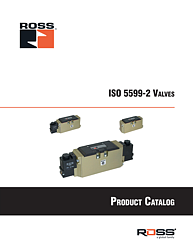
ROSS W65 Series ISO 5599-2 Directional Control Valves Technical Catalog
Download the comprehensive technical catalog for ROSS Controls W65 Series directional control valves, engineered to meet ISO 5599-2 international standards for pneumatic valve mounting interfaces. This essential resource provides complete specifications, dimensional data, electrical and pneumatic requirements, and installation guidance for industrial automation professionals specifying reliable directional control valve solutions.
Product Overview: ISO 5599-2 W65 Series Directional Control Valves
The ROSS W65 Series represents a complete line of base-mounted spool and sleeve directional control valves designed for demanding industrial pneumatic applications. Conforming to ISO 5599-2 mounting interface standards, these valves provide universal compatibility with standard manifold systems while delivering exceptional performance, reliability, and flexibility in both individual sub-base and manifold configurations.
Key Features and Engineering Advantages
Spool and Sleeve Construction for Superior Performance
The W65 Series utilizes proven spool and sleeve design technology, offering exceptional dirt tolerance in harsh industrial environments. Unlike poppet-style valves with vulnerable seal surfaces, the spool and sleeve construction eliminates seals subject to wear, significantly extending service life and reducing maintenance requirements. This robust design ensures consistent, reliable operation even in applications with contaminated air supplies.
Advanced Base Electrical Connector System
A defining feature of the W65 Series is the integrated base electrical connector, which eliminates the time-consuming need to disconnect individual wires when removing or replacing valves. This innovative design dramatically reduces maintenance downtime and simplifies troubleshooting procedures. Technicians can quickly swap valves for diagnostics or replacement without disrupting adjacent valve connections or shutting down entire manifold systems.
Flexible Mounting Options for System Integration
Engineers can specify W65 Series valves for individual sub-base mounting in standalone applications or integrate multiple valves into manifold base configurations for complex multi-actuator systems. Manifold bases feature optional modular plug-together electrical connections that terminate at end plates, offering convenient 25-pin D-sub or 19-pin round interfaces compatible with industrial control systems. This modular approach simplifies wiring, reduces installation labor, and enhances system reliability.
Automotive Connector Compatibility
For applications requiring standardized automotive-grade connections, the W65 Series offers an automotive connector option mounted on individual conduit covers. This feature is particularly valuable in mobile equipment, vehicle manufacturing, and applications where vibration resistance and environmental sealing are critical requirements.
Serial Bus System Integration
The W65 Series is adaptable to Serial Bus System communication protocols, enabling integration with modern industrial automation networks. This capability supports centralized monitoring, diagnostic feedback, and integration with PLC-based control systems for enhanced operational visibility and predictive maintenance strategies.
Complete Valve Size Range: ISO Size 1, 2, and 3
ISO Size 1 Valves: Compact Solutions for Space-Critical Applications
Dimensional Specifications:
- Length: 1.63 inches (41.4 mm)
- Width: Varies by configuration, 4.86 to 6.36 inches (123.5 to 161.6 mm)
- Height: 2.71 inches (68.8 mm)
- Weight: 0.8 to 1.5 lb (0.4 to 0.7 kg)
Performance Characteristics:
- Average Cv: 1.0
- Flow capacity: 980 Nl/min (normalized liters per minute)
- Ideal for precise control of small actuators and moderate flow applications
ISO Size 1 valves provide compact footprint solutions where mounting space is limited while maintaining the full functionality and reliability of the W65 Series design. These valves are commonly specified for small cylinder applications, clamping circuits, and auxiliary functions in automated machinery.
ISO Size 2 Valves: Versatile Mid-Range Performance
Dimensional Specifications:
- Length: 2.0 inches (50.8 mm)
- Width: Varies by configuration, 5.93 to 8.89 inches (150.6 to 225.8 mm)
- Height: 2.77 inches (70.4 mm)
- Weight: 0.8 to 2.5 lb (0.4 to 1.2 kg)
Performance Characteristics:
- Average Cv: 2.3
- Flow capacity: 2,300 Nl/min
- Optimized for medium-sized actuators and general industrial applications
ISO Size 2 represents the most versatile valve size in the W65 Series, offering excellent balance between flow capacity, physical size, and mounting flexibility. These valves are widely specified across manufacturing industries for material handling, assembly automation, packaging machinery, and general pneumatic control applications.
ISO Size 3 Valves: High-Flow Industrial Applications
Dimensional Specifications:
- Length: 2.54 inches (64.5 mm)
- Width: 9.76 inches (247.9 mm)
- Height: 3.18 inches (80.8 mm)
- Weight: 4.0 lb (1.9 kg)
Performance Characteristics:
- Average Cv: 3.4
- Flow capacity: 3,300 Nl/min
- Designed for large actuators and high-volume air consumption applications
ISO Size 3 valves deliver maximum flow capacity for demanding applications requiring rapid actuator response, high cycle rates, or control of large-bore cylinders. Common applications include heavy-duty clamping systems, large press automation, automotive body assembly fixtures, and high-speed packaging lines.
Actuation Options: Electrical Solenoid and Pneumatic Pilot Control
Solenoid Pilot Controlled Valves
Electrical Actuation Advantages:
The W65 Series solenoid pilot controlled valves combine electrical signal convenience with pneumatic pilot amplification, delivering high shifting forces with minimal electrical power consumption. This hybrid approach enables reliable operation even at maximum operating pressures while maintaining low heat generation and extended solenoid life.
Voltage Options:
- 24 VDC (most common in industrial automation)
- 110/120 VAC (for utility power applications)
Electrical Specifications:
- Power consumption: 3.5 watts on DC at 10 bar (exceptionally efficient)
- Power consumption: 6.5 VA holding on 50 or 60 Hz AC
- Duty rating: Continuous duty for sustained operation without thermal overload
Connection Types:
- Hardwired: Direct wire terminations for permanent installations
- Plug-in connector: Quick-disconnect convenience for maintenance and troubleshooting
- 4-pin M12 automotive connector: Industrial-grade sealed connections
Manual Override:
All solenoid pilot controlled valves include non-locking manual override capability, allowing technicians to manually actuate valves during setup, troubleshooting, or emergency situations without applying electrical power.
Pilot Supply Configuration:
Solenoid pilot controlled valves offer internal or external pilot supply selection, automatically adapting based on manifold configuration. Internal pilot uses inlet air pressure to shift the valve, simplifying plumbing. External pilot allows independent control pressure sources for specialized applications.
Pressure Controlled Valves
Pneumatic Actuation for Air-Powered Systems:
Pressure controlled valves in the W65 Series respond directly to pneumatic pilot signals, eliminating electrical requirements entirely. This actuation method is ideal for hazardous environments where electrical spark risk must be eliminated, remote locations without convenient electrical power, or systems designed for fail-safe operation using compressed air control.
Pilot Type:
All pressure controlled valves use external pilot supply, requiring dedicated pilot air connections (typically 1/8" NPT ports marked "12" and "14" on valve bodies).
Pilot Supply Requirements:
Pilot pressure must equal or exceed inlet pressure for reliable valve shifting. Minimum pilot pressure: 30 psig (2 bar). Engineers must ensure pilot air supply maintains adequate pressure margin above system operating pressure throughout all operating conditions.
Valve Functions: 5/2 and 5/3 Configurations
5/2 Two-Position Directional Control
Function Description:
5-way, 2-position valves provide two distinct flow path configurations:
- 5-way: Five functional ports (Pressure inlet, two work ports, two exhaust ports)
- 2-position: Two stable positions (activated and deactivated states)
Available Configurations:
- Single Solenoid, Spring Return: Single electrical input shifts valve; internal spring returns valve to default position when de-energized (fail-safe operation)
- Double Pilot, Detented: Two pneumatic inputs provide bidirectional control; valve remains in last-commanded position without continuous pilot signal (memory function)
Applications:
5/2 valves are specified for single-acting cylinders, double-acting cylinders with preferred return position, and applications requiring definite default states for safety or process requirements. Common uses include clamping, ejection, sorting, and directional control where one position represents the safe or neutral machine state.
5/3 Three-Position Directional Control
Function Description:
5-way, 3-position valves provide three distinct flow path configurations with a defined center position:
- 5-way: Five functional ports (identical to 5/2 configuration)
- 3-position: Two active positions plus one center position
Center Position Options:
Power Center (Open Center):
All ports interconnected in center position, allowing free actuator movement. Work ports A and B connect to each other and to exhaust, while pressure port blocks. This configuration enables manual positioning of actuators and is commonly used in applications requiring mid-stroke stopping or load floating capability.
Closed Center (All Ports Blocked):
All five ports blocked in center position, trapping air in both sides of double-acting cylinders. This configuration provides hydraulic-like locking of actuator position without continuous air consumption. Ideal for holding loads against external forces, maintaining precise positioning, or preventing actuator drift during machine indexing cycles.
Exhaust Center:
Work ports A and B connect to exhaust while pressure port blocks. This configuration vents both cylinder chambers, allowing free actuator movement and is used where controlled deceleration or manual positioning is required.
Actuation Options:
- Double Solenoid, Detented: Two independent solenoids control valve position; valve memory maintains position when both solenoids are de-energized
- Double Pilot, Detented: Pneumatic pilot signals control position; detented mechanism holds last position
Applications:
5/3 valves are essential for applications requiring mid-stroke stops, controlled deceleration, load holding, or actuator floating. Common specifications include stamping press control, adjustable positioning systems, multi-position indexing, and automated assembly stations requiring intermediate holding positions.
Default Position Configuration
Normally Open (High Pressure Default)
Valve design where work port A connects to pressure port P in the de-energized or non-piloted state. This configuration is specified when default position requires actuator extension or when system safety requires a specific default actuator position.
Normally Closed (Low Pressure Default)
Valve design where work port B connects to pressure port P (or in some configurations, A port exhausts) in the de-energized state. Engineers specify normally closed valves when retracted actuator position represents the safe machine state.
Operating Parameters and Environmental Specifications
Fluid Media Requirements
Filtered Air: W65 Series valves require clean, dry, filtered compressed air conforming to ISO 8573-1 air quality standards. Recommended filtration: 40 microns or finer. Moisture content should be minimized through adequate air dryer systems to prevent internal corrosion and seal degradation.
Operating Pressure Range
Standard Pressure Range:
- Minimum: 30 to 15 psig (2 to 1 bar) depending on valve size and actuation type
- Maximum: 150 psig (10 bar)
- Optimal operating range: 60-125 psig for longest service life and best efficiency
Pressure Considerations:
Solenoid pilot controlled valves require minimum 15-30 psig for reliable pilot function depending on configuration. Lower pressures may result in incomplete valve shifting or sluggish response. Pressure controlled valves absolutely require pilot pressure equal to or greater than inlet pressure.
Temperature Specifications
Ambient Temperature Range:
- Solenoid actuated: 40°F to 120°F (4°C to 50°C)
- Pneumatic actuated: 40°F to 175°F (4°C to 80°C)
Media Temperature Range:
- All configurations: 40°F to 175°F (4°C to 80°C)
Temperature Application Notes:
Standard temperature seals (Buna-N) provide reliable performance within specified ranges. For extreme temperature applications exceeding standard ranges, consult ROSS Controls engineering for fluoroelastomer seal options or specialized construction.
Materials of Construction
Valve Body Material:
Cast aluminum alloy provides excellent strength-to-weight ratio, corrosion resistance, and thermal conductivity for heat dissipation. Aluminum construction reduces manifold weight in multi-valve assemblies while maintaining structural integrity.
Poppet/Spool Material:
Precision-machined stainless steel provides exceptional wear resistance, corrosion resistance, and dimensional stability throughout millions of operating cycles. Stainless steel ensures consistent internal clearances for leak-free performance and long service life.
Seal Material:
Standard Buna-N (nitrile rubber) elastomer seals offer excellent compatibility with compressed air, wide temperature range, and proven reliability in industrial pneumatic applications. Buna-N provides optimal balance of sealing performance, chemical resistance, and cost-effectiveness.
Manifold System Integration
Manifold Base Advantages
Space Efficiency:
Manifold mounting consolidates multiple valves into minimal footprint, dramatically reducing pneumatic tubing, fittings, and panel space requirements compared to individually mounted valves. A six-valve manifold assembly can reduce installation space by 60-70% versus separate sub-base mounting.
Simplified Pneumatic Plumbing:
Common inlet and exhaust galleries within manifold body eliminate individual supply and exhaust tubing to each valve. Single inlet and exhaust connections serve entire valve bank, reducing potential leak points, simplifying maintenance, and improving system reliability.
Integrated Electrical Distribution:
Modular plug-together electrical connections within manifold bases eliminate individual valve wiring. Electrical signals route through manifold body to termination at end plates with standardized 25-pin D-sub or 19-pin round connectors, enabling single-cable connection to control systems.
System Scalability:
Manifold systems easily expand or reconfigure by adding valve stations, blanking plates, or auxiliary components. This flexibility supports equipment modifications, production changes, and future automation upgrades without wholesale system redesign.
Manifold Components and Accessories
Manifold Sub-Bases:
Individual sub-bases provide single-valve mounting capability with standard port connections (NPT or BSPP threads). Sub-bases enable rapid valve replacement while maintaining fixed plumbing connections.
Manifold Stations:
Intermediate stations connect multiple valves in series, providing common inlet and exhaust galleries. Available in configurations matching all ISO sizes with appropriate porting patterns.
End Stations:
Terminal stations cap manifold assemblies, providing inlet and exhaust connections, electrical termination, and structural support. Multiple port configurations available including side-ported and bottom-ported versions.
Blanking Plates:
Blanking plates (Part 2604H77 series) occupy unused manifold stations, maintaining pressure gallery continuity while reserving positions for future valve additions. This cost-effective approach enables system expansion without manifold replacement.
Base Size Transition Plates:
Transition plates (Part 729K86 series) enable connection of different ISO size valves within single manifold assembly. Engineers can optimize each valve position for specific actuator requirements while maintaining integrated manifold benefits.
Interposed Regulators and Modules:
Pressure regulation modules install between manifold base and individual valves, providing independent pressure control for specific actuators without requiring separate external regulators.
Response Time and Performance Characteristics
Valve Response Constants
Response Time Definition:
Response time represents the interval between electrical input signal (or pilot pressure application) and complete valve spool travel, measured in milliseconds. Actual response time varies based on inlet pressure, pilot supply pressure, and flow path configuration.
Factors Affecting Response:
- Inlet Pressure: Higher inlet pressure generally improves response time due to increased shifting force
- Pilot Supply Pressure: Adequate pilot pressure (equal to or exceeding inlet pressure) ensures optimal response
- Valve Size: Smaller valves (Size 1) typically respond faster than larger valves due to reduced spool mass
- Solenoid Energization: Response time includes solenoid coil energization delay (typically 5-15 milliseconds)
Application Considerations:
For applications requiring precise timing or rapid cycling (>10 cycles per minute), consult detailed response time data in the catalog technical specifications section. Consider adding pilot exhaust restrictors for controlled deceleration in applications sensitive to cylinder slamming.
Installation Guidelines and Best Practices
Mounting Requirements
Sub-Base Installation:
Mount individual sub-bases on flat, rigid surfaces using appropriate fasteners through mounting holes. Ensure mounting surface flatness within 0.002" over port pattern area to prevent distortion causing internal leakage. Torque mounting bolts to 90-110 in-lbs following diagonal sequence to prevent warping.
Manifold Assembly:
Assemble manifold components with tie rods threaded through entire assembly. Torque tie rod nuts evenly following manufacturer specifications to ensure uniform compression and seal integrity across all stations. Install manifold assembly on rigid mounting surface with adequate clearance for plumbing and electrical connections.
Plumbing Connections
Port Identification:
Standard ISO 5599-2 port marking:
- P: Pressure inlet (supply air)
- A, B: Work ports (to actuator)
- R, S: Exhaust ports
- 12, 14: Pilot inputs (pressure controlled valves and external pilot connections)
- X: Pressure monitoring (select models)
Thread Sealant Application:
Use thread sealant compound (never PTFE tape on pneumatic connections to avoid particle contamination) applied to male threads only. Use sparingly, keeping first 2-3 threads clean to prevent sealant entering valve body. Allow adequate cure time before pressurizing.
Tube Fitting Installation:
Install push-to-connect or threaded tube fittings following manufacturer torque specifications. Support tubing runs to prevent vibration transmission to valve body. Use appropriately sized tubing matching valve port size to optimize flow performance.
Electrical Connections
Wiring Best Practices:
Route valve electrical wiring separately from high-voltage power cables to minimize electromagnetic interference. Use properly sized wire gauge for current requirements and cable length. Follow NEC (National Electrical Code) and local electrical codes for industrial control wiring.
Grounding:
Ensure proper grounding of manifold assembly and electrical enclosures per applicable safety standards. Ground conductor must provide reliable path for fault current and static electricity dissipation.
Environmental Protection:
Protect electrical connections from moisture, coolant spray, and contaminants using appropriate conduit seals, connector boots, or enclosures rated NEMA 4 or IP65 minimum for industrial environments.
Applications and Industry Solutions
Manufacturing and Assembly Automation
W65 Series valves control clamping, part ejection, component feeding, and material transfer throughout automated manufacturing cells. Manifold-mounted configurations provide centralized control of multiple axes in assembly stations, robotic work cells, and transfer line automation.
Packaging Machinery
High-speed packaging applications leverage W65 Series reliability and fast response times for carton forming, product insertion, sealing, and labeling operations. Compact ISO Size 1 valves excel in space-constrained packaging machine designs.
Material Handling Systems
Automated warehousing, sortation systems, and conveyor control systems specify W65 Series valves for diverter gates, pneumatic stops, transfer mechanisms, and load positioning. The detented function options provide energy-efficient control by eliminating continuous air consumption in holding positions.
Automotive Manufacturing
Body assembly fixtures, paint line transfer systems, and final assembly automation utilize W65 Series manifold systems for coordinated multi-cylinder control. Automotive connector options integrate seamlessly with PLC-based control architecture prevalent in automotive facilities.
Food and Beverage Processing
Cast aluminum construction and stainless steel internal components resist corrosion in washdown environments common to food processing applications. W65 Series valves control dosing, filling, capping, and conveying operations while meeting sanitation requirements with proper mounting protection.
Technical Support and Product Selection
Catalog Contents Overview
This comprehensive catalog provides essential information including:
Detailed Product Specifications:
Complete electrical, pneumatic, dimensional, and performance data for all W65 Series valve configurations enabling precise specification selection.
Function Symbols and Schematics:
Standard ISO 1219-1 pneumatic symbols illustrate each valve function, center position configuration, and actuation method for simplified system design documentation.
Dimensional Drawings:
Precision outline dimensions, port locations, mounting hole patterns, and clearance requirements support accurate machine design integration and interference checking.
Manifold System Dimensions:
Complete dimensional data for manifold bases, end stations, and accessories enable manifold assembly design and panel layout planning.
Performance Curves:
Flow rate versus pressure drop curves assist in system analysis, actuator speed calculations, and air consumption estimation for compressor sizing.
Ordering Information:
Complete part numbering system explanation with configuration code breakdown simplifies correct product specification and procurement.
Installation Instructions:
Mounting procedures, torque specifications, and pneumatic connection guidelines ensure proper installation and optimal performance.
Maintenance Recommendations:
Service intervals, troubleshooting guidance, and replacement procedures maximize system uptime and service life.
ROSS Controls Engineering Support
The ROSS Controls engineering team provides comprehensive technical support including:
- Application consultation and valve selection assistance
- Custom manifold design and integration engineering
- CAD models and 3D solid model files for machine design integration
- Performance analysis and actuator sizing calculations
- Safety system design guidance and compliance verification
- On-site installation support and commissioning assistance
Why Specify ROSS Controls W65 Series
Proven Reliability
Over 75 years of pneumatic control expertise ensures W65 Series valves deliver consistent performance in demanding industrial environments. Extensive application experience across diverse industries validates design robustness and longevity.
Global Standards Compliance
ISO 5599-2 conformance ensures universal compatibility with standard components from multiple manufacturers, protecting your investment through standardized interfaces and enabling global procurement flexibility.
Comprehensive Product Range
Complete offering of sizes, functions, actuation options, and mounting configurations enables single-source procurement while maintaining design flexibility for complex control requirements.
Technical Innovation
Base electrical connector system, plug-together manifold wiring, and Serial Bus System compatibility represent ROSS Controls' commitment to innovation that simplifies installation, reduces maintenance costs, and supports Industry 4.0 initiatives.
Made in USA
Domestic manufacturing in Troy, Michigan ensures consistent quality, responsive delivery, and local technical support backed by comprehensive ISO 9001 certified quality management systems.
Industry-Leading Warranty
ROSS Controls stands behind W65 Series quality with comprehensive warranty protection and responsive field service support throughout North America.
Download Your Complete W65 Series Catalog Today
Access the full technical catalog to review detailed specifications, dimensional data, ordering information, and application guidelines for the complete ROSS W65 Series ISO 5599-2 directional control valve line. This essential reference provides the comprehensive information engineers need to specify the optimal valve configuration for your pneumatic control application.
Catalog Features:
- Complete technical specifications for all valve sizes and configurations
- Detailed dimensional drawings with mounting dimensions
- Electrical and pneumatic schematic symbols
- Performance curves and flow data
- Manifold system design information
- Installation and maintenance guidelines
- Part numbering system explanation
- Accessory and component selection guide
Download now to access this valuable engineering resource for your next pneumatic control system design project.