




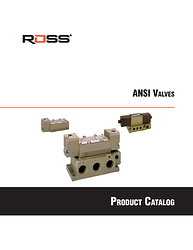
ROSS W70 & W74 ANSI Pneumatic Valve Series - Complete Technical Catalog
Download the Complete W70 & W74 ANSI Valve Series Catalog
Access comprehensive technical documentation for ROSS Controls' industry-leading W70 and W74 series ANSI-compliant pneumatic directional control valves. This detailed catalog provides engineers, maintenance professionals, and procurement specialists with essential specifications, dimensional drawings, installation instructions, and application guidelines necessary for proper valve selection, installation, and operation.
The ROSS W70 and W74 ANSI valve series represents decades of engineering excellence in pneumatic control technology, designed to meet the rigorous requirements of American National Standards Institute (ANSI) specifications for valve-to-base interface configurations. These valves are trusted across manufacturing, automation, and industrial processing applications worldwide for their reliability, performance, and compliance with industry standards.
W70 & W74 Series Overview - ANSI-Compliant Pneumatic Control Solutions
What Makes the W70 & W74 Series Unique
The ROSS W70 and W74 ANSI valve series delivers exceptional performance through innovative design and precision manufacturing. These base-mounted directional control valves conform to American National Standards Institute (ANSI) standards, ensuring universal compatibility with ANSI-standard bases and enabling seamless integration into existing pneumatic systems.
Available in both spool & sleeve and poppet construction, the W70 and W74 series offers engineers flexible solutions for diverse application requirements. The W70 series features durable spool and sleeve design with no internal seals to wear out, providing extended service life and minimal maintenance requirements. The W74 series utilizes poppet construction with rubber-coated aluminum and stainless steel components, delivering reliable sealing performance across a wide operating range.
Both series feature pilot operation that provides high shifting force with remarkably low power consumption, making them ideal for energy-efficient industrial automation systems. The non-locking manual override capability allows for safe manual operation during maintenance procedures or emergency situations, while individual sub-base or manifold base mounting options provide installation flexibility for various system configurations.
Available Valve Sizes and Flow Capacities
The W70 and W74 ANSI valve series encompasses five standard ANSI sizes to accommodate different flow requirements:
- ANSI Size 1: Average Cv of 1.0, compact design for applications requiring precise control with minimal air consumption
- ANSI Size 2.5: Average Cv ranging from 1.9 to 2.5, ideal for medium-flow applications balancing performance and footprint
- ANSI Size 4: Average Cv of 4.2, the most versatile size suitable for general industrial applications
- ANSI Size 10: Average Cv of 10.0 to 11.0, designed for high-flow requirements in larger cylinders and actuators
- ANSI Size 20: Maximum flow capacity for heavy-duty industrial applications requiring substantial air volume
This comprehensive size range ensures that engineers can select the optimal valve size for their specific application, maximizing efficiency while minimizing compressed air consumption and operating costs.
Technical Specifications and Performance Characteristics
Valve Construction Options
Spool and Sleeve Construction (W70 Series)
The W70 series features precision-machined stainless steel spools operating within aluminum sleeves, providing metal-to-metal sealing without traditional elastomeric seals. This design eliminates seal wear as a failure mode, resulting in extended service life and reduced maintenance costs. The spool and sleeve construction delivers excellent performance across the full operating pressure range, from vacuum service to 150 psig (10 bar).
Key benefits of spool and sleeve construction include:
- No internal seals to wear, stick, or deteriorate
- Superior performance in contaminated air applications
- Consistent shifting force throughout service life
- Excellent low-pressure and vacuum service capability
- Temperature stability from 40°F to 175°F (4°C to 80°C)
Poppet Construction (W74 Series)
The W74 series employs poppet design with rubber-coated aluminum and stainless steel components, delivering positive sealing with minimal internal leakage. Poppet valves provide fast switching speeds and are particularly well-suited for applications requiring tight shutoff and precise position control.
Advantages of poppet construction include:
- Minimal internal leakage for improved energy efficiency
- Fast response times for high-speed applications
- Positive sealing in both directions
- Suitable for applications requiring zero-leakage performance
- High-temperature variants available (up to 220°F/105°C media temperature)
Actuation and Function Options
The catalog provides detailed specifications for multiple actuation methods and valve functions:
Electrical Actuation Options:
- Single solenoid operation with spring or pneumatic return
- Double solenoid operation for detented (maintained) positions
- Direct solenoid actuation for smaller sizes (1 and 2.5)
- Pilot solenoid actuation for larger sizes (4, 10, and 20)
- Voltage options: 24 VDC, 110/120 VAC, and other voltages available
- Continuous duty rating with low power consumption (14-20 watts DC, 24-30 VA holding AC)
Pneumatic Actuation Options:
- Single pilot operation with spring return
- Double pilot operation for detented positions
- External pilot supply for independent control
- Internal/external pilot supply flexibility
Valve Functions:
- 5/2-way, 2-position operation for simple extend/retract applications
- 5/3-way, 3-position operation with center position options (open, closed, or exhaust center)
- Normally open or normally closed default positions
- Spring return, pneumatic return, or detented configurations
Operating Parameters and Environmental Specifications
Pressure Specifications:
- Operating Pressure Range: Vacuum to 150 psig (0 to 10 bar)
- Pilot Supply Minimum: Equal to or greater than inlet pressure
- Suitable for vacuum service with external pilot supply
Temperature Specifications:
- Standard Application Ambient Temperature: 40°F to 120°F (4°C to 50°C)
- Standard Application Media Temperature: 40°F to 175°F (4°C to 80°C)
- High-Temperature Application Ambient: 40°F to 175°F (4°C to 80°C)
- High-Temperature Application Media: 40°F to 220°F (4°C to 105°C)
Media and Filtration Requirements:
- Fluid Media: Filtered compressed air
- Filtration Recommendation: 40-micron filtration or better
- Lubrication: Not required (compatible with lubricated or non-lubricated air)
Installation and Mounting Configurations
Base Mounting Options
The W70 and W74 series valves feature standardized ANSI mounting interfaces, ensuring compatibility with industry-standard valve bases. The catalog includes detailed dimensional drawings and mounting specifications for:
Individual Sub-Base Mounting:
Individual bases provide flexibility for single-valve installations and simplify valve replacement during maintenance. Each valve mounts directly to its dedicated sub-base, which includes the pneumatic port connections and optional electrical connection interface.
Manifold Base Mounting:
Manifold mounting enables compact installation of multiple valves in a centralized location, reducing piping complexity and installation time. Manifold systems provide common inlet, exhaust, and outlet ports, with individual valve control for each cylinder or actuator.
The standardized ANSI interface ensures that valves from different manufacturers can be interchanged, though ROSS Controls' superior quality and performance characteristics make the W70 and W74 series the preferred choice for demanding applications.
Electrical Connection Methods
Hardwired Connections:
Traditional hardwired connections provide robust, reliable electrical interface for industrial environments. The catalog specifies wire gauge requirements, terminal configurations, and recommended conduit fittings.
Plug-and-Socket Connections:
ANSI-standard electrical connectors enable quick valve replacement without rewiring. Plug-and-socket connections are integrated into compatible valve bases, allowing maintenance personnel to swap valves in minutes rather than hours.
Key Features and Operational Benefits
Pilot Operation Advantages
Pilot-operated design delivers high shifting force with minimal power consumption, providing several operational advantages:
- Energy Efficiency: Solenoid power consumption as low as 14 watts DC or 24 VA holding AC
- Reliable Shifting: Pilot pressure multiplies switching force, ensuring reliable operation even at low inlet pressure
- Extended Coil Life: Lower power requirements reduce coil heating, extending solenoid service life
- Reduced Electrical Infrastructure Costs: Lower current draw minimizes wiring gauge and power supply requirements
Manual Override Capability
Non-locking manual override buttons allow operators to manually shift valves during setup, troubleshooting, or emergency situations. The non-locking feature ensures that valves return to normal electrical or pneumatic control when the override button is released, preventing inadvertent manual operation that could create safety hazards.
Vacuum Service Capability
When equipped with external pilot supply, both W70 and W74 series valves can operate reliably in vacuum applications. This capability expands application possibilities to include:
- Vacuum conveying systems
- Pick-and-place automation with vacuum grippers
- Vacuum packaging equipment
- Material handling systems using vacuum technology
Dimensional and Weight Specifications
The catalog provides comprehensive dimensional drawings for all valve sizes, including:
ANSI Size 1 Dimensions:
- Length: 2.33 inches (59 mm)
- Width range: 5.1 to 7.25 inches (129 to 184 mm) depending on configuration
- Height range: 1.97 to 3.57 inches (50 to 91 mm)
- Weight range: 2.5 to 3.0 lb (1.1 to 1.4 kg)
ANSI Size 2.5 Dimensions:
- Length: 2.63 inches (67 mm)
- Width range: 7.25 to 10.75 inches (184 to 273 mm)
- Height range: 2.60 to 3.57 inches (66 to 91 mm)
- Weight range: 3.0 to 5.0 lb (1.4 to 2.3 kg)
ANSI Size 4 Dimensions:
- Length: 3.46 inches (88 mm)
- Width range: 6.80 to 9.79 inches (173 to 249 mm)
- Height range: 2.64 to 3.96 inches (67 to 101 mm)
- Weight range: 4.3 to 6.5 lb (1.9 to 2.9 kg)
ANSI Size 10 Dimensions:
- Length: 3.9 inches (99 mm)
- Width range: 8.30 to 12.06 inches (211 to 306 mm)
- Height range: 2.57 to 3.97 inches (65 to 101 mm)
- Weight range: 6.1 to 8.5 lb (2.8 to 3.8 kg)
These precise dimensions enable engineers to plan installation layouts, design mounting brackets, and ensure adequate clearance for valve operation and maintenance access.
Materials of Construction and Seal Options
Valve Body Construction
Cast Aluminum Body:
All W70 and W74 series valves feature high-quality cast aluminum bodies that provide:
- Excellent strength-to-weight ratio for durable yet lightweight construction
- Superior corrosion resistance in industrial environments
- Good thermal conductivity for consistent operation across temperature ranges
- Precise machining surfaces for leak-free porting
Internal Component Materials
Poppet/Spool Materials:
- W70 Series: Precision-ground stainless steel spools for long service life
- W74 Series: Rubber-coated aluminum poppets with stainless steel components for positive sealing
Seal Material:
Standard Buna-N (nitrile) seals provide excellent performance with filtered compressed air across the full operating temperature range. Alternative seal materials are available for special applications requiring chemical compatibility or extended temperature ranges.
Application Guidelines and System Integration
Typical Applications
The W70 and W74 ANSI valve series excels in diverse industrial automation applications:
Manufacturing and Assembly Operations:
- Pneumatic actuator control for assembly equipment
- Material handling and transfer systems
- Robotic end-of-arm tooling actuation
- Clamping and fixturing control
Material Processing:
- Conveyor diverters and gates
- Press and stamping machinery
- Packaging equipment actuation
- Printing and converting machinery
General Industrial Automation:
- Machine tool work holding and positioning
- Cylinder extend/retract control
- Air-powered tooling and equipment
- Process control valve actuation
System Design Considerations
Air Preparation:
Proper air preparation is essential for optimal valve performance and service life. The catalog recommends:
- Filtration to 40 microns or better to protect internal components
- Pressure regulation to maintain consistent operating pressure
- Water removal to prevent corrosion and freezing
- Optional lubrication for enhanced performance (though not required)
Electrical System Integration:
When integrating W70 and W74 valves into electrical control systems, consider:
- Appropriate voltage selection matching control system power supply
- Inrush current requirements for proper relay or solid-state output sizing
- Surge suppression devices to protect control circuits
- Compliance with local electrical codes and standards
Pneumatic Circuit Design:
Effective pneumatic circuit design maximizes valve performance:
- Proper port sizing to minimize pressure drop
- Adequate exhaust capacity to ensure rapid cylinder motion
- Flow control valve placement for speed control when needed
- Pressure sensing for position verification when required
Catalog Contents and Technical Resources
What's Inside the Complete Catalog
The comprehensive W70 & W74 ANSI valve series catalog includes:
Product Selection Guides:
- Flow capacity charts for proper valve sizing
- Valve function selection matrices
- Actuation method comparison tables
- Application-specific recommendations
Technical Specifications:
- Complete dimensional drawings with mounting hole patterns
- Electrical specifications and wiring diagrams
- Pneumatic port configurations and thread specifications
- Performance curves showing flow vs. pressure relationships
Installation Instructions:
- Step-by-step installation procedures
- Torque specifications for mounting bolts
- Pneumatic connection requirements
- Electrical connection guidelines
Maintenance Information:
- Recommended maintenance intervals
- Troubleshooting guides
- Spare parts identification
- Seal replacement procedures
Compliance and Certifications:
- ANSI standard compliance documentation
- Safety certifications and approvals
- Environmental compliance information
- Quality system certifications
Why Choose ROSS Controls W70 & W74 ANSI Valves
ROSS Controls has been the trusted name in fluid power control for over 50 years, providing innovative solutions that enhance safety, reliability, and productivity in industrial automation systems. The W70 and W74 ANSI valve series embodies this commitment to excellence through:
Proven Reliability:
Millions of ROSS valves operate successfully in demanding applications worldwide, demonstrating consistent performance and long service life that reduces total cost of ownership.
Technical Support:
ROSS Controls provides comprehensive technical support, including application engineering assistance, system design consultation, and responsive customer service to ensure successful implementation.
Industry-Standard Compliance:
ANSI compliance ensures compatibility with existing systems and provides procurement flexibility while maintaining the superior quality that ROSS Controls is known for.
Application Expertise:
With decades of experience across diverse industries, ROSS Controls engineers understand real-world application requirements and can recommend optimal solutions for your specific needs.
Request Additional Information or Technical Support
The ROSS Controls technical team is available to answer questions, provide application assistance, and help specify the optimal valve configuration for your requirements. Contact ROSS Controls for:
- Custom valve configurations
- Application-specific engineering support
- Quotations for volume requirements
- Replacement parts and maintenance support
- Training and technical seminars
Download the complete W70 & W74 ANSI valve series catalog today to access detailed specifications, installation instructions, and technical resources essential for successful pneumatic system design and implementation.