




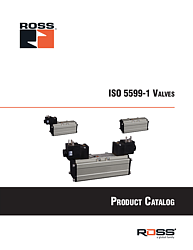
ROSS W60 & W64 Series ISO 5599-1 Directional Control Valves - Complete Technical Catalog
Professional-Grade Pneumatic Valves for Industrial Automation
The ROSS W60 and W64 Series directional control valves represent industry-leading solutions for pneumatic automation systems. These base-mounted valves conform to the internationally recognized ISO 5599-1 mounting interface standard, ensuring universal compatibility and interchangeability across global manufacturing operations. This comprehensive technical catalog provides engineers, procurement specialists, and maintenance professionals with detailed specifications, ordering information, dimensional data, and application guidance for both valve series.
W60 Series - Spool & Sleeve Construction for Precision Control
Advanced Spool and Sleeve Design
The W60 Series features a precision-engineered spool and sleeve construction that delivers exceptional performance in demanding industrial environments. Unlike conventional valve designs that rely on elastomeric seals prone to wear, the W60's spool and sleeve configuration eliminates seal degradation, providing consistent operation over millions of cycles. This robust design offers several critical advantages for industrial automation applications.
The stainless steel spool operates within an aluminum sleeve with minimal clearance, creating a fluid film that allows the spool to "float" during operation. This design reduces friction forces and ensures smooth, reliable actuation while maintaining excellent sealing characteristics. The absence of dynamic seals eliminates a common failure mode in pneumatic valves, significantly extending service life and reducing maintenance requirements.
W60 Series Technical Specifications
The catalog details W60 valves available in ISO Sizes 1, 2, and 3, with port sizes ranging from 1/8" to 3/4". Flow capacities are optimized for each size: ISO Size 1 delivers 0.8 Cv (790 Nl/min), Size 2 provides 1.9 Cv (1900 Nl/min), and Size 3 offers 3.8 Cv (3700 Nl/min). These flow ratings ensure adequate pneumatic power for a wide range of actuator sizes and application requirements.
Operating pressure ranges from full vacuum to 150 psig (10 bar), making W60 valves suitable for both standard compressed air systems and vacuum service applications. The temperature range accommodates ambient conditions from 40° to 120°F (4° to 50°C) for solenoid pilot controlled valves, with media temperatures up to 175°F (4° to 80°C). Pressure controlled valves extend the ambient temperature range to 175°F, providing flexibility for elevated temperature environments.
W64 Series - Poppet Valve Technology for Contaminated Environments
Contamination-Resistant Poppet Design
The W64 Series employs poppet valve technology specifically engineered for applications involving contaminated air or harsh operating conditions. Poppet valves utilize a ball, cone, or plate element that seals against a valve seat by spring force, providing superior leak tightness compared to spool valves. The W64's poppet design is highly tolerant of airborne contaminants and exhibits self-compensating wear characteristics that maintain performance over the valve's service life.
The poppet configuration's self-cleaning action results from high-velocity flow across the sealing surfaces, which continuously removes dirt and particulate matter. This feature makes W64 valves ideal for applications in concrete batching, mining, packaging, and other industries where air quality cannot be strictly controlled. The positive sealing action with no sliding contact prevents seal damage and ensures consistent operation even with ingested contamination.
W64 Series Technical Specifications and Temperature Options
W64 valves are manufactured in ISO Sizes 1, 2, and 3 with enhanced flow capacities: Size 1 delivers 1.0 Cv (980 Nl/min), Size 2 provides 2.0 Cv (2000 Nl/min), and Size 3 offers 4.0 Cv (3900 Nl/min). The operating pressure range is 30 to 150 psig (2 to 10 bar), optimized for the poppet valve design's sealing requirements.
A distinctive feature of the W64 Series is the availability of both standard and high-temperature variants. Standard temperature valves accommodate media temperatures from 40° to 175°F (4° to 105°C), while high-temperature models extend this range to 220°F (4° to 105°C). The high-temperature versions utilize fluorocarbon seals instead of standard Buna-N, enabling operation in elevated temperature applications such as drying systems, heat processing, and thermoplastic molding operations.
Comprehensive Valve Configurations and Functions
Actuation Methods: Solenoid Pilot and Pressure Controlled
Both W60 and W64 Series valves are available with multiple actuation options to suit diverse automation architectures. Solenoid pilot controlled valves feature low-power electrical coils (6 watts DC, 5.8-6.5 watts AC) that direct pilot air pressure to shift the main valve element. This pilot operation provides high shifting force with minimal electrical power consumption, making these valves ideal for control systems with multiple valve stations.
Solenoid valves are offered with single or double solenoid configurations for 5/2 function, and double solenoid only for 5/3 function. All solenoid valves include non-locking manual overrides, facilitating manual operation during setup, troubleshooting, or emergency situations. The DIN EN 175301-803 Form A electrical connector is standard, ensuring compatibility with widely available cable assemblies and connectors.
Pressure controlled (pneumatic pilot) valves eliminate electrical components entirely, operating on pneumatic signals alone. These valves are essential for intrinsically safe applications, electrically classified hazardous locations, and systems where electrical infrastructure is unavailable. The catalog includes single and double pilot pressure controlled valves in both 5/2 and 5/3 configurations.
5/2 and 5/3 Valve Functions with Center Position Options
The catalog thoroughly documents 5/2 (five-port, two-position) and 5/3 (five-port, three-position) valve functions. In 5/2 valves, the five ports include inlet (1), two outlets to actuator (2 and 4), two exhausts (3 and 5), with pilot ports 12 and 14 for control signals. The two-position function allows the valve to switch between two stable states, directing pressure alternately to each actuator port.
5/3 valves add a center position, available in three critical configurations: power center, closed center, and open center. In power center, the center position connects pressure to both actuator ports simultaneously, useful for clamping applications. Closed center blocks all ports in the neutral position, maintaining actuator position under load. Open center exhausts both actuator ports in neutral, allowing free actuator movement. These center position options enable sophisticated control strategies for complex automation sequences.
Mounting Solutions for Flexible System Integration
Individual Sub-Base Mounting
The catalog presents comprehensive sub-base mounting options for both side-ported and bottom-ported configurations. Individual sub-bases provide the interface between the ISO valve and system piping, with threaded ports in NPT or G (BSPP) thread forms. Side-ported bases facilitate horizontal plumbing layouts with ports oriented perpendicular to the valve mounting surface, while bottom-ported bases accommodate vertical plumbing with ports facing downward.
Sub-bases are available in sizes corresponding to each valve ISO size, with port sizes matched to optimize flow capacity. ISO Size 1 sub-bases accommodate 1/8" to 3/8" ports, Size 2 handles 3/8" to 1/2", and Size 3 supports 1/2" to 3/4" connections. The standardized mounting bolt patterns comply with ISO 5599-1 specifications, ensuring dimensional interchangeability with valves from multiple manufacturers worldwide.
Manifold Mounting for Compact Multi-Valve Systems
Manifold mounting enables multiple valves to be assembled on a common pressure and exhaust distribution system, dramatically reducing plumbing complexity and installation space. The catalog details manifold base stations that connect valves in series, with end station kits required to seal and port the manifold assembly. Manifold bases are available in both end-ported and bottom-ported configurations to accommodate different installation orientations.
A significant advantage of manifold mounting is the ability to mix different valve sizes on the same assembly using transition modules. The catalog specifies transition modules for connecting ISO Size 1 to Size 2, and Size 2 to Size 3, allowing system designers to right-size each valve position for its specific actuator while maintaining a unified manifold structure. This modularity reduces inventory requirements and simplifies system modifications.
Advanced Accessories and System Enhancements
Interposed Components for Enhanced Functionality
The catalog extensively covers interposed accessories that mount between the valve and sub-base, adding specialized functions without external plumbing. Interposed flow controls regulate exhaust flow from pneumatic cylinders, providing adjustable speed control for extension and retraction strokes. These units eliminate the need for external needle valves and associated tubing, reducing potential leak points.
Interposed pressure regulators allow independent pressure control for individual valve positions in a manifold assembly. This capability is critical when different actuators require different operating pressures, or when specific operations demand pressure reduction for safety or process reasons. The catalog details single and double pressure regulator models with various pressure ranges from 5 psig to 174 psig.
Interposed shut-off valves provide manual isolation of individual valve stations, facilitating maintenance without depressurizing the entire manifold. These manually actuated quarter-turn valves block all ports including pilot supply, enabling safe valve removal and replacement during system operation.
Electrical Connectors and Pneumatic Accessories
Pre-wired electrical connectors simplify field wiring and reduce installation time. The catalog specifies connectors with cable lengths of 2 meters (6.5 feet) in both standard and lighted versions, available for 24V DC, 120V AC, and 230V AC solenoid voltages. The lighted connectors incorporate LED indicators that illuminate when the solenoid is energized, providing valuable diagnostic feedback for troubleshooting and system monitoring.
Exhaust silencers are detailed for multiple port sizes from 1/4" to 3/4", addressing noise control requirements in industrial environments. These aluminum silencers accommodate pressures up to 290 psig (20 bar) and provide flow capacities matched to valve exhaust requirements, ensuring noise reduction without restricting exhaust flow or increasing back pressure.
Engineering Data for Precise Application Design
Response Time Calculations and Performance Optimization
The catalog provides valve response time data essential for calculating system cycle times and optimizing performance. Response time formulas use experimentally determined constants M and F for each valve size: Response Time (msec) = M + (F × V), where V is the volume in cubic inches to be filled or exhausted.
For W60 Size 1 single solenoid valves, M = 29 msec and F = 3.5-4.9 depending on valve configuration, while Size 3 valves achieve M = 51 msec with F = 0.8-1.1. These values enable engineers to predict actuator stroke times accurately, considering downstream volume, ensuring that valve sizing meets application speed requirements. Proper valve selection based on response time calculations prevents over-sizing that increases cost and under-sizing that compromises performance.
Detailed Dimensional Drawings and CAD Resources
Complete dimensional drawings in both inches and millimeters are provided for all valve models, sub-bases, manifold components, and accessories. These precisely dimensioned illustrations include mounting hole patterns, port locations, overall envelope dimensions, and connector positions, enabling accurate system layout and interference checking during design phases.
The catalog references downloadable CAD models available for all products, supporting 3D design workflows. These digital models can be imported directly into mechanical CAD systems, allowing designers to visualize valve installations, verify clearances, and generate manufacturing drawings with confidence. The availability of standardized CAD data significantly reduces design time and eliminates dimensional transcription errors.
Material Construction and Environmental Compatibility
Robust Aluminum and Stainless Steel Construction
W60 and W64 valve bodies are machined from bar stock aluminum, providing superior structural integrity compared to cast construction. The machining process allows precise control of wall thickness and eliminates the inconsistencies associated with casting, such as thin spots and voids. This manufacturing approach results in valves capable of withstanding full rated pressure with excellent impact and vibration resistance.
Spool elements in W60 valves are manufactured from stainless steel for corrosion resistance and wear characteristics. The W64 poppet elements combine aluminum and stainless steel components optimized for their respective functions. All internal passages are deburred and cleaned to prevent contamination introduction during assembly, ensuring reliable operation from initial installation.
Seal Materials for Temperature Range Optimization
Standard W60 and W64 valves utilize Buna-N (nitrile rubber) seals, providing excellent sealing performance and chemical compatibility with compressed air and neutral gases across the standard temperature range. Buna-N offers good resistance to mineral oils and greases, making it suitable for systems using air line lubricators.
High-temperature W64 valves employ fluorocarbon (Viton) seals that maintain sealing integrity at elevated temperatures up to 220°F (105°C). Fluorocarbon exhibits superior chemical resistance compared to Buna-N, making these valves appropriate for applications involving chemical vapors or aggressive environments. The catalog clearly identifies which valve models include high-temperature seals, enabling proper selection for specific operating conditions.
Compliance Certifications and Quality Standards
International Certifications and Safety Compliance
The catalog documents critical product certifications including UL approval for the U.S. and Canadian markets, ensuring compliance with North American electrical safety standards. This UL certification covers solenoid pilot controlled valves, verifying that electrical components meet stringent safety requirements for industrial equipment. Declaration of Conformity documentation confirms compliance with applicable European Union directives, facilitating global product acceptance.
IP65 enclosure rating per IEC 60529 standard ensures solenoid valves withstand dust ingress and water jets, enabling reliable operation in washdown environments and outdoor installations. This environmental protection is critical for food and beverage processing, pharmaceutical manufacturing, and other applications requiring frequent cleaning or operating in harsh conditions.
ISO 5599-1 Standard Compliance
Compliance with ISO 5599-1 standardized mounting interface ensures worldwide interchangeability of valves and mounting components. This international standard specifies port locations, mounting bolt patterns, orifice sizes, and actuation characteristics, enabling equipment manufacturers to design systems that accept valves from multiple suppliers without modification.
The standard promotes flexibility in global supply chains, reduces inventory complexity for OEMs serving international markets, and simplifies field service by allowing replacement valves from local suppliers. ROSS's commitment to strict ISO 5599-1 compliance ensures that W60 and W64 valves integrate seamlessly into existing automation systems and provide long-term interchangeability.
Application Guidance and Selection Criteria
Choosing Between Spool (W60) and Poppet (W64) Designs
The catalog aids engineers in selecting the optimal valve design for their specific application requirements. W60 spool and sleeve valves excel in applications demanding precise flow control, high cycle rates, and operation with clean, filtered air. The spool design provides excellent repeatability and fast response times, making it ideal for pick-and-place operations, sorting systems, and general factory automation.
W64 poppet valves are the preferred choice for harsh environments with contaminated air, such as concrete batching plants, lumber mills, mining operations, and outdoor installations. The self-cleaning poppet action tolerates particulate-laden air that would cause premature failure in spool valves. Poppet valves also deliver superior leak tightness when closed, critical for applications requiring isolation without leakage.
Pilot Supply Configuration: Internal vs. External
Understanding pilot supply configuration is essential for proper valve application. Internal pilot supply, standard on solenoid valves, draws pilot air from the valve's inlet port (port 1). This configuration simplifies installation by eliminating external pilot plumbing but requires minimum inlet pressure: 30 psig (2 bar) for ISO Size 1, and 15 psig (1 bar) for Sizes 2 and 3.
External pilot supply becomes necessary when inlet pressure falls below minimums, when operating in vacuum service, or when using interposed pressure regulators that isolate individual valves from manifold supply pressure. The catalog explains field conversion procedures for changing pilot supply configuration, providing flexibility to adapt valves to evolving system requirements without replacement.
Ordering Information and Model Number Nomenclature
Systematic Model Number Structure
The catalog presents a logical model number system that encodes all critical valve specifications. Model numbers identify the series (W60 or W64), function (5/2 or 5/3), configuration (single/double solenoid or pilot), temperature rating (standard or high), ISO size (1, 2, or 3), and voltage (W for 24V DC, Z for 120V AC, Y for 230V AC).
This systematic nomenclature enables engineers to specify exact requirements unambiguously and facilitates accurate quotation and ordering processes. For example, model W6476B2401W identifies a W64 series, poppet valve, standard temperature, Size 1, single solenoid pilot controlled, 24V DC. Understanding this nomenclature structure empowers users to decode existing installations and specify replacement or expansion valves correctly.
Complete Accessory Compatibility Tables
Comprehensive compatibility tables cross-reference valves with appropriate sub-bases, manifold bases, accessories, and replacement parts. These tables eliminate guesswork by clearly identifying which accessories fit specific valve models, ensuring proper component selection during initial specification and subsequent service activities.
The catalog includes separate ordering information for all mounting bases, end station kits, manifold accessories, silencers, connectors, and interposed components, with complete model numbers and specifications[26-38]. This detailed accessory documentation streamlines the procurement process and ensures that all system elements are correctly matched for optimal performance and long-term reliability.
About ROSS Controls:
ROSS Controls is the global leader in fluid power safety solutions and pneumatic valve technology. Since 1921, ROSS has been engineering innovative pneumatic valves, safety systems, and custom automation solutions for demanding industrial applications worldwide. ROSS products are trusted in automotive manufacturing, food processing, packaging, metal forming, and countless other industries where reliability, safety, and performance are paramount.
Download This Catalog:
Access the complete 39-page technical catalog featuring detailed specifications, dimensional drawings, ordering information, application notes, and accessory documentation for ROSS W60 and W64 Series ISO 5599-1 directional control valves. This comprehensive PDF resource provides engineers and procurement professionals with all necessary information for valve selection, system design, installation, and maintenance.