




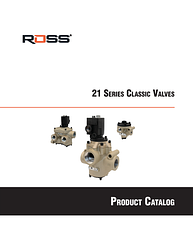
ROSS 21 Series Directional Control Classic Valves - Complete Technical Catalog
The ROSS Controls 21 Series represents a comprehensive line of inline poppet directional control valves engineered specifically for demanding pneumatic applications requiring extreme temperature operation, high flow capacity, and exceptional reliability. This technical catalog provides complete specifications, configuration options, dimensional data, and selection guidance for all 21 Series valve models designed to control the direction of airflow in industrial pneumatic circuits.
Overview of ROSS 21 Series Directional Control Valves
The 21 Series Classic inline poppet valves are precision-engineered directional control devices that regulate pneumatic airflow through multiple functions including stopping flow, passing flow, and changing flow direction. These rugged valves feature poppet construction that delivers superior performance characteristics including high flow rates, positive sealing with near-zero leakage, self-cleaning operation, and exceptional dirt tolerance that extends service life in harsh industrial environments.
Available in 2-way (2/2), 3-way (3/2), and 4-way (4/2) configurations with port sizes spanning 1/4 inch through 1-1/2 inches, the 21 Series accommodates a wide range of pneumatic system requirements. The valves are offered in both NPT (National Pipe Thread) and G thread (BSPP - British Standard Pipe Parallel) configurations to meet global installation standards.
The 21 Series distinguishes itself through its versatility in extreme temperature applications, with specialized models rated for high temperature operation up to 300°F (150°C) and low temperature operation down to -40°F (-40°C), making these valves suitable for applications ranging from arctic conditions to industrial heating and thermal processing systems.
Key Features and Benefits
Advanced Poppet Construction Technology
The perpendicular poppet face seal design creates optimal sealing surfaces that deliver high-flow performance combined with positive shut-off capability. Unlike sliding spool valves, the poppet design eliminates sliding action between sealing surfaces, preventing seal damage and wear that can lead to premature failure. This construction methodology ensures consistent performance throughout the valve's operational life.
The differential piston design employed in 21 Series valves delivers fast and consistent response times across the entire pressure range. Overwhelming shifting forces provide reliable no-stick operation even in contaminated air systems, ensuring predictable valve actuation under all operating conditions.
Self-Cleaning and Dirt Tolerance
High-velocity airflow across the poppet seats creates a self-cleaning effect that removes particulate contamination from sealing surfaces during normal operation. This design characteristic provides exceptional dirt tolerance, allowing the valves to maintain reliable performance in industrial environments where air quality may be compromised. The robust internal guidance system and self-compensating seals work synergistically to extend valve life even in demanding applications.
Extreme Temperature Capability
The 21 Series offers two distinct temperature range options:
High Temperature Models (Type H):
- Ambient temperature range: 0°F to 250°F (-17°C to 122°C)
- Media temperature range: 0°F to 300°F (-17°C to 150°C)
- Fluorocarbon seal material for high-temperature stability
- Ideal for thermal processing, heat treatment, and industrial ovens
Low Temperature Models (Type O):
- Ambient temperature range: -40°F to 120°F (-40°C to 50°C)
- Media temperature range: -40°F to 175°F (-40°C to 80°C)
- Buna-N or Fluorocarbon seal options
- Engineered for cold storage, outdoor installations, and arctic conditions
- Note: Air must be free of water vapor below 4°C to prevent ice formation
Vacuum Service Adaptability
The 21 Series is readily adaptable to vacuum service applications with specialized models featuring larger internal orifices that facilitate air transport even with minimal differential pressure between the vacuum within the valve and atmospheric pressure outside. These vacuum-rated models operate from full vacuum to 150 psig (10 bar), making them ideal for:
- Material lifting and handling systems
- Vacuum packaging operations
- Vacuum holding applications
- Leak testing systems
- Part manipulation in automated assembly
- Vacuum-assisted material transport
The ability to mount close to actuators reduces the length of piping that must be pressurized or exhausted on each cycle, improving response time and system efficiency in vacuum applications.
Valve Functions and Configurations
2/2 (Two-Way, Two-Position) Valves
Two-way, two-position valves feature an inlet port and an outlet port, controlling flow between these two ports. These valves are available in both normally closed (NC) and normally open (NO) configurations:
- Normally Closed: Blocks flow in the de-energized state; allows flow when actuated
- Normally Open: Allows flow in the de-energized state; blocks flow when actuated
Spring return mechanisms ensure the valve returns to its default position upon de-energization, providing fail-safe operation. 2/2 valves are ideal for simple on/off control of pneumatic actuators, process control applications, and systems requiring two-state control.
3/2 (Three-Way, Two-Position) Valves
Three-way, two-position valves incorporate an inlet port, outlet port, and exhaust port, enabling both supply and exhaust functions within a single valve body. Available in normally closed and normally open versions:
Normally Closed Configuration:
- De-energized: Outlet connected to exhaust; inlet blocked
- Energized: Outlet connected to inlet; exhaust blocked
- Ideal for extending cylinders and energizing devices
Normally Open Configuration:
- De-energized: Outlet connected to inlet; exhaust blocked
- Energized: Outlet connected to exhaust; inlet blocked
- Optimal for retracting cylinders and de-energizing devices
The 3/2 function reduces system complexity by combining supply and exhaust control in one valve, eliminating the need for separate exhaust valves and reducing installation costs.
4/2 (Four-Way, Two-Position) Valves
Four-way, two-position valves provide comprehensive control for double-acting cylinders and actuators with two separate ports (inlet and exhaust for each actuator connection). These valves feature four ports plus a supply port:
- Port 1: Supply inlet
- Port 2: Actuator connection A
- Port 3: Common exhaust
- Port 4: Actuator connection B
When energized, the valve switches connections to reverse actuator motion, enabling full bi-directional control of double-acting pneumatic cylinders. The 4/2 configuration is essential for applications requiring precise control of extend and retract functions with a single valve.
Port Sizes and Flow Capacity
Available Port Size Range
The 21 Series encompasses a comprehensive range of port sizes to accommodate varying flow requirements:
- 1/4 inch - Compact applications with moderate flow needs
- 3/8 inch - Small to medium pneumatic systems
- 1/2 inch - Standard industrial applications
- 3/4 inch - Medium flow requirements
- 1 inch - High flow industrial systems
- 1-1/4 inch - Large actuator applications
- 1-1/2 inch - Maximum flow capacity applications
Body sizes are designated based on the valve's flow characteristics and are not always identical to port sizes, allowing for optimized flow path design.
Flow Coefficient (Cv) Values
Flow capacity is specified using Cv values, representing the flow rate in gallons per minute of 60°F water at 1 psi pressure drop. The 21 Series offers Cv values ranging from 1.6 (smallest configurations) to 70.0 (largest configurations), ensuring appropriate flow capacity across the entire application spectrum.
For 3/2 valves, separate Cv ratings are provided for ports 1-2 (supply to outlet) and ports 2-3 (outlet to exhaust), as these paths may have different flow characteristics. For 4/2 valves, all four flow paths are individually rated to enable precise system design.
Flow rates can also be expressed in Normal liters per minute (Nl/min) for metric applications, with conversion factors provided in the catalog.
Actuation Options
Solenoid Pilot Control
Electrical solenoid pilot control offers precise electronic control integration with PLCs, control systems, and automation platforms. The 21 Series solenoids feature:
Voltage Options:
- 24 VDC (most common industrial standard)
- 110/120 VAC, 50/60 Hz
- 220/240 VAC, 50/60 Hz
- Additional voltages available upon request
Electrical Connections:
- Hardwired with conduit connection
- DIN connector (43650 standard)
- M12 connector for industrial Ethernet integration
- Conduit with flying leads
Power Consumption:
- AC models: 87 VA inrush, 30 VA holding at 50/60 Hz
- DC models: 14 watts continuous duty
- Continuous duty rating for sustained operation
Features:
- Encapsulated coils for environmental protection
- Class F insulation for high temperature stability
- Manual override options (non-locking button)
- Indicator light kits available for visual status confirmation
- Reversible pilot orientation for installation flexibility
Pneumatic Pilot Control
Air pilot actuation provides intrinsically safe control without electrical components, ideal for hazardous locations and explosive atmospheres:
Internal Pilot Supply:
- Utilizes inlet supply pressure for pilot actuation
- Pilot pressure automatically matches system pressure
- No external pilot supply required
- Simplified installation and reduced complexity
External Pilot Supply:
- Separate pilot supply connection for independent control
- Required pilot pressure: Equal to or greater than inlet pressure
- Vacuum models require minimum 30 psig (2.1 bar) pilot supply
- Enables pilot-operated control from remote locations
Pilot Selector Valve:
- Field-convertible between internal and external pilot supply
- Tool-free conversion capability
- Provides maximum installation flexibility
- Maintains consistent performance regardless of configuration
Manual Override Options
Manual override capability allows valve actuation independent of solenoid or pilot signal:
- Non-locking button: Push to actuate; releases when released
- Location: Accessible through electrical housing or pilot cap
- Purpose: Enables system testing, troubleshooting, and emergency operation
- Availability: Standard on most solenoid models; available as kit for pilot models
Operating Specifications
Pressure Requirements
Operating Pressure Range:
- Standard models: 30 to 150 psig (2 to 10 bar)
- Minimum pressure required for reliable actuation
- Maximum pressure ensures component integrity
Pilot Supply Requirements:
- Internal pilot: Automatically equals inlet pressure
- External pilot: Must equal or exceed inlet pressure
- Vacuum service with external pilot: Minimum 30 psig (2.1 bar)
Media and Environmental Specifications
Fluid Media:
- Filtered compressed air (primary application)
- 5-micron filtration recommended for optimal performance
- Lubrication not required but compatible with lubricated air
- Dry air required for sub-freezing temperatures to prevent ice formation
Ambient and Media Temperature:
- High temperature models: -17°C to 122°C ambient; -17°C to 150°C media
- Low temperature models: -40°C to 50°C ambient; -40°C to 80°C media
- Seal material selection critical for temperature compatibility
Environmental Protection:
- Aluminum valve bodies with corrosion-resistant finish
- Stainless steel internal components for durability
- Suitable for industrial environments with dust, moisture, and contamination
- IP65 rated electrical connections (DIN/M12 models)
Construction Materials and Design
Valve Body Materials
Primary Construction:
- Cast aluminum alloy for optimal strength-to-weight ratio
- Anodized or powder-coated finish for corrosion resistance
- Precision machined internal passages for consistent flow
- Integral mounting features for secure installation
Internal Component Materials
Poppet and Spool Assembly:
- Aluminum poppet bodies for lightweight operation
- Stainless steel piston components for wear resistance
- Stainless steel springs for temperature stability and long life
- Precision tolerances ensure leak-tight sealing
Superior Internal Guidance System:
- Multiple bearing surfaces prevent side loading
- Concentricity maintained throughout poppet travel
- Reduces seal wear and extends service life
- Ensures consistent actuation force requirements
Seal Materials and Temperature Compatibility
Fluorocarbon (Viton®) Seals:
- Temperature range: -40°F to 300°F (-40°C to 150°C)
- Excellent chemical resistance
- Superior high-temperature stability
- Standard for most 21 Series applications
- Minimal compression set for long seal life
Buna-N (Nitrile) Seals:
- Temperature range: -40°F to 175°F (-40°C to 80°C)
- Good general-purpose performance
- Cost-effective option for moderate temperature applications
- Excellent resilience characteristics
Self-Compensating Seal Design:
- Seals automatically adjust to compensate for wear
- Maintains sealing integrity throughout valve life
- Reduces maintenance requirements
- Ensures consistent leak-tight performance
Mounting and Installation
Inline Mounting Configuration
The 21 Series utilizes inline mounting, where the valve is installed directly in the pneumatic line between supply and actuator:
Installation Advantages:
- Flexible positioning anywhere in the pneumatic circuit
- No mounting base required
- Compact installation footprint
- Can be mounted close to actuators for improved response time
- Suitable for retrofit applications and existing systems
Mounting Orientations:
- Can be installed in any orientation (horizontal, vertical, inverted)
- Pilot housing can rotate for optimal electrical connection positioning
- Consider exhaust port orientation to direct expelled air appropriately
- Ensure electrical connections remain accessible for maintenance
Thread Types and Connections
NPT Threads (Standard):
- ANSI B2.1 compliant National Pipe Thread
- Standard for North American installations
- Tapered thread design for sealing
- Thread sealant or PTFE tape recommended
G Threads (BSPP):
- British Standard Pipe Parallel threads
- Designated with "D" prefix in model number (e.g., D2173B5001W)
- Common in European and Asian markets
- Requires sealing washer for leak-tight connection
Adapters Available:
- Thread adapters for conversion between types
- Reducer bushings for port size changes
- Silencer adapters for exhaust noise control
- Consult ROSS for specific adapter requirements
Electrical Connection Types
Conduit with Hardwired Leads
Traditional hardwired connection via electrical conduit:
- 1/2-inch conduit port (standard)
- Pre-wired leads for direct connection
- Secure strain relief
- Suitable for permanent installations
- Excellent vibration resistance
DIN 43650 Connector
Industry-standard modular electrical connection:
- Tool-free connector engagement
- Quick disconnect capability
- Gasket seal provides environmental protection
- LED indicator integration available
- Facilitates valve replacement and troubleshooting
M12 Connector
Industrial Ethernet compatible connection:
- IP67 rated protection
- Robust threaded coupling
- Excellent vibration resistance
- Compatible with modern industrial networks
- Ideal for harsh environments
Explosion-Proof and Hazardous Location Models
The 21 Series includes specialized models certified for use in hazardous locations where ignitable concentrations of flammable gases, vapors, liquids, combustible dust, or easily ignitable fibers may be present:
Certifications:
- CSA (Canadian Standards Association) certified
- FM (Factory Mutual) approved
- ATEX compliant for European installations
- Suitable for Class I, Division 1 and Division 2 locations
- Group B, C, and D gas classifications
Explosion-Proof Enclosure Design:
- Reinforced housing contains any internal spark or explosion
- Prevents ignition of surrounding flammable atmosphere
- Threaded housing joints with specified engagement length
- Conduit seals required per electrical code
- Larger physical size to accommodate explosion-proof construction
Applications:
- Petrochemical processing facilities
- Paint spray booths and finishing operations
- Grain handling and processing
- Chemical manufacturing plants
- Oil and gas production facilities
- Any hazardous classified area requiring certified equipment
Model Number Configurator and Ordering Information
Understanding 21 Series Model Numbers
ROSS 21 Series model numbers follow a systematic nomenclature that identifies all key specifications:
Format: [Thread Type][2][Function][Body Size][Actuation][Temperature][Special Features][Voltage]
Example: D2173B5001W
- D - BSPP (G) threads (no prefix indicates NPT)
- 21 - Series designation
- 73 - 3/2 function, normally closed (71=2/2 NC, 72=2/2 NO, 73=3/2 NC, 74=3/2 NO, 76=4/2)
- B - Solenoid actuation (A=pressure pilot)
- 5 - Body size designation
- 001 - Specific configuration code
- W - 24 VDC voltage (Z=110/120 VAC, other codes available)
Additional Prefixes:
- No prefix: NPT threads, standard construction
- D: BSPP (G) threads
- E: Explosion-proof/hazardous location certification
Configuration Selection Process
- Determine required valve function (2/2, 3/2, or 4/2)
- Select normally closed or normally open default position
- Identify port size based on flow requirements
- Choose temperature range (high or low temperature application)
- Select actuation type (solenoid or pneumatic pilot)
- Specify voltage (for solenoid models)
- Identify thread type (NPT or BSPP)
- Determine electrical connection type
- Identify any special requirements (vacuum, explosion-proof, etc.)
Options and Accessories
Manual Override Kits:
- Field-installable override buttons
- Non-locking actuation
- Available for most models
Indicator Light Kits:
- LED visual indication of valve state
- Integrated into electrical housing
- Available in multiple colors
Silencers:
- Reduces exhaust noise
- Multiple configurations for different port sizes
- Porous bronze or plastic construction
- Critical for noise-sensitive environments
Mounting Brackets:
- Support valves in vertical or horizontal orientations
- Reduces stress on piping connections
- Custom brackets available for specific applications
Technical Specifications Summary
Performance Characteristics
| Specification | Range/Value |
| Port Sizes | 1/4" to 1-1/2" (NPT or BSPP) |
| Valve Functions | 2/2, 3/2, 4/2 (NC and NO) |
| Operating Pressure | 30 to 150 psig (2 to 10 bar) |
| High Temp Range | 0°F to 300°F (-17°C to 150°C) |
| Low Temp Range | -40°F to 175°F (-40°C to 80°C) |
| Flow Coefficient (Cv) | 1.6 to 70.0 (depending on model) |
| Construction | Inline poppet |
| Valve Body Material | Cast aluminum |
| Internal Materials | Aluminum and stainless steel |
| Seal Materials | Fluorocarbon or Buna-N |
| Actuation Options | Solenoid or pneumatic pilot |
| Electrical Voltages | 24 VDC, 110/120 VAC, 220/240 VAC |
| Connection Types | Conduit, DIN 43650, M12 |
| Duty Rating | Continuous duty |
| Response Time | Fast and consistent |
| Leakage | Near-zero internal leakage |
| Mounting | Inline (any orientation) |
| Certifications | CSA, FM, ATEX (explosion-proof models) |
Table 1: 21 Series Technical Specifications Overview
Dimensional Information
Valve dimensions vary by body size and configuration. The catalog includes detailed dimensional drawings showing:
- Overall length, width, and height (envelope dimensions)
- Port locations and orientations
- Electrical connection locations
- Mounting clearance requirements
- Weight specifications for each model
- Center-to-center port spacing
- Exhaust port sizes (for 3/2 and 4/2 valves)
Dimensions are provided in both inches (millimeters) for global use.
Application Industries and Use Cases
Primary Industrial Applications
Manufacturing and Assembly:
- Automated assembly lines requiring directional control
- Part transfer and manipulation systems
- Pneumatic clamping and fixturing
- Pick-and-place operations
- Material handling equipment
Thermal Processing:
- High-temperature furnaces and ovens
- Heat treatment equipment
- Annealing operations
- Curing systems
- Plastic thermoforming
Food and Beverage:
- Packaging equipment
- Material conveying systems
- Vacuum sealing operations
- Pneumatic actuation in washdown environments
- Low-temperature cold storage applications
Automotive Manufacturing:
- Stamping press controls
- Welding fixture actuation
- Paint booth operations
- Assembly automation
- Part testing equipment
Pharmaceutical and Medical:
- Cleanroom pneumatic systems
- Packaging automation
- Material transfer systems
- Tablet press controls
- Sterilization equipment
Cold Storage and Refrigeration:
- Low-temperature automated storage
- Door actuators in freezer environments
- Pneumatic conveying in cold environments
- Arctic and outdoor installations
- Mobile refrigeration units
Vacuum Service Applications
Material Handling:
- Vacuum cup gripper systems
- Sheet material pickup and placement
- Part sorting and orientation
- Packaging material handling
- Automated loading systems
Vacuum Packaging:
- Food vacuum sealing
- Electronic component packaging
- Medical device packaging
- Pharmaceutical blister packing
- Industrial vacuum bagging
Testing and Quality Control:
- Vacuum leak detection systems
- Component seal testing
- Pressure decay testing
- Quality assurance verification
- Production line testing
Design Advantages Over Alternative Technologies
Poppet vs. Spool Valve Comparison
Poppet Valve Advantages (21 Series):
- No sliding seal surfaces to wear
- Self-cleaning operation
- Superior dirt tolerance
- Near-zero leakage when closed
- Longer service life in contaminated air
- Consistent response throughout life
- High flow capacity for given size
Where Spool Valves May Be Preferred:
- Modular manifold mounting requirements
- ISO standard footprint compliance
- Sub-base mounting configurations
- Very small port sizes (<1/4")
Inline vs. Base-Mounted Configuration
Inline Mounting Benefits (21 Series):
- Installation flexibility
- No mounting base required
- Can be positioned for optimal performance
- Easier retrofit into existing systems
- Reduced total installation cost
- Compact overall system footprint
Base-Mounted Alternatives:
- ROSS Dale Series for base mounting
- ROSS ISO valves for standard manifolds
- Consider when manifolding multiple valves
Maintenance and Service Life
Long-Life Design Features
The 21 Series is engineered for extended service life with minimal maintenance requirements:
Design Elements:
- Self-compensating seals adjust for wear
- Poppet construction eliminates sliding seal wear
- Self-cleaning high-velocity airflow
- Robust internal guidance prevents seal damage
- Corrosion-resistant materials
- Continuous duty rated components
Expected Service Life:
- Millions of cycles in clean air applications
- Extended life even with contaminated air
- Temperature extremes do not significantly reduce life
- Proper filtration maximizes valve longevity
Maintenance Recommendations
Routine Maintenance:
- Periodic inspection of electrical connections
- Verify exhaust ports are unobstructed
- Check for external air leakage at connections
- Monitor system air quality and filtration
- Verify operating pressure remains within specifications
Troubleshooting:
- Slow or erratic actuation: Check pilot supply pressure
- Valve won't actuate: Verify electrical power or pilot signal
- External leakage: Inspect port connections and thread sealant
- Reduced flow: Check for downstream restrictions
Service and Repair:
- Field repair kits available for critical internal components
- Solenoid coils field-replaceable
- Pilot assemblies can be serviced
- Contact ROSS technical support for guidance
Catalog Contents Summary
This comprehensive 21 Series catalog includes the following detailed information:
Technical Specifications:
- Complete specifications for all valve models
- Dimensional drawings and envelope dimensions
- Performance curves and flow data
- Pressure drop calculations
- Temperature rating charts
- Material compatibility information
Configuration Tables:
- Complete model number listings
- Available options matrix
- Thread type variations
- Voltage and electrical connection options
- Body size and port size relationships
- Weight specifications
Selection Tools:
- Valve function selection guide
- Port size selection based on flow requirements
- Temperature range selection criteria
- Actuation type comparison
- Application-specific recommendations
Installation Instructions:
- Mounting guidelines and best practices
- Piping connection recommendations
- Electrical wiring diagrams
- Pilot supply configurations
- Silencer installation
- Troubleshooting guide
Ordering Information:
- Model number configurator
- Options and accessories
- Lead times and availability
- Replacement part numbers
- Contact information for technical support
Why Choose ROSS Controls 21 Series Valves
ROSS Controls has manufactured pneumatic control products since 1921, establishing a reputation for quality, reliability, and innovation in fluid power control. The 21 Series represents over a century of valve design expertise:
Quality Assurance:
- Manufactured in ISO-certified facilities
- 100% factory tested before shipment
- Rigorous quality control processes
- Traceable materials and components
Technical Support:
- Experienced application engineers
- Custom configuration assistance
- System design consultation
- Rapid technical response
Global Availability:
- Worldwide distribution network
- Local technical support
- Competitive lead times
- Comprehensive inventory
Industry Recognition:
- Trusted by Fortune 500 manufacturers
- Specified by OEMs globally
- Proven performance in critical applications
- Track record of reliability
Related ROSS Products
27 Series Directional Control Valves:
- Standard temperature range alternative
- Larger port sizes (up to 2-1/2")
- Similar poppet construction
- Complementary product line
Dale Series Valves:
- Base-mounted inline poppet design
- Manifold-ready configuration
- Similar performance characteristics
- Alternative mounting solution
ISO Valves (W60, W64, W65, W66 Series):
- International standard footprints
- Modular manifold mounting
- Spool valve technology
- Global compatibility
NAMUR Valves:
- Actuator-mounted configuration
- Explosion-proof options
- Compact design
- Process valve control
Safety Control Products:
- DM2 Series dual valve monitors
- L-O-X lockout valves
- Safety exhaust systems
- Critical machine safety solutions
Contact and Ordering Information
Download the Complete Catalog:
Access the full ROSS 21 Series Directional Control Classic Valves catalog PDF for complete specifications, dimensional drawings, model selection tables, and ordering information.
Technical Support:
- Phone: (800) 438-7677 (US)
- Email: info@rosscontrols.com
- Website: www.rosscontrols.com
- Online configurator tools available
Request a Quote:
Contact your local ROSS distributor or ROSS sales representative for pricing, lead times, and application assistance.
Custom Configurations:
For requirements not covered by standard catalog products, ROSS Engineering can develop custom valve solutions tailored to your specific application needs.