




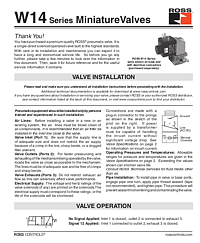
W14 Series Miniature 3/2 Directional Control Valves Installation Instructions
Overview
The ROSS Controls W14 Series Miniature Directional Control Valves are compact, single-direct solenoid operated 3/2 (three-way, two-position) valves built to the highest quality standards. The W14 Series is ideal for applications requiring a space-efficient, base-mounted directional control valve with reliable poppet construction for controlling pneumatic actuators, cylinders, and other devices.
The W14 operates on a simple, reliable circuit: with no signal applied, Port 1 (inlet) is closed and Port 2 (outlet) is connected to Port 3 (exhaust). When Signal 12 is applied, Port 1 connects to Port 2 and Port 3 is closed, allowing compressed air to flow to the actuated device. This 3/2 normally closed behavior is fundamental to many pneumatic machine control circuits.
The W14 Series is available in base-mounting configuration and uses EN 175301-803 Form A connectors for solenoid electrical connections. Standard voltages are 24 volts DC and 110–120 volts AC at 50/60 Hz. Operating pressure ranges from vacuum to 150 psig (10 bar). ROSS Controls was founded in 1921 and has over 100 years of fluid power expertise. Contact ROSS at 1-800-GET-ROSS or visit rosscontrols.com.
Key Features
Poppet Design for Long Life and Reliability
The W14 Series uses a poppet valve construction, which provides positive sealing and excellent reliability compared to spool-type valves in small directional control applications. The poppet design is inherently resistant to contamination-related leakage, making the W14 well-suited to environments where air quality may not be perfectly controlled.
Compact Base Mounting
Base mounting simplifies installation and wiring by grouping multiple W14 valves on a common manifold base. The base mounting design also keeps air line connections at the base rather than at the valve body, simplifying maintenance: the valve can be removed and replaced without disturbing the port piping.
IP65 Enclosure Protection
The W14 Series carries an IP65 enclosure rating per IEC 60529, providing protection against dust ingress and water jets. This rating ensures reliable electrical performance in typical industrial environments, including those where washdown or coolant exposure may occur.
Broad Operating Pressure Range
The W14 operates across a pressure range from vacuum to 150 psig (10 bar), accommodating both vacuum handling applications and standard compressed air supply pressures. This versatility makes the W14 suitable for a wide range of pneumatic machine control applications.
Technical Specifications
Specifications from W14 Series installation instructions (SS106):
- Construction Design: Poppet
- Mounting Type: Base
- Solenoids: Single, rated for continuous duty
- Standard Voltages: 24 volts DC; 110–120 volts AC, 50/60 Hz
- Power Consumption: 6 watts DC; 8 VA inrush, 6 VA holding (50 or 60 Hz)
- Enclosure Rating: IP65 per IEC 60529
- Ambient Temperature: 5° to 120°F (-15° to 50°C)
- Media Temperature: 5° to 175°F (-15° to 80°C)
- Operating Pressure: Vacuum to 150 psig (10 bar)
- Flow Media: Filtered compressed air
- Valve Body: Cast Aluminum
- Seals: Buna-N
- Electrical Connections: EN 175301-803 Form A connector
- Valve Function: 3/2 normally closed (no signal: Port 1 closed, Port 2 to exhaust 3; signal applied: Port 1 to Port 2, exhaust 3 closed)
- Manual Override: Flush, metal, locking and non-locking
Applications
Pneumatic Actuator and Cylinder Control
The W14 Series is widely used to control single-acting pneumatic cylinders, pneumatic rotary actuators, grippers, and other pneumatic devices requiring a compact, base-mounted 3/2 directional control valve. The miniature footprint allows multiple W14 valves to be grouped on a valve island or manifold, conserving panel space.
Pilot Supply and Sequencing Circuits
The W14 is also deployed as a pilot valve to control larger, pressure-operated directional valves. In sequencing circuits, the W14's reliable poppet design and IP65 protection make it suitable for automated machine lines where multiple pneumatic operations must be coordinated in sequence.
Safety and Compliance Standards
- IP65 Enclosure Protection — IEC 60529
- EN 175301-803 Form A — Solenoid electrical connector standard
- ROSS recommended: 5-micron-rated inlet air filter
- Compatible lubricants: petroleum base oils, ISO 32 or lighter, aniline point 180–220°F; avoid phosphate-additive oils
Installation and Setup Guide
Air Line Preparation
Before installing the valve, blow all air lines clean of contaminants. Install a 5-micron-rated air filter in the inlet line close to the valve. Clean, filtered air is essential for long valve life.
Port Connections
Valve Inlet (Port 1): Supply line must be adequately sized and free of crimps and sharp bends. Valve Outlet (Port 2): Locate the valve as close as possible to the mechanism. Lines must be adequately sized and free of restrictions. Valve Exhaust (Ports 3): Do not restrict exhaust — restriction adversely affects valve performance.
Solenoid Electrical Connection
Connections are made with a plug-in connector to the prongs on the solenoid pilot. The connector follows EN 175301-803 Form A. The Ground, Line (AC/DC), and Manual Override connections are arranged per the solenoid connector sketch in the installation instructions. If power is supplied by a transformer, it must handle inrush current without significant voltage drop.
Pipe Thread Installation
To install pipe in valve or base ports: engage pipe one turn, apply pipe thread sealant (tape not recommended), and tighten. This prevents sealant from entering and contaminating the valve.
Why Choose ROSS Controls
ROSS Controls has been manufacturing fluid power products since 1921. The W14 Series reflects ROSS's commitment to quality, reliability, and compact design in directional control valve products. Contact ROSS at 1-800-GET-ROSS or visit rosscontrols.com for additional technical documentation and distributor information.
Download This Document
The official W14 Series installation instructions (SS106) are available as a free PDF download from ROSS Controls.
PDF Download URL: https://ross-admin-global-us-east.s3.amazonaws.com/production/uploads/document_language_file/file/3/SS106_Series_14_Miniature_3-2-Valves.pdf
Related Products and Resources
- W60 Series ISO 5599-1 Directional Control Valves
- ROSS 55 Series Silencers — exhaust noise reduction
- ROSS FRL Products — Filters, Regulators, Lubricators
- ROSS DM2® Series C — Category 3/4 safety double valves
- ROSS L-O-X® Lockout Valves — pneumatic energy isolation
Frequently Asked Questions
Q: What is the W14 valve function?
A: The W14 is a 3/2 (three-way, two-position) normally closed directional control valve. With no signal applied: Port 1 (inlet) is closed and Port 2 (outlet) is connected to Port 3 (exhaust). With Signal 12 applied: Port 1 connects to Port 2 and Port 3 is closed.
Q: What operating pressure range does the W14 support?
A: The W14 operates from vacuum to 150 psig (10 bar), accommodating both vacuum handling and standard compressed air supply pressures.
Q: What voltages are available?
A: 24 volts DC and 110–120 volts AC at 50/60 Hz are the standard voltages.
Q: What is the IP rating?
A: IP65 per IEC 60529 — protected against dust ingress and water jets from any direction.
Q: Is the W14 suitable for low temperatures?
A: The W14 operates from 5°F (-15°C) ambient and 5°F (-15°C) media temperature. At temperatures below 40°F (4°C), the air must be free of water vapor to prevent ice formation.
Q: What type of valve construction does the W14 use?
A: Poppet construction, which provides positive sealing and high reliability in small directional control valve applications.
Q: Does the W14 have a manual override?
A: Yes. Flush metal manual override options are available in both locking and non-locking versions.
Q: What electrical connector standard does the W14 use?
A: EN 175301-803 Form A connector.
Q: What materials are used for the W14 body and seals?
A: Cast Aluminum body with Buna-N seals.
Q: How should I clean the W14?
A: Use a good commercial solvent. Do not scrape varnished surfaces or use chlorinated solvents or abrasives. Before reassembly, lubricate sliding surfaces with Dow Corning BR-2 or equivalent.