




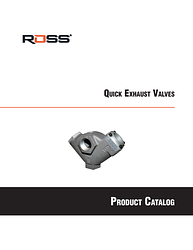
Quick Exhaust Valves 18 Series - Complete Technical Catalog
Accelerate Your Pneumatic Systems with ROSS Heavy-Duty Quick Exhaust Valves
The ROSS Quick Exhaust Valves 18 Series catalog provides comprehensive technical documentation for industrial pneumatic professionals seeking to optimize cylinder speed and system efficiency. This essential resource covers the complete range of ROSS heavy-duty quick exhaust valves designed for demanding applications where rapid air exhaust and quick cylinder reversal are critical performance requirements.
What Are Quick Exhaust Valves and Why They Matter
Quick exhaust valves represent a fundamental solution to a common pneumatic challenge: slow cylinder retraction caused by restricted exhaust flow. When a control valve is positioned at a distance from an air cylinder, or when the exhaust path through the control valve restricts airflow, cylinder reversal times increase significantly, reducing productivity and system efficiency.
ROSS quick exhaust valves solve this problem by providing a rapid exhaust pathway for controlled air when mounted directly onto an air cylinder downstream of the control valve. As soon as the control valve begins exhausting, the ROSS quick exhaust valve opens immediately, allowing air to vent directly to atmosphere through a large, unrestricted exhaust port rather than traveling back through the control valve and supply lines. This dramatically accelerates cylinder reversal times and enables faster cycle speeds in automated manufacturing processes.
ROSS 18 Series Quick Exhaust Valve Features
Advanced Poppet Construction Design
The ROSS 18 Series employs a sophisticated poppet design that delivers superior performance compared to alternative valve constructions. This dirt-tolerant, self-cleaning poppet design ensures reliable operation even in contaminated environments where other valve types would fail or require frequent maintenance. The poppet construction is inherently resistant to sticking and binding, providing consistent performance across millions of cycles.
For extreme temperature applications, ROSS offers alternate materials that extend the operational temperature range beyond standard specifications, making these valves suitable for foundries, heat treatment facilities, cold storage environments, and other extreme-condition applications.
Tight-Seal Technology for Maximum Efficiency
Every ROSS quick exhaust valve features engineered tight-seal technology that provides exceptional efficiency and durability. The precision-machined seating surfaces combined with high-quality Buna-N seals ensure bubble-tight shutoff when the valve is in the supply position, preventing air waste and maintaining downstream pressure. This tight-seal design translates directly to reduced compressed air consumption, lower operating costs, and improved system reliability.
Rugged Construction for Industrial Environments
Built to withstand the harsh conditions found in manufacturing facilities, the ROSS 18 Series features rugged construction utilizing corrosion-resistant cast aluminum valve bodies. This material selection provides the optimal balance of strength, weight, and corrosion resistance for industrial pneumatic applications. The robust construction ensures long service life even in demanding applications involving exposure to coolants, wash-down environments, and other corrosive conditions.
Technical Specifications and Performance Data
Valve Configuration and Function
The ROSS 18 Series quick exhaust valves are configured as 3-way, 2-position (3/2) pneumatically actuated valves. The three ports serve distinct functions:
- Port 1 (Inlet): Receives pressurized air from the control valve
- Port 2 (Outlet): Supplies pressurized air to the cylinder
- Port 3 (Exhaust): Provides rapid exhaust to atmosphere
The valve operates pneumatically based on differential pressure sensing. When supply pressure is applied to Port 1, the poppet seals Port 3 and allows air to flow from Port 1 to Port 2, pressurizing the cylinder. When the control valve begins exhausting and Port 1 pressure drops, the higher pressure at Port 2 shifts the poppet to seal Port 1 and open Port 3, allowing rapid exhaust directly to atmosphere.
Operating Conditions and Environmental Ratings
Temperature Range:
- Ambient Temperature: -40°F to 175°F (-40°C to 80°C)
- Media Temperature: -40°F to 175°F (-40°C to 80°C)
Critical Temperature Considerations:
- For temperatures below 40°F (4°C), air must be free of water vapor to prevent ice formation
- For applications below -40°F (-40°C), consult ROSS engineering for specialized solutions
Pressure Specifications:
- Operating Pressure: 5 to 150 psig (0.3 to 10.3 bar)
- Signal Pressure: Must be equal to or greater than inlet pressure for proper operation
Flow Media:
- Filtered air (5-micron filtration recommended for optimal performance and service life)
Construction Materials and Components
Valve Body: Cast aluminum construction provides excellent strength-to-weight ratio and natural corrosion resistance
Poppet Elements: Combination of acetal and stainless steel delivers optimal sealing performance, chemical resistance, and mechanical durability
Seals: Buna-N (Nitrile) elastomer seals provide excellent compatibility with compressed air and standard pneumatic lubricants while maintaining flexibility across the operating temperature range
Mounting and Installation Flexibility
Mounting Type: Inline threaded port connection allows direct mounting to cylinder ports or integration into pneumatic manifolds
Mounting Orientation: Any orientation - ROSS quick exhaust valves can be mounted in any position without affecting performance, providing maximum installation flexibility
Connection Options:
- NPT Thread: Standard American National Pipe Taper thread for North American applications
- G Thread: ISO 228-1 parallel thread (also known as BSPP or Rp thread) for European and international applications
Complete Model Range and Specifications
Model 1868A3005 / D1868A3005 - 1/2" Body Size
Port Sizes:
- Inlet (Port 1): 3/8" NPT or G thread
- Outlet (Port 2): 3/8" NPT or G thread
- Exhaust (Port 3): 1/2" NPT or G thread
Flow Performance:
- Supply Flow (Ports 1-2): 2.9 Cv (2,900 Nl/min)
- Exhaust Flow (Ports 2-3): 3.4 Cv (3,300 Nl/min)
Physical Dimensions:
- Length: 4.69 inches (119 mm)
- Width: 2.00 inches (51 mm)
- Height: 3.19 inches (81 mm)
- Weight: 1.0 lb (0.5 kg)
Thread Designation:
- 1868A3005: NPT threads
- D1868A3005: G (ISO 228-1) threads
This compact model is ideal for smaller cylinders and applications where space is limited but rapid exhaust is still required.
Model 1868A4005 / D1868A4005 - 1/2" Body Size
Port Sizes:
- Inlet (Port 1): 1/2" NPT or G thread
- Outlet (Port 2): 1/2" NPT or G thread
- Exhaust (Port 3): 1/2" NPT or G thread
Flow Performance:
- Supply Flow (Ports 1-2): 2.9 Cv (2,900 Nl/min)
- Exhaust Flow (Ports 2-3): 3.4 Cv (3,300 Nl/min)
Physical Dimensions:
- Length: 4.69 inches (119 mm)
- Width: 2.00 inches (51 mm)
- Height: 3.19 inches (81 mm)
- Weight: 1.0 lb (0.5 kg)
Thread Designation:
- 1868A4005: NPT threads
- D1868A4005: G (ISO 228-1) threads
This model provides uniform 1/2" porting throughout, simplifying plumbing in systems with standardized 1/2" connections.
Model 1868A5005 / D1868A5005 - 1" Body Size
Port Sizes:
- Inlet (Port 1): 3/4" NPT or G thread
- Outlet (Port 2): 3/4" NPT or G thread
- Exhaust (Port 3): 1" NPT or G thread
Flow Performance:
- Supply Flow (Ports 1-2): 7.2 Cv (7,000 Nl/min)
- Exhaust Flow (Ports 2-3): 10 Cv (9,800 Nl/min)
Physical Dimensions:
- Length: 6.50 inches (165 mm)
- Width: 2.56 inches (65 mm)
- Height: 4.31 inches (110 mm)
- Weight: 2.5 lb (1.1 kg)
Thread Designation:
- 1868A5005: NPT threads
- D1868A5005: G (ISO 228-1) threads
This larger model delivers significantly higher flow rates, making it suitable for medium to large cylinders requiring rapid actuation and retraction.
Model 1868A6005 / D1868A6005 - 1" Body Size
Port Sizes:
- Inlet (Port 1): 1" NPT or G thread
- Outlet (Port 2): 1" NPT or G thread
- Exhaust (Port 3): 1" NPT or G thread
Flow Performance:
- Supply Flow (Ports 1-2): 7.2 Cv (7,000 Nl/min)
- Exhaust Flow (Ports 2-3): 10 Cv (9,800 Nl/min)
Physical Dimensions:
- Length: 6.50 inches (165 mm)
- Width: 2.56 inches (65 mm)
- Height: 4.31 inches (110 mm)
- Weight: 2.5 lb (1.1 kg)
Thread Designation:
- 1868A6005: NPT threads
- D1868A6005: G (ISO 228-1) threads
This model provides full 1" porting throughout all three ports, maximizing flow capacity for large cylinder applications and high-speed operations.
Understanding Flow Coefficients (Cv Values)
The flow coefficient (Cv) is the critical metric for determining a valve's flow capacity. A Cv value represents the number of gallons per minute of water at 60°F that will flow through the valve with a 1 psi pressure drop across the valve. For pneumatic applications, the Cv value correlates to the valve's ability to pass compressed air efficiently.
The ROSS 18 Series features two distinct Cv ratings:
Supply Flow (Ports 1-2): This rating indicates the valve's capacity when supplying air to the cylinder. While important, this value is typically less critical because pressurization speed is also governed by the control valve and supply lines.
Exhaust Flow (Ports 2-3): This rating is the primary performance indicator for quick exhaust valves. Higher exhaust Cv values mean faster air evacuation and quicker cylinder retraction. Notice that in all ROSS 18 Series models, the exhaust Cv exceeds the supply Cv, which is essential for quick exhaust functionality.
The larger exhaust port size (compared to inlet/outlet ports) in models 1868A3005/D1868A3005 and 1868A5005/D1868A5005 provides the enhanced exhaust flow capacity that defines quick exhaust valve performance.
Industrial Applications and Use Cases
Automated Manufacturing and Assembly
Quick exhaust valves are essential in automated assembly lines where cycle time directly impacts production throughput. Applications include:
- Pick-and-place operations: Accelerating gripper open/close cycles
- Parts feeding systems: Rapid ejector and pusher cylinder actuation
- Clamping fixtures: Fast workpiece loading and unloading
- Transfer mechanisms: High-speed part transfer between stations
Packaging and Material Handling
The packaging industry benefits significantly from quick exhaust valves in applications such as:
- Carton forming and sealing: Rapid cylinder actuation for folding and sealing operations
- Product pushing and diverting: High-speed sortation and routing
- Labeling operations: Quick label applicator actuation
- Wrapping and bundling: Fast film cutters and product positioning
Metal Stamping and Forming
In metalworking operations, quick exhaust valves enable:
- Part ejection systems: Rapid removal of stamped parts from dies
- Transfer press feed systems: High-speed part advancement between forming stations
- Die cushion controls: Quick return of cushion cylinders
- Safety gate actuation: Rapid safety barrier deployment
Automotive Manufacturing
Automotive assembly plants utilize quick exhaust valves throughout production lines:
- Spot welding gun actuation: Fast electrode opening and closing
- Riveting and fastening: Rapid tool retraction between operations
- Component installation: Quick positioning cylinders for parts placement
- Quality inspection stations: Fast reject gate actuation
Food and Beverage Processing
In food processing environments, quick exhaust valves support:
- Product sorting and grading: High-speed reject mechanisms
- Bottle and can handling: Rapid pusher and diverter actuation
- Filling and capping operations: Quick tool positioning and retraction
- Conveyor control systems: Fast stop gates and product metering
Accessory Components - Exhaust Silencers
Why Exhaust Silencers Are Essential
Quick exhaust valves, by their very nature, release large volumes of compressed air rapidly to atmosphere. This creates significant noise levels that can exceed workplace safety thresholds established by OSHA (85 dBA time-weighted average) and similar international regulations. ROSS offers engineered exhaust silencers specifically designed to reduce noise while maintaining the high flow capacity that makes quick exhaust valves effective.
ROSS Exhaust Silencer Specifications
Model 5500A4003 / D5500A4003 - 1/2" Silencer
- Port Size: 1/2" male NPT or G thread
- Flow Capacity: 6.8 Cv (6,700 Nl/min)
- Pressure Rating: 0-290 psig (0-20 bar) maximum
- Construction Material: Aluminum
- Dimensions: 3.6" length (91 mm), 1.25" hex size (32 mm)
- Weight: 0.2 lb (0.1 kg)
This silencer is compatible with models 1868A3005, D1868A3005, 1868A4005, and D1868A4005 exhaust ports.
Model 5500A6003 / D5500A6003 - 1" Silencer
- Port Size: 1" male NPT or G thread
- Flow Capacity: 18 Cv (18,000 Nl/min)
- Pressure Rating: 0-290 psig (0-20 bar) maximum
- Construction Material: Aluminum
- Dimensions: 5.4" length (137 mm), 2.0" hex size (51 mm)
- Weight: 0.9 lb (0.4 kg)
This high-capacity silencer is designed for models 1868A5005, D1868A5005, 1868A6005, and D1868A6005 exhaust ports.
Silencer Selection Criteria
When selecting exhaust silencers for ROSS quick exhaust valves, ensure that:
- Flow capacity equals or exceeds valve exhaust capacity: The silencer must not create a flow restriction that would diminish the quick exhaust valve's performance
- Thread type matches valve: NPT silencers for NPT valves, G thread silencers for G thread valves
- Port size matches valve exhaust port: Use 1/2" silencers for 1/2" exhaust ports, 1" silencers for 1" exhaust ports
- Pressure rating exceeds system pressure: Ensure silencer pressure rating is adequate for your application
- Resistance to clogging: ROSS silencers feature porous aluminum construction that resists contamination while maintaining acoustic performance
Installation Best Practices and Safety Guidelines
Pre-Installation Requirements
Before installing any ROSS quick exhaust valve:
- System shutdown and lockout: All energy sources must be turned off, the entire pneumatic system shut down and exhausted, and all power sources locked out per OSHA 1910.147 and EN 1037 requirements
- Qualified personnel: Installation should only be performed by persons with training and experience with pneumatic equipment
- Component verification: Inspect valve for shipping damage and verify model number matches application requirements
- System compatibility: Confirm operating pressure and temperature conditions fall within valve specifications
Air Quality Requirements
Filtration: ROSS recommends 5-micron filtration for all pneumatic systems to prevent contaminants from interfering with valve performance. Dirt, scale, and moisture are present in virtually every air system, and while ROSS poppet valves are dirt-tolerant, optimal performance and maximum service life require clean, dry air.
Lubrication: ROSS quick exhaust valves can operate with or without lubrication. If lubrication is used, employ only petroleum-based oils with oxidation inhibitors, an aniline point between 180°F and 220°F, and ISO 32 or lighter viscosity. Avoid oils with phosphate-type additives which can harm seal materials.
Proper Valve Positioning
Mounting location: Install the quick exhaust valve as close as possible to the cylinder port. The primary purpose of a quick exhaust valve is to eliminate the long exhaust path back to the control valve, so proximity to the cylinder is essential for optimal performance.
Orientation flexibility: ROSS quick exhaust valves can be mounted in any orientation without affecting performance. Select the orientation that provides the most convenient piping and maintenance access.
Exhaust port considerations: Ensure the exhaust port is not obstructed and exhausting air will not create hazards for personnel or equipment. Consider using exhaust silencers to reduce noise levels and remote exhaust piping if needed to direct exhaust air away from sensitive areas.
Critical Installation Warnings
Do not restrict supply flow: Never install restrictions, check valves, or undersized fittings in the supply line to the quick exhaust valve. Reduced supply pressure below minimum requirements can cause erratic valve operation.
Do not restrict exhaust flow: Never restrict the valve's exhaust port. If exhaust silencers are required for noise control, they must have flow capacities at least as great as the exhaust capacity of the valve. Contamination of silencers reduces flow and increases back pressure, adversely affecting valve operation.
Signal pressure requirements: The pressure signal at Port 1 must be equal to or greater than the inlet pressure for proper valve operation. If this condition cannot be met, consult ROSS engineering for application assistance.
Maintenance and Service Considerations
Routine Inspection Schedule
Establish a regular inspection schedule based on:
- Cycle frequency
- Environmental conditions
- Criticality of the application
- Historical performance data
Signs Requiring Attention
Monitor for these indicators of potential service needs:
- Reduced cylinder speed
- Unusual noise during operation
- Air leakage from exhaust port when valve should be sealed
- Sluggish or inconsistent valve response
- Visible damage to valve body or ports
Service and Overhaul
When service is required:
- Follow all lockout/tagout procedures before beginning work
- Use only genuine ROSS replacement components and service kits
- Functionally test overhauled valves prior to reinstallation
- Update maintenance records with service performed
Product Compliance and Certifications
The ROSS 18 Series Quick Exhaust Valves are manufactured in compliance with applicable international standards and include a Declaration of Conformity. ROSS maintains ISO 9001:2015 certification for quality management systems, ensuring consistent manufacturing quality and traceability.
Technical Support and Engineering Assistance
ROSS Controls provides comprehensive technical support through a global network of locations and distributors. For application-specific questions, custom valve configurations, or assistance selecting the appropriate quick exhaust valve for your requirements, contact your local ROSS representative or visit www.rosscontrols.com.
CAD Models and Technical Resources
Downloadable CAD models are available for all ROSS 18 Series quick exhaust valves, enabling precise integration into pneumatic system designs. These models are available in multiple formats compatible with leading CAD software platforms.
Catalog Contents Summary
This comprehensive ROSS Quick Exhaust Valves catalog includes:
- Page 1: Product overview and quick exhaust valve function explanation
- Page 2: Valve features, specifications, and valve schematic
- Page 3: Complete ordering information table with model numbers, port sizes, flow ratings, and weights
- Page 4: Detailed dimensional drawings for both 1/2" and 1" body sizes with downloadable CAD model information
- Page 5: Exhaust silencer specifications, model numbers, and dimensions
- Page 6: Accessories section
- Page 7: Critical safety information, installation warnings, filtration/lubrication requirements, and standard warranty
Why Choose ROSS Controls Quick Exhaust Valves
Heritage of Innovation Since 1921
ROSS Controls has been manufacturing premium pneumatic valves for over a century, earning a reputation for innovation, quality, and reliability. The ROSS 18 Series quick exhaust valves represent decades of engineering refinement and real-world application experience.
Global Support Network
With manufacturing facilities and technical support centers across North America, Europe, Asia, and South America, ROSS provides truly global support. This worldwide presence ensures parts availability, technical assistance, and application engineering support wherever your operations are located.
Quality and Reliability
Every ROSS quick exhaust valve undergoes rigorous testing and quality inspection before shipment. The robust poppet design, corrosion-resistant materials, and precision manufacturing processes ensure reliable performance across millions of cycles in demanding industrial environments.
Comprehensive Warranty Protection
ROSS backs the 18 Series quick exhaust valves with a comprehensive one-year warranty against defects in materials and workmanship. This warranty demonstrates ROSS's confidence in the durability and performance of these products.
Ordering Information and Part Number Structure
ROSS quick exhaust valve part numbers follow a structured format that identifies key specifications:
Format: [D]1868A[size]005
- D prefix: Indicates G (ISO 228-1) thread; no prefix indicates NPT thread
- 1868: Series designation for 18 Series quick exhaust valves
- A: Design variation identifier
- Size digit: Indicates port size configuration (3, 4, 5, or 6)
- 005: Manufacturing code suffix
Example: D1868A5005 = Quick exhaust valve with G threads, 18 Series, Type A design, size 5 configuration (3/4" in/out, 1" exhaust)
Related ROSS Products for Complete Pneumatic Solutions
ROSS Controls offers a comprehensive portfolio of pneumatic components that complement quick exhaust valves:
- DM2 Series Double Valves: Control-reliable safety valves for Category 4, PLe applications
- L-O-X® Lockout Valves: Energy isolation devices for lockout/tagout compliance
- Air Flow Control Valves: Speed controls for precise cylinder velocity adjustment
- Manifold Systems: Integrated pneumatic distribution solutions
- Filters, Regulators, and Lubricators (FRL): Air preparation components for optimal system performance
Environmental Considerations
ROSS quick exhaust valves are designed with environmental responsibility in mind:
- Energy efficiency: Tight seals minimize compressed air waste
- Long service life: Durable construction reduces replacement frequency and waste
- Recyclable materials: Aluminum and steel components are fully recyclable at end of life
- Reduced noise pollution: Compatible silencers available to meet workplace noise regulations
Download Your Complete Catalog Today
This comprehensive catalog provides all the technical information needed to specify, order, install, and maintain ROSS 18 Series Quick Exhaust Valves. Whether you're designing a new pneumatic system or upgrading existing equipment for improved performance, this catalog serves as your complete reference guide.
The catalog includes:
- Complete model range with specifications
- Detailed dimensional drawings
- Flow performance data
- Installation guidelines
- Safety warnings and compliance information
- Accessory component specifications
- Ordering information
- Global contact information
Download the ROSS Quick Exhaust Valves catalog now to access this essential technical resource for optimizing your pneumatic systems.
Frequently Asked Questions
What is the primary benefit of installing a quick exhaust valve?
Quick exhaust valves dramatically reduce cylinder retraction time by allowing air to exhaust directly to atmosphere near the cylinder rather than traveling back through long supply lines and the control valve. This can reduce cycle times by 50% or more in many applications.
How close to the cylinder should a quick exhaust valve be mounted?
Mount the quick exhaust valve as close as physically practical to the cylinder port - ideally within 6-12 inches. The closer the valve, the shorter the exhaust path and the faster the cylinder response.
Can quick exhaust valves be used with both single-acting and double-acting cylinders?
Yes, quick exhaust valves work with both cylinder types. For single-acting spring-return cylinders, install on the air side. For double-acting cylinders, install quick exhaust valves on both ports for maximum speed in both directions.
What is the difference between NPT and G thread models?
NPT (National Pipe Taper) threads are tapered threads commonly used in North America, creating a seal through thread interference. G threads (ISO 228-1, also called BSPP) are parallel threads used internationally, requiring a sealing washer or O-ring for seal. Choose based on your regional standards and existing equipment.
Why does the exhaust port have a higher Cv rating than the inlet port?
The larger exhaust port and higher Cv rating are essential for quick exhaust functionality. This design allows air to evacuate faster than it enters, which is necessary to achieve rapid cylinder retraction.
Do ROSS quick exhaust valves require external power or controls?
No, ROSS quick exhaust valves are pneumatically actuated and operate automatically based on pressure differential. They require no electrical connections or external control signals.