



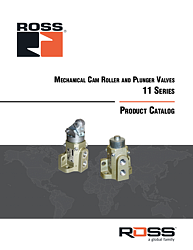
ROSS Mechanical Cam Roller and Plunger Valves – Complete Product Catalog for Series 11 Directional Control Valves
Overview of ROSS Mechanical Cam, Roller, and Plunger Valves
The ROSS Mechanical Cam, Roller, and Plunger Valves catalog provides comprehensive technical specifications, dimensional drawings, ordering information, and application guidelines for the industry-leading Series 11 mechanical directional control valves. These pneumatic valves are engineered specifically for automation applications where mechanical action must automatically open or close an air circuit, making them essential components in manufacturing, material handling, assembly lines, and industrial machinery.
ROSS mechanical valves excel as remote pilot valves, passing operating signals to other pressure-actuated valves throughout pneumatic systems. Their robust poppet valve construction delivers reliable performance in demanding industrial environments where consistent signal transmission and mechanical actuation are critical to operational efficiency and safety.
Catalog Contents and Technical Resources
This comprehensive catalog includes detailed technical data for the complete Series 11 mechanical valve product line, featuring:
- Product specifications for cam roller valves (1-direction and 2-direction configurations)
- Dimensional drawings with mounting dimensions and port configurations
- Performance data including flow coefficients (Cv), pressure ranges, and temperature ratings
- Material specifications for valve bodies, seals, and internal components
- Installation instructions for inline and flange mounting options
- Ordering information with complete model numbering system and configuration options
- Application guidelines for proper valve selection and system integration
- Technical tables for port sizes, thread types, and connection standards
Series 11 Mechanical Valve Product Features and Benefits
Proven Poppet Valve Construction
ROSS Series 11 mechanical valves utilize time-tested poppet valve design that delivers superior sealing performance and extended service life. The poppet construction provides:
- Positive sealing that eliminates leakage in both actuated and non-actuated positions
- Dirt tolerance with self-cleaning action that prevents contamination buildup
- Consistent performance across wide pressure ranges from 5 to 150 psig (0.3 to 10 bar)
- Reliable operation through millions of cycles in industrial environments
- Minimal maintenance requirements reducing total cost of ownership
The poppet design's simplicity ensures dependable signal transmission even in harsh conditions where dust, moisture, or temperature fluctuations could compromise lesser valve designs.
Rugged Cast Aluminum Construction
Every Series 11 valve features a robust cast aluminum body engineered to withstand the rigors of industrial automation:
- Corrosion resistance for long-term durability in varied environmental conditions
- Lightweight design facilitating easier installation and machine integration
- High strength-to-weight ratio providing structural integrity without excess mass
- Dimensional stability maintaining precise tolerances throughout the valve's service life
- Excellent thermal conductivity preventing heat buildup during continuous operation
The cast aluminum construction combines industrial-grade strength with practical weight considerations, making these valves ideal for both stationary installations and moving machine components.
Flexible Mounting Options
ROSS mechanical valves provide versatile mounting capabilities to accommodate diverse installation requirements:
- Side mounting flanges for horizontal surface installation
- Bottom mounting flanges for vertical surface integration
- Inline configurations for direct pipe connection in space-constrained applications
- Multiple bolt patterns compatible with standard mounting footprints
- Universal orientation allowing installation in any position to suit machine layout
This mounting flexibility enables engineers to optimize valve placement for mechanical actuation accessibility, air line routing efficiency, and maintenance access.
Valve Types and Configurations Available
Cam Roller Valves – 1-Direction and 2-Direction
ROSS cam roller valves incorporate precision rollers that respond to cam actuation from moving machine components. Available configurations include:
1-Direction Cam Roller Valves:
- Designed for unidirectional cam contact
- Spring return to default position when cam disengages
- Ideal for end-of-stroke detection and sequential control
- Reduces wear on cam surfaces through rolling contact
- Available in 2/2 and 3/2 valve functions
2-Direction Cam Roller Valves:
- Actuate from cam contact in either direction
- Bi-directional sensing for reciprocating machine elements
- Eliminates need for multiple valve installations
- Provides operation verification in forward and return strokes
- Enhanced versatility for complex automation sequences
The roller mechanism significantly reduces friction and wear compared to fixed contact surfaces, extending both valve and cam service life while maintaining consistent actuation force requirements throughout millions of operating cycles.
Plunger Valves for Direct Contact Applications
Mechanical plunger valves utilize direct contact actuation without rollers, making them ideal for:
- Limit switch applications detecting precise machine positions
- Safety interlock circuits confirming guard or door closure
- Part presence verification in assembly and inspection operations
- Tool position confirmation in manufacturing processes
- Proximity sensing where direct contact provides positive confirmation
Plunger valves offer:
- Compact footprint for installation in confined spaces
- Direct mechanical feedback with no intermediate mechanisms
- Simple, robust design minimizing potential failure points
- Cost-effective solution for straightforward sensing applications
- Precise actuation points for repeatable position detection
Function Options: 2/2 and 3/2 Normally Closed Configurations
Series 11 mechanical valves are available in multiple functional configurations to match specific circuit requirements:
2/2 (Two-Way, Two-Position) Valves:
- Simple on/off directional control
- Normally closed (NC) default position
- Single outlet port for straightforward circuit design
- Ideal for pilot signal applications
- Minimal pressure drop and maximum flow efficiency
3/2 (Three-Way, Two-Position) Valves:
- Directional control with integral exhaust
- Normally closed primary flow path
- Separate exhaust port for spent air discharge
- Enables cylinder control and actuator positioning
- Reduces need for additional exhaust valves in circuit design
Both configurations feature spring return mechanisms ensuring automatic return to the default (normally closed) position when mechanical actuation force is removed, providing fail-safe operation critical for machine safety and process control.
Technical Specifications and Performance Data
Operating Parameters
Pressure Range:
- Operating pressure: 5 to 150 psig (0.3 to 10 bar)
- Broad range accommodates varied pneumatic system pressures
- Consistent performance across entire pressure spectrum
- No minimum pressure limitations for pilot applications
Temperature Range:
- Ambient temperature: -10°F to 175°F (-23°C to 80°C)
- Media temperature: -10°F to 175°F (-23°C to 80°C)
- Suitable for most industrial environments
- Special low-temperature configurations available upon request
- Important: Air must be free of water vapor below 40°F (4°C) to prevent ice formation
Flow Media:
- Designed for filtered compressed air
- Buna-N seals compatible with standard pneumatic media
- Consult ROSS for alternative media compatibility
- Proper filtration extends seal and internal component life
H3: Flow Performance and Port Sizes
Flow Coefficient (Cv):
- Average Cv: 0.5 for standard Series 11 valves
- Optimized for pilot signal transmission
- Sufficient flow for small actuator control applications
- Low pressure drop characteristics
Port Configurations:
- NPT threaded ports: Standard U.S. pipe thread connections
- G threaded ports: ISO metric thread option for international applications
- Standard port sizes: 1/4" inlet, 1/4" outlet, 1/4" exhaust (3/2 models)
- Inline mounting for direct pipe connection
- Thread sealant or PTFE tape recommended for leak-free installation
Physical Dimensions and Weight
Compact Footprint:
- Length: 1.82 inches (46 mm)
- Width: 2.76 inches (70 mm)
- Height: 3.38 to 4.50 inches (86 to 114 mm) depending on actuator type
- Weight: Approximately 1.0 lb (0.5 kg)
The compact dimensions enable installation in space-restricted locations typical of modern automated machinery, while the lightweight construction minimizes impact on moving machine elements when mounted to mobile components.
Applications and Industry Uses
Remote Pilot Control Applications
ROSS mechanical valves serve as critical pilot signal generators in sophisticated pneumatic control systems:
- Main valve actuation: Providing control signals to larger solenoid or pilot-operated valves
- Sequential control: Triggering timed operations in multi-step manufacturing processes
- Interlock circuits: Ensuring proper machine state before permitting subsequent operations
- Emergency stop systems: Mechanical interruption of pilot signals for safety shutdown
- Redundant control: Backup confirmation in safety-critical applications
The mechanical actuation provides deterministic control independent of electrical systems, ensuring operation even during power interruptions or electrical failures.
Automation and Industrial Manufacturing
Series 11 mechanical valves enable automation across diverse industrial sectors:
Assembly Operations:
- Part feeding verification
- Tool position confirmation
- Fixture clamping control
- Sequential workstation advancement
- Quality checkpoint integration
Material Handling:
- Conveyor indexing control
- Transfer station positioning
- Part presence detection
- Gate and diverter actuation
- Accumulation table management
Packaging Machinery:
- Product positioning for filling operations
- Container presence verification
- Sealing mechanism actuation
- Label application triggering
- Case loading confirmation
Machine Tools:
- Chuck jaw position verification
- Tool turret indexing
- Coolant flow control based on spindle position
- Guard interlock confirmation
- Work holding pressure control
Position Detection and Limit Sensing
Mechanical valves excel in applications requiring precise position confirmation:
- Cylinder stroke completion: Verifying full extension or retraction
- Rotary actuator positioning: Confirming angular position achievement
- Linear slide positioning: Detecting carriage arrival at programmed locations
- Door and guard closure: Safety verification before machine operation
- Gripper jaw state: Confirming open or closed position in robotic systems
The positive mechanical contact eliminates potential issues with non-contact sensors such as magnetic field interference, optical contamination, or capacitive sensing drift.
Advantages of ROSS Mechanical Valves
Reliability and Longevity
ROSS mechanical valves deliver exceptional reliability through:
- Proven design heritage: Decades of field-proven performance across millions of installations
- Minimal wear components: Simple mechanism reduces failure modes
- Quality materials: Corrosion-resistant aluminum bodies and stainless steel internal components
- Robust sealing: Buna-N elastomers provide consistent sealing across temperature ranges
- Field serviceability: Replaceable seals and components extend operational life
The simplicity of mechanical actuation eliminates electronic failure modes, ensuring continued operation in electromagnetic interference (EMI) environments where electronic sensors may prove unreliable.
Cost-Effective Automation Solutions
Implementing ROSS mechanical valves provides significant economic advantages:
- Lower initial cost compared to electronic sensing and control alternatives
- Reduced system complexity by eliminating controllers, wiring, and power supplies for basic applications
- Minimal maintenance requirements reducing ongoing operational costs
- Extended service intervals due to robust construction and wear-resistant design
- Lower total cost of ownership throughout equipment lifecycle
For applications where simple mechanical position detection suffices, mechanical valves deliver automation functionality at a fraction of the cost of programmable logic controller (PLC)-based solutions.
Safety and Fail-Safe Operation
Mechanical valves contribute to overall machine safety:
- Positive mechanical actuation: Direct physical contact ensures reliable signal generation
- Spring return to safe state: Automatic return to normally closed position when actuation force removed
- No power dependency: Operation independent of electrical power availability
- Tamper-resistant: Mechanical state visible through actuator position
- Redundancy compatible: Can be used alongside electronic systems for verification
These safety characteristics make mechanical valves valuable components in machine safeguarding systems and emergency shutdown circuits where reliability under all conditions is paramount.
Selecting the Right Mechanical Valve
Cam Roller vs. Plunger Selection Criteria
Choose cam roller valves when:
- Machine components move past the valve continuously
- Reducing friction and wear is critical
- Cam can contact roller from consistent angle
- Longer cam contact duration is acceptable
- Bidirectional sensing capability is needed (2-direction models)
Choose plunger valves when:
- Direct contact provides most reliable sensing
- Precise actuation point is required
- Compact installation space is limited
- Lower cost is prioritized
- Simple limit switch function is needed
2/2 vs. 3/2 Function Selection
Select 2/2 valves for:
- Simple pilot signal applications
- Minimizing exhaust noise
- Applications where exhaust routing is managed elsewhere in the circuit
- Smallest possible valve footprint
- Basic on/off control requirements
Select 3/2 valves for:
- Direct single-acting cylinder control
- Applications requiring local exhaust
- Simplified circuit design with fewer additional components
- Situations where controlled exhaust provides benefits
- Systems requiring positive venting of downstream components
Thread Type and Port Size Considerations
NPT (National Pipe Thread) – Standard for:
- North American installations
- Equipment designed to U.S. standards
- Compatibility with existing NPT piping systems
- Applications using inch-based tubing and fittings
G Thread (ISO Parallel) – Preferred for:
- European and international equipment
- Metric system applications
- Equipment requiring ISO standard compliance
- Applications with G-threaded mating components
Ensure thread type selection matches existing pneumatic system infrastructure to avoid adapter requirements and potential leak points.
Installation and Integration Guidelines
Mounting Best Practices
Proper mounting ensures optimal valve performance and longevity:
Location Selection:
- Position valve where cam or actuating mechanism provides consistent, perpendicular contact
- Ensure adequate clearance for actuator travel and maintenance access
- Protect valve from excessive vibration, mechanical shock, or direct impact
- Consider routing of air lines to minimize pressure drop and fitting stress
Mechanical Considerations:
- Use appropriate fasteners matched to mounting surface material
- Torque mounting bolts to manufacturer specifications to prevent distortion
- Verify valve body remains unstressed after mounting
- Ensure actuator (roller or plunger) can travel full stroke without obstruction
- For moving installations, verify valve body and air lines can accommodate motion without fatigue
Environmental Protection:
- Shield valves from direct exposure to cutting fluids, coolants, or wash-down spray when possible
- Install protection barriers if valve mounting location subjects it to impact from workpieces
- Consider temperature exposure if valve mounting location experiences extreme thermal conditions
- Protect air supply lines from pinching, abrasion, or heat exposure
Pneumatic Circuit Integration
Effective integration of mechanical valves into pneumatic systems requires:
Air Supply Quality:
- Filter compressed air to 40 microns or finer to prevent internal contamination
- Maintain air supply pressure within 5-150 psig operating range
- Ensure adequate flow capacity upstream of valve for intended application
- Consider pressure regulator if supply pressure exceeds valve rating or application requirements
Line Sizing and Routing:
- Match air line inside diameter to valve port size for optimal flow
- Minimize line length and number of fittings between valve and controlled device
- Avoid sharp bends that restrict flow or create pressure drop
- Secure air lines to prevent movement, vibration, or mechanical damage
Circuit Design:
- Incorporate manual isolation valves for maintenance shutoff capability
- Consider quick exhaust valves downstream of 2/2 models if rapid cylinder return is required
- Include pressure gauges at key circuit points for troubleshooting and performance verification
- Design exhaust paths to route spent air away from operators and sensitive equipment
Cam and Actuator Design Considerations
Cam design significantly impacts mechanical valve performance:
Cam Profile:
- Gradual approach angle (30-45 degrees recommended) reduces impact forces
- Sufficient dwell time ensures complete valve actuation
- Smooth cam surfaces minimize roller wear
- Hard cam materials (tool steel, case-hardened steel) extend service life
Actuation Force and Speed:
- Cam approach speed should allow valve to respond without excessive impact
- Ensure machine provides sufficient force to fully actuate valve throughout pressure range
- Account for spring return force in cam disengagement design
- Consider actuation force increases as valve approaches end of service interval
Safety Margin:
- Design cam to over-travel beyond valve actuation point
- Verify cam will reliably contact valve despite normal machine tolerance accumulation
- Consider wear effects on cam and valve over time in critical safety applications
- Implement redundant position verification for safety-critical operations
Maintenance and Service
Preventive Maintenance Recommendations
Regular inspection and maintenance extend valve service life:
Daily/Weekly Checks:
- Visual inspection for air leaks around body or connections
- Verification of proper actuation and return operation
- Listen for unusual sounds indicating internal wear or contamination
- Confirm secure mounting and absence of vibration-related loosening
Monthly Inspections:
- Check air supply filter for contamination and proper operation
- Inspect air lines for damage, wear, or degradation
- Verify cam or actuating mechanism for wear or misalignment
- Test valve response time and confirm proper function throughout machine cycle
Quarterly/Semi-Annual Service:
- Inspect roller (cam valves) for wear, flat spots, or roughness
- Check plunger (plunger valves) for wear or damage
- Examine seals for deterioration or leakage
- Clean valve exterior and verify port connections remain tight
- Document valve performance as baseline for future comparison
Troubleshooting Common Issues
Valve Does Not Actuate:
- Verify adequate actuation force from cam or mechanism
- Check for internal contamination restricting poppet movement
- Confirm air supply pressure within operating range
- Inspect for ice formation in low-temperature applications with moisture in air supply
- Verify proper valve selection for application (ensure normally closed type)
Slow Response or Intermittent Operation:
- Check for inadequate lubrication in extreme duty applications
- Inspect internal seals for wear or swelling
- Verify air supply quality (filtration, moisture removal)
- Confirm proper flow capacity of upstream components
- Examine for partial obstruction in ports or air passages
Air Leakage:
- Inspect threaded connections for proper sealant application
- Check for damaged or worn internal seals requiring replacement
- Verify valve body is not cracked or damaged
- Confirm poppet seats properly in both positions
- Ensure proper valve selection for media temperature (seal compatibility)
Excessive Wear:
- Verify cam material hardness and surface finish
- Confirm actuating speed is not excessive for application
- Check for contamination in air supply accelerating internal wear
- Ensure proper lubrication in high-cycle applications
- Verify valve mounting rigidity (flexing accelerates wear)
Service Parts and Replacement Components
ROSS provides comprehensive service support:
- Seal kits: Complete internal seal replacement for preventive maintenance
- Roller assemblies: Replacement rollers for cam-actuated models
- Springs: Return springs for applications with extreme duty cycles
- Complete rebuild kits: All wear components for extended service intervals
Consult ROSS Controls directly or through authorized distributors for:
- Service kit part numbers specific to valve model
- Technical support for valve service procedures
- Application engineering assistance
- Customized valve configurations for unique requirements
Ordering Information and Technical Support
How to Order ROSS Mechanical Valves
The catalog includes detailed ordering information with:
- Complete model numbering system explaining each digit's significance
- Configuration matrices showing available options for function, ports, and threads
- Specification tables for quick reference during selection
- Dimensional drawings numbered by model for accurate fitment verification
- Accessory information for compatible mounting hardware and fittings
When ordering, specify:
- Valve function (2/2 or 3/2)
- Actuation type (cam roller 1-direction, cam roller 2-direction, or plunger)
- Thread type (NPT or G)
- Port size
- Any special requirements (temperature extremes, alternative seals, etc.)
Contact ROSS Controls
Technical Support:
For application assistance, valve selection guidance, or technical questions:
- Phone: (800) 438-7677 (USA)
- Website: www.rosscontrols.com
- Engineering Support: Available for custom configurations and special applications
Sales and Distribution:
ROSS maintains an extensive distribution network throughout North America and internationally. Contact ROSS directly for:
- Local distributor information
- Pricing and availability
- Lead times for standard and custom configurations
- Volume quotations for OEM applications
International Inquiries:
ROSS Controls serves customers globally with regional sales offices and technical support. The website provides international contact information and support resources in multiple languages.
Download the Complete Catalog
Catalog Contents Summary
This comprehensive technical catalog provides everything needed for successful mechanical valve selection, specification, and integration:
✓ Complete product line coverage for all Series 11 mechanical valve configurations
✓ Technical specifications including pressure, temperature, flow, and dimensional data
✓ Application guidelines for proper valve selection and circuit design
✓ Installation instructions with mounting options and best practices
✓ Dimensional drawings with mounting dimensions and port locations
✓ Ordering information with model numbering system explanation
✓ Performance data including flow coefficients and response characteristics
✓ Material specifications for body, seals, and internal components
Why Download This Catalog?
Engineers, maintenance professionals, and system designers rely on this catalog for:
- Design phase: Accurate specifications for machine design and pneumatic circuit development
- Specification writing: Complete technical data for purchasing documents
- Troubleshooting: Reference information for installed valves
- Maintenance planning: Service intervals and replacement part identification
- Training: Educational resource for understanding mechanical valve operation and application
- OEM integration: Technical documentation for equipment manufacturers
Additional ROSS Resources
Beyond this catalog, ROSS Controls offers extensive technical resources:
- CAD models: 3D models in multiple formats for design integration
- Installation instructions: Detailed service and installation documentation
- Application notes: Technical papers on pneumatic control best practices
- Video tutorials: Visual guides for installation and maintenance procedures
- Technical white papers: In-depth coverage of valve technology and circuit design
About ROSS Controls
ROSS Controls stands as a global leader in pneumatic valve technology and fluid power safety solutions, serving industrial automation, manufacturing, and machine safety applications worldwide. With decades of engineering excellence and innovation, ROSS has established an unparalleled reputation for quality, reliability, and technical support.
ROSS Expertise in Mechanical Valves
ROSS mechanical valves represent the culmination of extensive engineering experience and real-world application knowledge. The Series 11 mechanical valve line builds upon proven designs refined through millions of installations across diverse industries, from high-speed packaging equipment to heavy-duty industrial presses.
Commitment to Quality and Safety
Every ROSS valve undergoes rigorous testing and quality verification before shipment, ensuring:
- Consistent performance meeting published specifications
- Long service life backed by comprehensive warranty
- Application suitability verified through extensive field testing
- Manufacturing excellence using advanced production techniques and quality systems
ROSS Controls maintains ISO certification and adheres to international standards for pneumatic components, ensuring global compatibility and regulatory compliance.
Related Products and Solutions
Complement your mechanical valve installation with ROSS's comprehensive pneumatic product line:
Directional Control Valves:
- Solenoid-operated valves for electrical control integration
- Pilot-operated valves for large flow applications
- Manifold-mounted valves for centralized control systems
Safety Valves:
- DM2® Series double valves for machine safeguarding
- SERPAR® and CROSSFLOW Series for press control applications
- Control reliable valves meeting ISO 13849 and ANSI standards
Air Preparation Equipment:
- Filters for protecting valve internals from contamination
- Regulators for stable pressure control
- Lubricators for extreme-duty applications requiring additional lubrication
- Integrated FRL units combining filtration, regulation, and lubrication
Flow Control Solutions:
- Meter-in and meter-out flow controls for cylinder speed regulation
- Quick exhaust valves for rapid cylinder return
- Check valves for directional flow restriction
Frequently Asked Questions
Q: Can ROSS mechanical valves operate without compressed air supply?
A: No, mechanical valves require compressed air at inlet port to pass signal to outlet when actuated. The mechanical actuator (cam, roller, plunger) opens the internal poppet, but air pressure is necessary to transmit the pneumatic signal.
Q: What is the minimum actuation force required?
A: Actuation force varies by model and operating pressure, typically 7-12 lbs for standard Series 11 valves. Consult specific model specifications in the catalog for precise force requirements.
Q: Can valves be mounted in any orientation?
A: Yes, Series 11 mechanical valves can be mounted in any orientation without affecting performance, allowing installation flexibility to suit machine layout.
Q: What thread sealant should be used?
A: PTFE thread tape (Teflon tape) or liquid thread sealant approved for pneumatic applications. Avoid excessive sealant that could enter valve body and contaminate internal components.
Q: How often should mechanical valves be replaced?
A: With proper air preparation and installation, ROSS mechanical valves can operate for millions of cycles. Replace valves when response time degrades, leakage develops, or seal wear becomes apparent through inspection.
Q: Are explosion-proof or hazardous location rated mechanical valves available?
A: Since mechanical valves contain no electrical components, they are inherently suitable for hazardous location installation. Consult ROSS for specific certifications if required.
Q: Can these valves control hydraulic fluid instead of air?
A: Series 11 mechanical valves are designed specifically for filtered air. For hydraulic applications, consult ROSS regarding appropriate valve series and seal materials.
Standards and Compliance
ROSS mechanical valves comply with relevant international standards for pneumatic components:
- ISO 5599: Pneumatic fluid power – Five-port directional control valves
- ISO 13849: Safety of machinery – Safety-related parts of control systems
- ANSI B93.2: Pneumatic fluid power standards
- RoHS: Restriction of Hazardous Substances in electrical and electronic equipment
Manufacturing facilities maintain:
- ISO 9001 quality management certification
- Environmental management system compliance
- Continuous improvement programs ensuring ongoing quality enhancement
Download the complete ROSS Mechanical Cam, Roller, and Plunger Valves catalog today to access detailed specifications, dimensional drawings, installation guidelines, and ordering information for the industry's most reliable mechanical pneumatic valves. Whether you're designing new automation systems, specifying replacement components, or seeking to understand mechanical valve capabilities, this comprehensive technical resource provides the information needed for successful application.
For immediate assistance with valve selection, technical questions, or application support, contact ROSS Controls at (800) 438-7677 or visit www.rosscontrols.com.