




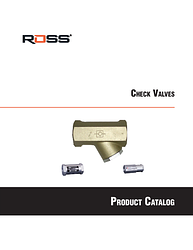
ROSS Heavy-Duty AFC Check Valves 19 Series: Self-Actuating Pneumatic One-Way Valve Solutions
Understanding ROSS Check Valves: Self-Actuating Pneumatic Protection
The ROSS Heavy-Duty AFC Check Valves 19 Series represent a pinnacle of pneumatic valve engineering, designed specifically for applications requiring reliable one-way fluid control in demanding industrial environments. These self-actuating pneumatic valves function as critical safety and operational components, allowing unrestricted airflow in one direction while completely preventing backflow to upstream equipment. This fundamental principle of unidirectional flow control is essential for protecting compressors, regulators, and other sensitive pneumatic components from pressure surges and contamination.
Check valves serve as the unsung guardians of pneumatic system integrity, operating without external control signals or manual adjustment. When inlet pressure exceeds the valve's cracking pressure, the internal poppet lifts, permitting fluid passage to the outlet. Conversely, when pressure reverses or drops below the cracking point, the poppet automatically closes, creating an airtight seal that prevents any back pressure from reaching upstream equipment. This automatic response mechanism makes ROSS check valves indispensable for industries ranging from automotive manufacturing to food processing, pharmaceutical production, and heavy equipment assembly.
Three Valve Configurations: Low-Profile, Mid-Range, and High-Capacity Models
ROSS recognizes that different industrial applications demand different performance characteristics, which is why the AFC Check Valves 19 Series encompasses three distinct valve configurations, each optimized for specific flow and pressure requirements.
Low-Profile Valve Design for Compact Applications combines space efficiency with functional reliability. Featuring a 1/4 body size with 1/8 port configuration, the low-profile model delivers a flow capacity of 0.5 CV (490 Nl/min) while maintaining minimal footprint. This design is particularly valuable in tight industrial spaces where real estate is premium, such as integrated valve manifolds, mobile equipment, and compact pneumatic circuits. The minimal weight of approximately 0.5 pounds makes these valves ideal for weight-sensitive applications without compromising durability or performance.
Mid-Range Valves for Standard Industrial Operations provide the versatility that modern manufacturing demands. Available in three body sizes—1/4, 3/8, and 1/2—these valves accommodate flow ratings from 2.9 to 3.9 CV (2,900-3,800 Nl/min). Engineers frequently specify mid-range check valves for general-purpose pneumatic systems, automated machinery, and standard industrial controls. The balanced design delivers superior performance without excessive weight, maintaining operational reliability across decades of continuous duty.
High-Capacity Valves for Demanding Fluid Power Systems tackle the most challenging applications, from large-scale assembly lines to heavy construction equipment. Ranging from 3/4 to 2-1/2 body sizes, these industrial-grade valves handle flow capacities up to 50 CV (49,000 Nl/min), making them essential for systems requiring maximum throughput. The robust construction and enhanced material specifications enable these valves to perform reliably under extreme conditions where typical solutions would fail.
Advanced Features and Engineering Benefits
The technical sophistication embedded in ROSS check valves reflects decades of pneumatic engineering expertise. The poppet design employs a dirt-tolerant, self-cleaning architecture that maintains performance even in less-than-perfect air quality conditions. This resilience is critical because industrial compressed air systems inevitably contain some level of particulate contamination. Unlike sensitive valves that degrade rapidly when exposed to contaminated air, ROSS poppets incorporate design features that allow self-cleaning action during normal operation, extending service intervals and reducing maintenance costs.
For applications involving temperature extremes, ROSS offers alternate material options beyond the standard Acetal and Stainless Steel configuration, enabling reliable operation from -40°F to 175°F (-40°C to 80°C). This extended temperature range accommodates harsh outdoor environments, cold storage facilities, and high-temperature industrial processes without sacrificing performance or seal integrity.
The soft-seal design represents a critical advancement in pneumatic valve technology, providing multiple benefits including whisper-quiet operation, extended component life, and superior leak prevention. Traditional hard-seal designs generate noise through metal-to-metal contact during valve cycling. ROSS soft-seal technology eliminates this noise source while simultaneously improving the airtight seal that prevents leakage—a crucial feature in safety-critical applications.
Low cracking pressure technology ensures that valves open reliably even at minimal differential pressures, improving system responsiveness and reducing energy consumption. This characteristic proves particularly valuable in pilot-operated systems and applications where minimal pressure differentials are expected.
For applications vulnerable to vibration-induced drift or intentional tampering, ROSS offers positive locking mechanisms on high-capacity valves. This feature prevents unintended adjustment of the cracking pressure knob, maintaining consistent system calibration in challenging environments.
Technical Specifications and Performance Data
The ROSS AFC Check Valves 19 Series operates reliably within clearly defined parameters. The standard operating pressure rating of 150 psi (10.3 bar) accommodates the majority of industrial pneumatic applications while maintaining substantial safety margins. For applications approaching or exceeding this rating, ROSS technical specialists can recommend alternative product families or system modifications.
Temperature considerations require special attention in system design. While the -40°F to 175°F range covers most applications, compressed air below 40°F requires moisture-free air to prevent ice formation that could block valve ports. Below -40°F, consultation with ROSS engineers ensures appropriate component selection and system modifications.
The cast aluminum valve body provides optimal balance between weight reduction and structural integrity, while Acetal and Stainless Steel poppets deliver superior wear resistance and corrosion protection. The Buna-N seals offer broad chemical compatibility with industrial oils and compressed air additives.
Complete Ordering Information and Model Numbers
ROSS provides comprehensive product identification through a systematic model numbering scheme. Each check valve designation includes information about valve style, body size, port configuration, and thread type. Low-profile models begin with designation 1968D, mid-range models use 1968D designation with alternative port combinations, and high-capacity models employ 1968A designations with increased capacity numbers. Thread configuration options include both NPT (National Pipe Thread) and ISO G metric thread standards, ensuring compatibility with diverse international equipment.
The flow data clearly indicates performance characteristics for each model, enabling engineers to select appropriate valves for specific system requirements. Flow coefficients (CV values) measured in cubic feet per minute (CFM) and liters per minute (Nl/min) provide the technical basis for accurate system calculations.
Installation, Maintenance, and Safety Guidelines
Proper installation ensures optimal valve performance throughout its operational life. Before any maintenance or service activity, comprehensive system shutdown is mandatory. ROSS emphasizes adherence to OSHA lockout/tagout procedures (1910.147) and equivalent international standards (EN 1037) to ensure personnel safety during servicing.
Filtration and lubrication significantly impact valve longevity and performance consistency. ROSS recommends 5-micron air filtration for normal applications, with more stringent filtration (3-micron) recommended for sensitive applications. Appropriate lubrication using petroleum-base oils with proper oxidation inhibitors and aniline point ratings maintains seal flexibility and extends component life.
Pre-installation testing of newly installed or serviced valves is mandatory before placing systems into production. This functional verification ensures that maintenance work was completed correctly and that no incidental damage occurred during installation.
Download Your ROSS AFC Check Valves Catalog
This comprehensive catalog provides engineers, procurement specialists, and maintenance technicians with the complete technical foundation needed for confident valve selection and system design. The detailed specifications, dimensional drawings, and ordering information eliminate guesswork from the specification process while the included CAD models facilitate digital system design workflows.
FAQ Section:
What is a check valve and how does it function in pneumatic systems?
Check valves are passive devices that allow fluid flow in one direction while preventing backflow. ROSS check valves use internal poppet mechanisms that automatically open when forward pressure exceeds the cracking pressure and close completely to prevent reverse flow.
Which ROSS check valve model should I specify for my application?
Selection depends on three primary factors: space constraints (low-profile vs. high-capacity), flow requirements (compare CV ratings), and operating conditions (temperature range and pressure). Consult ROSS technical specifications or contact application engineers for precise recommendations.
What maintenance do ROSS check valves require?
Proper system filtration (5-micron minimum), periodic lubrication with compatible oils, and inline serviceability enable efficient maintenance. Most check valve maintenance can be performed without removing the valve from the system.
Are ROSS check valves suitable for extreme temperature applications?
Yes. While standard models operate from -40°F to 175°F, alternate material options extend this range for specialized applications. Contact ROSS for recommendations exceeding standard specifications.
How do I obtain CAD models for system design?
The catalog references downloadable CAD models available through ROSS. These digital resources facilitate 3D system design and integration planning.