




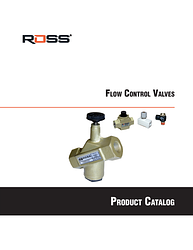
ROSS Flow Control Valves Technical Catalog: Series 19 & 11 Complete Product Guide
Overview of ROSS Flow Control Valves Catalog
Welcome to the comprehensive technical resource for ROSS Flow Control Valves. This catalog serves as your essential guide to understanding, selecting, and specifying pneumatic flow control solutions for industrial automation applications. Whether you're an automation engineer, maintenance professional, procurement specialist, or machine designer, this document provides the critical technical data needed to optimize cylinder speed control in your pneumatic systems.
The ROSS Flow Control Valves catalog encompasses the complete Series 19 and Series 11 product lines, representing over a century of fluid power expertise from ROSS Controls—a global leader in pneumatic and hydraulic safety solutions since 1921. This technical document includes detailed specifications, dimensional drawings, flow capacity data, mounting configurations, and ordering information for over 100 valve configurations designed to meet diverse industrial requirements.
What's Inside the Flow Control Valves Catalog
Complete Product Line Coverage
This comprehensive catalog features four primary product families within the ROSS Flow Control Valve portfolio:
Low-Profile Flow Control Valves (Series 19): Compact inline-mounted valves with slot or knob adjustment options, ideal for space-constrained applications. Available in port sizes from 1/8" to 1/2" with flow coefficients (Cv) ranging from 0.5 to 2.3. These valves feature aluminum construction and operate reliably in ambient temperatures from 41°F to 140°F (5°C to 60°C).
High-Capacity Flow Control Valves (Series 19): Designed for applications requiring maximum flow rates, these valves deliver Cv ratings up to 50 in inline and offset mounting configurations. Available in port sizes from 1/4" through 2-1/2", these cast aluminum valves handle operating pressures from 5 to 150 psig (0.3 to 10 bar) across extended temperature ranges of -40°F to 175°F (-40°C to 80°C).
Low-Profile High-Capacity Flow Control Valves (Series 19): A hybrid design combining compact dimensions with enhanced flow capacity. These valves feature visible brass stem indicators that provide real-time visual confirmation of flow adjustment, plus positive locking mechanisms to prevent inadvertent changes due to vibration or tampering.
Right-Angle Flow Control Valves (Series 11): Specialized 90-degree configuration allowing direct cylinder port mounting in confined spaces. The inlet port swivels 360° for optimal positioning flexibility. Available with both slot and knob adjustment options in port sizes from 1/8" to 1/2" with Cv ratings from 0.5 to 2.8.
Technical Specifications and Performance Data
The catalog provides exhaustive technical specifications essential for proper valve selection and system design:
Operating Parameters: Detailed pressure ranges (5-150 psig / 0.3-10 bar operating pressure, up to 217 psi supply pressure for low-profile models), temperature ratings for both ambient and media conditions, and flow media requirements (filtered air with 5-micron filtration recommended).
Flow Characteristics: Complete Cv (flow coefficient) data for each valve model in both free-flow direction (port 1 to 2) and controlled-flow direction (port 2 to 1). The catalog explains how flow adjustment ranges from near-zero to maximum capacity through precision needle control.
Materials of Construction: Comprehensive materials specifications including valve body materials (cast aluminum, aluminum barstock), seal materials, and construction details critical for chemical compatibility and environmental suitability assessments.
Dimensional Data: Precision dimensional drawings in both inches and millimeters showing mounting footprints, port locations, adjustment mechanism access, and clearance requirements. This information is critical for CAD integration and panel layout planning.
Valve Function and Application Principles
The catalog includes detailed explanations of flow control valve operation and application best practices:
Flow Control Function: Flow control valves enable high air flow rates into cylinders during extension while providing precisely controlled, adjustable flow rates during retraction. This differential control is essential for smooth, predictable cylinder motion and accurate cycle time management.
System Design Considerations: Guidance on selecting flow control valves with sufficient flow capacity to avoid becoming limiting factors in cylinder control systems. The catalog emphasizes matching full-flow capacity to control valve specifications to maintain smooth, predictable motion in both directions.
Adjustment Mechanisms: Detailed operational instructions for both slot-adjustment (screwdriver) and knob-adjustment models, including turn specifications (ranging from 8 turns for 1/8" and 1/4" ports to 24 turns for larger configurations).
Product Line Features and Benefits
Advanced Design Characteristics
Poppet Construction: ROSS flow control valves utilize dirt-tolerant poppet design technology that provides self-cleaning action and maintains consistent performance even in contaminated air environments. This construction ensures longer service life and reduces maintenance requirements compared to alternative valve technologies.
Bidirectional High Flow: Unlike meter-out-only designs, ROSS flow control valves deliver high flow capacity in both free-flow and reverse-flow directions, enabling greater application flexibility and simplified system design.
Wear-Compensating Design: The poppet configuration automatically compensates for seal wear throughout the valve's operational life, maintaining consistent response times and flow characteristics without periodic adjustment or calibration.
Vibration-Resistant Locking: Low-Profile High-Capacity models incorporate positive locking features that prevent unintended flow adjustment changes caused by machine vibration or environmental factors—critical for maintaining process consistency in high-vibration industrial environments.
Thread and Port Configurations
The catalog details comprehensive threading and connection options:
NPT Threading: Standard National Pipe Thread (NPT) configurations for North American applications, with male threaded inlet and outlet ports sized from 1/8" through 2-1/2".
BSPP Threading (G Thread): British Standard Pipe Parallel threading options available across the product line, designated with "D" prefix in model nomenclature (e.g., D1968F2007). This provides compatibility with international equipment and global manufacturing standards.
Tube Fitting Options: Selected models offer tube fitting compatibility, enabling direct push-to-connect or compression fitting installation for streamlined system assembly.
Application-Specific Valve Selection
Low-Profile Series - Space-Critical Applications
Low-Profile Flow Control Valves are engineered for applications where mounting space is limited but precise flow control remains essential. Common applications include:
- Compact automated assembly equipment
- Medical device manufacturing machinery
- Small robotic actuators and pick-and-place systems
- Electronic component handling equipment
- Packaging machinery with tight dimensional constraints
The minimal footprint of Low-Profile valves (as small as 40mm length × 16mm width × 53mm height) enables direct cylinder mounting without manifold blocks or intermediate fittings, reducing system complexity and potential leak points.
High-Capacity Series - High-Flow Demand Applications
High-Capacity Flow Control Valves address applications requiring maximum flow rates to drive large-bore cylinders or achieve rapid cycle times. Typical applications include:
- Heavy stamping and forming presses
- Large-scale material handling systems
- Automotive assembly line actuators
- Steel and aluminum processing equipment
- High-speed packaging and palletizing systems
With Cv ratings up to 50, these valves support cylinder bore sizes exceeding 6 inches and stroke speeds measured in feet per second, while maintaining precise control during retraction phases.
Right-Angle Series - Confined Space Solutions
Right-Angle Flow Control Valves provide unique installation advantages in applications where:
- Linear space for inline mounting is unavailable
- Direct cylinder port mounting is preferred to eliminate additional plumbing
- 360° swivel capability is needed for optimal hose routing
- Maintenance access requires adjustment mechanism repositioning
Industries leveraging right-angle configurations include metalworking machinery, woodworking equipment, plastics processing machines, and custom automation systems where non-standard orientations are common.
Technical Specifications Deep Dive
Operating Pressure and Temperature Ranges
Low-Profile Models: These valves operate within supply pressure limits of 217 psi (14.9 bar) with maximum operating pressure of 150 psi (10.3 bar). Ambient and media temperature ranges span 41°F to 140°F (5°C to 60°C), suitable for standard factory floor environments.
High-Capacity and Right-Angle Models: Extended temperature capability from -40°F to 175°F (-40°C to 80°C) accommodates harsh industrial environments including outdoor installations, foundries, cold storage facilities, and extreme climate manufacturing locations. Operating pressure range of 5 to 150 psig (0.3 to 10 bar) provides flexibility for both low-pressure air prep system applications and high-pressure industrial compressed air networks.
Flow Coefficient (Cv) and Performance Calculations
The Cv rating quantifies a valve's flow capacity and enables precise system design calculations. The catalog provides Cv values for each valve model, enabling engineers to:
- Calculate expected flow rates at specific pressure differentials
- Size valves appropriately for cylinder displacement requirements
- Predict cylinder extension and retraction speeds
- Optimize energy consumption by avoiding oversized valve selections
For example, a valve with Cv of 2.3 at 50 psi differential pressure will flow approximately 115 SCFM (Standard Cubic Feet per Minute), while a high-capacity valve with Cv of 50 at the same pressure differential delivers approximately 2,500 SCFM—critical data for matching valve capacity to actuator requirements.
Mounting and Installation Requirements
The catalog includes detailed mounting specifications:
Inline Mounting: Standard threaded installation directly into pneumatic circuit piping or manifold blocks. Orientation flexibility (any position for low-profile models, vertical preferred for optimal performance).
Cylinder Port Mounting: Right-angle models feature direct mounting into cylinder port threads, eliminating connecting hoses and fittings. The 360° swivel inlet provides routing flexibility regardless of cylinder orientation.
Panel and Bracket Mounting: Dimensional data enables fabrication of custom mounting brackets or integration into control panel pneumatic circuits.
Ordering Information and Model Number Breakdown
Model Nomenclature System
Understanding ROSS model numbering enables precise specification:
Threading Prefix: Models beginning with "D" feature BSPP (G) threading; models without prefix use NPT threading.
Series Designation: "1968" indicates Series 19 standard flow controls; "1868" indicates Series 18 quick exhaust valves; "11" series designates right-angle configurations.
Valve Type Code: Alphabetic characters indicate profile type (F = Low-Profile, B = High-Capacity, A = Right-Angle).
Port Size Indicator: Numeric characters specify inlet/outlet port sizing (1 = 1/8", 2 = 1/4", 3 = 3/8", 4 = 1/2", etc.).
Adjustment Type: Final digits indicate adjustment mechanism (007/008 designations correlate to knob or slot adjustment options).
Complete Model Number Examples
- 1968F2007: NPT threaded, Low-Profile, 1/4" ports, knob adjustment
- D1968B4007: BSPP threaded, High-Capacity, 1/2" ports, knob adjustment
- 1968A3018: NPT threaded, Right-Angle, 3/8" ports, knob adjustment
Related Products and Accessories
While focused on flow control valves, the catalog references complementary ROSS product lines essential for complete pneumatic system design:
Check Valves (Series 19): Low-profile and mid-range check valves prevent backflow and enable advanced circuit design including piloted circuits and quick return functions.
Shuttle Valves (Series 19): Standard and high-flow shuttle valves (dual-inlet, single-outlet) enable OR-logic circuits for multiple actuator control and emergency override systems.
Quick Exhaust Valves (Series 18): High-flow exhaust valves positioned near cylinder ports dramatically increase retraction speeds by providing short-path exhaust routing that bypasses control valve restrictions.
Installation and Maintenance Guidelines
Pre-Installation Requirements
The catalog emphasizes critical pre-installation considerations:
Air Quality: Filtered air with 5-micron filtration minimum is required for all ROSS flow control valves. Particulate contamination accelerates seal wear and compromises adjustment precision. The catalog references ROSS air preparation products (filters, regulators, lubricators) for complete FRL system specification.
System Pressure Verification: Confirm supply pressure and cylinder operating pressure fall within valve specifications. Operating valves beyond rated pressures voids warranty and creates safety hazards.
Thread Sealant Selection: Use appropriate thread sealants compatible with pneumatic service. Avoid PTFE tape over-application that can contaminate downstream components.
Adjustment Procedures
Detailed operational guidance for flow adjustment:
Slot Adjustment: Requires standard flat-blade screwdriver. Turn counterclockwise (out) to increase flow, clockwise (in) to decrease flow. Adjustment range spans 8-24 complete turns depending on port size.
Knob Adjustment: Hand-operated adjustment without tools. Knurled adjustment knob provides tactile feedback and allows precise incremental adjustments during system tuning. Locking mechanisms (where equipped) prevent inadvertent changes.
Industry Standards and Compliance
ROSS Controls manufactures flow control valves in compliance with relevant industrial standards:
Product Credentials: The catalog includes reference to UL, C-UL, and CE certifications applicable to ROSS valve products, ensuring compliance with North American and European safety and performance requirements.
Quality System Certification: ROSS Controls operates under ISO 9001 certified quality management systems, providing manufacturing consistency and traceability essential for regulated industries.
Why Choose ROSS Flow Control Valves
Heritage of Safety and Reliability
Since 1921, ROSS Controls has specialized in fluid power safety and control solutions. This catalog represents the culmination of over 100 years of engineering expertise specifically focused on protecting workers, safeguarding machinery investments, and maximizing production uptime.
Proven Performance: ROSS flow control valves operate in the most demanding industrial environments worldwide—steel mills, aluminum smelters, automotive assembly plants, food and beverage processing facilities, and aerospace manufacturing operations.
Global Support Network: With engineering and technical support centers across North America, Europe, and Asia-Pacific, ROSS provides local expertise backed by global resources for application engineering, troubleshooting, and custom solutions.
Total System Approach
ROSS offers comprehensive pneumatic system solutions beyond individual components:
Integrated Safety Valves: ROSS pioneered control-reliable double valves (DM2 Series) and lockout/tagout solutions (L-O-X Series) that integrate with flow control valves to create complete safety systems compliant with OSHA, ANSI, CSA, and ISO safety standards.
Engineered Solutions: The ROSS/FLEX custom engineering program modifies standard products to meet unique application requirements—different port configurations, mounting arrangements, or environmental specifications—without requiring complete custom valve development.
Training and Education: ROSS provides comprehensive machine safety training programs, including the Total Machine Safety Course, educating engineers and technicians on proper pneumatic system design, safety circuit implementation, and regulatory compliance.
How to Use This Catalog
This technical catalog is organized for efficient valve selection and specification:
- Identify Application Requirements: Determine required port size, flow capacity (Cv), mounting configuration, and environmental operating conditions.
- Select Valve Series: Choose Low-Profile, High-Capacity, or Right-Angle series based on space constraints and flow demands.
- Specify Threading: Select NPT (standard) or BSPP "D" prefix models for international compatibility.
- Choose Adjustment Type: Specify slot (screwdriver) or knob (hand-operated) adjustment based on accessibility and operator interaction requirements.
- Verify Specifications: Cross-reference dimensional data, weight, Cv rating, and operating parameters against system design requirements.
- Generate Part Number: Use model nomenclature guidelines to construct complete ordering part number.
Additional Technical Resources
Beyond this catalog, ROSS Controls provides extensive technical documentation:
Installation Instructions: Step-by-step installation, adjustment, and troubleshooting procedures for each valve series.
3D CAD Models: Downloadable CAD models in multiple file formats (STEP, IGES, Solidworks, AutoCAD) for direct integration into machine design software.
Application Notes: Technical bulletins addressing specific application challenges—temperature extremes, contaminated environments, special media compatibility, and custom modifications.
Safety Whitepapers: Educational resources on pneumatic safety system design, risk assessment, and regulatory compliance from ROSS's global safety engineering team.
Download Your Complete ROSS Flow Control Valves Catalog
Access comprehensive technical specifications, dimensional drawings, and ordering information for the complete Series 19 and Series 11 Flow Control Valve product lines.
This master catalog includes:
- ✓ Over 100 valve configurations with complete specifications
- ✓ Detailed dimensional drawings in imperial and metric units
- ✓ Flow coefficient (Cv) data for accurate system design calculations
- ✓ Model number nomenclature and ordering guide
- ✓ Installation and adjustment procedures
- ✓ Materials of construction and compatibility data
- ✓ Temperature and pressure rating tables
- ✓ Thread options: NPT and BSPP (G Thread)
Need Application Support?
ROSS Controls' experienced application engineers are available to assist with valve selection, system design, and technical specifications.
Contact ROSS Controls:
- Phone: 1-800-GET-ROSS (1-800-438-7677)
- Technical Support: Available for custom application engineering, ROSS/FLEX modifications, and integration assistance
Explore Related Resources:
- Pneumatic Safety Valves (DM2 Series)
- Energy Isolation Solutions (L-O-X Series)
- Air Preparation Products (FRL)
- Machine Safety Training Programs
FAQ’s
Q: What valve series are covered in this catalog?
A: This catalog covers ROSS Series 19 Flow Control Valves (Low-Profile, High-Capacity, and Low-Profile High-Capacity) and Series 11 Right-Angle Flow Control Valves, including over 100 configurations.
Q: What port sizes are available in ROSS flow control valves?
A: ROSS flow control valves are available in port sizes from 1/8" through 2-1/2" with both NPT and BSPP (G Thread) options.
Q: What is the operating pressure range for these valves?
A: Most models operate from 5 to 150 psig (0.3 to 10 bar), with low-profile models supporting supply pressure up to 217 psi (14.9 bar).
Q: What temperature ranges do ROSS flow control valves support?
A: Low-Profile models: 41°F to 140°F (5°C to 60°C); High-Capacity and Right-Angle models: -40°F to 175°F (-40°C to 80°C).
Q: What is flow coefficient (Cv) and why is it important?
A: Cv quantifies a valve's flow capacity. ROSS valves range from Cv 0.5 to Cv 50, enabling precise system design calculations for cylinder speed control and energy optimization.