



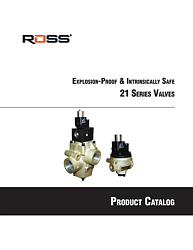
ROSS 21 Series Explosion-Proof and Intrinsically Safe Valves - Complete Catalog & Technical Specifications
The ROSS Controls 21 Series Explosion-Proof and Intrinsically Safe Valves catalog is your comprehensive resource for selecting and specifying pneumatic directional control valves designed for hazardous location applications. This complete technical document provides detailed specifications, dimensional drawings, ordering information, and safety certifications for ROSS's proven line of solenoid pilot controlled valves engineered specifically for low temperature environments where electrical ignition of flammable gases, vapors, combustible dust, or easily ignitable fibers poses a serious safety concern.
Why Download This Catalog?
This catalog serves as an essential technical reference for safety engineers, plant managers, automation specialists, and procurement professionals responsible for specifying fluid power components in hazardous locations. Whether you're designing new pneumatic systems for oil and gas facilities, chemical processing plants, paint spray booths, grain handling operations, or retrofitting existing equipment to meet updated safety standards, this document provides the critical information needed to ensure compliance, safety, and operational reliability.
The ROSS 21 Series represents over seven decades of engineering excellence in pneumatic safety solutions, combining field-proven poppet valve technology with explosion-proof and intrinsically safe coil options to deliver maximum protection in the most demanding industrial environments.
ROSS 21 Series Explosion-Proof Valves - Product Overview
Designed for Hazardous Location Safety
The ROSS 21 Series explosion-proof and intrinsically safe valves are specifically engineered for applications where safety from electrical ignition is paramount. These solenoid pilot controlled valves provide reliable directional control in classified hazardous locations including:
- Class I, Division 1 & 2 - Locations where flammable gases or vapors may be present
- Class II, Division 1 & 2 - Areas containing combustible dust
- Class III, Division 1 & 2 - Environments with easily ignitable fibers or flyings
- ATEX Zones 1 & 2 - European classified hazardous areas
- Low temperature environments - Arctic conditions, refrigerated storage, outdoor installations
The valves are ideal for industries including oil and gas exploration and refining, petrochemical processing, pharmaceutical manufacturing, food and beverage production, grain handling and storage, paint and coating operations, mining and mineral processing, wastewater treatment, and chemical manufacturing.
Explosion-Proof vs. Intrinsically Safe Technology
Explosion-Proof Coils: These coils are designed to contain any spark, arc, or thermal event originating from within the solenoid coil or housing. In the event of an internal failure, the explosion-proof enclosure prevents the ignition of flammable materials in the surrounding atmosphere, containing the potential explosion within the robust coil housing. This technology is essential for Division 1 hazardous locations where ignitable concentrations of flammable gases or vapors may exist under normal operating conditions.
Intrinsically Safe Coils: These coils are engineered to limit the electrical and thermal energy available in the circuit to levels incapable of causing ignition under both normal and abnormal conditions. By restricting voltage, current, and power to safe levels, intrinsically safe designs prevent spark generation that could ignite surrounding hazardous atmospheres. This approach is particularly effective in Division 1 applications requiring enhanced safety assurance.
Key Features and Engineering Advantages
Perpendicular Poppet Face Seal Design
The ROSS 21 Series utilizes a proprietary perpendicular poppet face seal configuration that delivers exceptional performance advantages over traditional spool valve designs. This engineering approach creates high-flow capacity with positive sealing characteristics, ensuring zero leakage when closed and maximum flow when open. The perpendicular sealing action eliminates the sliding friction present in spool valves, dramatically reducing wear and extending valve service life in contaminated environments.
Differential Piston Design for Consistent Response
Each valve incorporates a differential piston design that leverages the pressure differential between inlet and outlet ports to generate overwhelming shifting forces. This design ensures fast, consistent response times regardless of operating pressure variations, temperature changes, or minor contamination. The differential force multiplier effect means the solenoid pilot requires minimal power consumption while delivering powerful actuation force to the main valve element.
Self-Cleaning High-Velocity Airflow
The valve's internal flow path directs high-velocity air across the poppet seats during each actuation cycle. This engineered airflow pattern provides continuous self-cleaning action, purging contaminant particles away from sealing surfaces. Combined with the perpendicular sealing motion that naturally dislodges trapped debris, this design delivers exceptional dirt tolerance—a critical requirement for real-world industrial pneumatic systems where perfect air filtration is challenging to maintain.
Superior Internal Guidance and Self-Compensating Seals
ROSS engineers designed the 21 Series with precision internal guidance systems that maintain perfect alignment between moving poppet elements and their sealing surfaces throughout the valve's operational life. Self-compensating seal materials automatically adjust to minor wear, maintaining sealing integrity over millions of cycles. This combination of precise guidance and adaptive sealing technology results in predictable, long-term performance with minimal maintenance requirements.
Manual Override for Emergency Operation
Every ROSS 21 Series valve includes a push-type, non-locking manual override that allows manual actuation in case of electrical failure, during commissioning procedures, or for quick cycle testing during troubleshooting. This feature is essential for maintaining operational flexibility and ensuring emergency shutdown capabilities remain available even during power outages or control system failures.
Technical Specifications Summary
Available Valve Functions
2/2 Valves (Two-Way, Two-Position):
- Normally Closed configurations for fail-safe exhaust applications
- Normally Open configurations for safe air entry or continuous flow applications
- Ideal for simple on/off directional control and energy isolation
3/2 Valves (Three-Way, Two-Position):
- Normally Closed configurations for single-acting cylinder control
- Normally Open configurations for alternative pneumatic logic functions
- Features separate exhaust port for enhanced flow capacity and control flexibility
4/2 Valves (Four-Way, Two-Position):
- Spring return configurations for double-acting cylinder control
- Allows reversible pneumatic actuator operation with single valve
- Provides independent supply and exhaust paths for each cylinder port
Port Size Options and Flow Capacities
The 21 Series is available in three body sizes to accommodate various flow requirements:
3/8" Body Size (Basic Size 1):
- Inlet/Outlet: 1/2" NPT or G thread
- Exhaust: 1/2" (3/2 valves)
- Flow capacity: 2.6-4.6 Cv (2,600-4,600 Nl/min)
- Compact dimensions for space-constrained installations
3/4" Body Size (Basic Size 2):
- Inlet/Outlet: 3/4" NPT or G thread
- Exhaust: 1" (3/2 and 4/2 valves)
- Flow capacity: 6.3-10 Cv (6,200-10,000 Nl/min)
- Optimal balance of size and flow for general industrial applications
1-1/4" Body Size (Basic Size 3):
- Inlet/Outlet: 1-1/2" NPT or G thread
- Exhaust: 1-1/2" to 2-1/2"
- Flow capacity: 19-28 Cv (19,000-28,000 Nl/min)
- Maximum flow capacity for high-volume pneumatic systems
Operating Parameters
Pressure Range: 30 to 150 psig (2.1 to 10 bar)
- Pilot supply must be equal to or greater than inlet pressure
- Internal pilot supplied from inlet port when pressure is within range
- External pilot option available for applications with variable inlet pressure
Temperature Capabilities:
- Ambient temperature: -4°F to 140°F (-20°C to 60°C)
- Media temperature: -4°F to 175°F (-20°C to 80°C)
- Specifically optimized for low temperature applications
- Seal materials selected for cold weather performance
Fluid Media: Filtered compressed air (40-micron filtration recommended)
Electrical Options:
- DC voltages: 12 VDC, 24 VDC
- AC voltages: 120 VAC, 240 VAC
- Continuous duty rating
- Power consumption: 1.6-3.5 Watts (depending on coil type)
Construction Materials
Valve Body: Cast aluminum alloy for optimal strength-to-weight ratio and corrosion resistance
Poppet/Spool Elements: Stainless steel and engineered acetal resins for wear resistance and dimensional stability
Seal Materials:
- Buna-N (Nitrile) standard for general low temperature service
- Fluorocarbon (Viton) available for enhanced chemical resistance and high temperature capability
Coil Housings:
- Explosion-proof: Heavy-duty aluminum with certified enclosure ratings
- Intrinsically safe: Energy-limited design with protective circuitry
Safety Certifications and Compliance
International Hazardous Location Approvals
ATEX Certification (European Union):
- Certified by TÜV SÜD, notified body for ATEX compliance
- Suitable for ATEX Zones 1 and 2 (gas/vapor) and Zones 21 and 22 (dust)
- Compliance with ATEX Directive 2014/34/EU
- Complete declaration of conformity included with each valve
FM Approval (Factory Mutual):
- FM Approved for use in North American hazardous locations
- Class I, Division 1, Groups B, C, D
- Class II, Division 1, Groups E, F, G
- Class III, Division 1
- Temperature classification per application requirements
CSA/UL Certification:
- Canadian Standards Association certified
- Underwriters Laboratories listed
- Compliance with CSA 22.2 No. 30 and UL 508 standards
- Suitable for installation in U.S. and Canadian facilities
Functional Safety Ratings
ISO 13849-1:2015 Compliance:
- Category 1 classification
- Performance Level: PL c
- Suitable for integration into safety-related control systems
- Validated architecture for safety function contributions
IEC 61508:2010 Compliance:
- Safety Integrity Level: SIL 2
- Functional safety data available for systematic capability evaluation
- Supports integration into SIL-rated safety instrumented systems
- Certificate of compliance documentation provided
Catalog Contents - What's Inside
This comprehensive technical catalog includes detailed information across multiple sections designed to support the complete valve selection, specification, ordering, installation, and maintenance lifecycle:
Product Overview Section
- Detailed feature descriptions with engineering rationale
- Cross-sectional valve illustrations showing internal flow paths
- Comparison of valve functions (2/2, 3/2, 4/2)
- Application guidelines for hazardous location classifications
- Technology explanations for explosion-proof vs. intrinsically safe designs
Complete Technical Specifications
- Operating pressure ranges and temperature limits
- Electrical specifications for all coil voltage options
- Flow capacity data (Cv values and normal liters per minute)
- Response time specifications
- Duty cycle ratings
- Power consumption specifications
- Pilot supply requirements
Dimensional Drawings
- Detailed dimension drawings for each body size and valve function
- Port location and thread specifications
- Mounting orientation requirements
- Clearance dimensions for solenoid coil and manual override
- Weight specifications for system design calculations
Model Number Configuration Guide
- Step-by-step model number construction system
-
Individual option codes explained:
- Valve function selection (2/2, 3/2, 4/2)
- Body size and port configuration
- Default position (normally closed or normally open)
- Pilot type (internal or external)
- Thread standard (NPT or G)
- Coil voltage and type (explosion-proof or intrinsically safe)
- Seal material selection
- Special options and modifications
Performance Data and Flow Curves
- Pressure drop vs. flow rate curves
- Response time vs. pressure differential
- Temperature derating information
- Seal material compatibility charts
- Expected service life data
Installation Instructions
- Mounting orientation requirements for optimal performance
- Piping connection best practices
- Electrical wiring guidelines for hazardous locations
- Grounding and bonding requirements per NEC/CEC standards
- Conduit entry specifications
- System air preparation requirements (filtration, pressure regulation, lubrication)
Maintenance Guidelines
- Recommended inspection intervals
- Seal replacement procedures
- Troubleshooting guide for common issues
- Spare parts identification
- Field service kit options
Accessories and Options
Exhaust Silencers:
- Thread-on silencer options for noise reduction
- Flow capacity matched to valve sizes
- Sintered bronze and plastic element options
Female Silencer Connectors:
- Adapters for remote exhaust piping
- Various thread configurations available
Solenoid Pilot Conversion Kits:
- Field conversion capability between voltage options
- Explosion-proof to intrinsically safe conversions
- Complete kit with all required components
Pressure Switches:
- Status feedback switches for control integration
- Normally open and normally closed contact options
- Adjustable pressure setpoints
Mounting Accessories:
- Bracket kits for secure installation
- Adapter fittings for non-standard piping connections
Application Industries and Use Cases
Oil and Gas Industry
ROSS 21 Series explosion-proof valves are extensively deployed in upstream, midstream, and downstream petroleum operations where flammable hydrocarbon vapors create Class I, Division 1 hazardous location conditions. Common applications include:
- Wellhead control systems and blowout prevention equipment
- Pipeline valve actuators and emergency shutdown systems
- Offshore platform pneumatic control systems exposed to salt spray and extreme weather
- Refinery process unit actuator controls
- Tank farm loading rack automation
- Gas compression station controls
- Drilling rig pneumatic systems operating in arctic conditions
The low temperature capability and explosion-proof certification make these valves ideal for installations in extreme climates, from Arctic drilling operations to scorching desert production facilities.
Chemical and Petrochemical Processing
Chemical manufacturing facilities require robust explosion-proof pneumatic components to safely control processes involving volatile organic compounds, reactive chemicals, and combustible dust environments:
- Reactor vessel actuated valve controls
- Batch process sequencing valves
- Emergency isolation and dump systems
- Solvent handling equipment automation
- Polymerization process controls
- Chemical storage and transfer system interlocks
- Dust collection system valve actuation in powder handling areas
The chemical resistance of fluorocarbon seal options and the self-cleaning poppet design provide reliable performance in corrosive chemical atmospheres.
Pharmaceutical Manufacturing
Pharmaceutical production facilities operating in solvent-rich environments or handling combustible pharmaceutical powders require certified explosion-proof controls:
- Tablet press automation in dust-generating operations
- Solvent-based coating booth valve controls
- Active pharmaceutical ingredient (API) handling systems
- Dust collection and containment system controls
- Clean room grade compressed air distribution with hazardous material handling
- Reactor and vessel controls in chemical synthesis areas
Food and Beverage Production
Food processing plants with grain dust hazards, alcohol vapors, or combustible flour dust require explosion-proof pneumatic components:
- Grain silo pneumatic conveying valve controls
- Flour milling equipment automation
- Alcohol distillation and fermentation equipment
- Spray drying system controls where combustible powder creates explosion risks
- Sugar refining process valve actuation
- Pneumatic conveying systems for combustible food powders
Low temperature rated valves are essential for cold storage facilities and refrigerated processing areas.
Paint and Coating Operations
Paint spray booths and coating application systems contain flammable solvent vapors requiring Class I, Division 1 explosion-proof controls:
- Spray booth pneumatic gun controls
- Automated paint application robot air supplies
- Coating material pump and valve actuation
- Paint mixing room equipment controls
- Oven conveyor system pneumatic components
- Ventilation damper actuator controls
Mining and Mineral Processing
Underground mining operations and mineral processing plants deal with combustible dust and potentially explosive methane gas:
- Underground coal mine pneumatic equipment controls
- Mineral processing mill equipment automation
- Conveyor system controls in dusty environments
- Dust collection system valve actuation
- Crushing and grinding equipment pneumatic controls
- Material handling system automation
Wastewater Treatment
Wastewater treatment facilities handling sewage and organic waste must address methane gas and hydrogen sulfide explosion hazards:
- Digester and aeration basin valve controls
- Biogas handling system automation
- Sludge handling equipment controls
- Chemical feed system valve actuation
- Odor control system pneumatic components
Why Choose ROSS Controls 21 Series?
Seven Decades of Pneumatic Safety Innovation
Since 1921, ROSS Controls has pioneered pneumatic and hydraulic safety valve technology, establishing the company as the global authority in control-reliable fluid power systems. The 21 Series represents the culmination of continuous engineering refinement, field feedback from thousands of installations, and unwavering commitment to worker safety.
Field-Proven Reliability
ROSS 21 Series valves are installed in tens of thousands of hazardous location applications worldwide, from Arctic oil fields to Middle Eastern refineries. This extensive field history provides real-world validation of the design's durability, safety, and performance under the most demanding conditions.
Comprehensive Certification Portfolio
ROSS maintains the most extensive portfolio of international safety certifications in the pneumatic valve industry, ensuring your installations meet local regulatory requirements whether you're building facilities in North America, Europe, Asia, or anywhere globally. ROSS certification expertise eliminates project delays caused by compliance issues.
Engineering Support and Technical Expertise
ROSS technical support engineers are available to assist with valve selection, system design review, certification documentation, and troubleshooting. Our applications engineering team brings decades of combined experience in hazardous location pneumatic system design and can help optimize your valve specifications for safety, performance, and cost-effectiveness.
Modular Design for Inventory Efficiency
The 21 Series modular architecture allows field conversion between voltage options and coil types using conversion kits, reducing spare parts inventory requirements. This flexibility is particularly valuable for facilities with multiple voltage standards or those transitioning between explosion-proof and intrinsically safe designs during equipment upgrades.
Frequently Asked Questions
What's the difference between explosion-proof and intrinsically safe valves?
Explosion-proof valves use robust mechanical enclosures to contain internal sparks or explosions, preventing ignition of the surrounding atmosphere. Intrinsically safe valves limit electrical energy to levels incapable of causing ignition under any failure condition. Both approaches achieve hazardous location safety but through different engineering methodologies. The choice depends on your specific application requirements, existing control system architecture, and facility safety standards.
Can ROSS 21 Series valves be used outdoors in cold climates?
Yes, the 21 Series is specifically designed for low temperature applications down to -4°F (-20°C) ambient and media temperatures. The Buna-N seal material maintains flexibility and sealing performance at sub-freezing temperatures. For arctic or extreme cold applications, ROSS can provide application-specific seal materials rated to -40°F (-40°C).
What flow capacity do I need for my pneumatic cylinder?
Flow capacity (Cv) requirements depend on your cylinder bore diameter, stroke length, cycle time requirements, and available supply pressure. As a general guideline, use the Cv values in the catalog to ensure the valve's flow capacity exceeds your calculated cylinder flow demand by at least 20% to prevent excessive pressure drop and sluggish actuator response. ROSS applications engineers can assist with proper valve sizing using your specific system parameters.
How do I select between NPT and G thread options?
NPT (National Pipe Thread) is the standard tapered thread used in North American industrial piping. G thread (ISO 228-1, formerly BSP Parallel) is the cylindrical thread standard common in European and Asian systems. Select the thread standard that matches your facility's piping components. Both provide equivalent performance; the choice is based on regional standards and existing facility infrastructure.
Can these valves be mounted in any orientation?
ROSS 21 Series valves must be mounted vertically with pilot solenoids on top to ensure proper drainage and prevent contaminant accumulation in the pilot section. This orientation also provides optimal heat dissipation from the solenoid coil and allows manual override access. Horizontal or inverted mounting can compromise valve performance and shorten service life.
What air quality is required?
ROSS recommends filtered compressed air with maximum 40-micron particulate filtration. While the poppet design provides exceptional dirt tolerance compared to spool valves, proper air preparation extends valve life and ensures consistent performance. A filter-regulator-lubricator (FRL) combination is recommended for optimal system performance, though lubrication is not required for valve operation.
Are replacement parts readily available?
Yes, ROSS maintains comprehensive spare parts inventory for all current and legacy valve series. Seal kits, coil assemblies, and other wear components are available for immediate shipment. The modular design allows field replacement of most components without removing the valve from the system.
What's the expected service life?
ROSS 21 Series valves are designed for multi-million cycle service life when operated within specified parameters and with proper air preparation. Actual life depends on operating pressure, cycle frequency, temperature conditions, and air quality. In typical industrial service with proper maintenance, valves commonly achieve 5-10 years of reliable operation.
How to Order ROSS 21 Series Valves
Using the Model Number Configurator
The catalog includes a comprehensive model number configuration guide that walks you through each selection criterion:
- Valve function - Choose 2/2, 3/2, or 4/2 based on your pneumatic circuit requirements
- Body size - Select 3/8", 3/4", or 1-1/4" based on flow capacity needs
- Default position - Specify normally closed or normally open based on fail-safe requirements
- Pilot type - Choose internal pilot (simplest) or external pilot (for variable inlet pressure)
- Thread standard - Select NPT or G to match facility piping standards
- Coil specification - Choose voltage (12/24 VDC, 120/240 VAC) and type (explosion-proof or intrinsically safe)
- Seal material - Standard Buna-N or optional Fluorocarbon for enhanced chemical/temperature resistance
- Special options - Manual override, specific certifications, custom modifications
Technical Support for Valve Selection
ROSS technical sales engineers are available to assist with valve selection and provide application-specific recommendations. Contact ROSS Controls at 1-800-438-7677 or through the website contact form to speak with a pneumatic safety specialist who can help optimize your valve specification for your unique application requirements.
Custom Engineering Solutions
For applications requiring modifications beyond standard catalog offerings, ROSS engineering services can develop custom solutions including special voltage coils, alternative seal materials, modified port configurations, or integrated pressure switches and sensors. ROSS has extensive experience creating application-specific pneumatic safety valves for unique industrial requirements.
Download Your Free Catalog
Click the download button above to access your complete PDF copy of the ROSS Controls 21 Series Explosion-Proof and Intrinsically Safe Valves catalog. This technical resource will be immediately available for offline reference, team sharing, and integration into your design documentation.
The catalog is regularly updated with the latest product specifications, certification information, and technical data. Bookmark this page to ensure you always have access to the most current version.
For additional ROSS Controls product catalogs, technical white papers, safety application notes, and installation guides, visit the ROSS Controls Documents library.
Related ROSS Controls Resources
27 Series Explosion-Proof Valves:
Higher temperature capability (up to 175°F/80°C) for standard industrial environments requiring hazardous location certification.
DM2 Series C Explosion-Proof Safety Exhaust Valves:
Monitored redundant safety valves with explosion-proof coils for Category 4, PL e safety functions in hazardous locations.
NAMUR Valves with Explosion-Proof Options:
Compact NAMUR interface valves for direct mounting to pneumatic actuators in hazardous locations.
Pneumatic Safety Valve Selection Guide:
Comprehensive white paper explaining valve selection methodology for safety-related pneumatic systems.
Hazardous Location Classification Guide:
Technical reference explaining North American and international hazardous location classification systems.
Contact ROSS Controls
North American Headquarters:
ROSS Controls
1-800-438-7677
Email: info@rosscontrols.com
Website: www.rosscontrols.com
Technical Support:
Available 8:00 AM - 5:00 PM Eastern Time
Direct technical hotline for engineering assistance
International Locations:
ROSS maintains sales and technical support offices in Europe, Asia, and South America. Visit rosscontrols.com for regional contact information.