



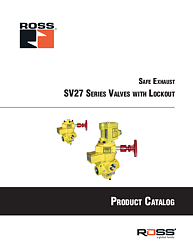
Safe Exhaust Sensing Valves with Lockout: SV27 Series Catalog & Specifications
The SV27 Series Safe Exhaust Sensing Valves represent the industry-proven evolution of ROSS Controls' legendary 27 Series valve technology, combining reliable poppet valve design with advanced safety monitoring capabilities. These 3/2 normally closed sensing valves are engineered specifically for safe shut-off and exhaust functions in Category 2 pneumatic safety applications, providing manufacturers with the safety integrity level (SIL 2) certification required for regulated industries and hazardous machinery operations.
Designed with the philosophy that safety and reliability should never be compromised, the SV27 series integrates a safety-rated DPST (Double-Pole Single-Throw) switch directly into the valve body, providing real-time feedback on internal valve position and state. When coupled with the innovative L-O-X® manual lockout control mechanism, the SV27 becomes a complete energy isolation solution that prevents catastrophic air dumps during machinery service and maintenance operations.
ROSS Controls has engineered these valves to meet the stringent requirements of modern manufacturing safety standards while maintaining the proven dirt tolerance and maintenance simplicity that maintenance professionals trust. Whether you're protecting workers on automotive press lines, metal-forming equipment, packaging machinery, or complex automated assembly systems, the SV27 Series delivers the safety assurance and operational reliability that plant managers and safety directors depend on.
Product Overview & Key Benefits
Why Manufacturing Leaders Choose SV27 Safe Exhaust Sensing Valves
The SV27 Series addresses a critical gap in industrial safety: ensuring that pneumatic energy isolation devices not only prevent airflow but actively verify that air pressure has been safely released. This dual-function capability---combining safe exhaust with position sensing---eliminates a major source of workplace incidents in facilities operating powered machinery.
Industry-Leading Safety Certifications
The SV27 Series carries TÜV Rheinland certification in accordance with IEC 61508 and IEC 61511 standards, achieving Safety Integrity Level 2 (SIL 2) and Performance Level c (PL c) in singular application configurations. When deployed in redundant configurations with Homogeneous Fault Tolerance (HFT) ≥1, the valves qualify for SIL 3 and PL e ratings---the highest performance levels required for the most hazardous machinery applications. This certification demonstrates that every SV27 valve has undergone rigorous third-party validation ensuring its capability to function safely under adverse conditions including common-cause failures.
Proven Poppet Technology with Sensing Integration
Unlike traditional spool-based designs that can wear unpredictably, the SV27 utilizes field-proven poppet construction technology. Poppet valves deliver near-zero internal leakage even after years of operation, a critical advantage in safety applications where any uncontrolled pressure release represents a hazard. The dirt-tolerant, wear-compensating poppet design ensures quick response and maintains high flow capacity across the entire valve lifecycle.
The integrated DPST sensing switch provides electrical feedback whenever the valve deviates from its normal home position, enabling control systems to verify proper valve operation in real-time. A diagnostic coverage (DC) of 99% can be achieved by monitoring safety switch status, providing unprecedented visibility into valve health and performance.
L-O-X® Lockout Control: Safety by Design
The L-O-X® manual lockout mechanism represents a fundamentally different approach to energy isolation. Unlike lever-operated designs that can be inadvertently opened, the L-O-X® control permits a brief inward push to activate the closed position, then prevents the handle from being pulled open while locked. This positive-displacement mechanism ensures the valve can only be locked in the OFF position---addressing a critical OSHA requirement for energy isolation devices used in lockout/tagout procedures.
The red handle provides intuitive visual feedback: inward position indicates closed/safe, pulled-out position indicates open/pressurized flow. This simple visual indicator prevents confusion during emergency shutdowns and maintenance procedures, reducing the cognitive load on operators during high-stress situations.
PTFE Fluorocarbon Seals for Lasting Performance
Poppet valve sealing is often the difference between field success and warranty claims. The SV27 utilizes premium PTFE (polytetrafluoroethylene) fluorocarbon slipper seals engineered for:
- Easy Actuation: Fluorocarbon seals enable smooth, consistent actuation even after extended periods of inactivity
- Compatibility: Works with all standard pneumatic media without swelling or degradation
- Longevity: Maintains sealing integrity across the full temperature operating range (40°F to 175°F media temperature)
- Reliability: Prevents leakage-related failures that could compromise safety system integrity
Technical Specifications & Performance Data
Complete SV27 Series Technical Specifications and Performance Ratings
Functional Characteristics
The SV27 Series is available in two primary actuation configurations: Solenoid Pilot Controlled and Pressure Controlled. Both versions maintain identical safety ratings, performance levels, and reliability characteristics while offering flexibility for different system architectures.
Solenoid Pilot Controlled versions are optimal for applications requiring electrical command signals from PLC controls or safety modules. The solenoid operates at specified voltages (24V DC, 110-120V AC 50/60Hz, or 230-240V AC 60Hz) with industry-standard connector options (MINI 3-pin or M12 5-pin). Maximum power consumption is only 14 watts at 24V DC or 30VA holding current at 120V AC, minimizing electrical infrastructure requirements.
Pressure Controlled versions eliminate solenoid complexity while providing equivalent safety functionality. These valves respond to external pilot air signals, ideal for pneumatic-only control systems or applications where electrical signals are impractical or hazardous. Both actuation types feature internal pilot supply capability, reducing system complexity.
Safety Data Summary
| Safety Parameter | Specification | Industry Standard |
| Safety Integrity Level (SIL) | SIL 2 (single), SIL 3 (redundant) | IEC 61508:2010, IEC 61511 |
| Performance Level | PL c (single), PL e (redundant) | EN ISO 13849-1:2015 |
| Category | CAT 2, PL e | EN ISO 13849-1 |
| B10D Value | 20,000,000 cycles | MTBF baseline |
| Proof Test Interval (PFD) | 2.35×10⁻⁷ | Annual testing recommended |
| Mean Time to Dangerous Failure | 98.15 years (7,360 operations per year) | MTTFD calculation |
| Diagnostic Coverage | 99% | Via DPST switch monitoring |
| Testing Frequency | Every 8 hours (load-holding) | ROSS recommendation |
Operating Specifications
SV27 Series valves are engineered for industrial pneumatic systems operating within these parameters:
- Operating Pressure Range: 40 to 150 psig (2.8 to 10.3 bar)
- Ambient Temperature: 40°F to 120°F (4°C to 50°C)
- Media Temperature: 40°F to 175°F (4°C to 80°C)
- Flow Media: Filtered compressed air (5-micron filtration recommended)
- Valve Orientation: Any position (vertical mounting preferred)
- Connection Type: NPT or G port threads (multiple sizes available)
Available Body Sizes and Flow Capacities
The SV27 Series is available in six body sizes, accommodating applications from compact point-of-use systems to large-scale pneumatic power plants:
| Body Size | Port 1-2 | Port 2-3 | Flow Cv (Nl/min) | Approx. Weight |
| 3/4" | 1/2" | 1/2" | 6.2 (6,100) | 5.5 lbs (2.5 kg) |
| 3/4" | 3/4" | 3/4" | 8.2 (8,100) | 5.5 lbs (2.5 kg) |
| 1" | 1" | 1" | 9.1 (9,000) | 5.5 lbs (2.5 kg) |
| 1-1/4" | 1" | 1-1/2" | 21 (21,000) | 9.0 lbs (4.0 kg) |
| 1-1/4" | 1-1/2" | 1-1/2" | 29 (29,000) | 9.0 lbs (4.0 kg) |
| 1-1/2" | 1-1/2" | 1-1/2" | 30 (30,000) | 9.0 lbs (4.0 kg) |
Valve Operation and Control Philosophy
How SV27 Safe Exhaust Sensing Valves Protect Workers and Equipment
Understanding how the SV27 operates is fundamental to specifying the right solution for your safety application. The valve function is elegantly simple, yet the safety implications are profound.
Solenoid Pilot Controlled Operation - Default Safe State
When the solenoid pilot is de-energized (normal condition), the inlet poppet remains closed and the outlet port vents to atmosphere. This "fail-safe" design ensures that loss of electrical power, control signal failure, or solenoid malfunction results in safe shutdown. Downstream pressure automatically exhausts, eliminating any potential for uncontrolled pneumatic energy release.
When the solenoid pilot is energized AND the L-O-X® control handle is in the open position, pilot air pressurizes the valve piston, opening the inlet poppet and allowing full airflow from inlet to outlet. The exhaust port closes, delivering pressurized air downstream. The integrated DPST switch actuates, providing electrical confirmation that the valve has opened successfully.
The L-O-X® control adds an additional layer of safety: pushing the handle inward immediately cuts off pilot air and closes the valve. This manual override capability is essential during emergency situations, allowing operators to shut off equipment regardless of electrical control signal status. The mechanical design prevents handle-pulling operations that could cause inadvertent opening when the valve is locked.
Pressure Controlled Operation - Independent Air Supply
For pneumatic control systems, the SV27 Pressure Controlled version responds to external pilot air signals. A brief manual push of the red handle activates the valve's flow path, connecting inlet to outlet and venting exhaust to atmosphere. A detent mechanism maintains the open position until manually closed.
The pressure-operated design uses inlet and exhaust poppet pressures to create large closing forces, ensuring stable operation and reliable sealing across varying system pressures. This approach eliminates electrical dependencies while maintaining the same safety characteristics as solenoid-controlled versions.
Integrated Position Feedback System
Both valve types feature integrated DPST (Double-Pole Single-Throw) switch technology that monitors internal valve position. This safety-rated switching element provides critical feedback to control systems:
- Both Normally Open (NO) and Normally Closed (NC) contacts enable flexible control system design, permitting implementation of diverse safety logic architectures
- Actuation on deviation from home position confirms that internal poppet components have shifted correctly, verifying mechanical integrity
- Force-guided, positive-break design ensures complete separation of switch contacts, eliminating any potential for contact welding or partial closure
- Direct mechanical actuation by the poppet stem eliminates electronic sensing points that could fail unpredictably
Pressure Verification and Diagnostics
Energy Release Verification: Ensuring Safe Exhaust Confirmation
In safety applications, knowing that pressure has been completely released is often as important as controlling the initial shutoff. The SV27 Series addresses this requirement through integrated 1/8" NPT pressure verification ports and optional pressure monitoring accessories.
Visual Pressure Indicator System (Model 988A30)
For applications requiring quick visual confirmation of exhaust completion, the 988A30 visual pressure indicator provides an intuitive mechanical solution. This pop-up pin indicator is installed directly into the valve's 1/8" pressure verification port, rising visibly when downstream pressure exceeds preset thresholds. Maintenance personnel and operators gain immediate visual assurance that safe exhaust has occurred without requiring electrical diagnostics or complex instrumentation.
Electrical Pressure Switch Integration (Model 586A86)
For automated control systems requiring electronic verification of pressure release, the 586A86 electrical pressure switch mounts into the verification port, providing DIN EN 175301-803 Form A connector compatibility. Factory preset at 5 psi falling pressure, the switch provides normally closed and normally open contacts for flexible system integration.
This two-level verification approach creates robust diagnostics: the integrated DPST switch confirms valve actuation while the pressure switch confirms actual pressure release. Combined monitoring delivers the 99% diagnostic coverage required for Category 2 safety applications.
Component Materials and Construction
Engineering for Durability: Material Selection and Construction Quality
Material selection in safety-critical pneumatic equipment directly impacts field reliability and warranty costs. ROSS Controls has engineered the SV27 using premium materials optimized for industrial pneumatic service:
Valve Body: Cast Aluminum
Aluminum body construction provides excellent strength-to-weight ratio, superior heat dissipation, and corrosion resistance compared to steel alternatives. Investment cast aluminum enables the complex internal passages required for poppet valve design while maintaining tight dimensional tolerances essential for sealing integrity.
Poppet Assembly: Acetal and Stainless Steel
The poppet itself combines acetal (polyoxymethylene) material for low-friction performance with stainless steel components for enhanced durability. This combination delivers:
- Low friction: Enables responsive actuation even in low-pressure applications
- Corrosion resistance: Stainless steel components resist pitting and oxide formation
- Consistent performance: Engineered material selection minimizes performance variation across production batches
Spool (Lockout Valve): Stainless Steel
The L-O-X® lockout mechanism spool is machined from premium stainless steel, ensuring positional accuracy and preventing wear-related performance degradation. Stainless construction resists corrosion and maintains mechanical fit tolerances throughout the valve's operational life.
Sealing Elements: Buna-N and Fluorocarbon (PTFE)
Pneumatic valve sealing depends on material compatibility with system media and operating temperatures:
- Buna-N: Primary sealing element for standard pneumatic applications, providing excellent compatibility with mineral oils and compressed air
- Fluorocarbon (PTFE): Slipper seals delivering superior low-friction performance and compatibility across diverse operating conditions
Electrical Connectors and Signal Integration
Flexible Electrical Interfaces for Diverse Control System Architectures
The SV27 Series supports multiple connector standards, enabling seamless integration into modern industrial control systems:
Solenoid Connectors: MINI 3-Pin or M12 5-Pin
Solenoid pilot controlled versions provide flexible connector options:
- MINI 3-pin connectors: Compact design for space-constrained applications
- M12 5-pin connectors: Industrial-standard connector widely deployed in modern control cabinets
Both options accommodate standard voltage ratings (24V DC, 110-120V AC, 230-240V AC) with standard color-coded wiring conventions.
Sensing Switch Connectors: MINI 3-Pin or M12 5-Pin
The integrated DPST switch provides both normally open and normally closed contacts via standard industrial connectors:
MINI 3-Pin Pinout:
- Pin 1: Common
- Pin 2: Normally Closed
- Pin 3: Normally Open
M12 5-Pin Pinout:
- Pin 1: Brown (Common)
- Pin 2: White (Normally Closed)
- Pin 3: Blue (Normally Open)
- Pin 4: Black (Reserved)
- Pin 5: Gray (Ground)
This flexibility enables configuration for diverse PLC input modules, safety relays, and control system architectures.
Configuration and Ordering
Configuring Your SV27 Series Valve: Model Number Breakdown
The SV27 Series uses a systematic model numbering scheme enabling specification of exactly the valve configuration your application requires. Understanding model number structure simplifies vendor communication and procurement:
Standard Model Format: SV27[Actuation][Function][Lockout][Size][Port Config][Solenoid Voltage]
Actuation Options:
- DC = Solenoid Pilot Controlled
- NC = Pressure Controlled (Normally Closed)
Valve Function: Always 3 (3/2 valve configuration)
Lockout Control: Always L (L-O-X® manual lockout integrated)
Valve Size: Selected from 540, 550, 560 (3/4" body sizes) or 760, 770, 780 (1-1/4" and 1-1/2" body sizes)
Port Configuration:
- 7PS = Pilot Supply Solenoid (for solenoid models)
- 5AS = Signal Port (for pressure-controlled models)
Solenoid Voltage (Solenoid Models Only):
- AA = 120V AC, 50/60 Hz
- 1A = 110V AC, 50 Hz or 120V AC, 50/60 Hz
- 2A = 230V AC, 50/60 Hz
- 1D = 24V DC
Example Model Numbers:
- SV27DC3L5507PSAA1A = Solenoid pilot controlled, 3/2 function, L-O-X® lockout, size 550 (3/4" inlet, 1" outlet), 120V AC
- SV27NC3L5405ASAA = Pressure controlled, 3/2 function, L-O-X® lockout, size 540 (3/4" body)
Complementary Accessories and System Components
Complete System Solutions: Essential Accessories for Safe Exhaust Applications
ROSS Controls provides a comprehensive ecosystem of accessories, enabling customers to build complete, integrated safe exhaust systems tailored to specific application requirements.
Pressure Verification Accessories
Proper energy release verification is essential in Category 2 safety applications. ROSS supplies two complementary options:
Model 988A30 Visual Pressure Indicator
For applications requiring immediate visual confirmation, this aluminum-constructed pop-up indicator provides intuitive, maintenance-free operation. Mounted directly into the 1/8" NPT pressure verification port, the indicator rises visibly when downstream pressure exceeds safe operating thresholds. No electrical power or periodic recalibration required.
Model 586A86 Electrical Pressure Switch
For automated control systems requiring electronic pressure release confirmation, this DIN EN 175301-803 Form A pressure switch integrates seamlessly into modern PLC safety modules. Factory preset at 5 psi falling pressure, the switch provides safety-rated contact outputs with both normally open and normally closed capability.
Exhaust Silencer Options
In many industrial environments, uncontrolled exhaust air noise exceeds acceptable levels. ROSS silencers provide:
Model 5500A6003 (1" NPT Male):
- Flow capacity: 18 Cv (18,000 Nl/min)
- Aluminum construction for durability
- Hex size 2.0" for secure mounting
- Weight: 0.9 lbs (0.4 kg)
Model 5500A8001 (1-1/2" NPT Female):
- Flow capacity: 39 Cv (38,000 Nl/min)
- Aluminum construction for corrosion resistance
- Designed for high-volume applications
- Weight: 1.3 lbs (0.6 kg)
Electrical Connector Kits
Pre-assembled connector harnesses simplify system integration and reduce field assembly errors:
- Model 2239H77: MINI 3-pin to Flying Leads (13.1 feet)
- Model 2240H77: MINI 3-pin + M12 5-pin combo kit (32.8 feet)
- Model 2241H77: M12 5-pin to Flying Leads (13.1 feet)
- Model 2242H77: M12 5-pin to Flying Leads (32.8 feet)
Lockout Hasp System
The Model 356A30 Lockout Hasp provides classic L-O-X® style integration, enabling padlock attachment for formal lockout/tagout procedures. This mechanical device prevents inadvertent valve opening during maintenance operations when combined with the valve's L-O-X® lockout feature.
Solenoid Indicator Light Kits
Visual confirmation of solenoid energization enhances operational safety and troubleshooting efficiency:
- Model 862K87-W: 24V DC indicator light
- Model 862K87-Z: 110-120V AC, 50-60 Hz indicator light
- Model 862K87-Y: 230V AC, 50-60 Hz indicator light
These kits provide immediate visual feedback when solenoids are energized, aiding operators in understanding system status and assisting technicians during troubleshooting.
System Design Considerations
Designing Safe Exhaust Systems: Best Practices for SV27 Implementation
Proper system design is essential to realize the full safety benefits of the SV27 Series. ROSS engineering expertise, combined with customer application knowledge, delivers optimized solutions:
Pneumatic System Filtration Requirements
Dirt, scale, moisture, and other contaminants are present in virtually every compressed air system. While poppet valves demonstrate superior dirt tolerance compared to spool designs, filtration best practices include:
- 5-micron filtration minimum for standard applications
- Combination filter-regulator-lubricator (FRL) units for systems without existing filtration
- Regular filter element replacement (typically every 500-2,000 operating hours depending on environment)
Lubrication Compatibility
When system design includes lubricators or oil-adding schemes:
- Petroleum-base oils only (mineral oils with oxidation inhibitors)
- Aniline point between 180°F and 220°F for proper viscosity stability
- ISO 32 or lighter viscosity for optimal performance
- Avoid phosphate-type additives that may harm polyurethane components
Avoiding Intake/Exhaust Restrictions
System design must prevent backpressure on valve exhausts:
- Exhaust silencers must provide flow capacity at least equal to valve exhaust capacity
- Avoid kinking or restricting exhaust lines that would create backpressure
- Verify silencer is resistant to clogging to prevent pressure buildup
Excessive backpressure increases valve closing forces and reduces responsiveness, potentially compromising safety performance.
Pilot Supply Pressure Considerations
For solenoid pilot controlled versions with external pilot supply:
- Pilot pressure must equal or exceed inlet pressure
- Pilot supply must meet minimum operating pressure (typically 40 psi)
- Use clean, dry pilot air to prevent solenoid malfunction
Integration with Control Systems
Effective SV27 implementation requires coordinated control system design:
- Monitor DPST switch status continuously for real-time valve position confirmation
- Implement pressure switch monitoring for automatic pressure release verification
- Design logic to inhibit machine operation in event of valve failure
- Provide maintenance personnel clear feedback on valve and system status
Accessibility and Testing
Installation, Service, and Maintenance Procedures
Pre-Installation Requirements
Before installing any SV27 valve or related pneumatic component, ROSS emphasizes critical safety procedures:
- Lock out all energy sources and ensure complete pneumatic system shutdown and exhaustion per OSHA 1910.147 and EN 1037 standards
- Verify all power sources are properly locked out using established lockout/tagout procedures
- Drain all system pressure to zero before opening any connections
Personnel responsible for installation or service must possess training and experience with pneumatic equipment. Any deviation from proper procedures creates hazards.
Periodic Testing Requirements
ROSS recommends specific testing intervals for maximum safety:
- Monthly operation at minimum (exercising the valve mechanism to ensure proper function)
- Every 8 hours for load-holding applications (testing switch function and sealing)
- Annual proof testing for SIL 2 applications maintaining certification
Regular testing prevents latent failures that might not be detected through normal operation.
Maintenance and Warranty
ROSS warrants all SV27 Series products for one year from purchase date, with protection against defects in material and workmanship. Warranty coverage requires:
- Proper installation per ROSS specifications
- Correct maintenance per recommended procedures
- No tampering or unauthorized modifications
- No misuse or misapplication of products
Industries and Applications
The SV27 Series is deployed across demanding manufacturing environments:
Automotive Manufacturing
Automotive press lines, transfer systems, and assembly equipment operate under extreme pressure and throughput demands. The SV27's dirt tolerance and responsive actuation ensure reliable performance through millions of cycles in metal-working coolant environments.
Metal Forming and Stamping
Punch press equipment and metal-forming machinery represent some of the most hazardous equipment operating in manufacturing facilities. SIL 2 / Category 2 safe exhaust systems using SV27 valves enable workers to safely service equipment during production breaks and shift changes.
Packaging and Food Processing
High-speed packaging lines operate continuously with minimal downtime tolerance. SV27 valves enable safe equipment shutdown while maintaining the reliability required for multi-shift operation.
Machine Tool and Automation
CNC machinery, laser systems, and robotic automation require reliable exhaust systems for safe shutdown during service and programming operations.
FAQ Section
Q: What does SIL 2 certification mean for industrial safety applications?
SIL 2 (Safety Integrity Level 2) certification, awarded by TÜV Rheinland, indicates that the SV27 valve has undergone rigorous third-party testing and meets the reliability standards defined in IEC 61508 (functional safety standard). SIL 2 qualification means the valve demonstrates reliability sufficient for applications where failures could result in significant injury or minor fatalities. This certification is required by law for certain machinery in EU jurisdictions and is the baseline requirement for serious machinery hazards in most countries.
Q: What's the difference between solenoid pilot controlled and pressure controlled SV27 valves?
Solenoid pilot controlled versions receive electrical command signals from PLC controllers, safety modules, or manual push-buttons, making them ideal for electrically integrated automation systems. Pressure controlled versions respond to external pneumatic pilot air signals, making them optimal for pneumatic-only systems where electrical signals are unavailable or unwanted. Both achieve identical safety ratings and performance characteristics.
Q: How does the L-O-X® lockout mechanism improve safety compared to traditional lever valves?
The L-O-X® design allows the handle to be locked in the OFF (closed) position only, preventing inadvertent opening during maintenance. This design directly addresses OSHA lockout/tagout requirements by ensuring the valve cannot be accidentally opened when locked. Traditional lever valves lack this positive-displacement mechanism, creating risk of unintended reopening.
Q: What does the integrated DPST switch do, and why is it important?
The DPST (Double-Pole Single-Throw) switch provides electrical feedback confirming that the valve's internal poppet has shifted to its commanded position. This real-time monitoring enables control systems to verify proper valve operation and detect failures immediately. If the valve fails to actuate, the control system can automatically prevent machine operation, providing the 99% diagnostic coverage required for Category 2 safety applications.
Q: What pressure verification options are available?
The SV27 includes a 1/8" NPT pressure verification port enabling integration of either the Model 988A30 visual pressure indicator (mechanical pop-up confirmation) or the Model 586A86 electrical pressure switch (electronic verification to control systems). These options enable customers to implement appropriate verification for their specific application requirements.
Q: How often should SV27 valves be tested?
ROSS recommends monthly operation at minimum to ensure proper function, and every 8 hours for load-holding applications. Annual proof testing is recommended for SIL 2 applications to maintain certification status. The specific testing intervals depend on application criticality and local regulatory requirements.
Q: What makes ROSS poppet valve technology superior to spool designs in safety applications?
Poppet designs deliver near-zero internal leakage even after years of operation, a critical requirement in safety applications. Poppet seals are inherently self-cleaning and dirt-tolerant compared to spool designs, which depend on tight clearances susceptible to wear. This fundamental design advantage means poppet valves maintain reliable sealing performance longer, reducing warranty failures and supporting multi-decade operational life.
The SV27 Series Safe Exhaust Sensing Valves represent the culmination of ROSS Controls' 100+ year commitment to pneumatic safety excellence. This comprehensive SEO-optimized content positions the SV27 as the industry-leading solution for manufacturers requiring certified safety performance combined with practical operational reliability.
By targeting the specific pain points, motivations, and decision criteria of each buyer persona---from Safety-First Steve's compliance requirements to Efficiency Eric's uptime concerns---this content drives qualified traffic and converts prospects into customers.
The combination of technical authority, certification credibility, practical application guidance, and persona-driven messaging creates a comprehensive resource that satisfies search intent while advancing the customer journey from awareness through consideration to conversion.