




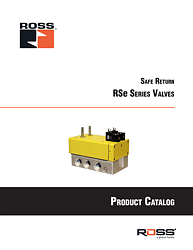
RSe Series Safe Return Double Valves - Complete Technical Catalog
Overview: Industry-Leading Safe Return Pneumatic Control Solutions
The ROSS Controls RSe Series Safe Return Double Valves represent the pinnacle of pneumatic safety engineering for industrial machinery applications. This comprehensive technical catalog provides essential information for engineers, safety managers, and maintenance professionals seeking control reliable valve solutions that meet or exceed the most stringent international safety standards, including ISO 13849-1 Category 4, Performance Level e (PL e).
Designed specifically for safe cylinder return applications, the RSe Series valves enable pneumatic actuators and double-acting cylinders to return to their home "safe" position whenever a fault occurs within the valve system or when signaled by the machine's safety circuit. This critical safety function reduces hazards during production operations, employee access for minor servicing, and emergency stop conditions.
As a cornerstone of ROSS Controls' pneumatic safety valve portfolio, the RSe Series delivers redundant control architecture, external monitoring capabilities, and proven spool-type valve design to provide manufacturers with confidence in their machine safety systems.
Key Features and Safety Benefits
Redundant Control Architecture for Maximum Safety
The RSe Series employs a dual spool and sleeve construction with two independent valve elements that operate synchronously. This redundant design ensures that if one valve element fails, the second valve element maintains control, allowing the cylinder to return to its safe position. When properly integrated with safety-rated control systems, RSe Series valves achieve Category 4, Performance Level e (PL e), representing the highest safety performance level for pneumatic control systems according to ISO 13849-1.
External Monitoring with 99% Diagnostic Coverage
Each valve element in the RSe Series incorporates a PNP proximity sensor that continuously monitors valve position. By monitoring both sensors on every actuation and de-actuation cycle, the external control system achieves up to 99% diagnostic coverage. This exceptional level of fault detection enables the safety system to identify valve failures before they compromise machine safety, allowing for predictive maintenance and reducing unplanned downtime.
Automatic Reset Functionality
RSe Series valves feature automatic reset by simply de-energizing the solenoids, streamlining the restart process after a safety stop or fault condition. This design reduces operator intervention time while maintaining safety integrity, contributing to improved overall equipment effectiveness (OEE) and production efficiency.
Rapid Response Times
The proven spool-type valve design delivers rapid actuation response times, minimizing the time required to return cylinders to their safe position during emergency stop conditions. This quick response capability is critical for reducing stopping distances and enhancing operator safety in accordance with ANSI B11 and other machinery safety standards.
Technical Specifications and Performance Data
Available Port Sizes and Flow Capacities
The RSe Series catalog details three standard port sizes to accommodate various cylinder sizes and flow requirements:
1/8" Port Size (RSe6EDA10A31P and RSe3EDA10A31P models):
- Ports 1-2 Flow: 0.90 Cv (886 Nl/min)
- Ports 1-4 Flow: 0.87 Cv (856 Nl/min)
- Ports 2-3 Flow: 0.68 Cv (669 Nl/min)
- Ports 4-5 Flow: 0.59 Cv (581 Nl/min)
- Dimensions: 3.97" L × 2.96" W × 3.67" H (100.8 × 75.0 × 93.2 mm)
- Weight: 2.9 lb (1.3 kg)
1/4" Port Size (RSe6ENB20A31P models):
- Ports 1-2 Flow: 1.09 Cv (1073 Nl/min)
- Ports 1-4 Flow: 1.04 Cv (1023 Nl/min)
- Ports 2-3 Flow: 0.91 Cv (895 Nl/min)
- Ports 4-5 Flow: 0.80 Cv (787 Nl/min)
- Dimensions: 4.41" L × 3.23" W × 3.99" H (112.0 × 82.0 × 101.4 mm)
- Weight: 3.7 lb (1.7 kg)
1/2" Port Size (RSe6ENB40A31P models):
- Ports 1-2 Flow: 3.06 Cv (3011 Nl/min)
- Ports 1-4 Flow: 2.96 Cv (2913 Nl/min)
- Ports 2-3 Flow: 1.95 Cv (1919 Nl/min)
- Ports 4-5 Flow: 1.91 Cv (1879 Nl/min)
- Dimensions: 6.81" L × 3.66" W × 4.56" H (173.0 × 93.0 × 115.9 mm)
- Weight: 6.6 lb (3.0 kg)
Operating Parameters and Environmental Specifications
- Operating Pressure Maximum: 145 psi (10 bar)
- Voltage: 24 VDC
- Power Consumption: 1.5 watts per solenoid
- Solenoid Connection Type: EN 175301-803 Form C (DIN connector)
- Status Indicator Connection: M8 connector
- Feedback Current: <23mA per proximity sensor
- Ambient Temperature Range: 40°F to 120°F (4°C to 50°C)
- Media Temperature Range: 40°F to 120°F (4°C to 50°C)
- Enclosure Rating: IP65 (protection against dust and water jets)
- Flow Media: Compressed, filtered air according to ISO 8573-1 Class 7:4:4
Construction Materials
- Valve Body: Cast Aluminum for lightweight durability
- Spool: Stainless Steel for corrosion resistance and longevity
- Seals: Buna-N (Nitrile) for reliable sealing performance
- Mounting: Base mounted with captive valve-to-base mounting screws
Thread Options
RSe Series valves are available with two thread standards to accommodate global installation requirements:
- NPT (National Pipe Thread) - Standard for North American applications
- G Thread (ISO 228-1) - Standard for international applications
Inlet and outlet ports on both sides provide flexible piping configurations, with plugs included for unused ports.
Applications: Versatile Safety Solutions
Safe Return Applications
The primary application for RSe Series 5/2 valves is controlling the direction of airflow into and out of double-acting cylinders or pneumatic actuators for normal machine operation, while ensuring the cylinder returns to its home "safe" position whenever a fault occurs. This safety function is critical for:
- Stamping and forming presses - Returning slide or ram to the up (safe) position
- Material handling equipment - Retracting grippers, clamps, or pushers
- Assembly automation - Returning tooling to safe positions during stops
- Packaging machinery - Retracting forming tools or sealing bars
- Robotic work cells - Returning pneumatic actuators to defined safe positions
Safe Return Dual Pressure Applications
RSe Series valves can be configured for dual pressure applications to control different supply pressures for cylinder extension and retraction:
- Port 3: Supply pressure for cylinder extension
- Port 5: Supply pressure for cylinder retraction (typically reduced pressure for safe return)
This configuration enables cylinders to extend with full force for production operations but retract with reduced force during fault conditions or when operator access is required, minimizing risk while maintaining functionality.
Safe Pressure Select Applications
The 5/2 RSe Series valve can be utilized for safe pressure select applications to control the pressure applied to a machine operation. In this configuration, a default (typically reduced) pressure is supplied during operator access or fault conditions, while a higher pressure is supplied only when proper operating signals are present. Applications include:
- Clamping operations - Full force during production, reduced force during operator intervention
- Press brake forming - Variable force selection based on material and operation mode
- Material testing equipment - Controlled pressure application for different test protocols
Safe Exhaust Applications
The RSe Series 3/2 valve variant is designed to supply air to a zone or entire machine system until signaled to shut off and exhaust residual downstream pneumatic energy. This safe exhaust (dump) function reduces hazards associated with residual energy during:
- Employee access for production-related tasks
- Minor servicing and adjustments
- Lockout/tagout procedures
- Emergency stop conditions
Important Note: The 3/2 RSe Series valve cannot exhaust pneumatic energy from downstream of obstructions such as check valves and closed center function valves. Additional exhaust provisions may be required for complete energy isolation.
Integration and Control System Requirements
External Monitoring System Requirements
Unlike internally monitored double valves (such as ROSS DM2 Series), RSe Series valves require an external monitoring system capable of:
- Dynamic Cyclical Monitoring: The control system must check the state of both valve position sensors with any and all changes in valve control signals
- Synchronous Operation Verification: Confirming both solenoids are energized/de-energized together
- Fault Response: Inhibiting further valve and machine operation upon detection of any monitoring failure
- Diagnostic Logging: Recording fault conditions for troubleshooting and maintenance planning
Suitable external monitoring systems include:
- Safety PLCs (Programmable Logic Controllers) such as Allen-Bradley GuardLogix or Siemens SIMATIC
- Safety relays with monitoring inputs
- Configurable safety systems compliant with ISO 13849-1 or IEC 62061
SISTEMA Library Support
ROSS Controls provides SISTEMA (Safety Integrity Software Tool) library files for RSe Series valves, enabling engineers to calculate and verify the safety performance level of their complete safety function. The SISTEMA library includes:
- Validated failure rate data for valve components
- Pre-configured valve architectures
- Diagnostic coverage calculations
- Integration examples for common safety circuits
These library files are available for free download from the ROSS Controls website, streamlining the safety validation process and reducing engineering time.
Electrical Connections and Wiring
Solenoid Connections:
- Type: EN 175301-803 Form C (DIN connector standard)
- Voltage: 24 VDC
- Power per solenoid: 1.5 watts
- Connection method: Individual connectors for each solenoid enable independent wiring
Proximity Sensor Connections:
- Type: M8 connector (4-pin)
- Sensor type: PNP (Positive-Negative-Positive transistor output)
- Current draw: <23mA per sensor
- Output: Discrete signal indicating valve position
ROSS Controls offers pre-assembled wiring kits and cable assemblies to simplify installation and reduce field wiring errors. These accessories are detailed in the catalog's accessories section.
Pilot Supply Options
RSe Series valves can be configured for either internal or external pilot supply:
Internal Pilot Supply:
- Pilot air is supplied from the valve's main supply port (Port 1)
- Simplifies piping but requires adequate supply pressure at all times
- Standard configuration for most applications
External Pilot Supply:
- Separate pilot air connection enables independent pilot pressure
- Useful when main supply pressure may vary below minimum pilot requirements
- Recommended for applications with pressure regulation downstream of the valve
The catalog includes detailed schematics showing both pilot supply configurations and conversion procedures.
Compliance with Safety Standards and Certifications
ISO 13849-1 Compliance
RSe Series valves are designed to achieve Category 4, Performance Level e (PL e) when integrated with appropriate safety control systems. This represents:
- Mean Time to Dangerous Failure (MTTFd): High (30-100 years per channel)
- Diagnostic Coverage (DC): High (90% to <99%)
- Common Cause Failure (CCF): Adequate measures implemented
- Safety-Related Software: Not applicable (hardware-based safety)
The combination of redundant architecture, high diagnostic coverage through external monitoring, and proven design principles enables RSe Series valves to meet the requirements for safety functions up to PL e.
Additional Standards Consideration
While specific certifications may vary by model, RSe Series valves are designed with consideration for:
- ANSI B11 Series Standards - Machinery safety standards for specific machine types
- OSHA Regulations - Occupational Safety and Health Administration requirements
- IEC 62061 - Functional safety of electrical/electronic/programmable safety-related systems
- NFPA 79 - Electrical standard for industrial machinery
Engineers should consult the catalog's certification section for specific approvals and test reports applicable to their region and application.
Installation, Maintenance, and Troubleshooting Guidance
Mounting and Installation Best Practices
The RSe Series catalog provides detailed installation instructions including:
Mounting Requirements:
- Base mounting with captive screws for secure attachment
- Orientation: Any position, preferably vertical for optimal exhaust performance
- Mounting surface: Flat, clean surface to ensure proper valve seating and seal integrity
- Torque specifications for mounting screws to prevent damage while ensuring security
Piping Considerations:
- Inlet and outlet ports on both sides of the valve body provide piping flexibility
- Use appropriate thread sealant compatible with pneumatic systems (PTFE tape or thread compound)
- Size piping to minimize pressure drop and ensure adequate flow
- Install silencers on exhaust ports to reduce noise and comply with workplace noise regulations
- Provide adequate support for connected piping to prevent stress on valve ports
Air Quality Requirements:
- Supply compressed air meeting ISO 8573-1 Class 7:4:4 or better
- Install adequate filtration upstream of the valve (40-micron recommended maximum)
- Ensure air is free of excessive moisture (dew point at least 10°F below ambient)
- Lubrication is generally not required for RSe Series valves
Maintenance Intervals and Procedures
RSe Series valves are designed for long service life with minimal maintenance requirements. The catalog outlines recommended maintenance schedules:
Regular Inspection (Monthly or per machine preventive maintenance schedule):
- Verify proximity sensor feedback signals are present and responding correctly
- Check for air leaks at connections and exhaust ports
- Inspect electrical connections for damage or looseness
- Verify mounting screws remain tight
Periodic Maintenance (Annually or per diagnostic system recommendations):
- Verify valve response times meet application requirements
- Check supply pressure and pilot pressure levels
- Inspect piping and connections for wear or damage
- Review fault logs from monitoring system for patterns indicating degradation
Component Replacement:
- Seal kits are available for field servicing
- Complete valve replacement may be recommended for critical safety applications
- Consult ROSS Controls technical support for repair vs. replace decisions
Troubleshooting Common Issues
The catalog includes a comprehensive troubleshooting guide addressing common symptoms:
Valve Fails to Actuate:
- Verify 24 VDC power at both solenoids
- Check pilot air supply pressure (minimum 30 psi typically required)
- Inspect proximity sensors for proper mounting and clearance
- Verify control system is providing simultaneous signals to both solenoids
Slow Valve Response:
- Check for restricted inlet piping or undersized supply lines
- Verify adequate flow capacity from air supply
- Inspect for partial blockage in valve ports
- Check exhaust port for restrictions or undersized silencers
Monitoring System Reports Fault:
- Verify both proximity sensors are reporting correct valve position
- Check for loose or damaged sensor wiring and connections
- Confirm sensors are within specified distance from target
- Verify control system monitoring logic is configured correctly for valve type
Excessive Air Leakage:
- Minor leakage from exhaust ports when actuated is normal
- Excessive leakage may indicate worn seals requiring replacement
- Check for contamination in supply air (moisture, particulates, oil)
- Verify valve is not subjected to pressures exceeding 145 psi maximum
Accessories and Complementary Products
Electrical Accessories
The catalog details various electrical accessories to simplify installation:
Pre-Wired Cable Assemblies:
- M12 to M12 cables for sensor connections
- DIN connector cables for solenoid power
- Available in various lengths (1m, 3m, 5m standard)
- Lighted and non-lighted versions available
- Junction box splitters for monitoring downstream pressure
Electrical Connectors:
- Individual DIN connectors (EN 175301-803 Form C)
- M8 sensor connectors (4-pin)
- Field-wireable versions for custom cable lengths
- Environmentally sealed versions for washdown environments
Pneumatic Accessories
Exhaust Silencers:
- Threaded bronze sintered metal silencers
- Available for all port sizes (1/8", 1/4", 1/2")
- Reduces exhaust noise to comply with OSHA noise exposure limits
- High-flow designs prevent back pressure that could slow valve response
Port Plugs:
- Threaded plugs for unused ports
- Included with valve purchase
- Brass or stainless steel construction
Mounting Hardware:
- Valve-to-base mounting screws (captive design)
- Base mounting adapters for various surfaces
- Vibration-resistant hardware for mobile equipment
Integration Guides and Documentation
The catalog references several integration guides available from ROSS Controls:
- 3/2 RSe Series Integration Guide - Safe exhaust application details
- 5/2 RSe Series Safe Return Integration Guide - Cylinder control applications
- 5/2 RSe Series Dual Pressure Integration Guide - Dual pressure configurations
- 5/2 RSe Series Pressure Select Integration Guide - Safe pressure selection applications
These guides provide detailed wiring diagrams, monitoring logic examples, pulse testing procedures, and safety distance calculations to assist engineers in properly integrating RSe Series valves into machine safety systems.
Comparing RSe Series to Other ROSS Safety Valve Solutions
RSe Series vs. DM2 Series (Internal Monitoring)
When to Choose RSe Series:
- External monitoring system already specified for the machine
- Integration with safety PLC or configurable safety controller
- Desire for maximum diagnostic coverage (up to 99%)
- Application requires SISTEMA analysis with validated library data
- Need for dual pressure or pressure select functionality
When to Choose DM2 Series:
- Self-contained monitoring preferred for simplified wiring
- Standalone safety function without central safety controller
- Manual reset after fault condition desired for positive acknowledgment
- Application requires CrossMirror internal monitoring technology
RSe Series vs. 77 Series (Internal Monitoring, Automatic Reset)
The 77 Series offers CrossMirror internal monitoring with automatic reset, similar to RSe Series automatic reset but with self-contained monitoring. Choose 77 Series for:
- Applications not requiring external monitoring integration
- Preference for ROSS proprietary internal monitoring
- Situations where external monitoring adds unnecessary complexity
RSe Series vs. CM26 Series (Internal Monitoring, Manual Reset)
The CM26 Series provides internal monitoring with manual reset requirements after fault conditions. This is appropriate for higher-risk applications requiring positive operator acknowledgment before restart.
Model Number Configuration and Ordering Information
The catalog provides detailed model number configuration guidelines to ensure correct product selection:
Model Number Structure
Example: RSe6ENA10A31P
Breaking down each element:
- RSe - Series designation (RSe Series)
- 6 - Valve function: 6 = 5/2 valve, 3 = 3/2 valve
- E - Mounting style: E = Base mounted
- N - Valve type: N = Single solenoid (NC function)
- A or B - Port side: A = G thread, B = NPT thread
- 10, 20, 40 - Port size: 10 = 1/8", 20 = 1/4", 40 = 1/2"
- A - Electrical configuration
- 31 - Solenoid/sensor specification
- P - Pilot supply: P = Internal/External pilot
Available Model Configurations
The catalog includes complete tables showing all available configurations, including:
3/2 Valve Models (Safe Exhaust):
- RSe3EDA10A31P - 1/8" G thread
- RSe3EDB10A31P - 1/8" NPT thread
- RSe3ENA10A31P - 1/8" G thread (alternate configuration)
- RSe3ENB10A31P - 1/8" NPT thread (alternate configuration)
- Additional 1/4" and 1/2" port size variants
5/2 Valve Models (Safe Return, Dual Pressure, Pressure Select):
- RSe6EDA10A31P - 1/8" G thread
- RSe6EDB10A31P - 1/8" NPT thread
- RSe6ENA10A31P - 1/8" G thread (alternate configuration)
- RSe6ENB20A31P - 1/4" NPT thread
- RSe6ENB40A31P - 1/2" NPT thread
- Additional variants with different port configurations
Technical Drawings and Dimensional Data
The RSe Series catalog includes comprehensive dimensional drawings with exact measurements for:
Valve Dimensions
Detailed dimensional drawings show:
- Overall length, width, and height
- Port locations and center-to-center spacing
- Mounting hole positions and sizes
- Electrical connector locations and orientations
- Clearance requirements for solenoid and sensor connectors
Base Mounting Dimensions
The catalog provides base mounting patterns including:
- Mounting hole spacing and diameter
- Base footprint dimensions
- Mounting screw specifications
- Surface flatness requirements
Port Connection Details
Technical drawings detail:
- Thread depth and engagement length
- Port orientation and location
- Recommended wrench flats
- Clearance needed for fittings and hose connections
Connector Dimensions and Clearances
Critical information for panel design and installation planning:
- DIN connector profile and mating depth
- M8 sensor connector dimensions
- Minimum bend radius for cables
- Clearance required for cable routing
Performance Curves and Flow Data
The catalog includes graphical performance data to assist in proper valve sizing:
Flow Capacity Curves
Curves showing flow rates (Cv and Nl/min) versus supply pressure for each port configuration, enabling engineers to:
- Verify adequate flow for cylinder sizing
- Calculate cycle times based on available air supply
- Optimize system pressure for energy efficiency
Response Time Data
Typical response time measurements from signal input to complete valve actuation, including:
- Energization times (closed to open)
- De-energization times (open to closed)
- Temperature effects on response times
- Pressure effects on response times
Pressure Drop Characteristics
Data showing pressure drop across the valve at various flow rates, critical for:
- Calculating available cylinder force
- Sizing air supply and distribution systems
- Determining energy consumption
Environmental Considerations and Sustainability
Energy Efficiency Features
RSe Series valves contribute to energy-efficient pneumatic systems through:
Low Power Consumption:
- Only 1.5 watts per solenoid minimizes electrical energy use
- Proximity sensors draw <23mA, reducing control circuit power requirements
Optimized Flow Paths:
- Spool valve design provides high flow capacity with minimal pressure drop
- Reduced pressure drop translates to lower compressor energy consumption
- Quick exhaust capability reduces cycle times and air consumption
Materials and Recyclability
- Aluminum valve body is fully recyclable
- Stainless steel components are corrosion-resistant, extending service life and reducing replacement frequency
- Buna-N seals are industry-standard materials with established recycling streams
Compliance with Environmental Regulations
RSe Series valves are designed for compliance with:
- RoHS (Restriction of Hazardous Substances) directives
- REACH (Registration, Evaluation, Authorization of Chemicals) regulations
- ISO 14001 environmental management principles in manufacturing
Global Support and Technical Assistance
ROSS Controls Worldwide Presence
The catalog highlights ROSS Controls' global infrastructure with manufacturing and technical support facilities in:
- United States (headquarters)
- Germany
- France
- United Kingdom
- Japan
- China
- Brazil
- India
- Canada
This worldwide presence ensures engineers can receive local support in their language and time zone, with understanding of regional safety standards and certification requirements.
Technical Support Resources
ROSS Controls provides extensive technical support including:
Engineering Assistance:
- Application consultation for valve selection
- Safety circuit design review
- SISTEMA analysis support
- Custom valve configuration for unique requirements
Training Programs:
- CFSE (Certified Functional Safety Expert) courses covering electrical and fluid power systems
- Fluid Power Domain Expert training
- On-site safety valve training for maintenance personnel
- Webinar series on pneumatic safety topics
Documentation Library:
- CAD models for all valve configurations (STEP, IGES, DWG formats)
- Integration guides and application notes
- Safety circuit examples and best practices
- Installation and maintenance videos
Warranty and Service
Standard warranty terms and service policies are outlined in the catalog, including:
- Product warranty period and coverage
- Return procedures for warranty claims
- Repair and refurbishment services
- Emergency technical support contact information
Conclusion: Why Choose RSe Series Safe Return Double Valves
The ROSS Controls RSe Series Safe Return Double Valves represent a comprehensive solution for engineers seeking to implement the highest levels of pneumatic safety in their machinery designs. By combining proven spool valve technology, redundant control architecture, and external monitoring capabilities achieving 99% diagnostic coverage, RSe Series valves enable safety functions up to Category 4, Performance Level e.
Key advantages that distinguish RSe Series valves include:
- Versatility - Suitable for safe return, dual pressure, and pressure select applications from a single valve platform
- Integration Flexibility - External monitoring enables seamless integration with modern safety PLCs and configurable safety systems
- SISTEMA Support - Free library files streamline safety validation and reduce engineering time
- Global Availability - Worldwide support network ensures consistent product availability and local technical assistance
- Comprehensive Documentation - Detailed catalog with specifications, dimensions, and application guidance accelerates implementation
- Proven Reliability - Backed by ROSS Controls' century of pneumatic valve engineering experience
Whether designing new machinery, upgrading existing safety systems, or replacing aging pneumatic components, the RSe Series catalog provides the technical information needed to specify, order, install, and maintain control reliable double valves that protect personnel, comply with safety standards, and support efficient production operations.
Download the complete RSe Series Safe Return Double Valves catalog today to access detailed specifications, dimensional drawings, model configurations, and integration guidance for your next pneumatic safety project.