



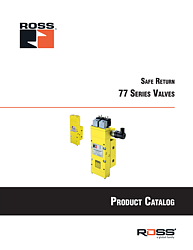
ROSS CROSSMIRROR® 77 Series Safe Return Double Valves - Complete Product Catalog
Download the comprehensive ROSS CROSSMIRROR 77 Series catalog featuring complete technical specifications, dimensional drawings, wiring diagrams, and application guidance for Category 4 PL e certified safe return double valves. This control-reliable valve series provides internally monitored, redundant pneumatic control for cylinder return applications where operator safety is paramount.
Constructed with dual precision stainless steel spools as the main valve elements, the 77 Series valves incorporate a self-contained dynamic monitoring system that eliminates the need for external valve monitoring controls. This innovative design approach reduces system complexity while maintaining the highest safety integrity levels required by modern industrial automation standards.
The 77 Series achieves Safety Category 4, Performance Level e (PL e) certification according to ISO 13849-1, and SIL 3 rating per IEC 62061, making it suitable for the most demanding safety applications. With proven functional safety data including a B10D value of 20,000,000 cycles and MTTFd of 301.9 years, these valves deliver exceptional reliability and longevity in critical safety functions.
Key Features and Benefits
Self-Contained Dynamic Monitoring System
One of the most significant advantages of the ROSS 77 Series is its integrated, self-contained dynamic monitoring system. Unlike traditional double valve configurations that require external safety monitoring relays or complex control circuits, the 77 Series incorporates all monitoring logic directly within the valve body. This internal monitoring continuously verifies synchronous operation of both valve elements during each actuation and de-actuation cycle, automatically detecting discordant operation and defaulting to the safe position when asynchronous movement is detected.
The monitoring system operates within a 500-millisecond window, ensuring both pilot signals or solenoids actuate within this timeframe. If the valve elements fail to operate synchronously, the valve immediately defaults to route inlet pressure to port 2 (cylinder retracted position) while exhausting port 4. This fail-safe behavior ensures the cylinder always returns to its safe home position in the event of a valve malfunction.
Automatic Reset Functionality
The 77 Series features automatic reset upon de-actuation, streamlining operation while maintaining safety integrity. When a fault condition occurs due to asynchronous valve element operation, the valve can be reset by de-energizing both solenoid pilots (on electrical models) or removing pneumatic pilot signals (on pressure-controlled models). This reset mechanism cannot be accomplished by simply cycling supply pressure, preventing inadvertent reset and ensuring deliberate operator intervention is required to restore operation after a fault.
This automatic reset design eliminates the need for manual mechanical intervention while still meeting the requirements of safety standards that prohibit automatic fault reset through power cycling. The result is reduced downtime during temporary fault conditions while maintaining full compliance with EN13736, ANSI B11.2, and ISO 13849-1 requirements.
Dual Stainless Steel Spool Construction
The 77 Series employs precision-machined dual stainless steel spools in a spool-and-sleeve configuration, providing superior performance compared to poppet-style valves in many applications. This spool design delivers several operational advantages:
- Fast, reliable actuation with minimal pressure differential required
- Excellent dirt tolerance due to the sliding seal design that can accommodate minor contaminants without jamming
- Low friction operation ensuring consistent actuation forces throughout the valve's service life
- Corrosion resistance from stainless steel construction, extending valve longevity in challenging environments
- Tight sealing when in the closed position, minimizing air consumption and preventing unintended actuator drift
The double spool and sleeve construction provides true redundancy at the valve element level, ensuring that even if one spool were to stick or malfunction, the second spool maintains control integrity. Combined with the internal monitoring system, this redundant architecture achieves the highest safety category ratings.
Status Indication and Machine Integration
Available models include an integrated status indication switch that provides a "ready-to-run" signal to the machine controller, informing the control system of valve condition before permitting machine cycle initiation. This switch indicates when both valve elements are properly positioned and the valve is ready for operation, enabling seamless integration with modern programmable safety controllers and machine control systems.
Additionally, an optional pressure switch provides a signal when the valve is in a faulted position, allowing the machine control system to provide appropriate operator feedback, trigger alarms, or initiate controlled shutdown sequences. These monitoring signals facilitate comprehensive machine diagnostics and can be integrated into overall equipment effectiveness (OEE) tracking systems.
The electrical connections utilize standardized DIN EN 175301-803 Form A connectors, ensuring compatibility with industrial automation components and simplifying installation and maintenance. These industry-standard connections also support quick disconnect capabilities, reducing mean time to repair (MTTR) during troubleshooting or valve replacement procedures.
Technical Specifications and Model Variations
Electrical Actuation Models (Solenoid Pilot Controlled)
The solenoid pilot controlled 77 Series valves provide electrical actuation through dual independent solenoid operators, making them ideal for integration with electrical safety control systems, programmable safety controllers (PSCs), and safety relay modules. These models are available in multiple voltage configurations to accommodate global electrical standards:
Voltage Options:
- 24 VDC - Standard industrial control voltage, most common selection for modern automation systems
- 110-120 VAC, 50/60 Hz - North American industrial standard for machinery control
- 230-240 VAC, 50/60 Hz - European/international standard (note: OSHA regulations limit press control voltage to 120 VAC maximum in US applications)
All solenoids are rated for continuous duty operation and feature IP65 enclosure rating per IEC 60529, providing protection against dust ingress and water jets. The solenoids incorporate LED indicators on selected models to aid troubleshooting and provide visual confirmation of energization status.
Operating pressure range for solenoid pilot controlled models spans 40 to 150 psi (2.5 to 10.3 bar), providing flexibility for various system pressure requirements. The valves function as 4-way, 5-port, 2-position directional control valves (5/2 function) with electrical actuation of both main solenoid operators required simultaneously for proper valve operation.
Pneumatic Actuation Models (Pressure Controlled)
Pressure controlled 77 Series valves offer pneumatic pilot operation, making them particularly well-suited for two-hand control applications, enabling buttons and palm button stations where electrical wiring to pilot devices would be impractical. These models provide "AND" gate logic control, requiring both pneumatic pilot signals (S1 and S2) to be present within the 500-millisecond discordance window to actuate the valve.
The pressure controlled configuration operates at 40 to 100 psi (2.5 to 7 bar) with pilot pressure requirements equal to or greater than inlet pressure (but not exceeding maximum inlet pressure). This design ensures reliable valve actuation across the operating pressure range while maintaining proper monitoring function.
Two-hand control applications benefit from the pneumatic actuation approach as it provides inherent AND gate logic without requiring electronic two-hand control modules. The 500-millisecond timing window ensures true concurrent operation of both inputs, preventing sequential actuation that could compromise the two-hand control safety function. If either pilot signal lags beyond this window, the valve defaults to the safe position with outlet port 2 receiving full inlet pressure and outlet port 4 exhausted.
Port Sizes and Flow Characteristics
The 77 Series catalog details multiple port size configurations to accommodate varying flow requirements:
Base Size 2:
- Inlet: 1/2" NPT, G (Rp), or SAE-12
- Outlet: 3/8" NPT, G (Rp), or SAE-12
- Exhaust: Built-in silencer
- Flow Coefficients (Cv): 1-2 = 2.0, 1-4 = 1.6, 2-3 = 1.6, 4-5 = 2.8
- Dimensions: 4.07-6.68" length × 3.16" width × 11.09" height
- Weight: 7.6-8.4 lb (3.4-3.8 kg)
Base Size 4:
- Inlet: 1/2" or 3/4" NPT, G (Rp), or SAE-12
- Outlet: 1/2" or 3/4" NPT, G (Rp), or SAE-12
- Exhaust: Built-in silencer
- Flow Coefficients (Cv): 1-2 = 3.2, 1-4 = 3.4, 2-3 = 2.7, 4-5 = 7.2
- Dimensions: 4.25-6.87" length × 4.11-4.88" width × 11.92-12.17" height
- Weight: 10.2-11.6 lb (4.6-5.3 kg)
Flow coefficients (Cv) indicate the flow capacity of each port path, with higher values indicating greater flow capability. The 4-5 exhaust path features the highest Cv values to ensure rapid cylinder retraction and exhaust without back pressure buildup that could slow return speed or create inconsistent cycle times.
All models feature integrated exhaust silencers to reduce noise emissions during cylinder exhaust, meeting workplace noise regulations and improving operator comfort. Thread types include NPT (National Pipe Thread), G/Rp (ISO 228-1 parallel threads), and SAE straight thread with O-ring face seal, accommodating global piping standards.
Safety Certifications and Compliance
ISO 13849-1 Category 4, Performance Level e
The 77 Series achieves the highest safety integrity classification under ISO 13849-1, the international standard for safety-related parts of control systems. Category 4 PL e represents the most stringent requirements for control reliability, requiring:
- Redundancy - Dual independent valve elements provide redundant flow control paths
- Monitoring - Self-contained dynamic monitoring detects faults during operation
- Fault Tolerance - System continues to operate safely even with a single fault present
- Fault Detection - High diagnostic coverage ensures faults are detected before they compromise safety
- Mean Time to Dangerous Failure (MTTFd) - 301.9 years (nop: 662,400 operations)
- Diagnostic Coverage (DC) - High level through continuous monitoring
- Probability of Dangerous Failure per Hour (PFHd) - 7.71×10⁻⁹
This certification enables the 77 Series to be used in the highest risk applications where failure could result in serious injury or death, including press operations, power transmission lockout, and other critical safety functions.
SIL 3 per IEC 62061
In addition to ISO 13849-1 certification, the 77 Series achieves Safety Integrity Level 3 (SIL 3) according to IEC 62061, the sector-specific safety standard for machinery control systems. SIL 3 classification indicates a probability of dangerous failure per hour between 10⁻⁸ and 10⁻⁷, aligning with the PL e classification under ISO 13849-1.
This dual certification approach allows safety engineers to utilize either the ISO 13849-1 or IEC 62061 framework for safety system design and validation, depending on industry sector preferences and company standards. Many organizations in process industries prefer IEC 62061 (derived from IEC 61508), while machine builders often utilize ISO 13849-1.
EN13736 and ANSI B11.2 Compliance
The 77 Series meets the specific requirements of EN13736 (European standard for pneumatic control systems for safety applications) and ANSI B11.2 (American national standard for hydraulic and pneumatic power systems). These standards establish design criteria, performance requirements, and validation testing protocols specifically for fluid power safety control components.
Meeting these standards ensures the 77 Series incorporates:
- Adequate redundancy to prevent single point failures
- Monitoring to detect valve malfunctions
- Fail-safe behavior under fault conditions
- Proper reset mechanisms preventing inadvertent restart
- Environmental protection suitable for industrial environments
- Adequate flow capacity and response time for the intended application
ANSI B11.2 compliance is particularly important for US manufacturing operations, as OSHA references B11 series standards in enforcement actions related to machine safety. Specification of B11.2 compliant components demonstrates due diligence in machine safety system design.
Global Certification Portfolio
The comprehensive certification portfolio of the 77 Series includes:
- CSA/UL Certification - Compliance with North American electrical and functional safety standards
- CE Marking - Conformity with European Union machinery and electrical directives
- DGUV Certification - German statutory accident insurance approval for safety components
- EAC Declaration - Eurasian Conformity marking for Russia, Belarus, Kazakhstan, and other CU countries
This global certification approach ensures the 77 Series can be specified for machinery built for export to virtually any market worldwide, eliminating certification barriers and accelerating time to market for OEM machine builders serving international customers.
Applications and Industry Solutions
Pneumatic Cylinder-Operated Presses
Small to medium-sized pneumatic cylinder presses represent the primary application for 77 Series valves. These presses utilize pneumatic cylinders to generate forming, stamping, punching, or assembly forces, creating significant hazards if operators access the point of operation during cycle execution. The 77 Series provides control-reliable cylinder return, ensuring the press cylinder retracts to the safe home position when the enabling device is released or a safety interlock opens.
In press applications, the valve typically interfaces with:
- Two-hand control stations (on pressure-controlled models)
- Light curtains or safety scanners
- Safety interlocks on access guards
- Emergency stop circuits
- Programmable safety controllers
The built-in monitoring function continuously verifies both valve elements actuate synchronously, providing the redundancy and fault detection required by OSHA regulations for mechanical power press control reliability. While the 77 Series is not designed for clutch/brake control on mechanical power presses (ROSS offers dedicated DM2 Series for this application), it excels at controlling cylinder-operated presses and other forming equipment.
Valve Operators and Actuator Control
Process valves equipped with pneumatic actuators require reliable control to prevent unintended valve movement during maintenance or when safety functions demand valve closure. The 77 Series provides control-reliable actuation of pneumatic valve operators, ensuring quarter-turn ball valves, butterfly valves, or linear gate valves respond predictably to control signals while defaulting to safe position during fault conditions.
In valve operator applications, the fail-safe behavior can be configured to:
- Spring return operators - Valve operators with internal springs automatically close (or open) when 77 Series de-actuates, exhausting actuator pressure
- Double-acting operators - Valve operators without springs are positively driven to either position based on 77 Series output port selection
The status indication feature enables integration with process control systems, providing valve position feedback for process visualization, interlocking logic, and alarm management systems.
Safety Latches and Position Locking
Safety latches powered by pneumatic cylinders secure access doors, sliding guards, robotic work cell gates, and other movable safeguarding. The 77 Series ensures these latches operate reliably, preventing guard opening while hazardous machine motion continues and preventing machine restart while guards remain open.
The control-reliable operation provided by the 77 Series enables:
- Guard locking with position monitoring - Status switch confirms latch engagement before permitting hazardous motion
- Trapped key interlocking - Integration with trapped key systems for complex interlocking sequences
- Redundant latch control - Meeting Category 4 requirements for high-risk applications where latch failure could result in serious injury
The automatic reset functionality reduces nuisance faults while maintaining safety integrity, minimizing production interruptions from temporary pressure fluctuations or electrical disturbances.
Assembly Automation and Material Handling
Automated assembly systems and material handling equipment utilize pneumatic actuators extensively for pick-and-place operations, part orientation, feeding mechanisms, and transfer motions. While many of these motions may not require Category 4 control reliability individually, the 77 Series provides value where:
- Multiple stations share common safeguarding (light curtains protecting multiple work zones)
- Access during automatic operation is necessary for part loading or quality inspection
- Risk assessment determines residual risk requires enhanced control reliability
- Machine builder standardization programs specify Category 4 components throughout
In material handling applications, the 77 Series enables point-of-use control rather than zone-wide pressure removal, reducing air consumption and eliminating system recharge time after safety stop events. This targeted control approach can significantly reduce cycle time compared to traditional dump valve architectures that exhaust entire pneumatic zones.
Valve Operation and Functional Description
Normal Operation - Solenoid Pilot Controlled Valves
During normal operation of solenoid pilot controlled 77 Series valves, the machine control system energizes both main solenoid pilots (S1 and S2) simultaneously when the safety control system permits operation. Both solenoids must energize within approximately 500 milliseconds of each other to ensure synchronous actuation of the dual valve elements.
When properly actuated, pressurized air from inlet port 1 flows to outlet port 4, extending the connected cylinder or actuating the downstream device. Simultaneously, outlet port 2 connects to exhaust port 3, allowing air downstream of port 2 to exhaust through the integrated silencer.
When the machine control system de-energizes both solenoid pilots (due to operator button release, safety device actuation, or cycle completion), both valve elements shift back to their home position. Air then flows from inlet port 1 to outlet port 2, retracting the cylinder or returning the actuator to safe position. Air downstream of port 4 exhausts through port 5 to atmosphere via the built-in silencer.
The rapid exhaust capability (Cv 4-5 = 7.2 for size 4 valves) ensures quick cylinder retraction, minimizing the time the hazardous motion continues after the safety stop command is issued. This rapid response directly impacts the safety distance calculations per ISO 13855 when designing light curtain or scanner installations.
Safety Function - Fault Detection and Default Behavior
The internal monitoring system continuously evaluates the position of both valve elements during each actuation and de-actuation cycle. If the system detects asynchronous movement—where one valve element moves while the other remains stationary or lags beyond the 500-millisecond window—the valve immediately defaults to its fail-safe configuration.
In the fail-safe condition:
- Inlet pressure (port 1) connects to outlet port 2, driving the cylinder or actuator to the retracted/safe position
- Outlet port 4 connects to exhaust port 5, venting any pressure that would cause hazardous motion
- The status indication switch (if equipped) changes state to indicate fault condition
- The optional pressure switch (if equipped) signals the control system that abnormal operation has occurred
This default behavior ensures the connected cylinder or actuator always moves toward or remains in the safe position during fault conditions. The valve cannot be actuated to the hazardous position while the fault persists, preventing unsafe machine operation.
Valve Reset Procedures
Following a fault condition, the 77 Series requires deliberate reset action to return to normal operation, preventing automatic restart that could surprise operators or maintenance personnel. The reset procedure varies by model type:
Solenoid Pilot Controlled Models:
- De-energize both main solenoid pilots completely
- Verify both solenoids are de-energized (minimum off time as specified in installation instructions)
- The valve automatically resets internally during this de-energization period
- Re-energize both solenoids simultaneously to resume normal operation
- Status indication switch returns to normal state when valve is ready for operation
Pressure Controlled Models:
- Remove pneumatic pilot signals from both pilot supply ports (S1 and S2)
- Verify both pilot ports are fully exhausted
- The valve automatically resets internally during this depressurization period
- Re-apply pneumatic pilot signals simultaneously (within 500 ms window) to resume normal operation
Critically, the valve cannot be reset by cycling main supply pressure at port 1 or by cycling electrical power to the valve (on electrical models). This design prevents inadvertent reset during system pressure fluctuations or power interruptions, ensuring operators must take deliberate action to restore valve operation after a fault.
Two-Hand Control Operation (Pressure Controlled Models)
Pressure controlled 77 Series valves excel in two-hand control applications, where operator safety requires concurrent actuation of two separate enabling devices. The pneumatic pilot configuration provides inherent AND gate logic with the 500-millisecond timing window ensuring true simultaneous actuation.
In a typical two-hand control installation:
- Operator presses both palm buttons or enable buttons within 500 milliseconds
- Pneumatic signals from both buttons reach the valve's S1 and S2 pilot ports
- If signals arrive within the timing window, both valve elements actuate, extending the cylinder
- If either signal arrives more than 500 ms after the first, the valve remains in or defaults to the safe position
- Cylinder retracts when either or both buttons are released
This configuration prevents "sequential" actuation where one hand could hold one button while the other hand reaches into the hazard zone before pressing the second button. The timing window enforces true two-hand concurrent operation, meeting the requirements of ANSI B11.19 and ISO 13851 for two-hand control devices.
The optional status indication switch provides feedback to the machine control system, enabling proper sequencing with other safety devices and ensuring the valve is ready for operation before permitting cycle initiation.
Installation, Mounting, and Integration
Mounting Configuration and Orientation
The 77 Series utilizes base mount configuration, allowing installation on manifolds, mounting plates, or machine frames using the standardized base pattern. The base mounting approach provides several advantages:
- Compact installation - Valve mounts directly to pneumatic supply manifold
- Simplified plumbing - Inlet connects through base mount, reducing fitting count
- Easy removal - Valve can be removed for service without disturbing cylinder lines
- Reduced leak points - Base mount connection eliminates threaded fittings at inlet port
While the valve can be mounted in any orientation, ROSS recommends vertical mounting with the valve upright for optimal performance and longevity. This orientation allows any condensate that might accumulate to drain naturally through exhaust ports, preventing moisture buildup that could affect seal materials or cause ice formation in cold environments.
Ensure adequate clearance around the valve for:
- Electrical connector access (on solenoid models)
- Pneumatic tubing connections at ports 2, 4, S1, and S2
- Visual inspection of LED indicators (if equipped)
- Status indication switch wiring (if equipped)
Pneumatic System Integration
Proper pneumatic system design ensures reliable valve operation and optimal performance. ROSS recommends the following system design practices:
Air Quality:
The 77 Series requires clean, filtered air meeting ISO 8573-1 Class 7:4:4 minimum (particle size, moisture, and oil content). Install a filter-regulator-lubricator (FRL) or filter-regulator (FR) combination upstream of the valve with:
- 40-micron maximum filtration
- Manual or automatic drain for moisture removal
- Pressure regulation to maintain system pressure within 40-150 psi range
- Optional lubrication (valve operates satisfactorily with or without lubrication)
Supply Pressure:
Maintain supply pressure at inlet port 1 within the specified operating range (40-150 psi for solenoid controlled, 40-100 psi for pressure controlled). Insufficient pressure may prevent proper valve actuation, while excessive pressure can reduce seal life and increase air consumption.
Pilot Pressure (Pressure Controlled Models):
Pilot pressure at ports S1 and S2 must equal or exceed inlet pressure but must not exceed the maximum inlet pressure rating. This ensures adequate pilot force to actuate the valve elements while preventing damage to pilot control mechanisms. Install regulators in pilot lines if pilot pressure source exceeds inlet pressure.
Exhaust Port Plumbing:
Ports 3 and 5 incorporate built-in silencers to reduce exhaust noise. Do not plug or restrict these ports, as back pressure during exhaust can slow cylinder retraction and affect response time. If additional noise reduction is required, pipe exhaust to a remote silencer or exhaust manifold, ensuring piping is adequately sized to prevent back pressure buildup.
Downstream Check Valves:
If check valves, closed-center directional valves, or other restrictions exist downstream of the 77 Series, ensure these do not prevent proper exhaust flow during cylinder retraction. Trapped pressure downstream of port 4 when the valve shifts to retract position must be able to exhaust through port 5 to achieve rapid retraction.
Electrical Integration and Wiring
Solenoid pilot controlled models require proper electrical installation for reliable operation and safety compliance:
Power Supply Requirements:
- Provide adequate current capacity for continuous solenoid operation
- Solenoid power consumption: 30 watts (base size D03, D07), 36 watts (base size D05)
- Use appropriately rated circuit protection (fuses or circuit breakers)
- Ensure voltage stability within ±10% of rated voltage
Wiring Connections:
All electrical connections utilize DIN EN 175301-803 Form A connectors (cord-grip style) providing:
- IP65 environmental protection when properly mated
- Secure mechanical connection resistant to vibration
- Quick disconnect capability for troubleshooting and maintenance
Wire both solenoids to energize simultaneously from the safety control system output. Do not use separate control channels for each solenoid, as this would compromise synchronous actuation. The safety system should provide dual redundant outputs that both drive the valve solenoids, or use a single output with appropriate power capacity for both solenoids.
Status Indication Switch Wiring:
The optional status indication switch connects to the machine control system to provide ready-to-run feedback. This normally closed switch opens when the valve is in a faulted condition, providing a "fail-safe" signal to the control system. Wire the switch into the safety control system or machine controller to:
- Enable machine cycle initiation only when valve is ready
- Provide fault indication to operator interface
- Integrate with diagnostic systems for predictive maintenance
Pressure Switch Integration (If Equipped):
The optional pressure switch provides a normally open contact that closes when the valve detects a fault condition. Maximum ratings are 4A @ 250 VAC or 50mA @ 24 VDC. Wire this switch to trigger alarms, illuminate fault indicators, or input to control system for data logging.
SISTEMA Library and Safety System Validation
ROSS provides SISTEMA library files for the 77 Series to facilitate safety system design validation using the SISTEMA software tool developed by IFA (Institute for Occupational Safety and Health of the German Social Accident Insurance). These library files include:
- Validated MTTFd values for the valve
- Diagnostic coverage (DC) parameters
- Common cause failure (CCF) considerations
- Mission time data for lifecycle calculations
Safety engineers can import the 77 Series library into their SISTEMA project to calculate the overall safety system performance level, verifying that the complete safety function (sensors, logic, and final elements) achieves the required PL rating determined through risk assessment.
The availability of manufacturer-validated SISTEMA libraries significantly reduces safety system validation time and provides confidence that component reliability data is accurate and supported by the manufacturer, which is essential for compliance documentation during machinery certification.
Maintenance, Troubleshooting, and Service
Routine Maintenance Requirements
The 77 Series is designed for low maintenance requirements, with typical service life exceeding 20,000,000 cycles (B10D value). However, proper maintenance practices maximize valve longevity and ensure continued reliable operation:
Periodic Inspection:
- Inspect pneumatic connections quarterly for leakage at ports and base mount
- Verify exhaust silencers are not obstructed by contaminants or debris
- Check electrical connections on solenoid models for security and environmental seal integrity
- Observe status indication LED (if equipped) during operation to verify proper solenoid function
Filter/Regulator Maintenance:
- Drain moisture from air preparation equipment per manufacturer recommendations
- Replace filter elements based on pressure drop monitoring or time intervals
- Verify regulated pressure remains within specified operating range
Performance Verification:
- Monitor cycle times for gradual degradation indicating valve wear or downstream restrictions
- Test safety function periodically by simulating fault conditions to verify proper default behavior
- Verify status indication switch operation during machine safety system testing
Environmental Considerations:
The 77 Series operates reliably in ambient temperatures from 40°F to 122°F (4°C to 50°C) and handles media temperatures from 40°F to 175°F (4°C to 80°C). In environments near these limits or with temperature cycling, increase inspection frequency to detect any seal degradation early.
Common Issues and Resolution
Valve Fails to Actuate:
- Verify both solenoid pilots are energized simultaneously (electrical models) or both pilot pressures are applied (pressure controlled models)
- Check supply pressure at inlet port 1 meets minimum requirement (40 psi)
- Inspect for obstructions in cylinder lines preventing flow
- Verify pilot pressure (pressure controlled models) equals or exceeds inlet pressure
- Check for contamination in valve ports restricting spool movement
Valve Locks Out / Status Switch Indicates Fault:
- Indicates asynchronous valve element operation detected by monitoring system
- De-energize both solenoids completely for minimum 5 seconds, then re-energize simultaneously
- If fault persists, indicates mechanical issue requiring valve service or replacement
- Check for pressure differential between pilot supplies (pressure controlled models)
- Verify electrical supply voltage is within ±10% of rated voltage
Slow Cylinder Retraction:
- Check for restrictions in exhaust path (port 5) limiting flow
- Verify cylinder exhaust ports are properly sized (not undersized from valve)
- Inspect for downstream check valves or closed center valves trapping pressure
- Clean or replace exhaust silencers if obstructed
Air Leakage at Exhaust Ports:
- Minor leakage through exhaust silencers during extended periods in one position is normal due to spool clearances
- Excessive continuous leakage indicates worn seals or contamination preventing proper spool seating
- If leakage is significant (audible hissing), valve requires service or replacement
Status Indication Switch Erratic:
- Check electrical connections for security and proper crimping
- Verify switch wiring is routed away from high voltage power lines to prevent electrical noise coupling
- Ensure switch is not being used to switch loads exceeding its rating (4A @ 250 VAC, 50mA @ 24 VDC)
Service Life and Replacement Criteria
With a B10D value of 20,000,000 cycles, the 77 Series delivers exceptional service life. The B10D metric indicates 10% of the population will have reached the end of their dangerous failure-free operating life at this cycle count. In practical terms:
- At 60 cycles per hour, 24/7 operation: Approximately 38 years to B10D
- At 600 cycles per hour, 16 hours/day, 5 days/week: Approximately 19 years to B10D
- At 1,200 cycles per hour, 8 hours/day, 5 days/week: Approximately 10 years to B10D
These calculations demonstrate the 77 Series is suitable for the majority of applications without planned replacement over the typical machine service life. However, for critical applications or where machine lifecycle exceeds these timeframes, consider:
- Establishing a preventive replacement schedule based on cycle counters
- Maintaining spare valve inventory for rapid replacement
- Implementing condition monitoring through cycle time tracking or pressure monitoring
When valve replacement is necessary, the base mount design allows quick changeout without disturbing cylinder or supply plumbing, minimizing downtime during planned or unplanned maintenance events.
Model Selection Guide and Ordering Information
Model Number Nomenclature
Understanding the ROSS 77 Series model number structure enables precise specification of the exact configuration required for your application. The model number format is:
Y[D][7/8][6/7/8][A][3/4/5][0/1/2][0/1][W/Z/Y]
Breaking down each position:
- Y / YS / YD - Series designator (Y = standard, YS = SAE thread, YD = G/Rp thread)
- 77 - Series number (77 Series)
- 7 - Actuation type (7 = electrical solenoid, 8 = pneumatic pressure)
- 6/7/8 - Port size code (6 = 3/8", 7 = 1/2", 8 = 3/4")
- A - Configuration designator
- 3/4/5 - Base size (3 = size 1, 4 = size 2, 5 = size 4)
- 4 - Function code
- 0/1/2 - Options code
- 0/1 - Status indicator (0 = none, 1 = included)
- W/Z/Y - Voltage (W = 24 VDC, Z = 110-120 VAC, Y = 230 VAC)
Example:
Model Y7776A3410W designates:
- Y = Standard series
- 77 = 77 Series valve
- 7 = Electrical solenoid actuation
- 7 = 1/2" port size
- 6 = 3/8" outlet size
- A = Standard configuration
- 3 = Base size 2
- 4 = Function code
- 1 = Option configuration
- 0 = No status indicator
- W = 24 VDC voltage
Common Model Selections by Application
Small Cylinder Presses (Bore ≤2.5"):
- Y7776A3401W - Base size 2, 1/2" inlet, 3/8" outlet, 24 VDC, with status indicator
- Provides adequate flow for cylinders up to 2.5" bore at typical press speeds
- Status indicator enables integration with press control safety circuits
Medium Cylinder Applications (Bore 2.5-4"):
- Y7786A4401Z - Base size 4, 1/2" inlet/outlet, 110-120 VAC, with status indicator
- Higher flow capacity (Cv 3.4) supports faster cycle times for larger cylinders
- North American standard voltage simplifies electrical panel design
Two-Hand Control Stations:
- Y7786A4420 - Base size 4, 1/2" inlet/outlet, pneumatic actuation, no status indicator
- Pressure controlled operation provides inherent AND gate logic
- Eliminates electrical wiring to palm button stations
Assembly Automation with High Cycling:
- YD7776A3410W - Base size 2, G thread, 24 VDC, no status indicator
- G/Rp threads match European pneumatic tubing standards
- 24 VDC matches standard automation control voltage
- Lower cost without status indicator for non-critical applications
Accessories and Complementary Products
The 77 Series catalog includes information on compatible accessories and complementary products that enhance functionality:
Mounting Bases:
- Standard mounting bases with inlet port configurations
- Manifold mounting options for multiple valve installations
- Custom mounting plates available for specific OEM applications
Pneumatic Accessories:
- Speed control valves for cylinder speed regulation
- Pilot supply regulators for pressure controlled models
- Exhaust flow controls for energy efficiency
- Remote silencers for centralized exhaust noise control
Electrical Accessories:
- Pre-wired cable assemblies with DIN connectors
- Voltage adapter modules for non-standard voltages
- LED indicator modules for visual status display
Related Safety Valve Products:
- CM Series - Alternative safe return valves for different port configurations
- RSe Series - Safe return valves with external monitoring for Category 4 PL e applications requiring separate monitoring
- DM2 Series - Control-reliable double valves for mechanical press clutch/brake control
- L-O-X Valves - Lockout/tagout valves for energy isolation during maintenance
Global Availability and Lead Times
ROSS maintains distribution and manufacturing facilities worldwide to support global customers:
- North America - ROSS Controls (Troy, Michigan, USA)
- Europe - ROSS EUROPA (Germany) and ROSS France
- Asia - ROSS Controls India and distributor network throughout Asia-Pacific
Standard model configurations typically ship within 2-3 weeks from order receipt, with exact lead times varying by model and order quantity. The catalog notes estimated ship dates based on standard manufacturing times for quantities of 10 or less, with typical estimates ranging from 2-4 weeks depending on configuration complexity.
For custom configurations, special voltage requirements, or large volume orders, contact ROSS or your local distributor for specific lead time quotations. Many distributors maintain inventory of high-volume standard models for immediate delivery to support emergency replacement needs and rapid prototype development.
Engineering Support and Resources
Technical Documentation Available
The complete ROSS 77 Series catalog provides comprehensive technical documentation including:
Product Specifications:
- Complete dimensional drawings with mounting hole patterns and port locations
- Performance specifications including flow coefficients, pressure ranges, and temperature limits
- Electrical specifications for all solenoid options
- Material specifications for body, seals, and internal components
Installation Instructions:
- Step-by-step installation procedures with illustrated guidance
- Pneumatic schematic symbols for documentation purposes
- Wiring diagrams showing proper electrical connections
- Mounting torque specifications and hardware requirements
Operation and Maintenance:
- Functional descriptions of valve operation in normal and fault conditions
- Troubleshooting flowcharts for common issues
- Maintenance schedules and procedures
- Service life data and replacement criteria
Compliance Documentation:
- Safety certification details for all applicable standards
- Declaration of conformity documents for CE marking
- Functional safety data for ISO 13849-1 and IEC 62061 validation
- DGUV test certificates for German market requirements
ROSS Technical Support
ROSS Controls provides comprehensive technical support throughout the product lifecycle, from initial specification through ongoing operation. Support services include:
Pre-Sales Application Engineering:
- Application review and valve selection assistance
- Pneumatic system design guidance
- Safety system architecture consultation
- Custom configuration feasibility evaluation
- Competitive product cross-reference assistance
Integration Support:
- Electrical integration guidance for safety control systems
- SISTEMA library assistance for safety validation
- Pneumatic schematic review and optimization
- Control system interface specifications
Post-Sales Technical Support:
- Installation troubleshooting via phone and email
- Field service support through distributor network
- Warranty claim processing and evaluation
- Repair and refurbishment services
Contact ROSS Controls technical support at (800) 438-7677 or through the website at www.rosscontrols.com for assistance with application-specific questions or technical issues.
Training and Education Resources
ROSS offers various educational resources to help customers understand and properly apply fluid power safety solutions:
Webinars and Online Training:
- Safety valve technology fundamentals
- ISO 13849-1 and IEC 62061 overview for machine builders
- OSHA lockout/tagout requirements for maintenance safety
- Application-specific training for press control, assembly automation, and material handling
On-Site Training:
- Custom training programs delivered at customer facilities
- Hands-on training with valve configuration, installation, and troubleshooting
- Safety system design workshops for engineering teams
White Papers and Technical Articles:
- "Standards Increase Productivity as Well as Promote Safety"
- "Control Reliable Valves for Clutch/Brake Systems"
- "When Safety Matters Most: Monitored Redundant Valves are the Solution"
- "Pneumatic Safety Systems and Cylinder Speed Control"
Access these resources through the ROSS Controls website documents section or request specific training programs through your ROSS representative.
Why Choose ROSS Controls for Pneumatic Safety
H3: Over 50 Years of Safety Innovation
ROSS Controls has been pioneering fluid power safety solutions since 1968, earning a reputation as the industry leader in safety valve technology. The company's focus exclusively on safety-related products has resulted in:
- More than 100 patents related to safety valve design and monitoring technology
- First company to develop internally monitored double valves eliminating external monitoring relays
- Inventor of the L-O-X® valve for single-point lockout/tagout
- Developer of CrossMirror® technology for control-reliable cylinder return
This heritage of innovation ensures customers receive the most advanced, reliable safety solutions available, backed by decades of field-proven performance across millions of installations worldwide.
Application Expertise Across Industries
ROSS safety valves protect workers across diverse industries including:
- Automotive Manufacturing - Press operations, assembly automation, stamping lines
- Food and Beverage - Packaging equipment, material handling, process control
- Pharmaceuticals - Tablet presses, packaging machinery, automated dispensing
- Plastics - Injection molding, blow molding, thermoforming equipment
- Steel and Metals - Stamping presses, coil processing, material handling
- Woodworking - Pneumatic presses, assembly systems, material handling
- General Manufacturing - Assembly automation, cylinder-operated equipment
This broad application experience enables ROSS to provide industry-specific guidance on safety requirements, typical configurations, and proven solutions that address common safety challenges.
Global Support Network
ROSS maintains an extensive global support network ensuring customers receive responsive service regardless of location:
- Manufacturing facilities in North America, Europe, and Asia
- Technical support staff in regional offices speaking local languages
- Extensive distributor network with inventory and application support
- Online resources available 24/7 including product catalogs, CAD models, and technical documentation
This global presence enables ROSS to support multinational machine builders with consistent product availability, technical support, and safety expertise across all manufacturing locations worldwide.
Commitment to Standards Compliance
ROSS actively participates in safety standards development organizations, ensuring products meet or exceed current and emerging safety requirements:
- Contributing member to ISO technical committees developing safety standards
- Active participation in ANSI B11 committees for machine safety standards
- Collaboration with European standards organizations on EN safety standards
- Engagement with certification bodies to validate compliance documentation
This proactive involvement in standards development ensures ROSS products are designed from the ground up to meet compliance requirements, rather than being retrofitted to achieve certification after design completion.
Frequently Asked Questions
What is the difference between the 77 Series and CM Series valves?
The 77 Series and CM Series both provide safe return cylinder control with internal monitoring, but differ primarily in port configurations and mounting styles. The 77 Series offers base mount installation with various port size combinations, while the CM Series provides manifold mounting with standardized port arrangements. Both achieve Category 4 PL e certification and feature self-contained monitoring, so selection typically depends on installation space constraints and preferred mounting method.
Can the 77 Series be used for press clutch/brake control?
No, the 77 Series is specifically designed for pneumatic cylinder return applications such as small cylinder-operated presses, but is not suitable for controlling clutch/brake mechanisms on mechanical power presses. For press clutch/brake control, ROSS offers the DM2® Series double valves which meet the specific requirements of OSHA 1910.217 and ANSI B11.1 for mechanical power press control systems.
How do I calculate if the 77 Series has adequate flow capacity?
Flow capacity is determined by the Cv (flow coefficient) values listed in the catalog for each port path. To evaluate adequacy for your application, calculate the required flow rate in SCFM based on cylinder bore, stroke length, and desired cycle time, then compare to the valve's Cv capability at your operating pressure. ROSS technical support can assist with flow calculations for specific applications if needed.
Is external monitoring required with the 77 Series?
No, the 77 Series incorporates a self-contained dynamic monitoring system that continuously verifies synchronous operation of both valve elements. This eliminates the need for external safety monitoring relays or control system monitoring logic, simplifying system design and reducing component count. The optional status indication switch provides ready-to-run feedback to the machine controller but is not required for the monitoring function itself.
What happens if only one solenoid fails or one pneumatic pilot signal is lost?
If one solenoid fails to energize or one pneumatic pilot signal is not present, the valve either remains in or defaults to the safe position where outlet port 2 receives inlet pressure (retracting the cylinder) and outlet port 4 is exhausted. The valve cannot actuate to the hazardous position without both pilot signals present simultaneously within the 500-millisecond timing window, ensuring fail-safe behavior under single-channel failure conditions.
Can the 77 Series be repaired if it fails?
ROSS offers repair and refurbishment services for 77 Series valves, though in many cases replacement is more cost-effective than repair due to the valve's robust construction and long service life. Contact ROSS technical support to discuss repair options for specific failure modes. The base mount design allows rapid valve replacement without disturbing cylinder plumbing, minimizing downtime during planned or emergency replacements.
How do I integrate the 77 Series with a programmable safety controller?
For electrical models, wire both solenoid pilots to a dual-channel safety output from your programmable safety controller (PSC) such as those from Allen-Bradley, Pilz, Siemens, or Omron. Wire the optional status indication switch to a safety input on the PSC to provide valve ready feedback. The PSC logic should require the status switch to indicate ready before permitting the outputs to energize the valve solenoids, ensuring proper sequencing and fault detection.
What SISTEMA library is available for the 77 Series?
ROSS provides validated SISTEMA library files for the 77 Series including all required parameters (MTTFd, DC, CCF) for Category 4 PL e calculations. These libraries can be downloaded from the ROSS website and imported directly into the SISTEMA software tool for safety system performance level validation. The libraries are regularly updated to reflect the latest certification data and testing results.
Download Your Complete 77 Series Catalog
Access the comprehensive ROSS CROSSMIRROR 77 Series catalog containing complete specifications, dimensional drawings, model selection tables, installation instructions, wiring diagrams, pneumatic schematics, and application guidance. This essential resource provides everything needed to specify, install, and maintain 77 Series safe return double valves for control-reliable pneumatic cylinder applications.
Catalog Contents Include:
- Product Overview - Detailed description of valve features, benefits, and applications
- Technical Specifications - Operating pressure ranges, flow coefficients, temperature limits, electrical specifications
- Dimensional Drawings - Complete dimensions for all base sizes with mounting hole patterns
- Model Selection Guide - Model number nomenclature and configuration tables for precise specification
- Installation Instructions - Step-by-step installation procedures with mounting requirements
- Wiring Diagrams - Electrical connection details for all solenoid options and status switches
- Pneumatic Schematics - Valve function diagrams showing all port configurations
- Operation Description - Detailed explanation of normal and fault condition valve behavior
- Maintenance Guidelines - Service recommendations and troubleshooting procedures
- Certification Data - Complete safety certification details for global compliance
- Accessories - Compatible mounting bases, electrical connectors, and complementary products
Download this catalog to ensure you have the most current technical information for your pneumatic safety system design and specification requirements.
Contact ROSS Controls for Application Support
The experienced application engineering team at ROSS Controls is ready to assist with valve selection, system design, safety validation, and technical support for your pneumatic safety applications. Whether you're designing a new machine, upgrading existing equipment for safety compliance, or troubleshooting an installation, ROSS provides the expertise to ensure successful implementation.
Contact Methods:
- Phone: (800) 438-7677 (North America toll-free) or +1 (248) 616-2700 (international)
- Email: info@rosscontrols.com
- Website: www.rosscontrols.com - Live chat support available during business hours
- Distributor Network: Locate your nearest authorized ROSS distributor through the website dealer locator
Information to Provide for Application Assistance:
- Application description (press, assembly system, material handling, etc.)
- Cylinder bore size, stroke length, and operating pressure
- Desired cycle time and frequency of operation
- Safety requirements and applicable standards
- Actuation preference (electrical vs. pneumatic)
- Integration requirements (control system type, safety devices)
- Environmental conditions (temperature, contamination, indoor/outdoor)
The ROSS team typically responds to application inquiries within one business day, providing valve recommendations, technical guidance, and quotations to support your project timeline requirements.
Related ROSS Safety Products
Explore the complete portfolio of ROSS Controls safety solutions designed to work together providing comprehensive machine safeguarding:
Safe Exhaust Valves:
- DM2® Series - Control-reliable double valves for press clutch/brake control
- RSe Series - Safe return valves with external monitoring for Category 4 PL e applications
- CC4 Series - 4/3 closed center double valves for load holding applications
Lockout/Tagout Solutions:
- L-O-X® Valves - Single-point lockout with trapped key interlocking capability
- SPLO Valves - Single-point lockout for zone-wide pressure removal
Safety System Components:
- Safety Monitoring Relays - External monitoring systems for valves requiring external monitoring
- Pressure Switches - Position confirmation and status indication devices
- Manifolds and Accessories - System integration components
Visit www.rosscontrols.com to explore the complete product portfolio and access technical documentation, CAD models, and application resources for all ROSS safety solutions.
Optimize Your Pneumatic Safety System Design
Maximize the safety, reliability, and efficiency of your pneumatic safety systems with ROSS Controls' application engineering expertise. Our team can review your machine safety architecture and provide recommendations for:
- Point-of-use control vs. zone-wide exhaust strategies to minimize air consumption and reduce cycle time
- Proper valve sizing to ensure adequate flow capacity while avoiding oversizing that increases costs
- Safety integrity level validation using SISTEMA software to verify Category 4 PL e performance
- Integration with safety PLCs and safety relay modules for comprehensive safety control
- Lockout/tagout compliance meeting OSHA 1910.147 requirements for energy isolation
- Single-point lockout implementation to reduce maintenance time and improve productivity
Contact ROSS to schedule a complimentary safety system review with our application engineering team, ensuring your design meets all safety requirements while optimizing operational efficiency.
The ROSS CROSSMIRROR 77 Series safe return double valves represent the pinnacle of pneumatic safety valve technology, combining precision engineering with advanced self-contained monitoring to deliver Category 4 PL e certified control reliability for pneumatic cylinder applications. With dual stainless steel spool construction, automatic reset functionality, and comprehensive global certifications, the 77 Series provides the safety, reliability, and performance required for modern industrial automation.
Whether you're designing small cylinder-operated presses, automated assembly systems, safety latches, or valve operator controls, the 77 Series delivers proven control-reliable operation backed by over 50 years of ROSS Controls safety innovation. Download the complete catalog today to access the technical specifications, dimensional data, and application guidance needed to specify the optimal 77 Series configuration for your pneumatic safety requirements.
For application assistance, technical support, or quotation requests, contact ROSS Controls at (800) 438-7677 or visit www.rosscontrols.com to connect with our global team of pneumatic safety experts.