



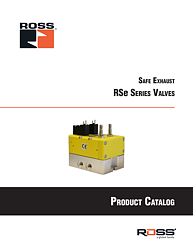
Redundant Safe Exhaust Double Valves for Industrial Pneumatic Safety | RSe Series
The RSe Series 3/2 safe exhaust double valves represent a fundamental breakthrough in pneumatic safety technology. Designed by ROSS Controls—a leader in fluid power safety with over 100 years of proven reliability—these redundant control valves are engineered to protect your workforce while maintaining operational efficiency.
When pneumatic energy is present in industrial machinery, residual pressure represents a genuine hazard during maintenance, servicing, and employee access. The RSe Series addresses this critical safety challenge by providing reliable shut-off of pneumatic supply and complete exhaust of downstream energy. This capability is essential across manufacturing sectors including automotive assembly, metal forming, packaging machinery, and complex automation systems where worker safety is non-negotiable.
Unlike conventional single-element valves that rely on a single point of failure, the RSe Series employs redundant, dual spool-and-sleeve construction with synchronized solenoid actuation. Each valve element features integrated PNP proximity sensors providing dynamic monitoring and diagnostic coverage up to 99%—meeting the most stringent international safety standards.
The Safety Imperative
Industrial facilities face constant regulatory pressure to comply with OSHA standards, ANSI protocols, and international safety directives. Beyond compliance, plant managers and safety professionals recognize that preventing even a single serious incident protects company reputation, prevents catastrophic liability exposure, and—most importantly—protects human life.
Residual pneumatic energy presents an insidious hazard because it's invisible and often underestimated. Workers performing routine maintenance or troubleshooting may not realize that pressurized systems downstream of isolation points still contain dangerous energy. The RSe Series eliminates this hazard through intelligent design that automatically exhausts all residual energy when de-energized.
The valve's safety function is explicit: shut off supply of pneumatic energy and exhaust any pneumatic energy from downstream of the valve. This dual function makes it the ideal choice for safety-critical applications where residual energy management is essential.
Technical Excellence and Certification
The RSe Series achieves remarkable safety credentials through rigorous engineering and comprehensive testing:
ISO 13849-1:2015 Compliance: The RSe Series achieves Category 4, Performance Level e (PLe)—the highest achievable safety level for pneumatic control devices. This certification means the valve maintains safe function even with single component failures.
IEC 61508 Safety Integrity: Rated SIL 3 (Safety Integrity Level 3) according to international standards, the RSe Series delivers quantifiable reliability metrics including a B10D value of 20,000,000 cycles and MTTF (Mean Time To Failure) of 301.9 years at normal operation frequency.
Third-Party Verification: DGUV certification and HSM 21030 "Sicherheit geprüft" (tested safety) designation confirm independent testing by recognized safety authorities.
These certifications reflect rigorous reliability validation: the valve demonstrates a Probability of Failure on Demand (PFHD) of 7.71×10⁻⁹, meaning extraordinary dependability across millions of operating cycles.
Redundant Control Architecture
The RSe Series employs a revolutionary dual spool design where two operating solenoids must be activated simultaneously to actuate the valve. This synchronized dual-solenoid design provides immediate diagnostic benefits:
Each valve element contains a dedicated PNP solid-state proximity sensor that monitors spool position during both actuation and de-actuation cycles. The external monitoring system can verify that both sensors respond correctly to control signals, confirming the valve operates as intended and no internal faults have developed.
This monitoring approach achieves 99% diagnostic coverage—meaning that 99% of potential internal failures can be detected before they impact safety. The maximum allowable discordance time is 250 milliseconds, ensuring rapid detection of any valve malfunction.
The redundancy isn't merely theoretical; it's operationally significant. Single component failures—solenoid malfunction, sensor degradation, or spool stiction—are immediately detected through sensor monitoring, enabling maintenance teams to address problems before catastrophic failure occurs.
Superior Design Features
Robust Construction: The valve body is precision-cast aluminum for durability and lightweight installation. Internal spools are stainless steel, providing corrosion resistance and extended service life. All seals are Buna-N rubber, compatible with compressed air according to ISO 8573-1 Class 7:4:4 standards.
Flexible Pilot Supply Options: The RSe Series accepts either internal pilot supply (using machine supply pressure) or external pilot supply (independent pressure source), providing flexibility for diverse system configurations.
Automatic Spring Return: De-energizing the solenoids automatically returns the valve to its normal closed position, ensuring passive safety function even during power loss conditions.
Base Mounting Design: Threaded NPT or G ports allow flexible piping arrangements. Captive mounting screws prevent accidental valve dislodgement, while included port plugs adapt the valve for various system configurations.
Comprehensive Specifications
Available Port Sizes: 1/8", 1/4", and 1/2" configurations accommodate system requirements from small laboratories to large production facilities. Flow capacities range from 0.63 CV (620 Nl/min) at 1/8" to 1.96 CV (1900 Nl/min) at 1/2", providing flexibility for diverse pneumatic load requirements.
Operating Parameters: The valve operates reliably across ambient temperatures of 40°F to 120°F (4°C to 50°C), functioning in challenging manufacturing environments from freezing outdoor assembly lines to hot industrial facilities.
Electrical Integration: 24 VDC solenoid operation at 1.5 watts per solenoid enables low-power control circuits. IP 65 enclosure rating protects against washdown and contamination. M8 connector technology provides industry-standard connectivity for integration with modern control systems.
Installation and Integration Support
ROSS Controls provides comprehensive support for RSe Series installation and integration:
Complete Technical Documentation: The Integration Guide for RSe Series 3/2 Safe Exhaust Double Valves provides detailed operational procedures, monitoring integration protocols, and control circuit examples.
CAD Models: Downloadable 3D CAD models accelerate design integration and ensure precise piping layouts.
System Accessories: ROSS supplies complementary components including redundant pressure switch assemblies for downstream energy verification, standard pressure switches, prewired electrical connectors, and exhaust silencers optimized for noise control without flow restriction.
Application Engineering Support: ROSS application engineers work directly with design teams to address custom requirements, unusual configurations, or integration challenges—ensuring your specific safety objectives are met.
Training and Documentation: Comprehensive service manuals, maintenance guides, and technical training empower your maintenance teams to manage the valves with confidence throughout their operational life.
Why Manufacturers Choose ROSS Controls
For over a century, ROSS Controls has been synonymous with pneumatic safety innovation. We combine rigorous engineering with genuine commitment to customer success. Our global distribution network ensures parts availability and responsive support across 100 locations worldwide. We stand behind our products with comprehensive warranties and proven reliability in the harshest manufacturing environments—from automotive press lines to aerospace assembly.
When safety matters, when compliance is non-negotiable, and when worker protection is paramount, manufacturers trust ROSS Controls.
KEY FEATURES
Redundant Control for Maximum Safety
- Dual solenoid architecture with synchronized actuation
- Single component failures detected and isolated
- 99% diagnostic coverage through integrated monitoring
Category 4/PLe Certification
- Meets ISO 13849-1:2015 highest safety level
- IEC 61508 SIL 3 qualified
- DGUV third-party tested and verified
External Monitoring Capability
- Integrated PNP proximity sensors on each valve element
- Dynamic, cyclical monitoring with customer control systems
- Minimum operation frequency once per month
Flexible Configuration
- Multiple port sizes: 1/8", 1/4", 1/2"
- NPT or G thread options
- Internal or external pilot supply modes
Proven Reliability
- B10D rating: 20,000,000 cycles
- MTTF: 301.9 years at normal operation
- PFHD: 7.71×10⁻⁹
Complete Integration Ecosystem
- SISTEMA library available
- Pressure switch assemblies for verification
- Prewired connectors and integration guides
- CAD models for design engineeringLONG-TAIL KEYWORD TARGETS (50-100 words for each)
Safe Exhaust Valves with Monitoring Safe exhaust valves with integrated monitoring systems represent the evolution of pneumatic safety technology. Unlike traditional dump valves that rely on operator action, monitored safe exhaust valves continuously verify proper function through external sensor monitoring. The RSe Series exemplifies this advancement—each solenoid and sensor combination provides continuous position feedback that can be evaluated by customer control systems. This monitoring capability enables diagnostic coverage exceeding 99%, detecting single component failures before they compromise safety. Industries including automotive manufacturing, pharmaceutical processing, and aerospace assembly increasingly mandate monitored safe exhaust solutions to meet regulatory requirements and manufacturing best practices.
Redundant Pneumatic Safety Valves Redundant pneumatic safety valves employ dual-element construction to eliminate single points of failure in critical safety applications. The RSe Series utilizes synchronized dual solenoids and dual spool-sleeve assemblies, with each element monitored through integrated proximity sensors. This architecture means that component failures are immediately detected rather than potentially going unnoticed until they cause unsafe conditions. Redundant designs achieve the highest safety levels—Category 4 and Performance Level e per ISO 13849-1—required for the most hazardous machinery. Manufacturers in high-consequence industries (automotive, heavy equipment, machinery building) increasingly standardize on redundant pneumatic safety solutions to minimize regulatory risk and worker injury potential.
ISO 13849-1 Category 4 Valves ISO 13849-1:2015 Category 4 represents the highest achievable safety rating for pneumatic control devices. Category 4 designation means the device maintains safe function even after single component failures, with failures detected through continuous monitoring. The RSe Series achieves Category 4 certification through its redundant dual-solenoid architecture combined with external monitoring. This certification is particularly significant for machinery manufacturers and system integrators who must meet stringent EU machinery directives and ANSI standards. Achieving Category 4 status typically requires independent third-party testing and documentation proving reliability through millions of operating cycles. For safety-conscious manufacturers, Category 4 certification eliminates compliance uncertainty and provides documented proof of meeting the highest international safety standards.
GLOSSARY
- Safe Exhaust Function: Shut-off of pneumatic supply and exhaustion of residual downstream energy
- Redundant Control: Multiple independent systems working in parallel to prevent single-point failures
- Solenoid Pilot Operated: Electromagnetic valve operation using pilot pressure rather than direct load pressure
- PNP Proximity Sensor: Non-contact position sensor providing digital output for valve spool location
- Diagnostic Coverage: Percentage of potential faults that can be detected through monitoring systems
- PFHD (Probability of Failure on Demand): Statistical measure of safety device reliability
- Performance Level (PLe): ISO 13849-1 safety rating indicating highest dependability category
- Category 4: ISO 13849-1 designation for valves maintaining safe function despite single component failures
- MTTF (Mean Time To Failure): Average operational duration before failure occurs
- B10D Value: Number of cycles at which 10% of tested devices fail
The RSe Series 3/2 Safe Exhaust Double Valves represent the convergence of rigorous engineering, proven reliability, and unwavering commitment to industrial safety. For manufacturers where worker protection is non-negotiable and operational compliance is essential, the RSe Series delivers the performance, certification, and peace of mind that only comes from a century of expertise.
Download the complete technical catalog today to discover how RSe Series valves can enhance your pneumatic safety strategy and protect your most valuable asset—your workforce.