




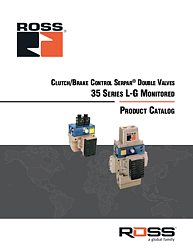
ROSS Controls 35 Series SERPAR® Clutch/Brake Control Double Valves—Mission-Critical Safety in Every Stroke
The Industry Standard for Monitored Pneumatic Press Control
The SERPAR® Series represents over a century of ROSS Controls' commitment to pneumatic safety innovation. These internally monitored double valves deliver the protection that mechanical stamping presses demand—automatic fault detection, built-in monitoring, and guaranteed fail-safe operation. Whether you're managing automotive stamping operations, precision metal forming, or any application requiring energy isolation, the 35 Series SERPAR® L-G Monitored valves provide the compliance certainty and operational reliability your facility cannot compromise on.
The core challenge in mechanical press safety is straightforward but unforgiving: a single valve malfunction can mean catastrophic injury or death. Traditional double valves required external monitoring systems—adding cost, complexity, and potential points of failure. ROSS Controls engineered the SERPAR® solution to integrate monitoring directly into the valve body, eliminating complexity while delivering superior safety assurance.
Why Monitoring Matters in Press Control
The L-G pneumatic monitoring system continuously validates that both valve elements are functioning correctly on every cycle. If one element fails—whether due to contamination, wear, or design defect—the monitoring circuit immediately detects the fault and forces the valve into a fail-safe condition, exhausting all downstream air and rendering the press inoperable until manually reset. This automatic fail-safe response transforms a potentially catastrophic scenario into a controlled system shutdown, protecting both workers and your production continuity.
Section 2: Key Features & Technical Advantages
Engineering Excellence Built Into Every Valve
Internal L-G Pneumatic Monitoring No external circuitry required. The L-G monitor is fully integrated, reducing system complexity and eliminating single points of failure in external monitoring hardware. This pneumatic-only approach means fewer electrical components to maintain and troubleshoot.
Dual Poppet Design with Dirt Tolerance The SERPAR® utilizes a proven dual-poppet architecture with wear-compensating features specifically engineered for contamination tolerance. Unlike traditional spool designs that can jam under particulate or moisture contamination, the poppet design provides superior performance even in harsh manufacturing environments—aluminum smelters, steel mills, and automotive stamping plants have logged millions of operating hours on this technology.
PTFE Backup Piston Rings Enhanced durability and extended service intervals. These rings enable operation with or without in-line lubrication, reducing maintenance requirements and providing flexibility in system design. The material selection reflects ROSS Controls' relentless focus on reliability in demanding applications.
Automatic Fault Lock-Out & Reset Function Upon fault detection, the valve automatically locks out to prevent further operation until a momentary pneumatic reset signal is applied. This dual-layer safety approach—automatic shutdown combined with mandatory reset—ensures your safety system prevents unplanned restarts while maintaining operational control.
Multiple Valve Sizes for Application Flexibility Available in Basic Sizes 4, 8, 12, and 30 with flow capacities ranging from 3 Cv (3,000 Nl/min) to 42 Cv (41,000 Nl/min), the 35 Series accommodates everything from compact precision applications to high-volume production lines. Port sizes from 3/8" to 1-1/2" (NPT or ISO G thread) provide seamless integration into existing pneumatic infrastructures.
Electrical Versatility Solenoid pilots rated for continuous duty operation support DC 24V, AC 110-120V 50/60Hz, and AC 230V 50/60Hz configurations. Low power consumption (11-14 watts on DC; 16-30 VA holding on AC) minimizes electrical panel requirements and cooling demands.
Section 3: Compliance & Certification Credentials
Built to Meet the World's Strictest Safety Standards
The SERPAR® 35 Series is engineered to exacting international safety standards and independently certified by leading notified bodies:
- ISO 13849-1:2015 Compliance: Category 4 (highest available) with Performance Level e (PLe) rating, meeting the requirements for safety-related control systems in mechanical power presses as specified by ISO 12100-1:2003.
- IEC 61508:2010 Certification: Safety Integrity Level 3 (SIL 3), demonstrating reliability and fault-handling capabilities for electrical/electronic/programmable safety systems.
- ANSI B4.19 & ISO 6162 Compatibility: Ported for seamless integration into North American and international pneumatic system architectures.
- Functional Safety Documentation: Complete Declaration of Conformity and Certificate of Compliance provided with every unit, supporting your regulatory audit trail and facility certification maintenance.
For manufacturers in regulated industries or facilities subject to OSHA, EU, or international press safety directives, the SERPAR® provides documented compliance pathways and the performance assurance your insurance carriers demand.
Section 4: Performance Specifications at a Glance
Technical Data Your Application Engineers Need
| Parameter | Basic Size 4 | Basic Size 8 | Basic Size 12 | Basic Size 30 |
| Valve Function | 3/2 Electrically Pilot-Controlled | 3/2 Electrically Pilot-Controlled | 3/2 Electrically Pilot-Controlled | 3/2 Electrically Pilot-Controlled |
| Port Connection | NPT or G Thread | NPT or G Thread | NPT or G Thread | NPT or G Thread |
| Operating Pressure Range | 30-100 psig (2.1-7 bar) | 30-125 psig (2.1-8.5 bar) | 30-125 psig (2.1-8.5 bar) | 30-125 psig (2.1-8.5 bar) |
| Media Temperature | 40-175°F (4-80°C) | 40-175°F (4-80°C) | 40-175°F (4-80°C) | 40-175°F (4-80°C) |
| Ambient Operating Range | 40-120°F (4-50°C) | 40-120°F (4-50°C) | 40-120°F (4-50°C) | 40-120°F (4-50°C) |
| Reset Pressure (Remote) | Minimum 30 psig (2 bar) | Minimum 60 psig (4 bar) | Minimum 60 psig (4 bar) | Minimum 60 psig (4 bar) |
| Enclosure Rating | IP65 (IEC 60529) | IP65 (IEC 60529) | IP65 (IEC 60529) | IP65 (IEC 60529) |
| Solenoid Power (DC 24V) | 11 watts | 14 watts | 14 watts | 14 watts |
| Mounting | In-Line with Piping Flanges | In-Line with Piping Flanges | In-Line with Piping Flanges | In-Line with Piping Flanges |
| Valve Body Material | Cast Aluminum | Cast Aluminum | Cast Aluminum | Cast Aluminum |
| Seal Material | Buna-N | Buna-N | Buna-N | Buna-N |
| Standard Weight | 8.4 lbs (3.8 kg) | 15.3 lbs (6.9 kg) | 19.0 lbs (8.6 kg) | 37.5 lbs (16.9 kg) |
Section 5: Application Examples & Industry Use Cases
Proven Performance Across the Toughest Manufacturing Environments
Automotive Stamping Operations
High-speed mechanical presses require split-second response times and absolute reliability. SERPAR® valves with response times as low as 15-20 milliseconds deliver predictable clutch engagement and brake control, while the L-G monitor prevents the catastrophic press runaway scenarios that have resulted in severe worker injuries in facilities worldwide.
Metal Forming & Fabrication
Aluminum smelters and steel mills operate equipment that creates extreme contamination and thermal challenges. The SERPAR® dual-poppet design with dirt-tolerant architecture thrives in these environments where traditional spool-based valves would fail. Facilities report service intervals of 3-5 years in continuous duty applications—compared to 6-12 months for competitor equipment.
Packaging Machinery
High-volume packaging lines depend on pneumatic clutch/brake control for consistent, repetitive cycling. The SERPAR® delivers microsecond response consistency cycle after cycle, enabling steady-state production throughput while maintaining the safety compliance that food and pharmaceutical packaging regulations require.
Energy Isolation & Lockout Systems
Beyond press control, the SERPAR® serves as an alternative energy isolation device for lockout/tagout (LOTO) applications where pneumatic isolation is required. The automatic fail-safe upon fault makes this valve an intelligent component in your facility's machine safeguarding strategy.
Section 6: What's Included in This Technical Catalog
Complete Engineering Documentation for Design & Integration
This comprehensive 15-page catalog provides everything your team needs for specification, ordering, and integration:
- Detailed Product Overview & Feature Analysis: Understanding the engineering behind monitored double valves and why the L-G pneumatic monitoring approach eliminates single points of failure.
- Complete Technical Specifications: Operating pressure ranges, temperature ratings, electrical data, and environmental performance parameters for all valve sizes and configurations.
- Valve Schematics & Operation Diagrams: Detailed illustrations showing normal operation, fault detection mechanisms, and lock-out sequences—critical for application engineers designing integrated control systems.
- Dimensional Drawings: Precise measurements (in both inches and millimeters) for all valve sizes, enabling accurate integration into control panel and piping layouts. Downloadable CAD models are available separately for seamless design integration.
- Model Number Configuration Guide: Step-by-step configurator for ordering the exact valve variant your application requires—port sizes, solenoid voltages, reset options, and thread configurations.
- Accessories & Integration Options: Pressure switches for electrical status indication, prewired electrical connectors, piping flange kits, and replacement valve modules for service and maintenance.
- Reset Valve Options: Complete specifications for companion reset valves (manual palm buttons, flush pushbuttons, mushroom buttons) and solenoid-controlled reset options for remote or automated reset scenarios.
- Electrical Wiring Diagrams: Simplified schematics showing solenoid connections, pinout configurations, and proper wiring protocols for safe, code-compliant installation.
- Performance Response Time Data: Formulas and reference data enabling calculations of valve response times based on downstream volume and system requirements.
- Specification Credentials & Certifications: Complete documentation of compliance certifications, standards conformance, and functional safety credentials required for regulatory submissions and facility certifications.
- Installation, Maintenance & Safety Guidance: Pre-installation protocols, filtration requirements, lubrication specifications, and comprehensive warnings to ensure proper commissioning and ongoing safe operation.
Section 7: Design & Integration Support
Application Engineering Excellence
ROSS Controls doesn't just provide components—we partner with your design and operations teams to ensure successful integration and sustained performance. This catalog serves as the technical foundation, but our application engineering resources extend far beyond these pages:
- Custom Specification Assistance: Your application may require non-standard port sizes, specialized solenoid configurations, or integrated monitoring solutions. Our application engineers have solved tens of thousands of unique challenges across global industries.
- System Integration Consultation: Whether you're integrating with Rockwell Automation control systems, implementing Industry 4.0 predictive maintenance, or designing standalone pneumatic safety circuits, ROSS Controls engineers provide strategic guidance.
- CAD & 3D Modeling Support: Download complete CAD models of valve bodies, flanges, and manifold interfaces for seamless integration into your design tools. Our engineering team can provide custom modeling support for complex assemblies.
- Compliance Documentation Assistance: Navigating ISO 13849-1 Category 4 requirements, ANSI mechanical power press standards, and EU machine safety directives can be complex. ROSS Controls provides compliance pathway documentation and guidance to accelerate your certification timelines.
- Field Commissioning Support: After installation, our service engineers provide on-site commissioning assistance, functional testing validation, and operator training to ensure your system launches with confidence.
Section 8: Comparing SERPAR® to Traditional Monitoring Approaches
Why Integrated Monitoring Delivers Superior Reliability
Many facilities still operate with external monitoring systems—separate valves, logic modules, and sensor circuits layered atop traditional double valves. This legacy approach creates cascading complexity:
Traditional External Monitoring System Challenges:
- Multiple leak points (more connections = higher failure risk)
- Increased electrical infrastructure and programming complexity
- Difficult troubleshooting when faults occur (which component failed—valve or monitor?)
- Spare parts inventory requirements for multiple component types
- Higher initial capital costs and ongoing maintenance labor
- Slower response times due to signal processing delays
ROSS SERPAR® Integrated Monitoring Advantages:
- Single integrated assembly eliminates connection leak paths
- Purely pneumatic monitoring (no electrical dependencies except solenoid pilots)
- Fault origin is unambiguous—the monitor identifies which valve element failed
- Simplified spare parts inventory (single valve type replaces the monitoring system)
- Lower total cost of ownership with extended service intervals
- Microsecond response times with no signal processing delays
- Reduced electrical panel complexity and power consumption
- Proven 100,000+ installation track record across global industries
For facility managers comparing upgrade options, the SERPAR® often delivers faster payback periods through reduced maintenance labor, extended intervals, and simplified troubleshooting—even with slightly higher initial component cost.
Section 9: Installation, Maintenance & Long-Term Reliability
Ensuring Years of Dependable Safety Performance
The SERPAR® valve's reliability reputation rests on proven design combined with proper installation and maintenance practices. This catalog includes detailed guidance on:
Proper Filtration & Air Quality ROSS Controls recommends 5-micron filtration for normal applications. Clean, dry air is the foundation of pneumatic valve reliability—dirt and moisture are the primary causes of premature valve wear. The SERPAR®'s dirt-tolerant poppet design is more forgiving than traditional alternatives, but clean air remains essential for extended service life.
Lubrication Compatibility The PTFE backup piston rings enable operation with or without in-line lubrication. If your system includes lubrication, ROSS Controls specifies petroleum-based oils with oxidation inhibitors, ISO 32 or lighter viscosity. Incompatible lubricants (phosphate-type additives, water, alcohol) can degrade polyurethane components and compromise valve performance.
Operational Requirements & Reset Protocols To maintain valve integrity and ensure proper operation, the valve requires minimum monthly operation. The electrical reset function (either manual momentary signal or remote pneumatic reset) must be validated during commissioning. Both solenoid pilots must be de-energized during reset to prevent inadvertent press cycling.
Pressure & Temperature Management Operating within specified pressure ranges (30-125 psig depending on size) and media temperatures (40-175°F) ensures optimal performance. Operations outside these parameters can reduce service life or affect response characteristics.
Preventive Maintenance Documentation ROSS Controls provides complete maintenance guidance, including inspection protocols, seal replacement procedures, solenoid coil testing methods, and diagnostics for identifying impending failures. Proper maintenance documentation supports OSHA compliance audits and demonstrates due diligence in your safety program.
Section 10: Ordering & Support Resources
Getting the Right Valve, Quickly
The comprehensive model number configurator in this catalog enables precise specification of your exact requirements:
- Valve Size Selection: Choose from Basic Sizes 4, 8, 12, or 30 based on flow requirements and port configurations
- Port Configuration: Specify inlet orientation (right or left), port thread type (NPT or G), and port sizes
- Solenoid Voltage: Select DC 24V, AC 110-120V 50/60Hz, or AC 230V 50/60Hz (note: US OSHA limits press control voltage to maximum 120V AC)
- Reset Function: Choose manual momentary reset or remote pneumatic reset with companion reset valve
- Accessory Integration: Optional pressure switches, prewired connectors, piping kits, and replacement cartridges
Global Support & Distribution ROSS Controls maintains a network of 100+ authorized distributors worldwide, ensuring rapid parts availability and local technical support. Whether you need emergency spare parts for an existing installation or complete new system integration, our global supply chain and distributor network provide responsive support.
Technical Resources & Documentation Beyond this catalog, ROSS Controls provides:
- Complete CAD models and 3D drawings (downloadable from rosscontrols.com)
- SISTEMA library files for safety validation and documentation
- White papers on mechanical press safety compliance
- Video demonstrations of valve operation and integration
- Application engineering consultation (contact information provided below)
Section 11: Why Manufacturing Facilities Trust ROSS Controls for Mission-Critical Safety
Over a Century of Pneumatic Safety Innovation
ROSS Controls has been engineering pneumatic safety components since 1919. The SERPAR® represents the culmination of decades of refinement, field testing across the world's harshest manufacturing environments, and commitment to advancing industrial safety standards.
Industry Leadership Through Innovation ROSS Controls didn't invent the mechanical power press safety requirement—but we've spent a century inventing better ways to meet it. The SERPAR® incorporates:
- Poppet valve technology proven in 100,000+ installations
- L-G pneumatic monitoring approach that eliminates external circuitry complexity
- Integrated fault detection enabling Category 4 / PLe safety compliance with minimal auxiliary systems
- Dirt-tolerant design that performs reliably in contaminated industrial environments
Proven Track Record in Global Industry From the automotive stamping lines of Detroit to the aluminum smelters of Norway, from precision metal-forming shops in Germany to high-volume packaging operations in Asia, the SERPAR® has logged millions of operating hours in the world's most demanding manufacturing facilities. This real-world experience informs every aspect of the valve's design and the support ROSS Controls provides.
Commitment to Your Success Purchasing a valve is a transaction. Partnering with ROSS Controls is a relationship built on:
- Responsive technical support from experienced application engineers
- Complete documentation supporting your compliance and safety programs
- Global distribution ensuring parts availability and rapid service
- Ongoing innovation maintaining your facility at the forefront of safety standards
- Educational resources helping your team understand pneumatic safety principles
Section 12: Getting Started - Next Steps
Download Your Complete Technical Resource
This catalog provides everything needed to understand, specify, and integrate SERPAR® 35 Series double valves into your pneumatic system. The detailed specifications, dimensional drawings, ordering guidance, and compliance documentation transform technical requirements into actionable engineering information.
For Safety Managers & Compliance Officers: This catalog documents the technical foundation of your facility's press safety program. The ISO 13849-1 Category 4 / PLe certification, complete functional safety credentials, and detailed operation descriptions provide the regulatory documentation your auditors require. Use this resource to demonstrate due diligence in component selection and system design.
For Plant Managers & Operations Leaders: The performance specifications, response time data, and real-world application examples illustrate how SERPAR® valves deliver the uptime and reliability your production schedules depend on. The cost-of-ownership analysis and maintenance guidance support your capital equipment decisions and long-term budget planning.
For Design & Applications Engineers: The valve schematics, dimensional drawings, response time formulas, and complete technical specifications provide the engineering documentation needed for integration into complex control systems. The available CAD models and SISTEMA library files accelerate your design cycle while ensuring specification accuracy.
For Maintenance & Service Teams: The detailed operation descriptions, maintenance protocols, and troubleshooting guidance prepare your team for proper commissioning, routine maintenance, and rapid diagnostics if issues arise.