



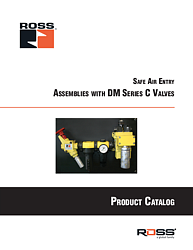
Complete Safe Air Entry Assembly Systems with DMC Series Double Valves
Comprehensive Catalog Overview - Pre-Engineered Pneumatic Safety Solutions
The ROSS Controls Safe Air Entry with DMC Series Double Valves catalog represents the industry's most advanced approach to pneumatic safety system design, combining energy isolation, air preparation, and safe exhaust functionality into pre-engineered, fully tested assemblies. This comprehensive technical resource provides detailed specifications, configuration options, and installation guidance for implementing the highest level of pneumatic safety in industrial automation and manufacturing environments.
This catalog serves as an essential reference for safety engineers, controls engineers, plant managers, maintenance professionals, and machine builders who require Category 4, Performance Level e (PL e), and Safety Integrity Level 3 (SIL 3) certified pneumatic safety systems that comply with global safety standards including ISO 13849-1:2015, ANSI/ASSE Z244.1, OSHA 1910.147, CSA Z142, and ANSI/PMMI B155.1.
DMC Series Double Valve Technology - The Heart of Safe Air Entry Systems
DM1 Series C Safe Exhaust Valves with Automatic Reset
The DM1 Series C represents ROSS Controls' internally monitored safe exhaust valve solution designed for applications requiring automatic reset functionality after fault conditions are cleared. These redundant 3/2 normally closed valves integrate dynamic monitoring and airflow control functions into two identical valve elements, providing the foundation for Category 4 safety system architectures.
Key Technical Features:
- Internal monitoring system: Integrated pressure switch with both normally open (NO) and normally closed (NC) contacts provides real-time status feedback indicating "ready-to-run" or fault conditions
- Automatic reset capability: When abnormalities clear upon removal of electricity to both solenoids, the valve automatically returns to ready-to-run status
- Dual poppet construction: Dirt-tolerant design with wear-compensating characteristics ensures quick response times and high flow capacity
- PTFE backup piston rings: Enhanced valve endurance enabling reliable operation with or without in-line lubrication
- High-flow silencers: Clog-resistant exhaust silencing integrated for operator comfort and noise reduction
- Flexible piping options: Inlet and outlet ports on both sides with plugs for unused ports and captive valve-to-base mounting screws
Performance Specifications:
- Operating pressure: Up to 150 psig (10.3 bar)
- Flow capacity: 2.2 Cv (21,964.8 Nl/min) on ports 1-2; 3.6 Cv (35,942.4 Nl/min) on ports 2-3
- Response time: Rapid actuation minimizing stopping time for critical safety applications
- Ambient temperature range: 15°F to 122°F (-10°C to 50°C)
- Media temperature range: 40°F to 175°F (4°C to 80°C)
DM2 Series C® Safe Exhaust Valves with Dynamic Memory
The DM2 Series C valve elevates pneumatic safety to the highest level with integrated dynamic memory functionality, ensuring that fault conditions are retained even when power sources are removed and reapplied. This advanced monitoring prevents automatic reset scenarios that could conceal potential hazards from operators and maintenance personnel.
Advanced Safety Features:
- Dynamic memory system: Fault information is retained regardless of air or electrical changes; requires deliberate reset procedure
- Manual reset requirement: Ensures fault acknowledgment by qualified personnel before returning valve to service
- Asynchronous detection: Monitors valve element synchronization on every cycle; detects and latches when elements move out of sync
- Residual pressure control: Maintains outlet pressure below 1% of supply in faulted condition
- Anti-tie-down protection: Built-in features prevent controls or operator errors from inadvertently bypassing safety functions
- Diminished performance monitoring: Detects sluggish operation within 100-125ms before catastrophic failure occurs
Dynamic Monitoring Explained:
Dynamic monitoring means all monitoring components change state on every valve cycle. This continuous verification ensures both valve elements are functioning synchronously. If asynchronous movement is detected, the valve immediately exhausts all downstream air, locks out, and prohibits further operation until manually reset by authorized personnel.
Certification and Compliance:
- Safety Category: Category 4 per ISO 13849-1:2015
- Performance Level: PL e (highest safety level)
- Safety Integrity Level: SIL 3 per IEC 61508
- DGUV Certification: Yes (German Statutory Accident Insurance)
- CE Certification: Yes (European conformity)
- EAC Declaration: Yes (Eurasian Conformity)
- CSA/UL Certification: Yes (North American safety standards)
H2: Complete Safe Air Entry Assembly Components and Configuration
Energy Isolation - Classic and Modular L-O-X® Lockout Valves
The foundation of every Safe Air Entry assembly begins with ROSS Controls' industry-leading L-O-X (Lockout and Exhaust) valve, providing compliant energy isolation for lockout/tagout (LOTO) procedures per OSHA 1910.147 and ANSI/ASSE Z244.1 requirements.
L-O-X Valve Design Advantages:
- Positive action manual operation: Large push/pull handle provides direct manual valve actuation with only two distinct positions (ON/OFF)
- Tamper-resistant lockout: Integrated lock attachment mechanism accepts standard padlocks for personal protective lockout
- Full-diameter exhaust: Rapid release of stored pneumatic energy through full-size exhaust port - not merely a bleed vent
- Visual pressure verification: Integrated sensing port with pop-up indicator or pressure gauge connection for energy dissipation confirmation
- Fluorocarbon slipper seals: Ensures easy shifting even after extended periods of inactivity
- Location flexibility: Can be positioned upstream or downstream of FRL components based on application requirements
Configuration Options:
- Classic L-O-X Series: Traditional robust design with metal bowl FRL components
- Modular L-O-X Series: Compact modular mounting system with integrated filter/regulator and high-strength polycarbonate bowls
Air Preparation - Filter, Regulator, and Lubricator (FRL) Systems
Proper air preparation is critical for optimal valve performance, system longevity, and consistent safety function. The catalog details multiple FRL configurations to match specific application requirements.
FRL Configuration Options:
-
Integrated Filter/Regulator (F/R) Units
- Single-body design combining filtration and pressure regulation
- Space-saving footprint for compact installations
- Metal or polycarbonate bowl options
- Pressure regulation range: Typically 0-150 psig adjustable
-
Separate Filter and Regulator (FR) Units
- Independent component mounting for maximum flexibility
- Metal bowl construction for harsh industrial environments
- Easier individual component servicing and replacement
- Enhanced filtration capacity for high-contaminant environments
-
Optional Lubricator Integration
- For applications requiring lubricated air
- Adjustable oil-drop rate for precise lubrication control
- Transparent bowl for visual oil level monitoring
- Compatible with mineral oils per DIN 51519, viscosity classes 32-46
Air Quality Requirements:
- Filtration: 5-micron rating minimum (standard); finer filtration available for critical applications
- Air quality: Compressed air per ISO 8573-1 Class 7:4:4 or better
- Contaminant tolerance: Valves designed for real-world industrial conditions
- Moisture removal: Ensures consistent valve operation in all climates
Optional Components and Accessories
Soft-Start Modules:
The catalog includes configurations with integrated EEZ-ON® soft-start functionality, allowing gradual pressure build-up during system energization. This prevents sudden surge forces that could cause cylinder rapid advancement, machine shock, or workpiece disturbance.
Pressure Monitoring Options:
- Analog gauges: Visual pressure indication for operator awareness
- Digital transducers: Electronic pressure measurement for control system integration
- Solid-state pressure sensors: High-accuracy monitoring for external safety system connectivity
Enhanced Installation Accessories:
- Extra port blocks (1/4", 1/2", 3/4"): Additional connection points upstream or downstream
- Mounting plates: Pre-drilled for consistent installation and easy valve replacement
- Drip legs: Condensate collection and removal for moisture-laden environments
- Silencers: Built-in or enhanced external for quieter operation in noise-sensitive areas
Applications and Industry Usage
Target Industries and Machinery Types
The Safe Air Entry with DMC Series catalog addresses safety requirements across diverse industrial sectors:
Automotive Manufacturing:
- Assembly line automation with frequent access requirements
- Robotic work cells requiring Category 4 safety
- Stamping and pressing operations with pneumatic cylinders
- Paint booth and material handling equipment
Packaging and Converting:
- Form-fill-seal machines requiring rapid jam clearance
- Converting equipment with routine maintenance access
- Cartoning and case packing machinery
- Labeling and product handling systems
General Manufacturing:
- CNC machine tools with pneumatic clamping
- Automated assembly systems and pick-and-place equipment
- Material handling conveyors and diverters
- Pallet handling and product transfer stations
Food and Beverage Processing:
- Filling and capping equipment
- Conveying and sorting systems
- Pneumatic actuators in washdown environments
- Automated inspection and rejection systems
Metalworking and Fabrication:
- Hydraulic press brake air systems
- Pneumatic clamps and fixtures
- Automated welding and cutting equipment
- Tube bending and forming machinery
Safety Function Applications
Lockout/Tagout (LOTO) Compliance:
Safe Air Entry assemblies enable rapid, compliant energy isolation for maintenance access, jam clearance, and machine servicing. The L-O-X valve provides the required manual energy isolation device with secure lockout attachment and visual energy dissipation verification.
Single-Point Lockout (SPLO) Systems:
When integrated with appropriate electrical safety controls per ANSI/ASSE Z244.1, these assemblies enable single-point lockout alternatives that dramatically reduce jam clearance time while maintaining or improving safety levels. Studies show SPLO systems can reduce lockout time by 4+ minutes per incident, yielding 32 minutes additional production time per 8-jam shift.
Zone Isolation and Machine Segmentation:
Multiple Safe Air Entry assemblies can isolate distinct machine zones, allowing maintenance access to one area while other zones remain operational, maximizing productivity while ensuring worker safety.
Safe Exhaust and Energy Removal:
The DMC Series valves provide rapid, reliable downstream pressure removal, reducing hazards associated with stored pneumatic energy during employee access for setup, adjustment, or minor servicing.
Safety Standards Compliance and Certification
Global Safety Standard Requirements
The catalog provides detailed compliance information demonstrating conformity with international safety standards:
ISO 13849-1:2015 - Safety of Machinery:
- Category 4 architecture: Highest safety category with redundancy and monitoring
- Performance Level e (PL e): Highest achievable performance level
- Diagnostic Coverage (DC): Up to 99% through internal monitoring
- Mean Time to Dangerous Failure (MTTFD): High reliability ratings
IEC 61508 - Functional Safety:
- Safety Integrity Level 3 (SIL 3): Second-highest safety integrity classification
- Suitable for safety instrumented systems requiring high reliability
- Proven-in-use documentation supporting safety case development
OSHA 1910.147 - Control of Hazardous Energy:
- Compliant energy isolation devices for lockout/tagout procedures
- Manual operation requirements met by L-O-X valves
- Full-diameter exhaust for rapid energy dissipation
- Visual energy verification provisions
ANSI/ASSE Z244.1 - Lockout/Tagout and Alternative Methods:
- Supports both traditional LOTO and alternative methods
- Enables single-point lockout system architectures
- Control-reliable valve functionality for alternative lockout
ANSI/PMMI B155.1 - Packaging Machinery Safety:
- Safety shut-off and exhaust valve requirements fully satisfied
- Lockable only in off position
- Full exhaust capacity (not merely bleed vents)
- Visible pressure indication provisions
ANSI B11 Series - Machine Tool Safety:
- Control reliability for pneumatic control systems
- Redundancy and monitoring requirements satisfied
- Suitable for press brake and machine tool applications
Third-Party Certification and Validation
All DMC Series Safe Air Entry assemblies undergo rigorous third-party testing and certification:
- TÜV Rheinland: German technical inspection association providing independent safety validation
- DGUV (Deutsche Gesetzliche Unfallversicherung): German Statutory Accident Insurance certification
- CSA (Canadian Standards Association): North American safety certification
- UL (Underwriters Laboratories): US product safety certification
- CE Marking: European Union conformity declaration
- EAC (Eurasian Conformity): Certification for Eurasian Economic Union markets
Technical Specifications and Selection Criteria
Valve Sizing and Flow Capacity Selection
The catalog provides detailed flow capacity data essential for proper valve selection:
Available Port Sizes:
- 1/4" NPT or G (ISO 228) threads: Compact applications with lower flow requirements
- 3/8" NPT or G threads: General purpose industrial applications (most common)
- 1/2" NPT or G threads: Higher flow applications and faster exhaust requirements
- 3/4" NPT or G threads: Maximum flow capacity for large-volume systems
Flow Coefficients (Cv) by Valve Body Size:
The Cv (flow coefficient) determines the valve's ability to pass air volume. Higher Cv values indicate greater flow capacity and faster response times. Catalog includes detailed Cv values for:
- Inlet to outlet flow (ports 1-2): Supply direction flow capacity
- Outlet to exhaust flow (ports 2-3): Critical exhaust/dump capacity - typically higher than inlet flow
Selection Considerations:
- Downstream air volume requiring exhaust: Larger volumes require higher Cv and larger port sizes
- Required stopping time: Faster stops demand higher exhaust flow capacity
- System pressure: Higher pressures increase actual flow through given Cv rating
- Piping restrictions: Avoid flow restrictions downstream of valve that negate valve capacity
Electrical Specifications and Control Integration
Standard Voltage Options:
- 24 VDC (most common): Industrial automation standard voltage
- 110 VAC: Available for specific applications
- 220 VAC: International applications
- Other voltages: Consult ROSS for custom requirements
Electrical Connection Types:
- M12 connector: Compact, IP67-rated circular connector (common on DM1C configurations)
- EN 175301-803 Form A: DIN connector standard (common on DM2C configurations)
- EN 175301-803 Form C: Multi-pin DIN connector for integrated feedback
Pin Configuration Options:
The catalog details available pin configurations for integrating solenoid control signals and feedback monitoring into control systems:
- Solenoid connections (A designation): Main valve actuation inputs
- Sensor/feedback connections (C designation): Status and monitoring outputs
- Reset connections: Manual reset signal input (DM2 Series)
Power Consumption:
- Nominal: 5.8 watts typical
- Maximum: 6.5 watts during actuation
- Holding current: Efficient operation minimizes heat generation and energy consumption
Feedback Contact Ratings:
- Mechanical pressure switch contacts: 0.1 A @ 125/250 VAC; 0.1 A @ 30 VDC; 0.3 A @ 60 VDC
- Contact configuration: Both NO (normally open) and NC (normally closed) available
- Integration requirement: Must connect to control system to prevent run signal during fault conditions
Environmental Specifications and Operating Conditions
Temperature Ranges:
- Ambient operating temperature: 15°F to 122°F (-10°C to 50°C)
- Media (air) temperature: 40°F to 175°F (4°C to 80°C)
- Storage temperature: Contact ROSS for extended temperature applications
Pressure Specifications:
- Maximum operating pressure: 150 psig (10.3 bar) typical
- Minimum operating pressure: Consult catalog for minimum pilot pressure requirements
- Proof pressure: Withstands pressure testing beyond operating range
- Burst pressure: Safety factor built into all pressure-containing components
Flow Media Requirements:
- Filtered compressed air per ISO 8573-1 Class 7:4:4 minimum
- Lubricated or non-lubricated operation capability
- Compatible with mineral oils per DIN 51519, viscosity classes 32-46
- Contamination tolerance: Poppet design provides superior dirt tolerance compared to spool valves
Construction Materials:
- Valve body: Cast aluminum for corrosion resistance and light weight
- Poppet/spool elements: Acetal and stainless steel for durability
- Seals: Buna-N (Nitrile) standard; other materials available for special media
- External components: Corrosion-resistant materials for industrial environments
Installation, Integration, and Validation
Pre-Engineered Assembly Advantages
ROSS Safe Air Entry assemblies are fully configured, tested, and ready for installation, providing significant advantages over field-assembled systems:
Factory Testing and Quality Assurance:
- Complete functional testing before shipment
- Leak testing of all connections and components
- Pressure testing to verify safe operating limits
- Performance verification of valve response times
- Documentation of test results for quality records
Installation Time Reduction:
- Pre-assembled units install in fraction of time versus individual components
- Pre-piped connections eliminate field plumbing and potential leak points
- Mounting hardware included for rapid machine integration
- Reduced labor costs and faster project completion
Consistent Performance:
- Factory calibration ensures optimal component settings
- Proper component sizing and matching for intended application
- Eliminates field configuration errors that could compromise safety
- ROSS quality standards applied throughout assembly process
Installation Guidelines and Best Practices
The catalog provides comprehensive installation instructions including:
Mounting Orientation:
- Preferred vertical mounting for optimal drainage
- Horizontal mounting acceptable with proper drain provisions
- Avoid mounting in orientations that trap condensate
- Ensure operator access to L-O-X valve handle and pressure indicators
Piping Recommendations:
- Supply piping: Minimize restrictions; use pipe/tube size matching valve port size
- Avoid undersized quick-disconnects, elbows, and fittings that restrict flow
- Exhaust piping: Must not restrict valve exhaust capacity
- Support piping independently - do not use valve body as pipe support
Electrical Integration:
- Route electrical connections per local codes and NEC/IEC requirements
- Use properly rated cable for voltage and environment
- Ensure secure connector engagement to prevent moisture ingress
- Connect feedback signals to control system per integration guide
Air Supply Quality:
- Install appropriate filtration upstream of assembly
- Ensure adequate flow capacity from compressed air source
- Pressure regulation upstream if supply pressure fluctuates significantly
- Consider air dryer for applications in humid environments
SISTEMA Library and Safety Validation
The catalog references ROSS Controls' available SISTEMA library for simplified safety system validation:
SISTEMA Software Integration:
SISTEMA (Safety Integrity Software Tool for Machinery Analysis) by IFA (Institut für Arbeitsschutz) is the widely used software for calculating and validating safety systems per ISO 13849-1. ROSS provides pre-validated SISTEMA library files containing DMC valve data.
Validation Process Benefits:
- Import ROSS valve data directly into safety system calculations
- Eliminates manual data entry and potential errors
- Speeds up safety validation documentation
- Provides confidence in achieving target Category 4, PL e ratings
Safety System Documentation:
The catalog emphasizes proper documentation requirements:
- Safety function specifications and requirements
- Risk assessment identifying hazards and required risk reduction
- Safety circuit schematics showing all components
- Validation calculations demonstrating achievement of target safety levels
- Installation verification and commissioning test results
- Periodic inspection and maintenance schedules
Troubleshooting, Maintenance, and Service Life
Routine Maintenance Requirements
Inspection Schedule:
The catalog recommends establishing periodic inspection schedules based on:
- Frequency of machine operation
- Cleanliness of air supply
- Environmental conditions (dust, moisture, temperature extremes)
- Regulatory requirements and company safety policies
Inspection Points:
- L-O-X valve operation: Verify smooth handle operation and positive detent positions
- Pressure indicators: Confirm proper pressure when energized and complete exhaust when de-energized
- Visual inspection: Check for air leaks, damaged components, loose connections
- Electrical connections: Verify secure attachment and absence of moisture/corrosion
- FRL components: Check filter element condition, lubricator oil level, pressure setting
Service Life Considerations:
- PTFE backup piston rings extend valve operating life
- Poppet construction provides wear compensation
- Metal bowl FRL components offer enhanced durability in harsh environments
- Proper air preparation maximizes component longevity
Common Fault Conditions and Resolution
The catalog addresses typical fault scenarios and troubleshooting approaches:
Valve Fails to Reset:
- Most common cause: Inadequate supply pressure due to undersized piping or restrictions
- Solution: Verify supply pressure at valve inlet; upgrade piping if necessary
- Check for: Partially closed upstream valves, clogged filters, undersized quick-disconnects
Nuisance Faulting:
- Cause: Insufficient supply flow capacity during actuation
- Solution: Increase pipe/tube size, reduce restrictions, verify adequate compressor capacity
- Note: Valve requires momentary high flow during actuation; inadequate capacity causes pressure drop and fault
Pressure Not Fully Exhausting:
- Check exhaust path for restrictions or blockages
- Verify silencer not clogged
- Confirm downstream volume not excessive for valve capacity
- Check for downstream check valves trapping pressure
Feedback Switch Not Changing State:
- Verify electrical connection security
- Test switch contact operation per catalog specifications
- Check control system wiring and input configuration
- Consult ROSS service for internal switch issues
Model Number Configuration and Ordering Information
Understanding ROSS Part Number Structure
The catalog includes detailed model number configurators explaining how part numbers indicate specific assembly configurations:
Typical Model Number Format Example: RC304-06W005
Breaking down the model number components:
- RC or DRC: Assembly series designation (R = standard, DR = alternate configuration)
- 3: Major assembly type (3 = Safe Air Entry with lockout and FRL)
- 04: Valve series (04 = DM1C or DM2C Series C valves)
- 06: Port size code (06 = 1/4", 08 = 3/8", 10 = 1/2", etc.)
- W: Thread type (W = NPT American National threads, or D/G = ISO 228 parallel threads)
- 005: Specific configuration code indicating voltage, connection type, FRL configuration, and options
Configuration Variables:
The catalog provides selection matrices for customizing assemblies:
- Valve series choice: DM1C (automatic reset) vs. DM2C (manual reset with memory)
- Port size and thread type
- Voltage and electrical connection type
- Soft-start inclusion
- Monitoring type (all DMC are internal monitoring)
- Gauge or transducer options
- Lockout series (Classic vs. Modular)
- Lockout location (upstream or downstream of FRL)
- Filter/regulator type (integrated vs. separate)
- Lubricator inclusion
- Extra port blocks and locations
- Mounting accessories
Custom Configurations and ROSS/FLEX® Solutions
The catalog references ROSS/FLEX custom engineering capabilities for applications requiring:
- Non-standard port locations or orientations
- Integrated mounting brackets for specific machines
- Multiple assemblies on common manifolds
- Explosion-proof solenoid pilots for hazardous locations (Class I, Division 1/2)
- Special voltage or electrical connection requirements
- Integration with customer-specific control panels
- Stainless steel or special material construction for corrosive environments
Custom Engineering Process:
- Application review with ROSS technical team
- Custom design using proven ROSS internal components
- No life-cycle re-testing required (uses existing certified components)
- Rapid turnaround (days or weeks vs. months for entirely new products)
- Customer-specific documentation and testing
Competitive Advantages and Value Proposition
Why Specify ROSS DMC Series Safe Air Entry Assemblies
Proven Technology with 60+ Years Heritage:
ROSS Controls has manufactured redundant, monitored valves for safety applications for over 60 years. The DMC Series represents the latest evolution of this proven technology, incorporating decades of field experience and continuous improvement.
Internal Monitoring Advantage:
Unlike externally monitored valves that depend on control system logic and can potentially be bypassed, DMC Series internal monitoring is integral to the valve design. The monitoring function is inherent and cannot be defeated, providing maximum safety integrity.
Poppet Valve Technology:
ROSS pioneered poppet valve technology for pneumatic safety applications. Advantages include:
- Superior contamination tolerance versus spool valves
- Wear compensation maintaining performance over service life
- Positive sealing with spring and pressure bias to closed position
- High flow capacity relative to body size
Single-Source Responsibility:
Pre-engineered assemblies from ROSS provide single-source responsibility for the complete pneumatic safety system inlet through exhaust, eliminating component compatibility questions and multiple-vendor coordination.
Global Support Network:
With facilities in North America, Europe, and Asia, plus worldwide distribution, ROSS provides local support for specification, installation, commissioning, and ongoing service regardless of project location.
Reduce Total Cost of Ownership:
- Factory-tested assemblies reduce installation time and labor costs
- Fewer leak points than field-assembled systems reduce troubleshooting time
- Long service life minimizes replacement frequency
- Global availability ensures parts and service accessibility
- Single-Point Lockout capability enabled by DMC valves dramatically reduces downtime
Additional Resources and Technical Support
Complementary Documentation Available
The Safe Air Entry with DMC Series catalog references additional technical resources available from ROSS Controls:
Product-Specific Documents:
- Individual DM1 Series C valve catalogs and data sheets
- Individual DM2 Series C valve catalogs and data sheets
- L-O-X valve installation and maintenance manuals
- FRL component specifications and service instructions
- SISTEMA library files for safety validation
Application Guides and White Papers:
- "Control Reliable Valves for Clutch/Brake Systems" (RPA010)
- "When Safety Matters Most: Monitored Redundant Valves" (RPA003)
- "Internal versus External Monitoring" comparison white paper
- "Standards Increase Productivity as Well as Promote Safety" (RPA002)
- Risk assessment guides and safety system design best practices
Training and Education:
- Total Machine Safety course offered by ROSS Controls
- Fluid Power Safety for Machine Guarding reference manual
- Webinars and technical seminars on pneumatic safety topics
- Machine safety services including risk assessments, conformity audits, and validation
Contacting ROSS Controls for Application Support
Technical Support Resources:
- Phone: 1-800-GET-ROSS (1-800-438-7677) - North America
- Email: Technical support available through rosscontrols.com website
- Local distributor network: Find authorized distributors worldwide
- Regional application engineers: Available for on-site consultation
Services Offered:
- Application review and product selection assistance
- Custom configuration and ROSS/FLEX solutions design
- Safety system validation support and SISTEMA integration
- Installation and commissioning assistance
- Training for maintenance and engineering personnel
- Ongoing technical support throughout product lifecycle
Website Resources:
Visit rosscontrols.com for:
- Complete product catalogs and CAD models (2D/3D)
- Installation instructions and maintenance manuals
- SISTEMA library downloads
- Technical articles and white papers
- Safety standard reference materials
- Online product configurator tools
- Webinar recordings and educational content
Industry Leadership in Pneumatic Safety
The ROSS Controls Safe Air Entry with DMC Series Double Valves catalog represents more than a product specification document—it embodies over a century of fluid power expertise and six decades of pioneering pneumatic safety valve development. As the global leader in fluid power safety solutions, ROSS Controls has continuously advanced the technology that protects workers, enhances productivity, and ensures regulatory compliance across diverse industrial applications worldwide.
The DMC Series Safe Air Entry assemblies deliver the highest available safety integrity (Category 4, PL e, SIL 3) through advanced internal monitoring, dynamic memory functionality, and proven poppet valve technology. By combining energy isolation, air preparation, and safe exhaust functionality into pre-engineered, factory-tested assemblies, ROSS eliminates complexity while maximizing reliability and performance.
Whether implementing lockout/tagout procedures, designing single-point lockout systems, or integrating pneumatic safety into complex automation systems, this catalog provides the technical foundation for success. The comprehensive specifications, configuration options, and application guidance enable safety engineers, controls designers, and maintenance professionals to specify and implement pneumatic safety systems with complete confidence.
Download this essential catalog today to access complete technical specifications, dimensional drawings, electrical schematics, model number configurators, and application examples that will guide your pneumatic safety system design. With ROSS Controls' DMC Series Safe Air Entry assemblies, you're not just specifying a valve—you're partnering with the global leader committed to making industrial workplaces safer, one machine at a time.
For immediate assistance with product selection, custom configurations, or application questions, contact ROSS Controls at 1-800-GET-ROSS (1-800-438-7677) or visit rosscontrols.com. Our global team of pneumatic safety experts stands ready to support your project from initial concept through installation, commissioning, and ongoing operation.
Safe manufacturing. Reliable performance. ROSS Controls—The Global Leader in Fluid Power Safety Since 1921.