




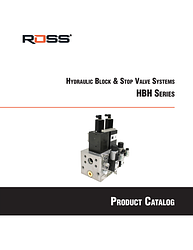
Advanced Redundant Valve Design for Hydraulic Safety
The HBH Series Hydraulic Block & Stop Valve Systems represent the pinnacle of redundant safety technology for critical fluid power applications. Manufactured by ROSS Controls, a 100-year industry leader in pneumatic and hydraulic safety solutions, the HBH Series combines proven engineering excellence with modern safety standards to protect both workers and critical manufacturing operations.
These redundant blocking valve systems are specifically engineered for applications requiring the highest levels of safety assurance—environments where unexpected cylinder motion could result in worker injury, equipment damage, or catastrophic operational failure. The HBH Series meets stringent international safety standards including ISO 13849-1:2015 Category 3 PLd and IEC 61508:2010 SIL 2 certifications, providing documented evidence of safety compliance for regulatory audits, OSHA inspections, and insurance verification.
Poppet and Spool Design Architecture
The HBH Series employs a sophisticated dual-element design combining poppet-type cartridge valve elements for blocking flow with spool-type solenoid pilot valves for control functionality. This hybrid architecture delivers several critical advantages:
Blocking Reliability: Poppet-type elements provide positive blocking of hydraulic fluid flow, stopping cylinder motion effectively and immediately when solenoid de-energization occurs. This direct mechanical blocking ensures failure-safe operation—if electrical power is lost, the valve defaults to the blocked position.
Dual Redundancy: The HBH Series incorporates two independent blocking valve elements in a single integrated system, creating redundancy at both the mechanical and functional levels. This dual-element design means that even if one blocking element experiences partial degradation, the second remains fully operational, maintaining safety compliance and system functionality.
Solenoid Actuation: Two solenoids (one per valve element) must be operated synchronously to achieve the unblock function. This synchronized requirement adds an additional layer of safety verification—both solenoids must receive simultaneous commands for motion to be permitted. Any loss of electrical signal, communication interruption, or control circuit fault immediately returns the system to the blocked state.
Tamper-Resistant Construction Features
ROSS Controls incorporates tamper-resistant design features throughout the HBH Series to prevent unauthorized modification or circumvention of safety functions. A special tool is required for disassembly, preventing casual tampering while allowing authorized maintenance personnel to service the valve when necessary. This design philosophy aligns with OSHA principles emphasizing that safety controls must be designed to resist defeat or bypass.
In-Line Mounting Configuration
The HBH Series utilizes Code 62 Flange port connections for both pilot supply (P1) and pilot return (P2) ports, with additional SAE-standard ports (X, Y, MP1, M-M, MP2) for main flow control. This standardized flange configuration simplifies system integration, reduces custom engineering requirements, and facilitates retrofit installation into existing hydraulic systems. The in-line mounting design allows flexible orientation—while horizontal mounting is preferred for optimal solenoid performance, the valve can be mounted in various orientations depending on system requirements.
Block & Stop Functionality: Motion Control for Critical Cylinders
The block and stop function is the core safety capability of the HBH Series. This function momentarily halts cylinder motion in response to safety commands, electrical interlocks, or emergency stop activation. Understanding when and how to use block and stop functionality is critical for proper system design.
Momentary Motion Stopping Capability
The HBH Series is specifically designed for momentary stopping of actuators—the valve interrupts flow to hydraulically controlled cylinders for brief periods, halting motion while allowing the cylinder to remain pressurized. This momentary function makes the HBH Series ideal for applications such as:
- Machine Guarding Systems: Hydraulic-powered guard gates that must stop immediately when an operator hand or body part enters the danger zone
- Press Control Systems: Punch presses and forming equipment that must cease downward motion instantly upon safety sensor activation
- Assembly Line Equipment: Multi-axis robotic systems requiring synchronized axis shutdown for worker safety
- Material Handling: Hydraulic lift systems and positioning equipment that must lock in place during maintenance or personnel movement
- Stamping & Metalworking: Progressive die equipment and metal shears requiring immediate motion stopping at any point in the cycle
Permissive Safety Device Operation
It is critical to understand that HBH Series valves function as "permissive" safety devices—they permit normal cylinder operation during authorized production cycles while blocking motion when safety conditions are not met. The valve is not designed for long-term holding of actuators in static positions.
Important Design Note: The HBH Series employs spool-type valve elements in the pilot stage, which experience normal spool leakage characteristic of spool valve technology. Over extended periods of static blockage, this internal leakage can gradually reduce system pressure, potentially allowing slow creep motion of the cylinder. Therefore, applications requiring prolonged holding of cylinders in locked positions should incorporate secondary holding devices such as:
- Pilot-Operated (PO) Check Valves: Provide secondary load-holding capability independent of main blocking valve function
- Counterbalance Valves: Maintain backpressure and prevent uncontrolled descent in vertically-oriented cylinders
- Mechanical Locking Devices: Mechanical locks, latches, or brakes that provide positive mechanical restraint independent of hydraulic pressure
Long-Term Holding Solutions & Integration
For applications requiring extended holding periods, ROSS Controls recommends a multi-layer safety approach combining HBH Series block and stop functionality with mechanical or pilot-operated secondary holding elements. This redundant holding strategy ensures that even if primary blocking capability is compromised, secondary mechanical or hydraulic systems maintain safe cylinder restraint.
The HBH Series Integration Guide (available from ROSS Controls) provides detailed circuit design guidance for incorporating secondary holding devices alongside HBH Series valves. ROSS application engineers work directly with customers to design systems that achieve required safety performance levels while ensuring practical, maintainable designs.
External Monitoring with Integrated Position Switches
A distinguishing feature of the HBH Series is its integrated inductive position switches—electronic sensors that monitor the position of internal valve spools in real time. These switches enable sophisticated external monitoring capabilities through integration with electrical safety control systems.
Inductive Position Switch Technology
The HBH Series incorporates two inductive position switches (one for each blocking valve element) that detect the axial position of the internal solenoid-controlled spools. Inductive sensor technology offers several advantages:
No Direct Mechanical Contact: Unlike mechanical limit switches, inductive sensors operate without direct contact with moving elements. They detect magnetic field changes caused by spool position, eliminating mechanical wear, contamination issues, and reliability concerns associated with rubbing contacts.
Robust Design: Inductive sensors are inherently robust in industrial environments, unaffected by dust, hydraulic spray, vibration, or thermal cycling common in manufacturing facilities.
Immediate Response: Inductive sensors provide instantaneous electrical signals reflecting valve spool position, enabling real-time monitoring and diagnostic capabilities.
Diagnostic Capability: The continuous position information from inductive sensors allows safety control systems to verify that valve position matches commanded state. If a command is issued to block flow but the spool fails to move to the blocking position, the monitoring system detects this fault condition immediately.
External Monitoring Integration with Safety Control Systems
The inductive position switches connect via M12 4-pin A-coded connectors (compatible with both 4-pin and 5-pin female cordsets) directly to customer-supplied electrical safety control systems. The external monitoring system must continuously validate proper valve operation:
- State Verification: Monitor that solenoid commands and spool position changes are synchronized
- Fault Detection: Identify any condition where valve spool position does not match commanded state
- Functional Testing: Perform regular diagnostic tests ensuring that solenoid actuation produces expected valve position changes
- Alarm Generation: Generate operator alerts if monitoring detects unsafe valve condition
The HBH Series is NOT a standalone safety device—it requires integration with a properly designed electrical safety control system capable of monitoring solenoid command signals and position switch feedback. The integration methodology must follow ISO 13849-1:2015 design and diagnostic protocols to maintain required safety performance levels.
Synchronous Solenoid Operation
Both solenoids in the HBH Series system must receive synchronized commands. The electrical control system must ensure that:
- Simultaneous Energization: Both solenoids receive simultaneous energization to permit cylinder motion
- Simultaneous De-energization: Both solenoids de-energize together, causing synchronized return to blocked state
- Dual-Channel Monitoring: Both position switches confirm that each valve element responds correctly to solenoid commands
This dual-command, dual-monitoring architecture provides inherent redundancy—a single electrical fault cannot cause unintended cylinder motion.
Technical Specifications & Performance Standards
The HBH Series is available in two body sizes, each optimized for specific flow and pressure requirements:
Flow Rate Specifications
| Size | Port Size | Flow Capacity | Application Range |
| Size 25 | 1.5" Code 62 | 0-90 GPM | Small to medium cylinders, precision applications |
| Size 32 | 2.0" Code 62 | 0-145 GPM | Large cylinders, high-flow applications |
Flow Capacity Note: These ratings represent maximum continuous flow under rated pressure conditions. Applications exceeding these limits require custom engineering evaluation.
Operating Pressure Ranges
- Maximum System Pressure: 5,000 PSI (344 bar)
- Minimum Operational Pressure: 300 PSI (21 bar)
- Typical Industrial Range: 1,000-3,000 PSI (69-207 bar)
The HBH Series solenoid-pilot design requires adequate backpressure (pilot pressure) to function correctly. Systems operating below 300 PSI may not provide sufficient pilot pressure for reliable solenoid operation.
Fluid Compatibility & Media Specifications
The HBH Series is compatible with standard industrial hydraulic fluids:
- Mineral Oil: HLP, HL-DIN 51524 (ISO VG 32-46)
- Vegetable Oil: HETG - VDMA 24568 (biodegradable alternatives)
Maximum Fluid Contamination: ISO 4406 class 20/18/15 (NAS 1638 class 9)
Fluid cleanliness is critical for long-term reliability. Hydraulic systems serving HBH Series valves should incorporate high-efficiency filtration maintaining contamination levels below the maximum specification.
Temperature Operating Conditions
| Parameter | Range |
| Ambient Temperature | -4°F to 160°F (-20°C to 71°C) |
| Hydraulic Media Temperature | -4°F to 140°F (-20°C to 60°C) |
| Solenoid Continuous Rating | 32°F to 140°F (0°C to 60°C) |
Temperature stability is important—extended operation at temperature extremes may affect solenoid responsiveness and seal material properties.
Product Variants: Size 25 and Size 32 Options
Size 25 Block & Stop Valve Series
The HBH Size 25 represents the compact option in the redundant valve system lineup:
- Body Weight: 112.3 lbs (50.9 kg)
- Flow Capacity: 0-90 GPM
- Port Configuration: 1.5" Code 62 flange (P1, P2); SAE #6 ports (X, Y, MP1, M-M, MP2)
- Footprint: Compact form factor suitable for space-constrained installations
- Applications: Precision machinery, smaller hydraulic cylinders, modular system designs
The Size 25 is ideal for original equipment manufacturers (OEMs) building compact safety systems and for retrofit applications where physical space is limited.
Size 32 Block & Stop Valve Series
The HBH Size 32 provides the high-flow capability needed for large industrial applications:
- Body Weight: 142.8 lbs (64.8 kg)
- Flow Capacity: 0-145 GPM
- Port Configuration: 2.0" Code 62 flange (P1, P2); SAE #6 ports (X, Y, MP1, M-M, MP2)
- Footprint: Larger form factor accommodating high-flow requirements
- Applications: Large hydraulic cylinders, press equipment, industrial material handling systems
The Size 32 accommodates higher flow demands while maintaining the same safety architecture and external monitoring capabilities.
Flow Capacity Comparison
For applications with marginal flow requirements between the two sizes, ROSS Controls recommends consulting application engineers. Custom port configurations, cavity modifications, or alternative valve selections may optimize performance.
ISO 13849-1 Certification & Safety Integrity
The HBH Series meets demanding international safety standards establishing its suitability for critical safety applications:
Category 3 Performance Level Compliance
The HBH Series achieves Category 3 per ISO 13849-1:2015, indicating:
- Redundant Architecture: Dual independent safety functions eliminate single-point-of-failure risks
- Diagnostic Coverage: The external monitoring system detects faults that could compromise safety performance
- Safe Failure Design: Valve design defaults to blocked (safe) state upon power loss or control circuit fault
- Certified Performance: Third-party testing and validation confirm safety performance claims
Category 3 is appropriate for machinery applications requiring high reliability without requiring continuous diagnostic monitoring of all system components.
PLd Safety Rating Achievement
The HBH Series achieves PLd (Performance Level d) per ISO 13849-1:2015, indicating mean time to dangerous failure (MTTDf) between 100 and 1,000 hours. This PLd rating supports applications up to SIL 2 equivalent safety integrity.
PLd Capability Matrix:
- Applications requiring PLa or PLb protection: Fully supported
- Applications requiring PLc or PLd protection: Direct qualification
- Applications requiring PLe protection: Requires custom analysis and higher-category architectural enhancements
SIL 2 Functional Safety Standards
The HBH Series meets SIL 2 per IEC 61508:2010 functional safety standards, confirming:
- Safety Integrity: The valve system achieves the defined safety function reliably under specified operating conditions
- Systematic Safety: Design, manufacturing, and testing processes follow IEC 61508 functional safety methodology
- Verified Performance: Independent validation confirms safety claims
SIL 2 capability makes the HBH Series suitable for most industrial machinery safety applications, from simple emergency stop functions to complex multi-axis machine guarding systems.
Electrical Integration & Control Systems
Proper electrical integration is essential for achieving safety performance. The HBH Series electrical architecture enables sophisticated monitoring and control.
24V DC Solenoid Configuration
The HBH Series employs 24-volt DC solenoids (per VDE 0580 standard):
- Operating Voltage: 24V DC nominal
- Power Consumption: 30 watts per solenoid (continuous duty rated)
- Duty Rating: Rated for continuous energization without thermal concerns
- Enclosure Rating: DIN EN 60529 IP 65 (dust and water-resistant)
- Electrical Connection: DIN EN 175301-803 Form A connectors
24V DC solenoid technology offers excellent compatibility with modern safety control systems, PLCs, and safety relays. The 30-watt continuous rating eliminates thermal cycling concerns—solenoids can remain energized indefinitely without duty cycle limitations.
PNP Inductive Position Sensors
The inductive position switches employ PNP (sourcing) output configuration:
- Connector Type: M12 4-pin A-coded male connector
- Output Signal: NO (Normally Open) on Pin 4; NC (Normally Closed) on Pin 2
- Supply Voltage: 24V DC nominal
- Maximum Current: 400 mA per sensor (200 mA typical)
- Response Time: Millisecond-level detection of spool position changes
PNP configuration is industry standard for safety control integration, compatible with virtually all modern safety PLCs and monitoring systems.
M12 Connector Standards
Both solenoid connectors and sensor connectors employ M12 A-coded connectors, enabling standardized cordset procurement:
- Solenoid Connector: M12 4-pin male, DIN EN 175301-803 Form A
- Sensor Connectors: M12 4-pin A-coded male (works with both 4-pin and 5-pin female cordsets)
- Cable Specifications: Standard industrial M12 connector cordsets rated for continuous duty in manufacturing environments
ROSS Controls offers a complete accessory line including prewired connector kits, extending cable assemblies, and lighted connectors for visual status indication.
Installation, Dimensions & Port Configurations
Proper installation is critical for safety and reliable operation. The HBH Series provides standardized port configurations simplifying system integration.
Code 62 Flange Port Connections
Both pilot supply (P1) and pilot return (P2) ports employ ISO 4401 Code 62 Flange connections:
- Size 25: 1.5" MT 62 flange ports
- Size 32: 2.0" MT 62 flange ports
Code 62 flange standardization enables direct connection to standard manifold cavity configurations, eliminating custom porting requirements in most applications.
SAE Port Configurations
Main function ports employ SAE standard connections:
| Port | Function | Size |
| X | Main inlet (from pump) | SAE #6 (-06 hose) |
| Y | Main outlet (to tank) | SAE #6 (-06 hose) |
| MP1 | Actuator port | SAE #6 (-06 hose) |
| M-M | Makeup/pilot port | SAE #6 (-06 hose) |
| MP2 | Return from actuator | SAE #6 (-06 hose) |
Port Sizing Note: Connecting tubing and piping must equal or exceed the stated port size at Port Y. Undersized return lines create excessive backpressure, affecting valve function.
Mounting Orientation Options
The HBH Series supports flexible mounting orientation:
- Preferred: Horizontal mounting provides optimal solenoid cooling and reliable spool centering
- Vertical: Solenoid pointing downward is acceptable for most applications
- Any Orientation: Engineering analysis required for non-standard orientations
Installation procedures and dimensional drawings are provided in the HBH Series installation documentation.
Accessories & Connector Options
ROSS Controls provides an extensive accessory catalog supporting HBH Series integration:
Solenoid Connector Kits
Standard prewired solenoid connector kits simplify installation:
- 5-Meter Cable Kits (Model 2243H77, 2244H77): Flying lead termination
- 10-Meter Cable Kits (Model 2244H77): Flying lead termination
- Lighted Connector Kits (Models 720K77-W, 721K77): 24V DC integrated indicator light showing solenoid energization
Inductive Position Sensor Connectors
Position sensor connector kits enable rapid sensor integration:
- 5-Meter Sensor Cables: M12 5-pin female, DIN EN 175301-803 (Models 2644B77, 2645B77)
- 10-Meter Sensor Cables: Extended length for remote monitoring installations (Models 2370B77, 2371B77)
- Cable Grip Options: Mechanical cable strain relief improving reliability in vibration environments
Cable Assemblies & Prewired Options
Complete prewired cable assemblies accelerate commissioning:
- 1/2" NPT Conduit Connectors: Industrial-grade conduit connections (Models 723K77, 724K77-W)
- Lighted Connector Versions: Integrated 24V DC indicator lights (Models 720K77-W, 724K77-W, 936K87-W)
- Custom Cable Lengths: Custom cable configurations available through ROSS Controls
Industry Applications & Safety Solutions
The HBH Series addresses critical safety challenges across diverse manufacturing environments:
Automotive Manufacturing Applications
Automotive manufacturing environments require absolute reliability in machine guarding, press control, and robotic safety:
- Robotic Deburring & Finishing: Solenoid-actuated robotic tool positioning requires immediate motion stopping when operators approach
- Welding Station Guards: Hydraulic guard gates protecting operators from welding equipment must stop reliably on sensor activation
- Press Line Integration: Multi-ton stamping presses require fail-safe motion stopping for operator safety
- Material Handling Systems: Hydraulic lift platforms for part transfer must achieve emergency lockout on command
Metal Forming & Stamping Operations
Heavy metal working equipment presents extreme safety hazards requiring redundant protective controls:
- Progressive Die Systems: Multi-station stamping dies with synchronized motion control
- Hydraulic Presses: 500-ton+ forming equipment requiring safety interlocks
- Shearing Equipment: Guillotine shears and metal shearing machinery
- Brake Press Operations: Sheet metal bending equipment with operator access zones
Packaging & Assembly Line Safety
Fast-moving packaging and assembly equipment requires responsive safety control without production disruption:
- Carton Sealing Equipment: Powered gates that must stop immediately upon guard activation
- High-Speed Assembly Conveyors: Hydraulic positioning systems synchronized with safety interlocks
- Labeling Equipment: Mechanical motion systems with emergency stop requirements
- Product Ejection Systems: Pneumatic/hydraulic ejectors requiring motion control on safety command
OSHA Compliance & Risk Mitigation
OSHA regulations (29 CFR 1910.147 Lockout/Tagout, 1910.212 Machine Guarding) require documented safety controls. The HBH Series supports compliance through:
- Documented Safety Architecture: ISO 13849-1 certifications provide regulatory evidence
- Redundant Safety Design: Multiple protective layers exceed minimum regulatory requirements
- Audit Trail Capability: External monitoring systems log safety function performance
- Training Documentation: ROSS Controls provides safety system training and documentation support
FAQ
Q: What is the difference between "block and stop" and permanent load holding? A: Block and stop valves momentarily interrupt flow to halt actuator motion but are not designed for long-term load holding. Spool-type leakage in pilot stages can allow gradual pressure decay. For permanent load holding, combine HBH Series block and stop functionality with pilot-operated check valves or mechanical locking devices.
Q: How does the HBH Series achieve ISO 13849-1 Category 3 PLd rating? A: Redundant valve elements eliminate single points of failure. Integrated inductive position switches enable external monitoring systems to continuously verify proper valve operation. Dual solenoid commands require synchronized signals from the control system. This multi-layer redundancy achieves the diagnostic coverage and reliability required for Category 3 / PLd.
Q: What electrical safety control system do I need for HBH Series integration? A: You need an electrical safety control system capable of monitoring solenoid command signals and inductive position switch feedback per ISO 13849-1:2015 protocols. This may be a dedicated safety PLC (Allen-Bradley, Siemens, etc.), safety relay module, or custom safety control logic. ROSS Controls Integration Guide provides detailed requirements and sample circuits.
Q: Can HBH Series valves be used for pressure relief applications? A: No. The HBH Series is specifically designed for block and stop functionality—momentary motion control. These valves are not pressure-relief devices and do not incorporate pressure limiting protection. System overpressure protection requires separate pressure relief valves.
Q: What happens if one solenoid fails or loses electrical signal? A: If either solenoid loses signal, both valve elements return to the blocking state, immediately stopping cylinder motion. The external monitoring system detects the condition (position switch mismatch with command signal) and generates an alarm. The redundant architecture ensures failure defaults to the safe state.
Q: How often should I perform diagnostic testing of HBH Series valves? A: ROSS Controls recommends minimum monthly functional testing ensuring both position switches respond correctly to solenoid commands. More frequent testing may be required for critical applications. Your safety control system should incorporate routine diagnostic protocols per ISO 13849-1 standards.