




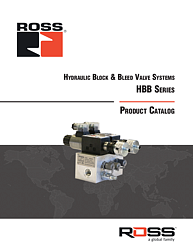
ROSS HBB Series Hydraulic Block & Bleed Valve Systems: Redundant Safety Solutions for Hazardous Energy Isolation
Understanding the HBB Series Hydraulic Block & Bleed Valve System
The ROSS HBB Series represents the engineered solution for safe hydraulic block and bleed applications across manufacturing, oil and gas, and process industries. These redundant 3/2 solenoid-operated valve systems deliver the performance level and safety integrity your operation demands while providing external monitoring capabilities through integrated inductive position switches. Whether your facility operates high-pressure hydraulic systems in automotive stamping, metal forming, or fluid power applications requiring Category 4 (ISO 13849-1) safety certification, the HBB Series delivers proven reliability in the most demanding environments.
Key Features and Safety Advantages
The HBB Series introduces a paradigm shift in hydraulic safety by combining redundancy, external monitoring, and tamper-resistant design in a single integrated system. These hydraulic block and bleed valves are engineered specifically for routine, repetitive production tasks requiring positive isolation of hydraulic energy without reliance on mechanical lock-out or complex external circuits.
Redundant Architecture for Maximum Safety
The HBB Series incorporates a fully redundant dual-valve architecture, with each independent valve performing synchronized block and bleed functions. This redundancy architecture eliminates single-point failure risk—if one valve element degrades, the second provides complete protection. Each valve independently operates under electrical solenoid actuation with dedicated 24 VDC solenoids operating in synchronous pairs, ensuring coordinated function for reliable energy isolation.
External Monitoring with Inductive Position Switches
Unlike traditional block and bleed systems relying on internal monitoring or manual verification, the HBB Series employs integrated inductive position switches on each main valve element. These switches provide dynamic, cyclical external monitoring through your existing electrical safety control system. Real-time status verification ensures both valve elements respond correctly to control signals, providing operational confidence and eliminating guesswork from maintenance procedures.
Tamper-Evident Relief Valve Technology
The inlet relief valve featured in HBB Series systems incorporates tamper-evident design requiring special tools for access. This prevents unauthorized pressure adjustments and maintains system integrity throughout the product lifecycle. The relief valve serves dual purposes: protecting the system from dangerous overpressure while simultaneously documenting that the system has received proper commissioning by qualified personnel.
Flexible Piping Architecture
The HBB Series provides redundant inlet, outlet, and tank ports on each valve size, delivering unprecedented installation flexibility. This multi-port design accommodates diverse piping layouts and application requirements, enabling integration into tight spaces or complex manifold configurations. Included port plugs for unused connections maintain system cleanliness and safety.
Technical Specifications and Performance Characteristics
The HBB Series offers three distinct size platforms—D03, D05, and D07—each engineered for specific flow and pressure requirements across manufacturing operations.
Size D03 - Compact Design for Space-Constrained Applications
The D03 size delivers 10 gpm maximum flow capacity with 5000 psi operating pressure, making it ideal for smaller hydraulic circuits and tightly integrated manifold systems. Direct solenoid actuation with spring return provides responsive pressure isolation without pilot pressure requirements. SAE-08 threaded port connections ensure compatibility with standard hydraulic fittings and minimize installation complexity.
Size D05 - Mid-Range Performance for Standard Applications
The D05 platform extends performance to 20 gpm flow capacity while maintaining the same 5000 psi maximum operating pressure as D03 variants. The D05 architecture accommodates larger diameter SAE-12 threaded ports, reducing pressure drop across the valve body and improving overall system efficiency. This size represents the most frequently specified configuration for manufacturing automation and production machinery.
Size D07 - Large Flow Capacity for High-Power Systems
The D07 size supports flows up to 50 gpm while operating across a wider pressure range from 116 psi to 5000 psi maximum. Unlike D03 and D05 direct solenoid designs, the D07 incorporates solenoid pilot operation for enhanced reliability at maximum flow rates. Code 62 and Code 61 flange port connections (P1/P2 and T respectively) accommodate large diameter hydraulic hoses and manifold integration for high-capacity systems.
Safety Certifications and Compliance Standards
The HBB Series hydraulic block and bleed valve systems achieve the highest safety classification levels demanded by modern manufacturing environments and regulatory frameworks.
ISO 13849-1:2015 Category 4, Performance Level e (PLe)
Category 4 classification under ISO 13849-1 indicates the HBB Series provides single-fault tolerance with no safety function loss when individual component failures occur. Performance Level e represents the highest achievement on the five-level scale (a through e), demonstrating that the valve system achieves a mean probability of dangerous failure less than 10-5 per hour of operation. This exceptional performance allows integration into safety-critical control circuits protecting personnel from hazardous energy release.
IEC 61508:2010 Safety Integrity Level 3 (SIL 3)
Safety Integrity Level 3 certification confirms the HBB Series can be deployed in functional safety applications requiring high reliability against dangerous random failures. SIL 3 rating indicates the system achieves a probability of dangerous failure on demand between 10-4 and 10-3, positioning it for use in safety-related control systems throughout manufacturing facilities.
DGUV Certified Safety-Tested Components
TÜV certification under DGUV testing protocols (HSM 220187) provides independent verification that the HBB Series meets comprehensive European machinery safety directives. DGUV certification demonstrates the system has undergone rigorous laboratory testing, analysis, and assessment by accredited third-party engineers—providing documentation that satisfies OSHA audits and insurance carrier requirements.
Electrical Specifications and Integration Requirements
The HBB Series integrates seamlessly into modern electrical safety control systems through standardized connectors and low-power requirements compatible with existing plant infrastructure.
24 VDC Solenoid Operation for Universal Industrial Compatibility
All HBB Series solenoids operate on 24 VDC power, the globally standardized control voltage in manufacturing facilities. Each solenoid draws 30 watts (D03, D07) or 36 watts (D05) for continuous duty operation, reducing electrical infrastructure demands compared to higher-voltage alternatives. Design according to VDE 0580 standards ensures electromagnetic compatibility and immunity from electrical noise in industrial environments.
PNP Inductive Position Switch Technology with M12 Connectors
The integrated position switch sensors employ PNP logic compatible with both standard 4-pin and extended 5-pin M12 A-coded female connectors (male connector on valve). Maximum current draw of 400 mA per switch ensures compatibility with standard industrial PLC input modules and safety relay modules. IP 65 DIN EN 60529 enclosure rating protects sensor electronics from moisture and contaminants common in manufacturing environments.
Synchronized Control Signal Requirements for Redundant Operation
Both solenoids must be operated synchronously—receiving identical control signals simultaneously—to maintain redundant safety function. Monitoring logic must verify that both valve position sensors respond identically to each control signal change. This synchronized operation requirement prevents asymmetric valve states that could compromise safety function integrity.
Hydraulic System Compatibility and Operating Conditions
The HBB Series accommodates a broad range of hydraulic fluids and operating environments, enabling integration into existing systems without fluid conversion.
Mineral Oil HLP and Vegetable Oil HETG Fluid Compatibility
The valve system seals utilize Buna-N elastomers compatible with both conventional mineral oil HLP fluids per DIN 51524 and eco-friendly vegetable oil HETG fluids per VDMA 24568. This fluid compatibility eliminates system conversion costs when deploying the HBB Series into facilities using either fluid type. Maximum fluid contamination tolerance of ISO 4406 class 20/18/15 (NAS 1638 class 9) accommodates modern hydraulic system cleanliness standards.
Temperature Operating Range for Diverse Environments
Ambient operating temperature range from -22°F to 158°F (-30°C to 70°C) enables deployment in both heated indoor manufacturing facilities and unheated outdoor fluid power systems. Media temperature tolerance of -4°F to 176°F (-20°C to 80°C) ensures reliable operation when hydraulic fluid temperatures fluctuate due to system cycling or seasonal variation. This broad temperature specification reduces the need for complex thermal management in diverse industrial applications.
Installation and Mounting Architecture
The HBB Series provides multiple mounting options optimized for seamless integration into diverse manifold and piping system designs.
SAE Threaded Port Integration for D03 and D05 Sizes
The D03 and D05 platforms feature in-line SAE threaded port connections enabling direct integration into existing hydraulic circuits without adapter fittings. Standard SAE-08 and SAE-12 threaded ports reduce installation complexity and minimize pressure drop compared to adapter-intensive configurations. Ports accommodate both straight and 90-degree fittings for flexible manifold routing.
Code 62 and Code 61 Flange Connections for D07 Size
The D07 platform utilizes industrial flange ports for high-flow applications: Code 62 flanges for P1 and P2 inlet/outlet ports and Code 61 flanges for tank connections. Flanges sold separately allow customers to standardize on their preferred flange specification without forcing adapter strategies. This flange architecture simplifies integration into large manifold blocks and minimizes internal manifold porting complexity.
Flexible Mounting Orientation and Installation Geometry
The HBB Series can be mounted in any orientation (horizontal preferred), eliminating constraints on installation location and manifold integration. Compact footprint and modular design enable integration into tight spaces, machine safeguards, or remote locations requiring distributed safety valve architecture. Mounting provision tolerances accommodate standard industrial mounting practices with minimal site adaptation.
Block and Bleed Safety Function - How the System Protects Workers
The block and bleed safety function represents the fundamental operational principle enabling safe maintenance access on energized hydraulic systems without requiring full plant shutdown or extended lockout procedures.
Understanding the Block and Bleed Operating Principle
When the HBB Series solenoids are de-energized (normal off condition), the spring-return mechanism simultaneously achieves two critical safety objectives: the block valve closes the inlet pressure supply, preventing any further hydraulic energy admission to the downstream circuit, while the bleed valve opens a direct path from the downstream circuit to the tank line. This dual action blocks new energy injection while simultaneously evacuating residual pressurized fluid through the bleed path to atmosphere (via the reservoir).
Pressure Intensification Considerations and System Design
The effective bleed function depends on careful consideration of downstream components that might inadvertently block the bleed path. Components such as pilot-operated checks, counterbalance valves, and closed-center control valves can be designed to block reverse flow under certain conditions. Depending on application requirements, these components may either support or compromise the bleed function. Successful block and bleed implementation requires qualified engineering analysis to ensure the bleed valve can effectively evacuate downstream pressure while respecting downstream safety-critical functions.
Minimum Operating Frequency and Maintenance Requirements
To ensure continued reliable operation, ROSS specifies a minimum monthly operation requirement—the safety function must be actuated at least once per month during normal production activities. This operational frequency verifies that both valve elements respond correctly to control signals and enables early detection of potential degradation. Maintenance operations require full lock-out/tag-out procedures to relieve all hazardous energy before personnel access the work area.
Application-Specific Benefits by Industry Sector
The HBB Series delivers exceptional value across diverse manufacturing and industrial environments, each with unique safety and operational requirements.
Automotive and Stamping Applications
Automotive stamping and forming operations expose workers to extreme force concentrations and moving machine elements. The HBB Series provides the rapid, reliable energy isolation necessary for safe maintenance of stamping dies, hydraulic presses, and forming equipment. Category 4, PLe certification satisfies OEM safety specifications and OSHA requirements for machinery sold into North American automotive supply chains.
Metal Fabrication and Sheet Metal Processing
Sheet metal fabricators employ hydraulic shears, brake presses, and forming equipment requiring precise pressure control and emergency isolation capability. The HBB Series external monitoring provides continuous verification that safety functions remain operational throughout the production shift, eliminating reliance on periodic manual testing. Redundant valve architecture ensures single-fault tolerance even during the highest-demand production cycles.
Packaging and Converting Operations
Modern packaging machinery integrates hydraulic components for sealing, forming, and material handling functions. The HBB Series compact D03 platform enables integration into distributed safety architectures where multiple independent block-and-bleed stations protect workers at different access points along the production line. The 10 gpm to 50 gpm range accommodates everything from small material handling cylinders to large container-forming hydraulic systems.
Oil and Gas Production and Pipeline Operations
Offshore and onshore oil and gas operations subject hydraulic systems to extreme pressure, temperature, and environmental conditions. The HBB Series 5000 psi rating and -30°C to +70°C ambient operating range enable deployment in remote production facilities requiring minimal maintenance intervention. Double block and bleed redundancy satisfies API 6D specifications for isolation valve architecture in critical well control and production applications.
Industrial and Mining Equipment
Mining machinery requires the most demanding functional safety performance due to hazardous environment exposure and remote operating conditions. The HBB Series Category 4 classification and SIL 3 certification provide the safety assurance necessary for powered roof supports, longwall equipment, and face machinery requiring positive energy isolation during personnel entry or maintenance procedures.
Pressure Relief Valve Configuration and System Overload Protection
The HBB Series integrates a factory-preset pressure relief valve in the inlet line, providing automatic system overpressure protection and preventing component damage from excessive load conditions.
Comprehensive Relief Valve Setting Options
ROSS provides relief valve factory presets spanning 1000 psi to 5500 psi maximum, accommodating virtually every industrial hydraulic system pressure specification. Relief settings from 1100 psi (for 1000 psi systems) to 5500 psi (for 5000 psi systems) maintain a 10% safety margin above maximum system operating pressure. Tamper-evident design prevents unauthorized adjustment after factory commissioning while enabling field adjustment by qualified service technicians when system pressure specifications change.
No-Valve Configuration Option for Integrated Systems
For applications where relief protection is provided by upstream pump load-sensing controls or integrated manifold relief valves, ROSS offers an XX (no relief) configuration. This option eliminates redundant overpressure protection and reduces component cost for systems with existing relief architecture.
Model Configuration and Ordering Information
The HBB Series model nomenclature provides clear visibility into all system parameters, enabling accurate specification and procurement for replacement and new projects.
Model Number Structure and Component Selection
The example model HBBDD11108SBAEXB decodes as follows:
- HBB: Series designation (Hydraulic Block and Bleed)
- DD: Double valve system
- 11: Revision level
- 108S: Size designation (D03, 0-10 gpm) with SAE threaded ports
- B: Buna-N seals
- A: External monitoring
- E: 24 VDC DC solenoid operation
- X: Relief valve (XX = no relief valve)
- B: Revision suffix
Size and Flow Rate Selection Criteria
- D03 (108S): 0-10 gpm, SAE-08 ports, direct solenoid, optimal for pilot circuits and small load holding applications
- D05 (212S): 0-20 gpm, SAE-12 ports, direct solenoid, ideal for medium-pressure industrial applications
- D07 (372F): 0-50 gpm, Code 62/61 flanges, pilot solenoid, designed for high-flow, high-power systems
Seal Material and Customization Options
Standard Buna-N seals accommodate mineral oil and vegetable oil hydraulic systems. ROSS custom FLEX program accommodates alternative seal materials for specialized fluids or extreme temperature applications. All models deliver full 24 VDC solenoid operation with integrated inductive position monitoring.
Accessories and Integration Components
The HBB Series integrates into complete electrical safety systems through standardized connectors and prewired harness options.
Electrical Connector Options and Cable Kits
ROSS provides multiple connector configurations supporting different installation preferences:
- DIN EN 175301-803 Form A Connectors: Standard in industrial facilities with existing DIN connectors
- M12 5-pin Female Connectors: Modern sensor interface supporting both standard and extended connector protocols
- Prewired Cable Kits: Available in 5-meter and 10-meter lengths with flying leads, eliminating field assembly and associated quality risks
Lighted and Standard Connector Variants
Optional lighted connector versions (with translucent housing and integrated indicator lights) provide visual confirmation that solenoids are energized, supporting operational troubleshooting and maintenance workflows. These connectors enable operators to visually verify safety system status without requiring multimeter testing or control system diagnostics.
Performance Curves and System Optimization
Understanding pressure drop characteristics enables engineers to optimize manifold design and selection of downstream components.
Pressure Drop Performance Across Size Ranges
Pressure drop curves provided for each size variant show the differential pressure across the valve body from inlet to outlet (P1 to P2) and across the bleed path (P2 to tank through the 3A bleed valve) across the full operating flow range.
D03 Performance:
- Pressure drop P1 to P2 ranges from approximately 25 psi at 2 gpm to 200+ psi at maximum 10 gpm flow
- Bleed path drop (P2 to tank) maintains 20-100 psi across the same flow range
D05 Performance:
- Pressure drop P1 to P2 increases from 20 psi at 5 gpm to approximately 140 psi at maximum 20 gpm
- Bleed function maintains effective depressurization across all operating conditions
D07 Performance:
- Large diameter porting reduces pressure drop to minimal levels even at 50 gpm maximum flow
- Bleed path design accommodates high-flow depressurization without pressure intensification
Utilizing Performance Data for System Efficiency
System designers should reference the provided pressure drop curves to verify that selected valve sizes accommodate the intended flow rates without exceeding acceptable pressure loss budgets. Excessive pressure drop reduces system efficiency, increases heat generation, and compromises overall safety function performance. Using appropriately sized valve elements ensures optimal power transmission while maintaining responsive isolation and bleed capability.
Design Verification and Safety Integrity Level Achievement
Implementing the HBB Series within safety-critical control systems requires systematic design verification following ISO 13849-1 methodology.
SISTEMA Software Support for Design Verification
ROSS provides complete SISTEMA libraries enabling digital design verification of control systems incorporating the HBB Series. These libraries contain all manufacturer reliability data (MTTFD, B10D values, diagnostic coverage percentages) necessary to calculate system Performance Level achievement. Integration guides provide detailed technical specifications supporting design engineers in control system architecture definition.
Performance Level Calculation Methodology
The SISTEMA software tool implements ISO 13849-1 calculation methodology across four primary dimensions:
- System Architecture Category: Ranging from Category 1 (basic fault tolerance) to Category 4 (single-fault tolerance with comprehensive monitoring)
- Mean Time to Dangerous Failure (MTTFD): Statistical reliability measure calculated from component reliability data and operational frequency
- Diagnostic Coverage (DC): Percentage of potential failures detected through built-in or external monitoring
- Common Cause Failure (CCF) Prevention: Evaluation of design practices preventing correlated failures in redundant channels
The HBB Series achieves exceptional reliability metrics enabling integration into safety-critical control systems requiring Performance Level d or e certification.
Standards Compliance and Regulatory Acceptance
The HBB Series maintains comprehensive compliance with international machinery safety directives, enabling global deployment.
European Machinery Directive 2006/42/EC Compliance
Achieving Category 4, Performance Level e classification ensures the HBB Series satisfies the machinery safety requirements of EU Directive 2006/42/EC. TÜV certification under DGUV protocols provides documentation of independent assessment meeting harmonized safety standards.
OSHA and North American Manufacturing Standards
The HBB Series integration guide references ANSI B11.19 machinery safety standards and OSHA lock-out/tag-out (LOTO) requirements. Systems designed according to the provided integration guidelines satisfy OSHA audit requirements for safe machine guarding and energy isolation.
International Standards Recognized Globally
ISO 13849-1 and IEC 61508 represent internationally recognized functional safety standards adopted across automotive, aerospace, pharmaceutical, and process industries worldwide. HBB Series certification against these standards enables equipment designed with these valves to be deployed globally without requiring redesign for regional compliance.
Maintenance and Service Considerations
Proper maintenance practices extend HBB Series operational life and preserve safety function reliability.
Preventive Maintenance Schedule and Operational Monitoring
The minimum monthly operating frequency requirement ensures opportunity to identify degradation through control system monitoring. Should either solenoid fail to energize or either position switch fail to indicate correct valve state, maintenance personnel receive immediate diagnostic indication enabling corrective action before the system reaches failure mode.
Seal Replacement and Component Service
Standard service intervals replace Buna-N seals and internal spool elements based on operational hours and accumulated cyclic loading. ROSS service networks throughout North America, Europe, and Asia-Pacific provide complete component availability and technical support for field maintenance procedures.
Troubleshooting Guide and Technical Support
The integration guide includes comprehensive troubleshooting procedures addressing common installation errors, electrical connection issues, and hydraulic system interactions. ROSS application engineering staff provide remote technical support for complex system design questions or field performance issues.
CAD Models and Technical Documentation Availability
Complete design documentation enables mechanical engineers and controls specialists to validate system integration.
Downloadable 3D CAD Models for All Size Variants
ROSS provides complete 3D CAD models in standard formats (STEP, IGES) for D03, D05, and D07 platforms. These models enable manifold designers to validate port locations, mounting interfaces, and spatial compatibility within integrated valve stacks. CAD models support rapid prototyping and manifold design optimization.
Dimensional Drawings and Port Configuration Documentation
Comprehensive dimensional documentation specifies exact port locations, mounting hole patterns, and overall envelope dimensions. Separate port lists identify all connection points (P1, P2, T, MP1, M-M, MP2) enabling manifold cavity design and cross-drilling strategy definition.
ROSS Quality Assurance and Global Support Network
The HBB Series represents the culmination of ROSS's 100+ year commitment to fluid power safety innovation.
Global Distribution Network and Availability
Over 100 ROSS distributors worldwide ensure HBB Series components, replacement parts, and technical support are available globally. Regional ROSS offices in the Americas, Europe, and Asia-Pacific provide local application engineering, spare parts inventory, and service support.
One-Year Standard Warranty and Extended Service
ROSS provides comprehensive one-year warranty on the HBB Series covering defects in material and workmanship. Extended service agreements provide multi-year component coverage, eliminating unexpected maintenance costs and ensuring continued operational reliability throughout the equipment lifecycle.
Industry Leadership in Fluid Power Safety Since 1921
ROSS pioneered modern pneumatic safety in 1921 with the introduction of the first patented four-ported pneumatic lever valve. This legacy continues with the 2018 launch of the HBB Series, representing over a century of safety innovation commitment. Reference installations in automotive, metals, oil and gas, and process industries document the HBB Series proven performance across the most demanding applications.