



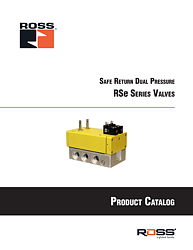
RSe Series Safe Return Dual Pressure Double Valves – Technical Catalog & Product Documentation
Overview of ROSS RSe Series Control-Reliable Double Valves
The ROSS RSe Series represents the next generation in pneumatic safety valve technology, engineered specifically for applications requiring control-reliable cylinder return and dual pressure functionality. This comprehensive catalog provides complete technical specifications, integration guidance, and application information for the RSe Series—safety valves that meet the most stringent international safety standards including ISO 13849-1 Category 4, Performance Level e (PL e), and comply with ANSI B11 requirements for machinery safety.
As a global leader in fluid power safety since 1921, ROSS Controls has pioneered safety innovations that protect workers and enhance machine productivity. The RSe Series continues this tradition by providing redundant, externally monitored valve systems that ensure fail-safe operation in critical pneumatic cylinder control applications across manufacturing, automation, packaging, assembly, and metal forming industries.
What Makes RSe Series Valves Unique for Safety-Critical Applications
The RSe Series double valves feature redundant spool-type construction with two operating solenoids that must be actuated simultaneously to shift the valve. Each valve element incorporates a PNP proximity sensor for external monitoring, providing diagnostic coverage up to 99% when properly integrated with safety control systems. This architecture allows the valves to achieve the highest safety category (Category 4, PL e) while offering three distinct application modes: safe exhaust, safe cylinder return, and safe return dual pressure.
Catalog Contents – Complete Technical Resource for RSe Series Valves
This catalog serves as the definitive technical reference for specifying, selecting, integrating, and maintaining RSe Series Safe Return Dual Pressure Double Valves. Whether you're a safety engineer conducting risk assessments, a machine designer implementing ISO 13849-1 compliant control systems, or a maintenance professional troubleshooting pneumatic circuits, this document provides the critical information needed to successfully deploy RSe Series technology.
Technical Specifications Included in This Catalog
The catalog provides exhaustive technical data for all RSe Series valve configurations, including:
Physical Dimensions and Construction: Detailed dimensional drawings with length, width, height, and weight specifications for each port size. The catalog covers three base sizes—1/8", 1/4", and 1/2"—with precise measurements essential for machine layout and mounting considerations. Valve body construction features cast aluminum housings with stainless steel spools and Buna-N seals, providing durability in industrial environments with ambient and media temperature ranges from 40°F to 120°F (4°C to 50°C).
Flow Performance Data: Comprehensive flow coefficient (Cv) values for all port configurations enable accurate sizing calculations. For 3/2 function valves, flow data covers ports 1-2 and 2-3. For 5/2 function valves, the catalog details flow characteristics for ports 1-2, 1-4, 2-3, and 4-5, with Cv values ranging from 0.59 to 3.85 depending on valve size and port configuration. Flow ratings are also expressed in normal liters per minute (Nl/min) for international applications, spanning from 581 Nl/min to 3,788 Nl/min across the product line.
Electrical Specifications: Complete electrical data includes 24 VDC voltage rating, EN 175301-803 Form C solenoid connection type, power consumption specifications, and M8 feedback connector details for the PNP proximity sensors. Sensor specifications include current ratings less than 23mA, enabling integration with modern safety PLCs and monitoring systems without overloading input circuits.
Pressure and Media Requirements: Operating pressure specifications detail maximum operating pressure of 145 psi (10 bar) with requirements for compressed, filtered air per ISO 8573-1 Class 7:4:4. The catalog explains internal/external pilot supply options and provides guidance on pressure requirements for reliable valve operation across the full temperature range.
Thread Types and Mounting Options: Port thread specifications include both G (BSPP) and NPT options, with inlet, outlet, and exhaust port sizing matching the base size designation. Base-mounted configurations feature captive valve-to-base mounting screws with flexible piping arrangements—inlet and outlet ports available on both sides with plugs provided for unused ports.
Integration and Application Guidance
Beyond raw specifications, the catalog delivers practical application engineering content:
Integration Guides: Step-by-step integration instructions for three primary applications: Safe Return 5/2 RSe Series Valves, Safe Return Dual Pressure 5/2 RSe Series Valves, and Safe Pressure Select 5/2 RSe Series Valves. Each guide addresses wiring diagrams, circuit design principles, safety function verification, and external monitoring system requirements. Integration guidance follows ISO 13849-1 methodology for achieving specified safety categories through proper system architecture.
SISTEMA Library Data: The catalog references downloadable SISTEMA (Safety Integrity Software Tool for Evaluation of Machine Applications) library files available from the ROSS website. SISTEMA is the software tool developed by IFA (Institute for Occupational Safety and Health of the German Social Accident Insurance) for evaluating the safety of control systems per ISO 13849-1. The availability of pre-configured SISTEMA files significantly reduces engineering time when performing safety calculations and performance level verification.
Safety Function Descriptions: Detailed explanations of how each valve configuration performs its intended safety function. For 3/2 Safe Exhaust applications, the catalog describes how the valve supplies air to zones or complete machine systems until signaled to shut off and exhaust residual downstream pneumatic energy, reducing hazards during employee access and minor servicing. For 5/2 Safe Return applications, technical details explain how the valve controls directional airflow for double-acting cylinders during normal operation and returns cylinders to their home "safe" position whenever a fault occurs within the valve.
Dual Pressure Application Theory: Comprehensive coverage of dual pressure functionality explains how RSe Series 5/2 valves can extend cylinders with supply pressure at port 3 and retract with supply pressure at port 5. This capability enables machines to operate with different pressure levels for extend versus retract operations—a critical feature for applications requiring high force during workpiece processing but lower pressure for safe return cycles. The catalog details how this configuration reduces overall air consumption while maintaining Category 4 PL e safety integrity.
Understanding Safe Return Dual Pressure Technology
Safe Return Dual Pressure functionality represents an innovative approach to pneumatic cylinder control that balances operational requirements with safety imperatives. Traditional pneumatic circuits typically operate at a single supply pressure for both extend and retract cylinder movements. While simple, this approach often results in excess air consumption, increased wear on system components, and potential safety concerns during retract cycles.
The Dual Pressure Advantage in Automated Manufacturing
The RSe Series Safe Return Dual Pressure configuration addresses these limitations by allowing two independent supply pressures—one for the extend stroke and another for the retract stroke. This capability proves particularly valuable in applications such as:
Assembly and Press Operations: During component assembly, high extend force may be required to properly seat parts or perform press-fit operations. However, the return stroke requires only enough force to overcome cylinder friction and return tooling weight. By supplying higher pressure (port 3) during the extend cycle and lower pressure (port 5) during retract, manufacturers achieve necessary assembly forces while reducing air consumption and cylinder wear during return movements.
Material Handling and Transfer Systems: Automated material handling frequently involves grasping or clamping operations where firm grip force is essential during transfer but excessive return pressure provides no benefit and wastes compressed air. Dual pressure control optimizes system efficiency while maintaining safe, controlled motion in both directions.
Heat Sealing and Packaging Equipment: High-speed packaging lines often incorporate heat sealing cylinders that must apply significant pressure during the sealing dwell period but should return quickly with minimal force to maximize production rates. The dual pressure approach provides process control flexibility previously requiring complex pressure regulation schemes.
Safety Function: Fail-to-Safe Return Operation
The critical safety aspect of RSe Series dual pressure operation lies in the fail-to-safe design philosophy. In the event of any valve fault detected by the external monitoring system, the valve automatically supplies pressure from port 5 to port 4 while exhausting port 2 through port 1 and blocking pressure at port 3. This failsafe action positively drives the cylinder to its retracted (safe) position regardless of external forces or pressure conditions.
This behavior contrasts with simple exhaust valves that merely remove supply pressure and rely on spring return cylinders or external forces to achieve the safe state. The RSe Series actively drives the cylinder home, providing predictable, repeatable safety function even when cylinder seals exhibit minor leakage, when back pressure exists in exhaust lines, or when tooling weight opposes return motion.
External Monitoring Architecture for Category 4 PL e Compliance
Achieving Category 4, Performance Level e requires more than simply installing redundant valve elements. The monitoring architecture—how faults are detected and responded to—determines whether a safety system can claim Cat 4 PL e performance. The RSe Series employs external monitoring, meaning the diagnostic functions reside in an external safety controller rather than being integrated within the valve body.
PNP Proximity Sensor Technology
Each valve element within an RSe Series double valve incorporates a dedicated PNP (positive switching) proximity sensor that detects spool position. These sensors provide real-time feedback on valve element state, enabling the external monitoring system to verify synchronous operation of both redundant valves during every actuation and de-actuation cycle.
The proximity sensors offer several advantages over mechanical limit switches or pneumatic sensing methods:
Non-Contact Operation: Proximity sensors operate without physical contact with moving valve components, eliminating wear and providing unlimited service life. This non-contact principle prevents the monitoring system from becoming a maintenance liability or failure mode.
Fast Response Time: Electronic proximity sensors respond in milliseconds, allowing the monitoring system to detect asynchronous operation virtually instantaneously. Fast fault detection minimizes the time window during which the safety function could be compromised following a valve element failure.
Clean Digital Signal: PNP proximity sensors provide clean, switch-like digital signals ideal for connection to safety PLC discrete inputs or safety relay input terminals. The M8 connector configuration ensures reliable electrical connection resistant to vibration, contamination, and environmental factors common in industrial settings.
Diagnostic Coverage and Fault Detection
When both proximity sensors are monitored during each valve actuation and de-actuation cycle, the RSe Series achieves diagnostic coverage up to 99%. This high diagnostic coverage (DC) percentage reflects the system's ability to detect dangerous failures before they compromise the safety function.
The external monitoring system—typically a safety PLC, configurable safety controller, or dedicated safety relay module—implements the monitoring logic. Proper monitoring verifies that:
- Both valve elements shift together when commanded to actuate (synchronous actuation)
- Both valve elements return together when solenoids are de-energized (synchronous de-actuation)
- Valve state changes occur within expected time windows (dynamic monitoring)
- No unexpected state changes occur when valves should be stable (stability monitoring)
Any discrepancy in sensor states during these checks indicates a valve fault—such as a stuck spool, broken spring, contamination, or mechanical failure—and triggers the safety function to inhibit further machine operation until the fault is cleared and the system is properly reset.
Technical Standards Compliance and Certifications
The RSe Series valves are engineered and tested to meet global safety standards for machinery and control systems. This comprehensive compliance profile ensures RSe Series valves integrate seamlessly into safety systems designed per international, European, and North American standards.
ISO 13849-1: Safety of Machinery – Control Systems
ISO 13849-1 provides requirements for the design and integration of safety-related parts of control systems (SRP/CS), including logic, input, and output devices. The standard defines five performance levels (PL a through PL e) representing the ability of control systems to perform safety functions under foreseeable conditions.
The RSe Series achieves Category 4, Performance Level e—the highest level defined by ISO 13849-1—when properly integrated with appropriate external monitoring controls. This achievement reflects the valve's redundant architecture, high diagnostic coverage, proven component technology, and fault tolerance characteristics.
Key RSe Series design features enabling Cat 4 PL e compliance include:
- Redundant Structure: Dual valve elements provide single-fault tolerance—if one element fails, the other continues to perform the safety function
- High Diagnostic Coverage: 99% DC ensures dangerous failures are detected before safety function loss
- Well-Tried Components: Spool valve technology with decades of proven service history
- Common Cause Failure Mitigation: Physical separation and diverse failure modes between valve elements minimize common cause failures
- Automatic Reset: Safety function resets by de-energizing solenoids, preventing inadvertent restart after fault conditions
ANSI B11 Machine Safety Standards
In North America, the ANSI B11 series of machine safety standards provide requirements for various machine types and safety system elements. ANSI B11.19 addresses safeguarding and risk reduction measures, while ANSI B11.0 provides general safety requirements for the design and construction of machines.
The RSe Series meets ANSI B11 requirements for control reliability in pneumatic systems. Specifically:
- Control Reliable Operation: Redundant, monitored valve design prevents single-point failures from defeating safety functions
- Positive Opening Action: Spring-return design ensures valves shift to safe state upon loss of electrical or pneumatic power
- Stop Performance: Valve exhaust capability and shifting speed enable achievement of required stop performance calculations per ANSI B11.19
- Single-Point Lockout Compatibility: RSe Series valves can be integrated with ROSS L-O-X lockout valves for ANSI/ASSE Z244.1 compliant energy isolation
Global Certifications and Approvals
The catalog details specific certifications and third-party approvals obtained for RSe Series valves:
DGUV Certification: Testing and certification by DGUV (Deutsche Gesetzliche Unfallversicherung—German Social Accident Insurance) validates compliance with European machinery safety requirements. DGUV certification specifically addresses the valve's ability to perform safety functions in accordance with DIN EN ISO 13849-1.
CE Marking: RSe Series valves carry CE marking indicating conformity with applicable European Union directives, including the Machinery Directive 2006/42/EC and potentially EMC Directive 2014/30/EU for electromagnetic compatibility.
cULus Certification: Testing and listing by UL (Underwriters Laboratories) and CSA (Canadian Standards Association) provide third-party validation for North American markets. This certification confirms the valves meet applicable electrical and mechanical safety standards for industrial control equipment.
EAC Declaration: Eurasian Conformity marking enables legal sales in member nations of the Eurasian Customs Union, including Russia, Belarus, Kazakhstan, Armenia, and Kyrgyzstan.
Safety Integrity Level (SIL) Rating: The catalog references SIL 3 classification per IEC 61508/62061 functional safety standards, enabling RSe Series integration into process industry safety instrumented systems requiring this certification framework.
RSe Series Product Configurations and Model Selection
The RSe Series encompasses multiple valve configurations designed to address different application requirements. Understanding the available options enables engineers to select the optimal valve configuration for specific machinery safety functions.
3/2 Function RSe Series Valves – Safe Exhaust Applications
Three-port, two-position (3/2) RSe Series valves provide safe exhaust functionality for zone isolation or complete machine shutdown applications. The safety function includes:
- Supply Blocking: Redundant closure prevents compressed air from reaching downstream equipment when safety function is activated
- Downstream Exhaust: Open exhaust paths allow residual pneumatic energy to dissipate rapidly from downstream circuits
- Lockout Capability: De-energized state prevents inadvertent restart until deliberate reset by authorized personnel
The 3/2 configuration proves ideal for applications where cylinders incorporate mechanical spring return or where external forces (gravity, tooling weight) drive actuators to safe positions once supply pressure is removed. Typical applications include:
- Press guarding systems where pneumatic clutch/brake or auxiliary functions must be disabled during operator access
- Robotic cell safety circuits requiring zone isolation when light curtains or gate interlocks are activated
- Machine tool coolant or air blast systems that must be disabled during tool changes or maintenance
- Assembly station guarding where multiple pneumatic pick-and-place or fastening operations require simultaneous isolation
Important Application Note: The 3/2 RSe Series valve cannot exhaust pneumatic energy trapped downstream of obstructions such as check valves or closed-center directional valves. Application engineers must consider complete circuit design to ensure effective energy dissipation when safety function activates.
5/2 Function RSe Series Valves – Safe Return and Dual Pressure Applications
Five-port, two-position (5/2) RSe Series valves control directional airflow for double-acting cylinders while providing Category 4 PL e safety integrity. The 5/2 function enables three distinct application modes:
Standard Safe Return Application: In this configuration, a single supply pressure connects to port 3. During normal operation, solenoid energization shifts the valve to supply port 3 → port 2 while exhausting port 4 through port 5, extending the cylinder. When safety function activates or solenoids de-energize, spring return shifts the valve to supply port 3 → port 4 while exhausting port 2 through port 1, positively retracting the cylinder to its safe home position.
Safe Return Dual Pressure Application: This advanced configuration supplies higher pressure to port 3 and lower pressure to port 5. During normal extend cycles, the valve supplies high pressure (port 3 → port 2) while exhausting the rod end through low pressure port 5. For retract, the valve supplies low pressure (port 5 → port 4) while exhausting through port 1. If a fault occurs during extend, the valve immediately shifts to supply low pressure for retraction, achieving safe return while optimizing air consumption during normal production. This configuration reduces overall system air consumption by up to 30-40% compared to single-pressure designs in applications with favorable extend/retract duty cycles.
Safe Pressure Select Application: This configuration enables selection between two different operating pressures during normal machine operation while maintaining safety function integrity. Applications include processes requiring gentle material handling at low pressure alternating with high-force operations at elevated pressure—all controlled through a single Category 4 PL e valve system.
Port Size Selection Guide
RSe Series valves are available in three port sizes to accommodate different flow requirements:
1/8" Port Size (RSe6Exx10xxx): Suitable for small cylinders (typically up to 2" bore) or applications where flow restriction through intentionally sized valve ports provides beneficial speed control. The 1/8" configuration offers compact dimensions (length approximately 3.97 inches) and light weight (approximately 2.9 lbs), making it ideal for OEM equipment with space constraints.
1/4" Port Size (RSe6Exx20xxx or RSe3Exx20xxx): The most commonly specified port size, suitable for medium cylinders (2" to 4" bore) in general industrial automation applications. Flow capacity (Cv 0.8 to 1.09) provides good response speed while maintaining compact valve dimensions (length approximately 4.41 inches, weight approximately 3.7 lbs).
1/2" Port Size (RSe6Exx40xxx or RSe3Exx40xxx): High-flow configuration for large cylinders (4" to 6" bore), high-speed cycling applications, or long piping runs requiring maximized flow area. The 1/2" configuration delivers flow coefficients up to Cv 3.85 (3,788 Nl/min) enabling rapid cylinder actuation in production equipment demanding minimal cycle times.
Application Engineering Considerations
Successful implementation of RSe Series valves requires thoughtful application engineering addressing circuit design, mounting, piping, and electrical integration. This section of the catalog provides practical guidance engineers need for first-time-right installations.
Circuit Design for Safe Return Dual Pressure Applications
Implementing dual pressure functionality requires additional circuit components beyond the RSe Series valve itself:
Dual Pressure Supply System: Two independent pressure sources must be provided—typically a high-pressure main plant air line and a locally regulated reduced pressure line. Pressure regulation should incorporate good filtration (5-micron recommended), adequate regulation capacity (regulator Cv sized for 150% of maximum valve flow), and gauge ports for pressure verification. Consider installing check valves in supply lines to prevent interaction between high and low pressure sources.
Cylinder Sizing Verification: Engineers must verify that the cylinder bore size and low-pressure supply setting provide adequate retract force under all loading conditions including friction, side loads, tooling weight, and back pressure. The calculation should consider maximum expected back pressure in the exhaust side during retract and include appropriate safety factors (minimum 20% recommended).
Stroke Time Analysis: Different extend and retract pressures result in different stroke speeds. Application engineers should calculate expected stroke times for both directions to ensure cycle time requirements are satisfied and that speed differentials don't create process issues. For applications requiring consistent speed in both directions despite pressure differences, consider adding meter-out flow controls.
Fail-Safe Motion Verification: Even though the RSe valve actively drives retract during safety function activation, engineers should verify that the cylinder mechanically can reach its safe position. Check for potential interference, binding, or situations where workpieces could obstruct return motion. Consider adding presence detection to verify successful return to safe position.
Mounting and Installation Guidelines
Base Mounting Requirements: RSe Series valves feature base-mounted configuration with captive mounting screws preventing loss during valve removal for maintenance. The mounting base should be flat, rigid, and properly supported to prevent distortion that could cause valve binding. Torque mounting screws to specifications in the installation instructions (typically 15-25 in-lbs for 1/8" and 1/4" sizes, 40-60 in-lbs for 1/2" size).
Porting Flexibility: Inlet and outlet ports are provided on both sides of the valve base, enabling flexible piping arrangements. Use the port positions that minimize tube routing complexity and stress on connections. Install the provided pipe plugs in all unused ports, applying appropriate thread sealant or PTFE tape. Ensure plugs are fully seated to prevent leakage.
Environmental Considerations: While RSe Series valves feature robust construction suitable for industrial environments, protect valves from direct exposure to coolant spray, cutting chips, welding splatter, and corrosive chemicals. Consider mounting valves in electrical enclosures or local junction boxes if ambient conditions are particularly harsh. Ensure adequate ventilation around valves to prevent heat buildup from solenoid coils operating in high ambient temperatures.
Orientation: RSe Series valves can be mounted in any orientation without performance degradation. However, avoid orientations where the exhaust ports face upward in applications where coolant or wash-down solutions could accumulate and drain into valve internals.
Piping Best Practices
Tubing Size and Routing: Select air line tubing with inside diameter matching or slightly larger than valve port size to avoid unnecessary flow restrictions. For 1/8" valves use minimum 1/8" ID tubing, for 1/4" valves use 1/4" ID, and for 1/2" valves use 1/2" ID tubing. Minimize line length and avoid unnecessary elbows or restrictions between valve and cylinder.
Supply Pressure Filtering: Install appropriate filtration upstream of RSe Series valves. Compressed air should meet ISO 8573-1 Class 7:4:4 minimum quality (maximum particle size 40 microns, pressure dew point 39°F, maximum oil content 5 mg/m³). Consider installing a local 5-micron coalescing filter within 3 feet of the valve for critical applications.
Exhaust Piping: While small exhaust pulses can discharge directly to atmosphere through the valve exhaust ports, consider piping exhaust away from the valve in applications with frequent cycling or large cylinder volumes. This prevents accumulation of oil mist and contaminants around the valve and improves workplace air quality. Ensure exhaust piping is sized adequately (equal to or larger than valve exhaust port) to avoid back pressure that could slow valve exhaust times.
Manifold Integration: For applications with multiple RSe Series valves, consider custom manifold solutions that consolidate supply connections and streamline installation. ROSS offers custom manifold design through its ROSS/FLEX® application engineering program, providing integrated solutions with common supply blocks, integrated flow controls, and consolidated electrical connections.
Electrical Integration and Wiring
Solenoid Connections: RSe Series valves utilize EN 175301-803 Form C (DIN 43650 Form C) electrical connectors on the solenoids. This standardized connector style ensures compatibility with readily available cordsets and junction boxes. Each valve requires two electrical inputs—one for each solenoid—that must be energized simultaneously to shift the valve. Wire both solenoids to the same output terminal on the external monitoring system to ensure synchronous actuation.
Proximity Sensor Connections: The PNP proximity sensors utilize M8 4-pin connectors. Standard M8 sensor cables are widely available from automation suppliers. Wire the sensors to appropriate input terminals on your external monitoring system (safety PLC, configurable safety controller, or safety relay). Consult the catalog integration guide for specific wiring diagrams showing proper sensor connection for your monitoring system brand.
Electrical Protection: While RSe Series solenoids and sensors feature robust construction, install appropriate overcurrent protection (typically 2 amp breakers or fuses) and consider surge suppression on inductive loads. Ensure 24 VDC power supply is adequate capacity for simultaneous energization of both solenoids plus sensors and has appropriate safety rating if part of the safety circuit.
Cable Routing: Route sensor cables separately from power wiring to minimize electrical noise. Use shielded cable if running sensor signals more than 50 feet or through electrically noisy environments with VFDs, welding equipment, or high-current switching. Ground cable shields at one end only (typically at the controller end) to avoid ground loops.
Maintenance, Troubleshooting, and Service Life
Long-term performance of RSe Series valves depends on proper maintenance practices and prompt attention to any fault indications from the monitoring system. The catalog includes maintenance recommendations and troubleshooting guidance.
Preventive Maintenance Schedule
Operational Testing: Perform functional testing of RSe Series valves per ANSI/ASSE Z244.1 requirements before each shift or production run when practical. The test verifies that valve elements shift properly and monitoring system detects simulated faults. Testing should include:
- De-energize both solenoids and verify cylinder returns to safe position
- Block supply pressure and verify system inhibits machine start
- If test points are provided, simulate individual valve element failures and verify monitoring system responds appropriately
Quarterly Inspection: Every 90 days, conduct detailed inspection including:
- Visual examination of valve body for cracks, corrosion, or damage
- Check electrical connections for tightness and signs of overheating
- Verify exhaust ports aren't obstructed with debris
- Listen for unusual sounds during valve actuation indicating wear or contamination
- Check response time remains within acceptable limits
- Verify supply pressure meets specifications and air quality standards are maintained
Annual Service: Once yearly, consider removing valves for detailed inspection and possible rebuild. For applications with clean, dry air and moderate cycling (less than 100,000 cycles annually), valves often provide 5-10 years of service before requiring maintenance. High-cycling applications (greater than 1 million cycles annually) or harsh environments may require more frequent service intervals.
Service Kits and Spare Parts
ROSS provides comprehensive service kits for RSe Series valves containing all renewable components including seals, o-rings, springs, and wear parts. The catalog provides service kit part numbers cross-referenced to specific valve models. Stock critical service kits as insurance spares for essential production equipment to minimize downtime if valve maintenance is required.
For facilities with multiple RSe Series installations, consider stocking complete valve assemblies as exchange spares. This enables fastest possible restoration of production by swapping the complete valve while sending the removed unit to the maintenance shop or returning to ROSS for factory rebuild.
Expected Service Life
Under normal operating conditions with properly filtered and regulated air supply, RSe Series valves provide exceptional longevity:
Mechanical Life: The spool and sleeve construction with stainless steel spools and aluminum bodies provides mechanical durability for millions of cycles. Typical mechanical life expectancy exceeds 5 million cycles in applications with clean air and operating pressures below 100 psi. Life may be reduced in applications with frequent shock pressure spikes, contaminated air, or operation near maximum pressure ratings.
Seal Life: Buna-N seals provide excellent service life in typical industrial compressed air applications with media temperatures maintained within the specified 40°F to 120°F range. Seal life is primarily affected by air quality—dirty air or oil-contaminated air significantly reduces seal life. Applications with exceptionally clean, dry air may achieve 10+ million cycles between seal replacement.
Solenoid Life: The electrical solenoids are rated for millions of operations. Solenoid failure typically results from electrical overvoltage, mechanical damage to coil insulation, or overheating due to continuous energization at excessive ambient temperatures. Maintain proper voltage (24 VDC ±10%) and ambient temperature below 120°F (50°C) for maximum solenoid life.
Proximity Sensor Life: Being solid-state electronic devices with no moving parts, the proximity sensors essentially never wear out under normal operating conditions. Sensor failures typically result from electrical overvoltage, reverse polarity connection, or physical damage to the sensor body or cable.
Comparing RSe Series with Alternative ROSS Safety Valve Technologies
ROSS Controls offers several safety valve product families, each optimized for specific application requirements. Understanding the distinctions helps engineers select the most appropriate valve technology for their machinery.
RSe Series vs. 77 Series CrossMirror Valves
The 77 Series represents ROSS's internally monitored, automatically resetting CrossMirror double valve technology. Key differences:
Monitoring Location: 77 Series incorporates monitoring logic within the valve body itself, eliminating the need for external monitoring equipment. RSe Series requires external monitoring via safety PLC or relay, providing flexibility to integrate with various control architectures.
Reset Method: Both series feature automatic reset—simply de-energizing solenoids resets the valve. This contrasts with manual reset valves that require deliberate mechanical or electrical reset action.
Safety Category Achievement: Both series achieve Category 4, PL e when properly applied. The 77 Series's internal monitoring provides self-contained solution ideal for retrofit applications or small machines with limited control systems. The RSe Series's external monitoring integrates naturally into modern safety PLCs and multi-function safety systems.
Application Flexibility: RSe Series offers all three functions—safe exhaust (3/2), safe return (5/2), and safe return dual pressure (5/2)—in a single product family. The 77 Series focuses primarily on safe return applications with standard single-pressure operation.
Cost Considerations: The 77 Series's integrated monitoring may reduce total installed cost when external monitoring infrastructure doesn't exist. The RSe Series leverages existing safety control infrastructure, potentially reducing cost in machines already incorporating safety PLCs.
RSe Series vs. CM26 Series CrossMirror Valves
The CM26 Series provides internally monitored, manually resetting CrossMirror valve technology. The manual reset requirement provides additional safety assurance in applications where automatic restart after fault clearance raises concerns. Key considerations:
Reset Philosophy: CM26 requires deliberate manual or electrical reset action after any fault condition. This prevents automatic restart when supply pressure is restored or electrical power returns after an interruption. RSe Series automatically resets when solenoids are de-energized, suitable for applications where automatic restart presents no additional hazard.
Application Suitability: CM26 manual reset suits applications where operator presence verification is required before restart (certain press applications, high-hazard operations). RSe Series automatic reset suits applications where rapid restart after fault clearance improves productivity without compromising safety (packaging lines, assembly systems).
RSe Series vs. DM2 Series Press Control Valves
The DM2 Series represents ROSS's premium internally monitored double valves specifically designed for mechanical press clutch/brake control. While both achieve Category 4 PL e, key differences include:
Application Specialization: DM2 Series is specifically engineered for the demanding requirements of mechanical power press clutch/brake control per OSHA 1910.217 and ANSI B11.1. The DM2 features poppet technology optimized for the extreme cycling rates, response time requirements, and reliability demands of press control. RSe Series targets general pneumatic cylinder control and zone isolation applications across diverse industries.
Monitoring Technology: DM2 incorporates Dynamic Monitoring and Memory (DM2™) technology with sophisticated internal monitoring that detects valve element asynchrony within microseconds and locks out further operation until deliberately reset. RSe Series provides external monitoring with customer-supplied monitoring equipment.
Cost and Complexity: DM2 Series represents the premium solution for press applications with pricing reflecting specialized capabilities. RSe Series provides cost-effective Category 4 PL e performance for general pneumatic safety applications.
Industries and Applications Benefiting from RSe Series Technology
The catalog showcases diverse industries successfully implementing RSe Series valves to enhance worker safety while maintaining production efficiency.
Packaging and Converting Equipment
High-speed packaging lines incorporate numerous pneumatic cylinders for carton forming, product loading, sealing, and transfer operations. Safety interlocks guard access points where operators load product, clear jams, or perform changeovers. RSe Series valves provide zone isolation capability, exhausting pneumatic energy from specific machine sections when guarding is defeated while allowing other areas to continue production.
The dual pressure capability particularly benefits packaging applications where gentle product handling during loading requires low pressure (20-40 psi) but firm carton sealing or case compression requires high pressure (80-100 psi). A single RSe valve eliminates the need for separate high and low pressure cylinders or complex pressure regulation schemes.
Automotive Assembly and Body-in-White Operations
Modern automotive assembly plants feature extensive automation with hundreds or thousands of pneumatic clamps, lifts, and positioning devices. Safety zones are defined around robot cells, welding stations, and manual assembly areas. When light curtains or safety gates are actuated, affected zones must rapidly exhaust pneumatic pressure while maintaining productivity in unaffected areas.
RSe Series valves provide the control reliability required by automotive industry safety standards while delivering fast exhaust times critical for minimizing delay when operators clear faults and restart production. The external monitoring architecture integrates seamlessly with Allen-Bradley GuardLogix, Siemens Safety Integrated, or other automotive-grade safety PLCs.
Metal Forming and Fabrication
Press brakes, stamping presses, and forming equipment involve significant hazards requiring robust safeguarding. While clutch/brake control in mechanical presses specifically requires DM2 Series valves, numerous auxiliary pneumatic functions benefit from RSe Series technology including:
- Die clamping and unclamping cylinders
- Part transfer and ejection mechanisms
- Back gauge positioning systems
- Scrap handling and material movement
- Tonnage monitoring and overload protection actuators
The dual pressure capability enables manufacturers to optimize air consumption in these auxiliary functions—using high pressure when precise positioning or firm clamping is required and low pressure for simple return movements.
General Manufacturing and Automation
Virtually any manufacturing operation incorporating pneumatic actuators and machine safeguarding benefits from RSe Series technology. Specific applications include:
Food and Beverage Processing: Filling equipment, capping machinery, sorting systems, and material handling all require safeguarding with control-reliable pneumatic isolation. RSe Series valves meet food industry requirements for stainless steel wetted materials (with appropriate port fittings) and can be specified with food-grade seal materials when necessary.
Pharmaceutical and Medical Device Manufacturing: Clean room environments demand compact, low-exhaust-pulse valves that won't disturb airflow patterns. The 1/8" and 1/4" RSe Series configurations provide ideal footprint and exhaust characteristics while meeting stringent regulatory requirements for validated equipment qualification.
Material Handling and Warehousing: Conveyor systems, palletizers, sortation equipment, and automated storage/retrieval systems increasingly incorporate pneumatic actuators requiring Category 4 PL e control. RSe Series valves integrate effectively with modern warehouse control systems and safety PLCs.
Plastic Injection Molding: Mold clamping, core pull mechanisms, ejection systems, and robot end-of-arm tooling all require control-reliable pneumatic safety valves. The RSe Series withstands the challenging thermal environment around molding presses while providing reliable service through millions of cycles.
Ordering Information and Technical Support
How to Order RSe Series Valves
The catalog provides complete model numbering explanation enabling precise specification of required valve configuration. RSe Series model numbers follow the format:
RSe [Function] [Actuation] [Port Thread] [Port Size] [Additional Options]
For example: RSe6ENB40A31P decodes as:
- RSe: Series designation (RSe Series Double Valve)
- 6: Function code (6 = Dual 5/2 Single Solenoid for safe return dual pressure)
- E: Actuation type (E = Electrical solenoid operated)
- N: Thread type (N = NPT threads; G = BSPP threads)
- B: Port material/configuration code
- 40: Port size (40 = 1/2" ports)
- A31: Electrical specification (A31 = 24 VDC with EN 175301-803 connectors)
- P: Proximity sensors (P = PNP proximity sensors for external monitoring)
The catalog includes complete model number tables showing all available combinations of port size, thread type, and electrical configurations. Engineers should consult the tables to identify exact model numbers meeting application requirements.
Lead Times and Availability
Standard RSe Series configurations typically ship within 4-6 weeks from ROSS Controls manufacturing facilities. The catalog notes estimated ship dates for typical order quantities of 10 or less pieces. For larger quantity requirements or custom ROSS/FLEX® configurations, consult ROSS Controls application engineers for project-specific lead time quotations.
ROSS maintains distributor inventory of popular configurations in key markets, potentially reducing lead time for urgent requirements. Contact your local ROSS distributor or regional ROSS office to check stock availability for specific models.
Technical Support Resources
ROSS Controls provides comprehensive technical support throughout the product lifecycle:
Application Engineering: ROSS application engineers assist with valve selection, circuit design, safety category verification calculations, and integration guidance. Contact ROSS Controls at 1-800-GET-ROSS (438-7677) to discuss application-specific requirements.
SISTEMA Software Support: ROSS provides pre-configured SISTEMA library files for RSe Series valves, available for download from www.rosscontrols.com. These files significantly streamline ISO 13849-1 performance level calculations when incorporating RSe Series valves into safety control systems. ROSS technical support can assist with SISTEMA software usage and interpretation of calculation results.
Integration Guides: Comprehensive integration guides for safe return, safe return dual pressure, and safe pressure select applications are available as separate documents referenced in the catalog. These guides provide wiring diagrams, pneumatic circuit schematics, PLC programming examples, and commissioning procedures.
Training and Education: ROSS Controls offers "Fluid Power Safety for Machine Guarding" courses and "TOTAL MACHINE SAFETY" training programs covering risk assessment, safety standards application, and proper implementation of pneumatic safety systems. Contact ROSS for training schedule and registration information.
After-Sales Support: ROSS provides ongoing technical support, troubleshooting assistance, and service guidance throughout product life. Service kits, replacement parts, and factory rebuild services ensure long-term supportability of RSe Series installations.
Why Download This Catalog?
This comprehensive catalog serves as an essential resource for:
- Safety Engineers performing risk assessments and specifying control-reliable pneumatic safety systems per ISO 13849-1 and ANSI B11 standards
- Machine Designers developing new equipment requiring Category 4 PL e pneumatic safety valves with dual pressure capability
- Automation Engineers integrating externally monitored safety valves with modern safety PLCs and configurable controllers
- Maintenance Professionals troubleshooting existing RSe Series installations and planning preventive maintenance programs
- OEM Equipment Manufacturers standardizing on proven safety valve technology backed by a global leader in fluid power safety
- End Users upgrading legacy machinery to meet current safety standards while improving productivity through optimized air consumption
The catalog consolidates technical specifications, application guidance, integration instructions, and compliance information in a single authoritative reference—saving engineering time and ensuring successful implementation of RSe Series technology.
About ROSS Controls – Global Leader in Fluid Power Safety
Since 1921, ROSS Controls has pioneered innovations in pneumatic valve technology and machine safety systems. From Charlie Ross's first hand-operated poppet valve through the introduction of the first double valve for press safety in 1953, through today's sophisticated externally monitored safety valves, ROSS has consistently advanced the state of the art in protecting workers while enhancing productivity.
With global headquarters in Ferndale, Michigan, and facilities in Germany, Japan, United Kingdom, France, Brazil, India, China, and Canada, ROSS serves customers worldwide through a comprehensive network of stocking distributors. ISO 9001 certified manufacturing facilities ensure consistent quality, and comprehensive safety certifications (CE, cULus, DGUV, EAC) enable global equipment deployment.
ROSS's commitment to fluid power safety extends beyond products to education and advocacy. The company publishes white papers on critical safety topics, provides risk assessment and safety system design training, and actively participates in standards development organizations shaping the future of machinery safety.
When worker safety and production reliability matter most, industry leaders specify ROSS Controls.
Download the Complete RSe Series Catalog
Access comprehensive technical specifications, integration guides, application examples, and ordering information for ROSS RSe Series Safe Return Dual Pressure Double Valves. This essential resource provides everything needed to successfully specify, integrate, and maintain Category 4 PL e pneumatic safety systems meeting ISO 13849-1 and ANSI B11 requirements.
For technical questions or application assistance, contact ROSS Controls at 1-800-GET-ROSS (438-7677) or visit www.rosscontrols.com.