




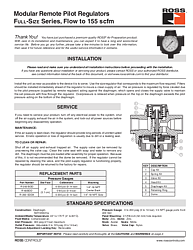
Remote Pilot Regulators Full-Size Series Installation & Operating Instructions
Overview
ROSS Controls, founded in 1921 with over 100 years of leadership in fluid power, offers the Modular Remote Pilot Regulators Full-Size Series as a premium compressed air pressure regulation solution for industrial pneumatic systems. These diaphragm-type, self-relieving regulators deliver flows up to 155 scfm and allow pressure to be set remotely from the main regulator body — a key advantage in installations where the regulator is mounted close to the point of use but the operator adjustment point must be located elsewhere for safety or convenience.
The air pressure is regulated by force created by the pilot pressure — supplied by a separate remote control regulator — acting against the diaphragm, which opens and closes the supply valve to maintain set downstream pressure. Overpressure is automatically relieved when pressure on the top of the diaphragm exceeds the pilot pressure acting on the bottom. Gauge ports on both front and rear of the regulator body accept standard 2-inch (5.1 cm) dial gauges.
Install the unit as near as possible to the device it serves and use the regulator size corresponding to the maximum flow required. Filters must be installed immediately upstream of the regulator to ensure a clean, dry supply of air. For product support, contact ROSS at 1-800-GET-ROSS or visit www.rosscontrols.com.
Key Features
Remote Pilot Pressure Setting
The Full-Size Series design allows a separate pilot regulator to be installed at a remote, convenient location — some distance from the main regulator — for easy pressure adjustment. The pilot pressure signal travels to the main regulator and acts on the underside of the diaphragm, setting and holding outlet pressure without requiring direct access to the main unit. This configuration significantly improves ergonomics and safety in complex pneumatic systems.
Self-Relieving Diaphragm Design
Constructed with a self-relieving diaphragm, excess downstream pressure is automatically exhausted through the regulator body whenever outlet pressure exceeds the pilot setpoint. This eliminates the need for a separate relief valve in many applications. The diaphragm must be pre-loaded after assembly for correct operation; for this reason, dome removal is not recommended in the field. If the regulator cannot be repaired by cleaning the valve and the pilot supply regulator is functioning correctly, the unit should be returned to ROSS for service.
Modular Port Sizes and Accessories
Available in port sizes of 1/4, 3/8, 1/2, and 3/4 inch NPT, the Full-Size Series integrates into ROSS modular air preparation assemblies using standard mounting brackets. Gauge port wall brackets (R-KA37-68) and extended wall brackets (R-KA37-68L) are available as accessories. The removable pressure adjustment locking key prevents unauthorized changes to the outlet pressure setting. Panel mounting requires a 2-1/16 inch (52 mm) cutout.
Technical Specifications
- Construction: Diaphragm, self-relieving
- Maximum Flow: 155 scfm
- Ambient/Media Temperature: 40° to 175°F (4° to 80°C)
- Fluid Media: Compressed air
- Inlet Pressure: 300 psig (21 bar) maximum
- Outlet Pressure: Adjustable 0 to 125 psig (0 to 14 bar)
- Pilot Ports: 1/4 NPTF
- Pressure Gauge: 0 to 200 psig (0 to 14 bar); 1/4 NPT gauge ports front and rear
- Panel Mounting: 2-1/16 inch (52 mm) hole required
- Body: Zinc; Dome: Zinc
- Knob: Acetal; Seals: Nitrile; Valve: Brass; Valve Cap: Nylon
- Pressure Adjustment Locking Key: Removable
- Port Sizes: 1/4, 3/8, 1/2, 3/4 inch NPT
- Part Numbers (Head Kit by port): R-KA37-01-1/4, R-KA37-01-3/8, R-KA37-01-1/2, R-KA37-01-3/4
Applications
Remote Operator Stations
When machinery or process equipment is installed in locations where direct access to the air preparation panel is restricted or inconvenient, the remote pilot regulator enables operators to adjust downstream pressure from an ergonomically positioned control station. This is common in large automated assembly systems, paint booths, and enclosed processing environments where the main air supply manifold is located behind guarding or in a machinery enclosure.
Precision Pressure Zones in Multi-Circuit Systems
In multi-circuit pneumatic systems requiring different pressure zones for different actuators or tools, remote pilot regulators allow each zone's pressure to be adjusted from a central operator interface. This simplifies pressure management during production changeovers and minimizes setup time. The Full-Size Series flow capacity of 155 scfm is well-suited to high-demand zones in larger automated production lines.
Safety and Compliance Standards
Pneumatic equipment should be installed and serviced only by trained and experienced personnel. Before any disassembly or service, shut off the air supply, exhaust all system air pressure, and lock out all power sources in accordance with OSHA 29 CFR 1910.147 and applicable lockout/tagout standards. The self-relieving feature provides overpressure protection, but the system designer must verify that all downstream components are rated for the maximum inlet pressure of 300 psig (21 bar).
Compatible lubricants must be petroleum base oils with oxidation inhibitors, aniline point between 180°F (82°C) and 220°F (104°C), and ISO 32 or lighter viscosity. Avoid oils with phosphate additives such as zinc dithiophosphate and diester oils, which can damage nitrile seals and valve components. Use oils specifically compounded for air line service.
Installation and Setup Guide
Before installation, verify that the upstream filter is in good condition and that air lines are blown clean of all contaminants. Select the regulator port size that matches the system line size. For new installations, use pipe thread sealant (not tape) applied after engaging pipe one turn; tighten securely to prevent sealant from contaminating the valve.
Step-by-Step Installation Procedure
- Step 1: Depressurize and lock out all air pressure upstream of the installation point.
- Step 2: Install a 5-micron-rated upstream filter immediately ahead of the regulator.
- Step 3: Mount the main regulator as close as possible to the device it serves, following flow direction arrow.
- Step 4: Connect the pilot supply line (1/4 NPTF) from the remote control regulator to the pilot port on the main regulator.
- Step 5: Install pressure gauges (0-200 psig) or plugs in the front and rear gauge ports.
- Step 6: Install the regulator in the modular bracket if required using wall bracket (R-KA37-68) or extended bracket (R-KA37-68L).
- Step 7: Re-pressurize the system and set the pilot supply regulator to the desired downstream pressure.
- Step 8: Verify outlet pressure using the installed gauge and confirm self-relieving action by momentarily exceeding setpoint.
- Step 9: Install the pressure adjustment locking key if tamper-resistant operation is required.
Maintenance and Cleaning
If the air supply is kept clean and dry, the regulator will provide extended periods of uninterrupted service. Erratic operation or loss of regulation is usually caused by dirt or a leaking seal. To clean or repair: shut off the air supply, exhaust trapped air, then remove the supply valve by unscrewing the valve cap. Clean the valve seat with soap and water to remove dirt. Replace worn seals and valve components using appropriate ROSS service kits. Do not remove the dome in the field.
Why Choose ROSS Controls
ROSS Controls, founded in 1921 with over 100 years of leadership in fluid power, is the trusted global authority in pneumatic safety and air preparation technology. For over a century, engineers and OEMs worldwide have specified ROSS products for their industry-proven reliability, broad product range, and responsive technical support. ROSS regulators are manufactured to consistent quality standards, backed by ROSS's global service network available at 1-800-GET-ROSS and www.rosscontrols.com.
Download This Document
The official PDF installation and operating instructions for the Remote Pilot Regulators Full-Size Series are available for download at: https://ross-admin-global-us-east.s3.amazonaws.com/production/uploads/document_language_file/file/196/ROSS_Regulator_Modular_Remote_Pilot_Full-Size_Series_SS-R013.pdf
Related Products and Resources
- Remote Pilot Piston Regulators MD4 Series (SS-R016)
- Remote Pilot Regulators High-Relief Full-Size Series (SS-R014)
- Regulators Bantam Series (SS-R001)
- ROSS Modular Air Preparation Filter/Regulator/Lubricator (FRL) Systems
- Integrated Filter/Regulators MD4 Series (SS-IFR006)
- ROSS Lubricators Full-Size and High-Capacity Series
- Visit www.rosscontrols.com for full product catalog and distributor locator
Frequently Asked Questions
Q: What is the maximum inlet pressure for the Full-Size Remote Pilot Regulator?
A: The maximum inlet pressure is 300 psig (21 bar). Exceeding this value can damage the regulator and create a safety hazard.
Q: What is the outlet pressure adjustment range?
A: Outlet pressure is adjustable from 0 to 125 psig (0 to 14 bar) via the remote pilot supply regulator.
Q: What is the maximum flow capacity?
A: The Full-Size Series delivers flows up to 155 scfm under rated conditions.
Q: Can I remove the dome for in-field repair?
A: ROSS does not recommend dome removal in the field. The diaphragm requires pre-loading after assembly for correct operation, and improper reassembly can cause performance issues. Return the regulator to the factory for dome-related repairs.
Q: What pilot pressure is required?
A: The pilot ports are 1/4 NPTF. Pilot pressure is supplied by a separate remote control regulator. Any M/P regulator can be used as the pilot, installed some distance from the main regulator for convenient remote adjustment.
Q: What filter rating is recommended upstream of the regulator?
A: ROSS recommends a 5-micron-rated filter installed immediately ahead of the regulator to ensure a clean supply of air and extend regulator service life.
Q: What materials are used in the regulator construction?
A: Body and Dome are zinc; Knob is acetal; Seals are nitrile; the Valve is brass and the Valve Cap is nylon.
Q: How do I lock the pressure adjustment to prevent tampering?
A: Install the removable pressure adjustment locking key on the adjusting knob after setting the desired outlet pressure. This prevents unauthorized pressure changes.
Q: What causes erratic operation or loss of regulation?
A: Erratic operation is most commonly caused by dirt in the valve seat or a leaking seal. Clean the valve seat with soap and water; replace seals using ROSS service kits if cleaning does not resolve the issue.
Q: How do I contact ROSS Controls for technical support?
A: Call 1-800-GET-ROSS, visit www.rosscontrols.com to find your nearest distributor, or contact ROSS Technical Services at 1-888-TEK-ROSS (835-7677).