




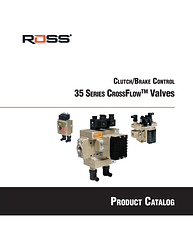
35 Series CrossFlow™ Pneumatic Clutch/Brake Safety Valves – Complete Technical Catalog
Overview: Safety-First Pneumatic Control for High-Risk Applications
The 35 Series CrossFlow™ valve catalog provides comprehensive technical documentation for one of ROSS Controls' most dependable pneumatic safety solutions. These dual poppet, solenoid-controlled valves are purpose-engineered to protect workers and equipment in demanding manufacturing environments where precision, reliability, and safety compliance are non-negotiable. With Category 4 Performance Level (PLe) certification per ISO 13849-1:2015 and SIL 3 rating per IEC 61508:2010, the 35 Series represents ROSS Controls' commitment to exceeding global safety standards in pneumatic valve technology.
Product Overview and Core Features
The 35 Series CrossFlow™ double valve system is specifically designed to provide precise control of clutch and brake mechanisms on stamping presses and other critical safety applications including alternative lockout systems for energy isolation, air cylinder press load-holding systems, and Category 3 and 4 safety circuits. This comprehensive product catalog contains complete technical specifications, dimensional drawings, electrical schematics, ordering configurations, and installation guidance for all five basic valve sizes.
Key Valve Features
External Monitoring Capability – The 35 Series incorporates dynamic, cyclical external monitoring with customer-supplied equipment. This monitoring verifies the state of both valve pressure sensors with any changes in valve control signals, providing continuous assurance that the safety system operates correctly on every machine cycle.
Dirt-Tolerant Poppet Design – The dual poppet design features wear-compensating characteristics that enable quick response and high flow capacity even in contaminated environments. This engineering approach means the valve maintains consistent performance throughout its operational lifecycle while reducing maintenance requirements.
PTFE Backup Piston Rings – Enhanced valve endurance and longevity are achieved through PTFE backup piston rings, which enable reliable operation with or without in-line lubrication. This design flexibility reduces system complexity and provides greater operational flexibility across diverse industrial environments.
Integrated Pressure Switches – When equipped with pressure switches (which OSHA compliance requires for press machinery control), the valves provide feedback signals to external monitoring devices. This allows main press controls to verify proper operation of each valve element on every cycle, creating the redundant verification essential for Category 4 safety certification.
High-Flow, Clog-Resistant Silencers – Basic Size 4, 8, 12, and 30 valves include integrated silencers that provide high flow capacity while resisting particulate clogging. These silencers enable safe, quiet exhaust while maintaining the system reliability required in safety-critical applications.
Flexible Mounting Options – Basic Sizes 1 and 2 feature base-mounted designs with captive valve-to-base mounting screws for simple valve replacement. Basic Sizes 4, 8, 12, and 30 provide inline mounting with flanged ports for compact system integration. These options ensure the 35 Series accommodates diverse system architecture requirements.
Technical Specifications for Safety and Performance
General Specifications
The 35 Series represents a 3/2 normally-closed solenoid pilot-controlled valve using dual poppet construction. Electrical actuation through independent solenoids allows simultaneous control of two valve elements, enabling the external monitoring and redundancy essential for safety-critical applications. All valves operate vertically with pilot solenoids mounted on top, ensuring optimal pilot pressure delivery and preventing debris accumulation.
Operating Conditions and Environmental Parameters
The 35 Series valves operate reliably across diverse manufacturing environments with the following specifications:
Temperature Operating Range: Ambient conditions of 15°F to 122°F (-10°C to 50°C) and media temperature range of 40°F to 175°F (4°C to 80°C) accommodate seasonal variations and diverse geographic operations. The filtered compressed air media requirement ensures system reliability while simplifying maintenance protocols.
Pressure Specifications by Valve Size: Basic Sizes 1 and 2 operate at 40 to 100 psig (2.8 to 7 Bar), Basic Size 4 at 40 to 150 psig (2.8 to 10 Bar), and Basic Sizes 8, 12, and 30 at 30 to 125 psig (2 to 8.5 Bar). These pressure ranges accommodate the diverse power requirements of clutch/brake systems across manufacturing equipment scales.
Electrical Specifications and Power Consumption
The 35 Series offers multiple electrical configurations to integrate with existing plant control systems:
DC Power: 24-volt DC operation with nominal power consumption ranging from 6 to 16 watts per solenoid depending on valve size. This energy-efficient design reduces operational costs while supporting the 24 VDC standard in industrial control environments.
AC Power Options: 110-120 volt 50/60 Hz and 230-volt 50/60 Hz configurations provide global operational flexibility. Maximum inrush current ranges from 8.5 VA to 35 VA, with holding power from 8.5 VA to 22 VA depending on valve size and power configuration. All solenoid duty ratings are continuous, enabling uninterrupted operation in high-cycle manufacturing processes.
Electrical Connections: DIN EN 175301-803 connectors ensure compatibility with standard industrial electrical interfaces. Form B connectors accommodate Basic Size 1, while Form A connectors serve Basic Sizes 2, 4, 8, 12, and 30. Mechanical pressure switches support NO/NC contact ratings of 0.1 A at 125/250 volts AC or 0.1 A at 30 volts DC with optional 0.3 A at 60 volts DC capability.
Solid State Sensor Ratings: When equipped with M12 solid state pressure sensors, supply voltage ranges from 8-30 volts DC with current consumption below 4mA, providing low-power monitoring suitable for modern PLC-based control systems.
Safety Certification and Functional Safety Data
The 35 Series achieves ISO 13849-1:2015 Category 4, Performance Level (PLe) certification, representing the highest safety classification for pneumatic valve systems in machinery applications. This certification requires redundant valve elements with mutual monitoring—exactly what the dual poppet design provides.
IEC 61508:2010 SIL 3 Certification indicates compliance with the international functional safety standard for electrical/electronic systems. This dual certification pathway (ISO 13849-1 for machinery safety plus IEC 61508 for electrical system safety) provides multiple regulatory compliance frameworks for global manufacturing operations.
TÜV Safety Testing (MHHW 00172) validates the 35 Series design and manufacturing quality through independent third-party evaluation, providing stakeholders with documented evidence of safety system reliability.
Functional Safety Parameters:
- Category: CAT 4 (Highest machinery safety classification)
- B10D: 20,000,000 cycles (mean time to dangerous failure)
- PFHD: 7.71×10⁻⁹ (probability of hazardous failure per hour)
- MTTFD: 301.9 years (mean time to failure—demanding, with 662,400 annual operations)
Vibration and Impact Resistance: Tested to DIN EN 60068-2-6, confirming reliable operation in high-vibration manufacturing environments common in stamping, forming, and assembly operations.
Valve Construction and Material Selection
Valve Body: Cast aluminum construction provides optimal balance between strength, weight, and cost-effectiveness while resisting corrosion from ambient plant environments.
Poppet Elements: Acetal and stainless steel dual poppets deliver durability, precise sealing, and extended service life. The combination material approach optimizes wear resistance while maintaining the tight sealing tolerance essential for safety-critical pneumatic control.
Seal Materials: Buna-N seals provide excellent compatibility with compressed air systems while maintaining flexibility across the full operating temperature range. Buna-N's proven durability in pneumatic applications reduces maintenance requirements and extends valve service intervals.
Flow Performance and Response Characteristics
Flow Capacity by Valve Size
Flow capacity varies significantly by valve size and port configuration, enabling system designers to match valve flow to specific application requirements:
Basic Size 1: Port sizes of 1/4" and 3/8" NPT thread deliver flow capacities of 0.9 to 1.7 Nl/min (890-1700 Nl/min), supporting small-capacity pneumatic circuits and auxiliary control functions.
Basic Size 2: 1/2" to 3/4" port sizes with left or right inlet orientation options provide flow ranges of 3.7 to 9.3 Nl/min (3,600-9,300 Nl/min), accommodating standard industrial pneumatic system flow requirements.
Basic Size 4: Port sizes of 3/8" to 3/4" flanged connections deliver 3.0 to 11 Nl/min (3,000-11,000 Nl/min) flow capacity for medium to large industrial applications.
Basic Sizes 8, 12, and 30: Large-capacity valves ranging from 3.5 to 43 Nl/min (3,400-42,000 Nl/min) support high-flow stamping presses and other power-intensive manufacturing equipment. Internal and external pilot supply options provide design flexibility for diverse system architectures.
Valve Response Time Characteristics
Response time is critical in safety applications. The 35 Series provides published average response constants (M and F values) enabling engineers to calculate precise valve response times for their specific pneumatic circuit volumes:
- M Value: Average time for parts movement (typically 15-25 milliseconds depending on valve size)
- F Value: Milliseconds per cubic inch of circuit volume
This engineering data allows safety system designers to verify that the valve response time meets machinery control system requirements and enables comprehensive safety analysis per ISO 13849-1 methodology.
Valve Operation and Safety Monitoring
Conditions at System Startup
At startup, inlet port 1 remains closed to outlet port 2 through both valve poppets (elements A and B). Outlet port 2 is open to exhaust port 3. Pressure signals at both pressure switches SWA and SWB are exhausted. Normally-closed switch contacts (contacts 1 and 2) of both pressure switches are connected, preventing unintended actuation.
Normal Operational Cycle
When press controls simultaneously energize both solenoids, pilot pressure actuates both valve poppets, causing inlet port 1 to connect to outlet port 2 through internal crossflow passages. This connection allows pressurized air to flow to the clutch/brake mechanism. Simultaneously, exhaust port 3 closes, preventing unwanted pressure venting. Sensing pressure at each switch equals inlet pressure. Both switches trip, shifting their contacts from positions 1-2 to positions 1-4.
Cycle Completion and Reset
When the press control de-energizes both solenoids simultaneously, pilot pressure exhausts from both valve elements, allowing the poppets to return to their normal closed position. Inlet port 1 again closes to outlet port 2. Outlet port 2 reopens to exhaust. Pressure switches return to their normally-closed state.
Critical Malfunction Detection
The 35 Series' redundant dual poppet design creates an elegant safety mechanism for detecting valve malfunctions. If a single poppet fails (e.g., one valve element sticks open while the other closes), pressurized air can flow from the inlet, through the crossflow passages, and toward the outlet. However, the spool portion of the closed element substantially blocks this flow. The large open exhaust passage past the closed element maintains outlet pressure below 2% of inlet pressure—a condition detected immediately by the pressure switches.
This pressure differential triggers distinct switch conditions: one switch receives full inlet pressure (and trips), while the other receives reduced pressure (and remains untripped). An external monitoring device programmed to verify that both switches respond identically to every solenoid command detects this mismatch immediately. The monitoring system can then de-energize the valve solenoids and halt the machine, preventing continuation of the machine cycle and potential operator injury.
Valve Sizing and Configuration Options
Basic Size 1: Compact Base-Mounted Valve
Basic Size 1 is specifically designed for applications requiring compact valve packages with simple replacement procedures. The base-mounted design with captive mounting screws enables field technicians to replace the valve without removing piping. Port sizes of 1/4" and 3/8" NPT accommodate small to medium flow requirements. Optional two-pressure-switch configuration provides external monitoring capability.
Available with 24 VDC, 110-120 VAC, or 230 VAC solenoid actuation and NPT or G thread port options, Basic Size 1 integrates readily into diverse manufacturing control systems worldwide.
Basic Size 2: Flexible Inlet Orientation Design
Basic Size 2 expands on the Basic Size 1 concept with left-hand and right-hand inlet orientation options, providing greater system design flexibility. This valve size accommodates port sizes from 1/2" to 1" NPT, enabling substantial flow capacity while maintaining the base-mounted simplicity of Basic Size 1. The multiple inlet orientation options eliminate the need for external crossover piping in many applications.
Basic Size 4: Inline Flanged Port Configuration
Basic Size 4 transitions to inline flanged mounting for medium to large industrial applications. Flanged port connections provide space-efficient system integration compared to threaded connections. Port sizes from 3/8" to 3/4" support diverse flow requirements. The integrated high-flow, clog-resistant silencer is standard on all Basic Size 4 valves. Left-hand or right-hand inlet orientation options provide design flexibility.
Basic Sizes 8, 12, and 30: High-Flow Industrial-Scale Valves
These three valve sizes serve the largest stamping presses and industrial hydraulic power units. Basic Size 8 features 1/2" to 3/4" inline flanged ports. Basic Size 12 accommodates 3/4" to 1-1/4" ports. Basic Size 30 supports the largest systems with 1-1/4" to 1-1/2" flanged connections.
Advanced features include internal and external pilot supply options. Internal pilot supply uses system inlet pressure for pilot actuation. External pilot supply enables operation with pilot pressure equal to or greater than inlet pressure, providing design flexibility for diverse hydraulic and pneumatic systems. This advanced feature allows engineers to optimize system performance and energy consumption across demanding manufacturing applications.
Accessories and System Integration
Pressure Switches for External Monitoring
The 35 Series catalog includes several pressure switch options for implementing the external monitoring required by OSHA regulations (1910.217) for press machinery:
Mechanical Pressure Switches (Model 1104A30) use industry-standard DIN EN 175301-803 Form A connectors with M10×1 or M12 port threads. Factory preset to 22 psi (1.5 bar) falling pressure, these switches provide proven reliability in industrial environments.
Solid State Pressure Sensors (Model 1335B30W) offer M12 connectors with 8-30 VDC supply voltage and <4mA current consumption, integrating readily with modern PLC-based control systems. Factory preset to 17 psi (1.2 bar) falling pressure, these sensors enable digital monitoring and data logging capabilities.
Verification Type Switches (Model 586A86) install downstream of the main valve for additional system verification. Electrical design with DIN EN 175301-803 Form A connectors and 1/8" NPT ports provide simple integration. Factory preset to 5 psi (0.3 bar) falling pressure.
Redundant Pressure Switch Assemblies (Model RC026-13) incorporate dual electrical switching for enhanced monitoring redundancy. Model RC026-13 features DIN EN 175301-803 Form A connectors, 3/8" NPT ports, and 5 psi (0.3 bar) falling pressure setting.
Solenoid Electrical Connectors
The 35 Series supports multiple solenoid connector options for diverse installation requirements:
Prewired Connector Kits (Models 721K77, 371K77) feature flying leads with 2-meter cable for direct integration with plant control systems. Available in 24 VDC, 120 VAC, and 230 VAC configurations with optional LED indicator illumination.
Cable Grip Connectors (Model 937K87 and variants) provide tool-free field installation with 1/2" NPT conduit fitting options, supporting applications requiring flexible wiring configurations.
Miniature Valves and Compact Valve Series reset valve options enable remote reset functionality when combined with appropriately sized 3/2 normally-closed reset valves.
Exhaust Silencers
High-capacity exhaust silencers prevent noise and air contamination while maintaining flow capacity:
- 1/4" Silencers: 2.3 Nl/min flow capacity
- 3/8" Silencers: 2.9 Nl/min flow capacity
- 1/2" Silencers: 6.8 Nl/min (standard) to 15 Nl/min (optional) capacity
- 3/4" Silencers: 7.2 Nl/min (standard) to 15 Nl/min (optional) capacity
- 1" Silencers: 18 Nl/min (standard) capacity
Aluminum construction rated to 290 psig (20 bar) maximum enables reliable operation across the full 35 Series pressure range.
Installation, Maintenance, and Safety Considerations
Pre-Installation Safety Requirements
Before installation or servicing of any 35 Series valve or pneumatic system component, all energy sources must be turned off, the entire pneumatic system must be shut down and exhausted, and all power sources must be locked out per OSHA 1910.147 and EN 1037 standards. Failure to follow lockout/tagout procedures creates serious hazard risks.
Filtration and Lubrication Best Practices
Compressed air system cleanliness significantly impacts valve performance and service life. ROSS Controls recommends installing a filter with a 5-micron rating upstream of the 35 Series valve to remove dirt, scale, moisture, and other contaminants common in industrial air systems.
Lubricant selection is equally critical. Only use lubricants compatible with 35 Series valve materials. Standard lubricants should meet the following criteria:
- Petroleum base oils with oxidation inhibitors
- Aniline point between 180°F (82°C) and 220°F (104°C)
- ISO 32 viscosity or lighter for optimal valve performance
- Avoid phosphate-type additives that can damage polyurethane components and create hazardous failure conditions
Intake and Exhaust Flow Restrictions
Do not restrict intake air supply lines, as this reduces supply pressure below the minimum required for valve operation, causing erratic action and unsafe response. Similarly, do not restrict valve exhaust ports. Exhaust silencers must provide flow capacity at least equal to the valve's exhaust capacity. Contamination or clogging of silencers reduces flow and increases back pressure, potentially affecting valve safety function.
System Reset Caution
Critical Safety Warning: If the system must be reset, electrical signals to both solenoids must be removed simultaneously to prevent the machine from immediately recycling and creating a potentially hazardous condition for personnel.
Regular Maintenance and Testing
Verify proper valve function at a minimum once per month by executing a complete system cycle. This ongoing verification ensures early detection of valve degradation or malfunction before failure occurs during critical press operations.
Valve Selection and Ordering
The 35 Series model configurator enables customization across multiple dimensions to match specific application requirements. Key configuration parameters include:
Pressure Switch Options
Select valves without pressure switches only for non-safety applications. OSHA regulations (1910.217) and machinery safety standards explicitly require pressure switches on all valves controlling press clutch/brake mechanisms. When pressure switches are selected, they must be used in conjunction with an external monitoring device capable of detecting valve malfunctions and inhibiting machine operation upon failure detection.
Port Thread Standards
Choose NPT (National Pipe Thread) for standard US industrial applications or G (ISO metric pipe thread) for international operations. NPT and G threads are not interchangeable—confirm your system's existing port thread before ordering.
Port Size Selection
Available port sizes range from 1/4" on Basic Size 1 to 1-1/2" on Basic Size 30. Select port sizes based on your system's required flow capacity, considering both normal operating requirements and peak demand conditions. Undersized ports restrict flow and reduce system responsiveness. Oversized ports provide unnecessary capacity at increased cost.
Electrical Actuation Configuration
Select 24 VDC for low-voltage DC systems, 110-120 VAC for standard North American industrial power, or 230 VAC for international installations. All configurations support continuous duty operation.
Pressure Switch Type Selection
Choose between mechanical pressure switches for proven industrial reliability or solid-state sensors for digital integration with modern PLC-based monitoring systems. Both types provide equivalent safety performance when properly installed and maintained.
Warranty and Technical Support
The 35 Series valve carries a comprehensive one-year warranty from the date of purchase, covering defects in material and workmanship. Warranty replacement or repair is ROSS Controls' sole obligation and remedy.
Warranties become void if the product is subjected to misuse, misapplication, improper maintenance, modification, or tampering. Products for which warranty coverage is sought must be returned to ROSS Controls with prepaid freight.
ROSS Controls provides extensive technical support through regional facilities worldwide. The 35 Series SISTEMA library is available for download, providing safety calculation tools for professional design engineers. Experienced application engineers are available to answer technical questions and support complex system designs.
Document Specifications
Format: PDF (Portable Document Format)
Language: English
Latest Revision: January 29, 2025
Total Pages: 20 pages of comprehensive technical documentation
File Size: 3.5 MB
This catalog consolidates critical technical information required for successful 35 Series valve selection, installation, configuration, and maintenance. Engineering teams, safety professionals, procurement specialists, and plant operations personnel will find the complete information necessary to implement reliable, OSHA-compliant pneumatic safety systems in manufacturing environments.