




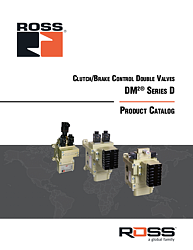
DM2D Series D Double Valves for Press Clutch/Brake Control - Complete Technical Catalog
Download the comprehensive technical catalog for ROSS Controls DM2D Series D self-monitored double valves—the industry-leading pneumatic safety solution for mechanical power press clutch and brake control systems. This complete catalog provides detailed specifications, dimensions, certifications, installation guidelines, and selection criteria for implementing control reliable double valves that comply with OSHA 1910.217 and ANSI B11.1 safety standards.
What Are DM2D Series Double Valves?
DM2D Series D double valves represent over 50 years of ROSS Controls' innovation in pneumatic safety valve technology for the mechanical press industry. These control reliable double valves are patented 3/2 normally closed valves with an intermediate lockout position, distinguished by SERPAR® (Series-Parallel) crossflow passages with poppet and spool valving on the main valve stems.
The DM2D Series provides three critical safety functions in a single, integrated package:
- Redundancy - Dual valve elements ensure fail-safe operation if one component fails
- Dynamic Monitoring - Continuous verification of proper valve operation within 100-125ms response time
- Complete Memory - Faulted valves remain locked out regardless of power cycling or air supply changes
These base-mounted, dual-ported safety devices are specifically engineered for controlling pneumatically operated clutch and brake assemblies on mechanical stamping presses, power presses, and similar industrial machinery where operator safety is paramount.
Why DM2D Double Valves Are Required for Press Safety
Federal and international safety regulations mandate the use of control reliable double valves on mechanical power presses to protect operators and maintenance personnel from hazardous machine cycles. Understanding these requirements is essential for regulatory compliance and workplace safety.
OSHA 1910.217 Compliance Requirements
OSHA Standard 1910.217(b)(7)(xi) explicitly states: "The control of air-clutch machines shall be designed to prevent a significant increase in the normal stopping time due to a failure within the operating valve mechanism, and to inhibit further operation if such failure does occur."
This federal regulation establishes two mandatory objectives:
- Fail-safe braking - Valve failures must immediately initiate the braking process without increasing stopping time
- Operation inhibition - Faulted valves must lock out and prevent further press strokes until reset
DM2D Series D double valves are specifically designed and tested to meet these OSHA requirements, providing documented compliance for workplace safety inspections.
ANSI B11.1 Safety Standard Requirements
ANSI B11.1 Section 6.4.4.1 specifies that clutch/brake operating valves for part revolution clutch presses must be "designed and constructed to prevent a significant increase in the normal stopping time due to any single failure within the operating valve mechanism and to inhibit further operation if such failure does occur."
This American National Standard reinforces OSHA requirements and provides detailed technical specifications for:
- Valve construction and materials
- Performance testing protocols
- Monitoring system requirements
- Documentation and certification procedures
ISO 13849-1 Category 4 PLe Certification
DM2D Series D double valves achieve the highest safety integrity level—Category 4 Performance Level e (PLe)—when integrated with proper safety control systems. This international standard certification demonstrates:
- Probability of dangerous failure less than 3 × 10⁻⁸ per hour
- Mean time to dangerous failure (MTTFd) exceeding 100 years
- Diagnostic coverage greater than 99%
- Common cause failure prevention through physical separation and diverse technology
Patented Crossflow (SERPAR) Design Technology
The revolutionary crossflow design represents a significant advancement over earlier double valve configurations. Understanding this technology helps engineers appreciate why DM2D valves deliver superior safety and reliability.
Evolution from Series and Parallel Circuits
Early press safety systems used either series or parallel valve configurations, each with inherent limitations:
Series Circuit Limitations:
- Two 3/2 valves connected in series required both to shift for clutch pressure
- Difficult to detect single valve failure in open condition
- Machines could operate unsafely on one valve element
- Limited exhaust flow capacity
Parallel Circuit Limitations:
- Increased exhaust flow capacity compared to series
- Residual pressure after single valve failure could engage clutch or release brake
- Incomplete air evacuation created hazardous conditions
- Monitoring complexity increased
Crossflow Design Advantages
ROSS Controls' patented crossflow (SERPAR) design combines the best characteristics of both series and parallel circuits while eliminating their disadvantages:
Redundant Safety (Series Advantage):
- Both valve elements must function for system pressurization
- Single component failure immediately exhausts all downstream air
- Residual outlet pressure reduces to less than 1% of supply pressure
High Flow Capacity (Parallel Advantage):
- Dual-ported configuration with exhaust paths on both valve elements
- Significantly faster exhaust response compared to series circuits
- Flow coefficients (Cv) ranging from 2.17 to 53.7 across product line
- Clog-resistant silencers maintain performance in contaminated environments
Integrated Monitoring:
- Self-contained pneumatic monitoring system with no external controllers required
- Detection of asynchronous valve movement within 100-125 milliseconds
- Automatic lockout upon fault detection
- Visual and electrical status indication options
DM2D Catalog Contents and Technical Information
This comprehensive catalog provides all the technical data, specifications, and guidance needed to specify, order, install, and maintain DM2D Series D double valves for your mechanical press applications.
Detailed Specifications by Valve Size
The catalog includes complete technical specifications for all five DM2D valve sizes:
Size 2 (Nominal 1/4" Ports):
- Inlet/Outlet Port Size: 1/4" NPT or BSPP
- Flow Coefficient (Cv) In-Out: 2.17
- Flow Coefficient (Cv) Exhaust: 3.7
- Operating Pressure Range: 30-150 psig (2.1-8.3 bar)
- Applications: Small press clutches, pilot systems, compact machinery
Size 4 (Nominal 1/2" Ports):
- Inlet/Outlet Port Size: 1/2" NPT or BSPP
- Flow Coefficient (Cv) In-Out: 2.8
- Flow Coefficient (Cv) Exhaust: 6.7
- Operating Pressure Range: 30-150 psig (2.1-8.3 bar)
- Applications: Light stamping presses, assembly machinery, brake systems
Size 8 (Nominal 1" Ports):
- Inlet/Outlet Port Size: 1" NPT or BSPP
- Outlet Port Size: 1-1/2" NPT or BSPP
- Flow Coefficient (Cv) In-Out: 8.9
- Flow Coefficient (Cv) Exhaust: 20.8
- Operating Pressure Range: 30-150 psig (2.1-8.3 bar)
- Applications: Medium stamping presses, forming presses, transfer systems
Size 12 (Nominal 1-1/2" Ports):
- Inlet Port Size: 1-1/2" NPT or BSPP
- Outlet Port Size: 2" NPT or BSPP
- Flow Coefficient (Cv) In-Out: 20.2
- Flow Coefficient (Cv) Exhaust: 53.7
- Operating Pressure Range: 30-150 psig (2.1-8.3 bar)
- Applications: Large mechanical presses, heavy-duty clutch systems, high-tonnage applications
Size 30 (Nominal 2" Ports):
- Custom high-flow configurations for specialized applications
- Consult ROSS Controls for specific requirements
- Applications: Extra-heavy-duty presses, large transfer systems
Dimensional Drawings and Mounting Information
The catalog features detailed dimensional drawings for all valve sizes including:
- Overall height, width, and length dimensions in inches and millimeters
- Base mounting hole patterns and specifications
- Port locations and orientations (dual-ported left/right configuration)
- Solenoid and electrical connection positions
- Pressure switch mounting locations (when equipped)
- Clearance requirements for installation and maintenance
Base Mounting Advantages:
- Quick valve replacement without disturbing air piping
- Captive valve-to-base mounting screws prevent loss during service
- Consistent mounting footprint within size families
- Inlet and outlet ports on both sides with plugs for unused ports included
Electrical Specifications and Wiring Diagrams
Comprehensive electrical data enables proper integration with press control systems:
Solenoid Specifications:
- Enclosure Rating: IP65 per DIN 40050 and IEC 60529
- Duty Rating: Continuous duty (100% duty cycle)
- Standard Voltages: 110/120 VAC 50/60 Hz, 220 VAC 50/60 Hz, 24 VDC
- Solenoid Connection: DIN 43650 Form A (EN 175301-803)
- Power Consumption Size 2-4: 24.6 VA holding, 36 VA inrush
- Power Consumption Size 8-30: Varies by size, refer to catalog specifications
Status Indication Options:
- Pressure switch with normally open (NO) and normally closed (NC) contacts
- Feedback connection: DIN or M12 5-pin connector
- Solid-state pressure sensor option (selected models)
- Visual indicator integration for at-a-glance status verification
- Ready-to-run vs. lockout condition feedback to press controls
Wiring Diagrams Include:
- Single solenoid actuation circuits
- Reset solenoid configurations (air, electric, manual)
- Status feedback integration with press control systems
- Emergency stop circuit integration
- LOTO (Lockout/Tagout) system compatibility
Performance Data and Flow Curves
Understanding valve performance characteristics ensures proper application sizing:
Flow Performance:
- Inlet-to-outlet flow coefficients (Cv) for all sizes
- Outlet-to-exhaust flow coefficients (Cv) for exhaust capacity
- Flow curves showing pressure drop vs. flow rate
- Response time data at various supply pressures
- Exhaust time calculations for different downstream volumes
Operating Parameters:
- Minimum operating pressure: 30 psig (2.1 bar) for Size 2
- Minimum operating pressure: 30 psig (2.1 bar) for Size 4-30
- Maximum operating pressure: 150 psig (8.3 bar) all sizes
- Operating temperature range: 40°F to 150°F (4°C to 66°C)
- Media compatibility: Compressed air, filtered to 40 microns
Material Construction and Durability Features
DM2D valves are engineered for long service life in demanding industrial environments:
Valve Body Materials:
- Aluminum alloy construction for corrosion resistance
- Hard-anodized surfaces for extended wear life
- Precision-machined internal passages for consistent performance
Sealing Technology:
- PTFE backup rings on piston seals enhance endurance
- Operates effectively with or without inline lubrication
- Dirt-tolerant poppet design compensates for wear
- Self-cleaning valve seats maintain sealing integrity
Silencer Design:
- High-flow, clog-resistant exhaust silencers included as standard
- Sintered bronze or polyethylene construction
- Sound attenuation to reduce workplace noise
- Serviceable or replaceable depending on model
Key Safety Features of DM2D Double Valves
The DM2D Series incorporates multiple layers of safety technology to achieve the highest reliability standards for mechanical press applications.
Dynamic Monitoring System
Dynamic monitoring represents a fundamental advance over static monitoring approaches:
How Dynamic Monitoring Works:
- All monitoring components actively change state during every valve cycle
- Piston movement in both valve elements is continuously compared
- Asynchronous movement detection occurs within 100-125 milliseconds
- Upon fault detection, both valve elements exhaust to atmosphere
- Lockout condition engages, prohibiting further operation
Advantages Over Static Monitoring:
- No external monitoring modules required
- Cannot be defeated or bypassed through tampering
- Self-testing on every cycle eliminates latent faults
- Fail-safe to exhaust position under all fault conditions
- Reduced wiring complexity and potential failure points
Complete Memory Function
Memory capability ensures faults are not hidden or overlooked:
Memory System Operation:
- Fault conditions are mechanically latched within valve assembly
- Lockout state persists through power cycling or air supply interruption
- Valve cannot self-reset when electrical power is removed and reapplied
- Valve cannot reset when inlet air supply is removed and restored
- Only defined reset procedures (air signal, electric solenoid, or manual) can restore operation
Safety Implications:
- Prevents concealment of hazardous conditions from operators
- Ensures maintenance personnel investigate and correct faults before restart
- Complies with OSHA requirements for operation inhibition
- Supports systematic troubleshooting and root cause analysis
- Provides audit trail for safety system performance
Anti-Tie-Down Protection
Built-in anti-tie-down features prevent deliberate or accidental safety system bypass:
Anti-Tie-Down Mechanisms:
- Reset function requires specific sequence and cannot be maintained in actuated state
- Valve actuation requires both control inputs in proper timing sequence
- Single continuous input signal will not maintain valve in energized position
- Time-delay verification ensures intentional operator actions
- Hardware-based protection independent of control system programming
Preventing Operator Circumvention:
- Physical valve design prevents mechanical override of monitoring system
- No accessible adjustment points that could compromise safety function
- Tamper-evident seal provisions available for high-security applications
- Compliance with ANSI requirements for operator protection
Redundancy and Fail-Safe Operation
Dual valve element design provides true redundancy:
Redundant Valve Elements:
- Two identical valve spools/poppets operate in synchronized motion
- Each element capable of independently exhausting system pressure
- Mechanical coupling ensures coordinated movement in normal operation
- Divergent movement triggers immediate lockout and exhaust
Fail-Safe Exhaust:
- Loss of electrical power de-energizes solenoids, exhausting system
- Loss of air supply prevents valve actuation, maintaining exhaust state
- Internal spring return ensures exhaust position under all fault conditions
- Residual outlet pressure guaranteed less than 1% of supply pressure
- Multiple exhaust paths prevent single-point exhaust blockage failure
Applications and Industry Usage
DM2D Series D double valves serve critical safety functions across multiple industries and machine types where pneumatic clutch and brake control is required.
Mechanical Stamping Press Applications
Primary application for DM2D valves in metal forming operations:
Clutch Control:
- Engagement control for part-revolution clutches on stamping presses
- Precise control of clutch actuation timing for die protection
- Fast response for single-stroke and continuous operation modes
- Integration with light curtains and two-hand controls
Brake Control:
- Brake release control synchronized with clutch engagement
- Rapid brake application for emergency stop functions
- Anti-repeat protection preventing unintended successive strokes
- Dynamic braking performance monitoring
Press Types Served:
- Gap frame (C-frame) mechanical presses from 10 to 1000+ tons
- Straight-side mechanical presses for heavy-duty stamping
- Transfer presses with multiple press stations
- Progressive die presses requiring precision control
- High-speed stamping presses (up to 1200 SPM)
Power Press and Forming Equipment
Broader application spectrum for forming operations:
Metal Forming:
- Hydraulic and pneumatic press brakes
- Roll forming equipment with pneumatic clutches
- Coil processing lines with clutch/brake stations
- Tube bending and forming machinery
Assembly and Manufacturing:
- Pneumatic press-fit assembly stations
- Riveting and fastening equipment
- Component insertion presses
- Part ejection and transfer mechanisms
Industrial Machinery Safety Systems
General industrial applications requiring control reliable air control:
Material Handling:
- Pneumatic clamping and workholding systems
- Automated guided vehicle (AGV) safety brakes
- Conveyor stopping and positioning systems
- Lift table safety controls
Process Equipment:
- Gate and valve actuation requiring fail-safe exhaust
- Emergency shutdown systems for process equipment
- Robot end effector safety controls
- Machine tool work envelope protection
Selection and Sizing Guidelines
Proper valve selection ensures optimal safety, performance, and service life for your specific application requirements.
Flow Rate Requirements Calculation
Determining required flow capacity (Cv):
Step 1 - Calculate Volume to Fill:
Volume = (Clutch/Brake Volume) + (Line Volume) + (Fitting Volume)
Convert to standard cubic feet (SCF) or liters
Step 2 - Determine Required Fill Time:
- Fast engagement typically requires 50-150 milliseconds fill time
- Standard engagement allows 150-300 milliseconds
- Application requirements dictate acceptable response time
Step 3 - Apply Cv Formula:
Cv = Q / (22.48 × √(ΔP × (P₁ + 14.7)))
Where:
Q = Flow rate in SCFM
ΔP = Pressure drop across valve (typically 5-10 psi)
P₁ = Inlet pressure in psig
Selection Tip: Select valve size providing 20-30% higher Cv than calculated to account for system variations and future requirements.
Pressure System Considerations
Operating pressure affects valve selection and performance:
Supply Pressure Range:
- Minimum 30 psig required for Size 2 valve operation
- Minimum 30 psig required for Size 4-30 valve operation
- Maximum 150 psig for all DM2D Series valves
- Optimal performance typically achieved at 80-100 psig
Downstream Pressure Requirements:
- Clutch actuation pressure typically 40-80 psig
- Brake release pressure typically 50-90 psig
- Verify equipment manufacturer specifications
- Consider pressure drop through air lines and fittings
Pressure Drop Analysis:
- Calculate total pressure drop from compressor to clutch/brake
- Include filter/regulator, valves, fittings, and line losses
- Ensure adequate pressure margin for reliable operation
- Oversized piping reduces pressure drop and improves response
Environmental Conditions
Operating environment influences material and configuration selection:
Temperature Considerations:
- Standard operating range: 40°F to 150°F (4°C to 66°C)
- Extended temperature options available by request
- Consider ambient temperature near valve mounting location
- Heat from press operation may affect valve surroundings
Contamination Protection:
- Install inlet air filtration to 40 microns minimum
- Water removal upstream of valve (coalescing filter + separator)
- Poppet design provides excellent dirt tolerance
- PTFE seals resist chemical contamination
Special Environments:
- Hazardous location (Class I Div 2) options available
- Wash-down applications may require IP67 enclosures
- Corrosive atmospheres may require stainless steel construction
- Consult ROSS Controls for special environment requirements
Voltage and Control Integration
Electrical compatibility with existing press controls:
Voltage Selection:
- Match valve voltage to available press control voltage
- Standard voltages: 110/120 VAC, 220 VAC, 24 VDC
- Consider voltage drop in long solenoid supply lines
- Verify power supply capacity for inrush current requirements
Control System Integration:
- Status feedback compatible with relay logic or PLC systems
- Normally open and normally closed contacts available
- Solid-state outputs for high-speed monitoring
- Emergency stop circuit integration requirements
- LOTO (Lockout/Tagout) interface considerations
Reset Options Selection
Choose reset method based on operational requirements and safety protocols:
Solenoid Reset (Electric):
- Most common configuration for automated operations
- Integrates directly with press control system
- Requires dedicated reset input from control system
- Prevents automatic restart after fault clearance
Air Signal Reset:
- Pneumatic reset signal from control system
- Useful in environments with electrical noise concerns
- Requires separate air supply and control valve
- Independent of electrical control system failures
Manual Reset:
- Operator must physically press reset button on valve
- Highest level of operational awareness and verification
- Requires operator presence at valve location
- Mandates inspection before restart
- Preferred for maintenance and setup operations
Installation and Setup Best Practices
Proper installation ensures DM2D valve performance, longevity, and safety system integrity.
Mounting Location Recommendations
Strategic valve placement optimizes performance and maintainability:
Proximity Considerations:
- Mount as close as practical to clutch/brake assembly
- Minimize air line length to reduce fill/exhaust time
- Locate for easy access during maintenance and adjustment
- Ensure adequate clearance for electrical connections
- Provide sufficient space for visual status indicator visibility
Environmental Protection:
- Avoid locations with direct exposure to metal debris and coolant spray
- Protect from excessive heat sources (furnaces, heat treat equipment)
- Ensure adequate ventilation for heat dissipation
- Shield from direct impact by material handling equipment
- Consider protective enclosures in harsh environments
Base Mounting Configuration:
- Install on vibration-isolated mounting surface when possible
- Use all mounting holes to distribute mechanical stress
- Apply thread-locking compound to mounting fasteners
- Ensure mounting surface is flat and perpendicular to inlet ports
- Verify adequate support for weight of valve and connected piping
Air Supply Line Installation
Proper piping practices ensure optimal valve response:
Pipe Sizing Guidelines:
- Inlet lines should equal or exceed valve inlet port size
- Outlet lines should equal or exceed valve outlet port size
- Avoid undersized quick-connect fittings that restrict flow
- Use full-port ball valves if manual isolation is required
Line Routing:
- Minimize bends and elbows in high-flow sections
- Pitch horizontal lines slightly (1/4" per 10 feet) toward drain point
- Support piping independently—do not use valve as pipe support
- Allow for thermal expansion in long pipe runs
- Install flexible sections to isolate valve from pipe vibration
Air Preparation:
- Install filter/regulator upstream (40 micron filtration minimum)
- Locate water separator as close to valve as practical
- Consider coalescing filters in high-humidity environments
- Verify regular filter element replacement in maintenance schedule
- Monitor air quality with periodic sampling
Electrical Connections and Wiring
Correct electrical installation prevents control system issues:
Solenoid Connections:
- Use cable specified for continuous flexing if valve vibration is present
- DIN 43650 connectors provide positive electrical connection
- Apply dielectric grease to connector contacts in humid environments
- Route solenoid cables in separate conduit from high-voltage power lines
- Use shielded cable if electromagnetic interference (EMI) is present
Status Feedback Wiring:
- Pressure switch contacts rated for control circuit loads
- Use twisted-pair wire for solid-state sensor signals
- Verify control system input impedance compatible with sensor output
- Test status feedback during commissioning before production
- Document wire color codes and terminal connections
Grounding Requirements:
- Provide reliable earth ground connection to valve body
- Ground cable shields at control panel end only
- Use star-point grounding topology to minimize ground loops
- Verify continuity of ground connection during installation
- Re-verify grounding after any electrical modifications
Initial Testing and Commissioning
Comprehensive testing before production startup:
Pre-Operation Checks:
- Verify all air connections are tight and leak-free
- Confirm electrical connections match wiring diagrams
- Check supply air pressure and quality meet specifications
- Verify status indicator shows ready-to-run condition
- Ensure exhaust ports are not obstructed
Functional Testing:
- Cycle valve multiple times observing status indication changes
- Verify smooth valve actuation without sticking or hesitation
- Measure outlet pressure rise time to confirm adequate flow
- Test exhaust time with clutch/brake system connected
- Verify fault detection by intentionally creating test fault (if safe to do so)
Integration Verification:
- Test valve actuation from press control system
- Verify status feedback received correctly by controls
- Test emergency stop circuit integration
- Confirm anti-tie-down protection functions properly
- Validate reset functionality (solenoid, air, or manual)
Documentation:
- Record valve model number, serial number, and installation date
- Document initial pressure settings and response times
- Photograph final installation for maintenance reference
- File installation checklist and test results
- Train operators and maintenance personnel on valve operation
Maintenance and Service Information
Proactive maintenance maximizes DM2D valve service life and ensures continued safety system reliability.
Preventive Maintenance Schedule
Recommended inspection and service intervals:
Daily Operator Checks:
- Verify status indicator shows ready-to-run before shift start
- Listen for unusual sounds during valve cycling
- Check for visible air leaks at fittings and exhaust ports
- Confirm smooth press operation without clutch/brake hesitation
- Report any abnormal conditions immediately to maintenance
Monthly Maintenance Tasks:
- Inspect air supply filter and drain accumulated moisture
- Replace filter element if visibly contaminated
- Check solenoid electrical connections for tightness
- Verify exhaust silencers are not clogged or restricted
- Test status feedback signal continuity to control system
Quarterly Inspections:
- Measure valve response times and compare to baseline data
- Inspect air lines for cracks, chafing, or deterioration
- Verify mounting hardware torque specifications
- Test reset function and verify proper operation
- Clean accumulated debris from valve exterior surfaces
Annual Service:
- Perform complete functional test including fault simulation
- Measure exhaust air flow and compare to specification
- Inspect electrical connectors for corrosion
- Document performance data for trend analysis
- Consider valve rebuild or replacement based on cycle count
Troubleshooting Common Issues
Systematic diagnostic approach for valve problems:
Symptom: Valve Locks Out Unexpectedly
Possible Causes:
- Contamination affecting valve element movement
- Supply air pressure below minimum specification
- Supply air quality issues (water, oil, particles)
- Electrical noise affecting solenoid operation
- Worn internal seals allowing pressure equalization
Diagnostic Steps:
- Check supply pressure under load conditions
- Inspect air filter for contamination
- Verify solenoid voltage during operation
- Test with known-good valve if available
- Monitor pressure switch output during cycle
Symptom: Slow Response or Weak Clutch Engagement
Possible Causes:
- Undersized valve for application requirements
- Excessive pressure drop in supply lines
- Exhaust flow restriction
- Downstream air leaks reducing system pressure
- Clogged silencer reducing flow capacity
Diagnostic Steps:
- Measure outlet pressure during engagement
- Check for leaks at clutch/brake connections
- Verify inlet pressure meets minimum specification
- Inspect exhaust silencers for clogging
- Calculate Cv requirements and compare to valve rating
Symptom: Status Indicator Not Changing State
Possible Causes:
- Pressure switch failure or adjustment drift
- Electrical connection loose or corroded
- Control system input failure
- Pressure switch pneumatic connection blocked
- Incorrect wiring or polarity
Diagnostic Steps:
- Verify pressure at switch sensing port
- Check electrical continuity of switch contacts
- Test switch contact resistance in both states
- Inspect connector for corrosion or moisture
- Validate control system input operation with test signal
Rebuild vs. Replace Decision Criteria
Determining economic service life:
Consider Rebuild When:
- Valve has less than 5 million cycles
- Valve body shows no signs of corrosion or damage
- Rebuild cost is less than 50% of replacement cost
- Replacement lead time is unacceptable
- Application requirements have not changed
Consider Replacement When:
- Valve exceeds 10 million cycles
- Multiple rebuild cycles already performed
- Body shows corrosion, cracks, or wear
- Technology upgrade available (newer model features)
- Application requirements changed requiring different size
- Rebuild cost approaches new valve cost
ROSS Rebuild Services:
- Factory rebuild program available for DM2D Series valves
- Complete disassembly, cleaning, and inspection
- Replacement of all wear components with genuine parts
- Performance testing to original specifications
- Certificate of conformance issued with rebuilt valve
- Warranty coverage on factory rebuilds
Certifications and Compliance Documentation
DM2D Series D double valves maintain comprehensive third-party certifications and regulatory approvals.
Safety Certifications
Independent testing and certification verification:
ISO 13849-1 Category 4 PL e:
- Highest safety integrity level achievable
- Validated by TÜV Rheinland or equivalent accredited body
- MTTFd exceeds 100 years per component
- Diagnostic coverage (DC) greater than 99%
- Certificate numbers available in catalog appendix
CE Marking:
- European Union Machinery Directive 2006/42/EC compliance
- Pressure Equipment Directive 2014/68/EU (where applicable)
- Electromagnetic Compatibility (EMC) Directive 2014/30/EU
- Declaration of Conformity provided with each valve
North American Standards:
- UL recognition for electrical components (file number in catalog)
- CSA approval for Canadian installations
- OSHA 1910.217 compliance verification
- ANSI B11.1 conformance documentation
SISTEMA Library and Safety Calculations
Software support for safety system design:
SISTEMA Integration:
- Complete DM2D valve library for SISTEMA software
- Pre-calculated safety parameters for all valve configurations
- Integration with control system components
- Automated PL and Category determination
- Free download available from ROSS Controls website
Safety Calculation Support:
- Technical support for PL calculations
- Application-specific safety analysis services
- FMEA (Failure Modes and Effects Analysis) assistance
- Risk assessment consultation
- Safety system validation support
Quality Management and Traceability
Manufacturing quality assurance:
ISO 9001:2015 Certified:
- ROSS Controls manufacturing facilities quality certified
- Documented quality management system
- Continuous improvement processes
- Supplier quality management program
Product Traceability:
- Unique serial numbers for individual valve tracking
- Bill of materials maintained for each serial number
- Component lot traceability for quality investigations
- Certificate of conformance available upon request
- Material certifications (for critical applications)
Technical Support and Resources
ROSS Controls provides comprehensive support throughout the product lifecycle.
Application Engineering Assistance
Expert technical support for valve selection and application:
Pre-Sale Application Support:
- Valve sizing calculations and verification
- Application feasibility analysis
- Custom configuration recommendations
- Pressure and flow system analysis
- Integration with existing press controls guidance
Contact ROSS Technical Services:
- Phone: 1-800-GET-ROSS (1-800-438-7677)
- Email: techsupport@rosscontrols.com
- Online chat available during business hours
- Technical support hours: Monday-Friday 8 AM - 5 PM Eastern
Training and Education Programs
Comprehensive training for operators, maintenance, and engineers:
On-Site Training Available:
- DM2D valve operation and maintenance
- Press safety system fundamentals
- Troubleshooting and diagnostics workshops
- Safety circuit design and validation
- Custom training programs for specific applications
Online Resources:
- Video tutorials on valve installation and maintenance
- Webinar series on press safety topics
- Technical white papers and application notes
- CAD model library (STEP, IGES, DWG formats)
- Product selection tools and configurators
Warranty and Service Programs
Comprehensive warranty coverage and service options:
Standard Warranty:
- 2-year warranty on materials and workmanship
- Coverage begins from date of shipment
- Warranty includes repair or replacement at ROSS discretion
- Return authorization required for warranty claims
- Freight prepaid on warranty returns (within North America)
Extended Service Plans:
- Extended warranty programs available
- Predictive maintenance services
- Emergency spare parts programs
- Priority technical support packages
- On-site service contracts
Replacement Parts and Accessories
Complete parts support for installed base:
Genuine ROSS Replacement Parts:
- Solenoid coils (all voltages)
- Pressure switches and sensors
- Seal kits and wear components
- Exhaust silencers and mufflers
- Mounting bases and hardware
Ordering Information:
- Parts must be ordered by valve serial number or complete model number
- Technical support assists with parts identification
- Expedited shipping available for emergency requirements
- Parts availability typically 1-2 weeks for standard items
- Critical spare parts recommended for high-uptime requirements
Ordering Information and Model Number Configuration
Understanding DM2D valve model numbering system facilitates accurate ordering.
Model Number Breakdown
DM2D valve model numbers follow standardized format:
Format: DM2D [Size] [Options] [Voltage] [Threads] [Reset]
Example: DM2DNA88B21
Decoded:
- DM2D = Double Valve Series D
- N = NPT threads
- A = 24 VDC voltage
- 88 = Size 12 (1-1/2" inlet ports)
- B = Status indicator included (pressure switch)
- 21 = Solenoid reset
Size Codes:
- 20 = Size 2 (1/4" ports)
- 42 = Size 4 (1/2" ports)
- 67 = Size 8 (1" ports)
- 88 = Size 12 (1-1/2" ports)
- Custom = Size 30 (consult factory)
Thread Options:
- N = NPT (National Pipe Taper)
- D = BSPP (British Standard Pipe Parallel/ISO 228-1)
Voltage Codes:
- A = 24 VDC
- B = 110/120 VAC
- C = 220 VAC
- Other voltages available (consult factory)
Status Indicator:
- B = Pressure switch included
- X = Port available (switch not included)
Reset Options:
- 21 = Solenoid reset
- 11 = Air signal reset
- 01 = Manual reset only
Configuration Selection Worksheet
Guide for specifying correct valve configuration:
Step 1 - Determine Size:
- Calculate required Cv based on flow rate and pressure
- Reference sizing table in catalog
- Select size providing 20-30% margin
Step 2 - Select Thread Type:
- NPT threads common in North America
- BSPP threads common in Europe and international markets
- Match existing press piping threads when possible
Step 3 - Choose Voltage:
- Match available press control panel voltage
- Consider voltage drop in long wire runs
- Verify control system output capacity for solenoid inrush current
Step 4 - Configure Status Feedback:
- Pressure switch provides discrete on/off signal
- Solid-state sensor provides analog signal (selected models)
- Port available option allows future switch installation
Step 5 - Specify Reset Method:
- Solenoid reset most common for automated operations
- Air reset for electrically noisy environments
- Manual reset for maximum operational control
Step 6 - Verify Special Requirements:
- Hazardous location approval needs
- Extended temperature range requirements
- Custom port configurations
- Special agency certifications
Lead Times and Availability
Delivery expectations and inventory programs:
Standard Lead Time:
- Stock configurations: 1-2 weeks
- Non-stock configurations: 4-6 weeks
- Custom specials: 6-8 weeks
- Emergency expedite available (surcharge applies)
Distributor Inventory:
- ROSS authorized distributors maintain common configurations
- Local stock availability varies by distributor and region
- Contact your local ROSS distributor for immediate availability
- Distributor locator available at www.rosscontrols.com
Planned Outage Support:
- Advance orders for maintenance shutdowns
- Consignment inventory programs available
- Critical spare recommendations based on press population
- Emergency 24/7 order entry for unplanned failures
Why Choose ROSS Controls DM2D Series Valves
ROSS Controls has been the global leader in double valve and safety valve technology for over 50 years, continuously innovating to provide the most advanced safety products available.
Industry Leadership and Innovation History
Founded 1960s:
- Pioneer in pneumatic safety valve technology
- First patented crossflow designs
- Established Category 4 safety standards
Continuous Innovation:
- Self-monitored designs eliminating external controllers
- Dynamic monitoring advances
- Complete memory systems
- Anti-tie-down protection
Global Presence:
- Manufacturing facilities in USA and Europe
- Technical support in multiple languages
- Worldwide distributor network
- Local application engineering support
Proven Reliability in Demanding Applications
Industry Adoption:
- Installed in over 1 million presses worldwide
- Trusted by Fortune 500 manufacturers
- Original equipment manufacturer (OEM) partnerships
- Long-term customer relationships spanning decades
Application Diversity:
- Automotive stamping and assembly
- Appliance manufacturing
- Aerospace component production
- Electronics manufacturing
- Contract stamping and job shops
Performance Record:
- Service life exceeding 10 million cycles
- Failure rates measured in parts per million
- Consistent performance across temperature ranges
- Proven durability in contaminated environments
Commitment to Safety and Compliance
Safety Philosophy:
- Self-monitored, stand-alone Category 4 PLe devices
- Fail-safe operation without external dependencies
- User-friendly designs minimizing installation errors
- Comprehensive documentation and support
Standards Development Participation:
- Active membership in ANSI B11 committees
- ISO standards development contribution
- OSHA regulatory guidance collaboration
- Industry best practice leadership
Customer Success:
- Zero workplace injuries when properly applied
- Compliance audit support and documentation
- Risk assessment assistance
- Safety system validation services
Related Products and System Solutions
Complement DM2D double valves with additional ROSS Controls safety products for comprehensive press protection.
Air Preparation Components
Essential upstream components for optimal valve performance:
Filter-Regulator Combinations:
- Y34 Series integrated FRL units
- 40-micron filtration minimum
- Pressure regulation 0-150 psig
- Modular mounting for compact installation
- High flow capacity to supply multiple valves
Coalescing Filters:
- Remove oil mist and water vapor
- Protect valve internal seals
- Extend seal and poppet service life
- Critical for plants with older compressor systems
Lockout Valves for LOTO Compliance
Implement single-point lockout for faster jam clearance and OSHA 1910.147 compliance:
L-O-X® Series Lockout Valves:
- Integrate with DM2D double valves
- Single padlock point for energy isolation
- Manual valve with lockout hasp
- Visible position indication
- Reduces jam clearance time by 4+ minutes per incident
SPLO (Single Point Lockout) Systems:
- Complete LOTO solutions for complex machines
- Multiple energy source isolation
- Group lockout capability
- Documented compliance with OSHA requirements
Counterbalance Systems for Mechanical Presses
Optimize press performance and reduce operating costs:
Automatic Counterbalance Valves:
- Maintain optimal counterbalance pressure throughout stroke
- Reduce clutch and brake wear
- Extend press component service life
- Energy savings compared to continuous high pressure
- Integration with DM2D safety valve systems
Safe Exhaust and Dump Valves
Additional safety layers for cylinder-operated machinery:
77 Series CrossMirror® Safe Exhaust Valves:
- Category 4 PLe safety exhaust for pneumatic cylinders
- Redundant exhaust paths for fail-safe operation
- Dynamic monitoring capability
- Common mounting base with DM2D valves
Soft Start Valves:
- Control cylinder speed during startup
- Prevent sudden machine motion after E-stop
- Adjustable ramp time
- Integrates with safety circuits
Frequently Asked Questions About DM2D Double Valves
General Questions
Q: What is the difference between DM2D and DM2C Series valves? A: DM2D Series uses pneumatic dynamic monitoring while DM2C Series uses electronic monitoring with solid-state pressure sensors. Both achieve Category 4 PLe. DM2D is self-contained and requires no external monitoring module. DM2C provides analog feedback for predictive maintenance applications.
Q: Can DM2D valves be used for applications other than mechanical presses? A: Yes. While designed specifically for press clutch/brake control, DM2D valves are suitable for any application requiring fail-safe pneumatic control with Category 4 safety integrity. Applications include die protection, pneumatic brake systems, and safety-critical machine functions.
Q: How often should DM2D valves be replaced? A: With proper maintenance, DM2D valves typically provide 10+ million cycles. Replacement should be based on condition monitoring, performance trending, and preventive maintenance schedule rather than arbitrary time intervals. Annual inspection helps determine remaining service life.
Q: Are DM2D valves compatible with synthetic lubricants? A: Yes. PTFE backup rings and fluorocarbon seals provide compatibility with synthetic compressor oils, mineral oils, and dry air. Lubrication is optional—valves operate effectively either lubricated or non-lubricated.
Installation and Configuration
Q: Can I mount the valve in any orientation? A: DM2D valves should be mounted in the upright position as shown in dimensional drawings with exhaust ports oriented downward. This ensures proper drainage of moisture and prevents accumulation of contaminants in exhaust passages.
Q: What pipe sealant should be used? A: Use PTFE tape or anaerobic pipe sealant rated for compressed air service. Apply sealant carefully avoiding the first thread to prevent contamination entering valve. Do not use hemp or liquid sealants that can flake and cause valve malfunction.
Q: Do I need a surge suppressor on the solenoid coils? A: Solenoid coils include integral surge suppression. External suppression is typically unnecessary unless specified by press control system manufacturer. Verify control system output is rated for inductive loads.
Troubleshooting and Maintenance
Q: The valve locked out but I don't know why. How do I diagnose the problem? A: Lockout indicates asynchronous valve element movement. Possible causes: contaminated air supply, worn seals, solenoid malfunction, or pressure supply fluctuation. Inspect air filter, verify supply pressure stability, and check solenoid voltage during actuation. Contact ROSS Technical Services for diagnostic assistance.
Q: Can I rebuild the valve myself or must it be returned to factory? A: Field rebuild is possible with proper training, tools, and genuine ROSS parts. However, factory rebuild is recommended to ensure proper testing, adjustment, and certification. Field rebuilt valves may not maintain original safety certification unless tested per published procedures.
Q: What spare parts should I keep in inventory? A: Recommended spares: solenoid coils (matched to your voltage), complete seal kit, pressure switch (if equipped), and exhaust silencers. For critical applications, maintain complete spare valve. Parts should be ordered by valve serial number or model code.
Download the Complete DM2D Series Catalog
Access comprehensive technical documentation including specifications, dimensions, flow curves, installation instructions, and certification data.
Catalog Contents:
- Complete specifications for all five valve sizes
- Detailed dimensional drawings with mounting dimensions
- Flow performance curves and Cv data
- Electrical wiring diagrams and connection details
- Installation best practices and guidelines
- Troubleshooting procedures and maintenance schedules
- Model number configuration and ordering information
- Certification documents and compliance data
- Application examples and case studies
- Contact information for technical support
Download Button: [Primary CTA - Download DM2D Catalog PDF]
Alternative Access:
- Request printed catalog by phone: 1-800-GET-ROSS (1-800-438-7677)
- Email catalog request: literature@rosscontrols.com
- Browse additional documentation at: www.rosscontrols.com/en/documents
Contact ROSS Controls for Expert Assistance
Our team of application engineers and technical specialists is ready to help you select, install, and maintain DM2D Series double valves for optimal press safety and performance.
Technical Support:
- Phone: 1-800-GET-ROSS (1-800-438-7677)
- International: +1-248-655-9900
- Email: techsupport@rosscontrols.com
- Hours: Monday-Friday, 8:00 AM - 5:00 PM EST
Sales and Distribution:
- Find your local authorized ROSS distributor
- Direct factory sales for OEM applications
- Request quotation online
- Email: sales@rosscontrols.com
Additional Resources:
- Website: www.rosscontrols.com
- LinkedIn: ROSS Controls
- YouTube: ROSS Controls Channel
- Press metalforming page: www.rosscontrols.com/press-solutions