




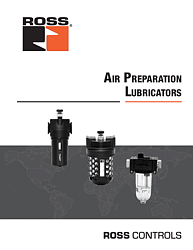
Overview of ROSS FRL Lubricators
Proper air line lubrication is essential for extending the life of valves, cylinders, and other pneumatic components. ROSS lubricators are designed to meter a controlled quantity of oil into the compressed‑air stream while minimizing pressure drop and simplifying maintenance. The catalog details both sight‑feed and wick‑feed designs across multiple body sizes and flow ranges, from compact Bantam units up to large, high‑capacity lubricators rated to 500 scfm.
Across the range, users can choose between polycarbonate bowls with protective guards or rugged metal bowls to match ambient conditions and plant safety requirements. Many models feature an external, tamper‑resistant oil adjustment, modular and in‑line mounting options, and quick‑fill caps to speed refilling and reduce downtime.
Lubricator Series Covered in this Catalog
The catalog is organized by lubricator series, making it easy to cross‑reference existing installations or standardize on a specific platform.
Under the Bantam Series, the catalog presents modular lubricators for low‑flow, small‑port applications. These units cover port sizes from 1/8 to 1/4 with threaded or quick‑connect tube fittings and bowl capacities around 2 oz. Selection tables show model numbers for polycarbonate and metal bowls, with and without quick‑fill caps, as well as dimensional data and flow ratings up to approximately 27 scfm.
The Miniature Series includes in‑line lubricators with 1/8 and 1/4 ports and flow capability to about 25 scfm. These wick‑feed designs emphasize compact installation, internal tamper‑proof adjustment, and both polycarbonate and aluminum bowls. The catalog provides separate listings for high‑flow and low‑flow variants, along with detailed flow‑versus‑pressure‑drop charts to support accurate sizing.
For mainstream industrial circuits, the Mid‑Size Series delivers modular lubricators with 1/4, 3/8, and 1/2 ports and flows to roughly 110 scfm. These are sight‑feed lubricators with external tamper‑resistant adjustments, offering clear visual confirmation of oil delivery through a nylon sight dome. Tables summarize model configurations by thread type, bowl material, and fill option, along with bowl capacity (approximately 4 oz), envelope dimensions, and weights.
The catalog then covers two key modular platforms widely used in modern FRL assemblies: MD3 and MD4 Series lubricators. MD3 lubricators support 1/4 to 1/2 port sizes with flows up to about 150 scfm, while MD4 units extend coverage to 3/8, 1/2, and 3/4 ports with flows to around 205 scfm. Both series emphasize flexible configuration via model‑number building tables that specify pipe size, bowl material and capacity, bowl extension options, cap color, and fill‑type (standard fill port or quick‑fill cap). Flow charts simplify matching the lubricator to required system flow and allowable pressure drop.
For large air mains and high‑demand equipment, the Full‑Size and High‑Capacity Series provide lubricators with port sizes from 1/4 up to 1‑1/2 and flow ratings reaching approximately 500 scfm. Users can choose sight‑feed or wick‑feed construction, various bowl sizes (16, 35, and 62 oz), and either polycarbonate with steel shatterguard or heavy‑duty aluminum bowls with integrated sight glass. The catalog documents oil feed rates, minimum flow requirements, and dimensional data for standard and extended bowls, helping engineers ensure sufficient lubrication in long distribution lines.
Technical Data, Flow Charts, and Sizing Information
A significant portion of the catalog is dedicated to flow charts and performance curves for each lubricator family. These graphs relate inlet pressure, pressure drop, and flow (in scfm and l/s), enabling precise selection for target operating conditions. Minimum flow requirements and “high oil delivery” versus “low oil delivery” configurations are clearly identified for wick‑feed designs, while maximum operating pressures and temperature ranges are specified separately for polycarbonate and metal bowls.
Each series section also includes:
- Construction details (body, bowl, sight dome, seals)
- Ambient and media temperature limits
- Maximum operating pressure by bowl type
- Oil adjustment style (external or internal, tamper‑proof or removable knob)
- ISO graphic symbols for quick circuit documentation
This level of technical detail supports accurate design, documentation, and compliance with in‑house or customer specifications.
Accessories, Mounting Components, and Replacement Elements
Beyond the lubricators themselves, the catalog includes a comprehensive FRL accessories section. Users will find mounting brackets and bracket kits for filters, regulators, lubricators, and complete FRL or Clean Air Packages; modular connector kits; male and female end ports; extra port blocks; and in‑line mounting pipe brackets.
Several pages are devoted to pressure gauges, electronically controlled and automatic drains, and silencers. Specifications cover pressure ranges, case diameters, port sizes, materials, and key electrical data for electronic drains such as voltage, timing range, temperature limits, and maximum pressure.
For maintenance planners, the catalog provides exhaustive tables of replacement filter elements by FRL series, bowl type, micron rating, and material (polyethylene or sintered bronze for particulate filters, borosilicate glass fiber for coalescing and oil‑vapor removal elements). This makes it straightforward to match spare elements to existing filters across Bantam, Miniature, Mid‑Size, MD3, MD4, Full‑Size, and multiple High‑Capacity lines.
Safety, Compatible Lubricants, and Polycarbonate Bowl Cautions
The final section of the catalog highlights critical safety information and warranty terms. ROSS outlines recommended compatible lubricants for pneumatic systems—typically petroleum‑based oils with oxidation inhibitors, an aniline point between 180 and 220 °F, and ISO 32 or lighter viscosity—while warning against oils with phosphate additives that can damage polyurethane components.
Special attention is given to polycarbonate bowl cautions, including using these bowls only with compressed air, always retaining supplied metal bowl guards, and avoiding exposure to a detailed list of chemicals and solvents known to attack polycarbonate. Guidance is also provided on filtration, air quality, and avoiding intake or exhaust restrictions that could compromise valve and FRL performance.
The catalog concludes with standard warranty language and a global directory of ROSS Controls locations and distributors, ensuring users know where to obtain technical support, replacement parts, and additional documentation.
Why Use This Catalog
For engineers, system designers, and maintenance teams working with ROSS FRL assemblies, this Air Preparation Lubricators catalog is the authoritative source for:
- Selecting the correct lubricator series, port size, and flow rating
- Verifying bowl materials, capacities, and environmental limits
- Building precise model numbers from configurable options
- Planning mounting, interconnection, and integration into modular FRL systems
- Specifying accessories, drains, silencers, and replacement elements
- Applying best practices for lubricant choice and polycarbonate bowl safety