




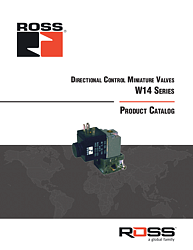
ROSS W14 Series Miniature Directional Control Valves - Complete Technical Catalog
The ROSS W14 Series represents a comprehensive family of miniature 3/2 directional control valves engineered for applications where compact size, reliable performance, and precise pneumatic control are critical requirements. This technical catalog provides complete specifications, installation guidelines, dimensional data, electrical connection details, and application recommendations for integrating W14 Series valves into your pneumatic systems.
Designed for space-constrained industrial automation, medical equipment, packaging machinery, laboratory instrumentation, and precision manufacturing applications, W14 Series valves deliver full-featured directional control in a remarkably compact footprint. With multiple voltage options, manual override configurations, and optional indicator lights, the W14 Series offers versatility for diverse pneumatic control requirements while maintaining the quality and reliability that characterize all ROSS Controls products.
W14 Series Valve Construction and Operating Principles
Poppet Construction for Reliable Sealing
ROSS W14 Series valves utilize proven poppet construction technology, featuring perpendicular poppet face seals that deliver positive sealing performance with self-compensating wear characteristics. Unlike sliding spool designs, the poppet configuration ensures consistent actuation forces throughout the valve's operational life, maintaining reliable shifting performance even after millions of cycles. The face seal design provides superior leak-tight performance compared to dynamic seals, making W14 valves ideal for applications requiring dependable air isolation and minimal pressure drop.
The poppet mechanism employs a spring-return design in the normally closed configuration, meaning the valve's default state blocks flow from inlet (Port 1) to outlet (Port 2) while connecting the outlet to exhaust (Port 3). When the solenoid is energized, the electromagnetic force overcomes spring pressure to shift the poppet, opening the inlet-to-outlet path while simultaneously closing the exhaust port. This 3-way, 2-position (3/2) functionality provides complete control over single-acting actuators or serves as a pilot source for larger pneumatically-actuated valves.
Single Direct Solenoid Actuation
The W14 Series employs single direct solenoid operation, where electrical energization directly actuates the valve element without requiring pilot air pressure. This direct-acting design offers several advantages: faster response times compared to pilot-operated valves, operation from vacuum through full rated pressure without performance degradation, and simplified installation without pilot plumbing requirements. The continuous duty rating allows indefinite energization without thermal concerns, supporting applications requiring sustained valve actuation.
Power consumption specifications reflect ROSS's commitment to energy efficiency. DC variants consume just 6 watts continuously, while AC versions draw 8 VA inrush current dropping to 6 VA holding power. This low power profile enables W14 valves to integrate seamlessly with programmable logic controllers (PLCs), distributed control systems, and other industrial control platforms without requiring high-capacity power supplies or triggering nuisance fuse operations.
Technical Specifications and Performance Characteristics
Pressure and Flow Capacity
Operating Pressure Range: Vacuum to 150 psig (10 bar)
W14 Series valves accommodate the full spectrum of pneumatic system pressures encountered in industrial applications. The ability to operate from vacuum conditions makes these valves suitable for vacuum pick-and-place systems, material handling applications, and other processes requiring below-atmospheric pressure control. The 150 psig maximum rating covers standard factory air systems (typically 80-125 psig), providing adequate margin for pressure transients and system variations.
Flow Coefficient (Cv): 0.1
The flow coefficient of 0.1 indicates the valve's flow capacity under standardized test conditions. While seemingly modest, this Cv value is appropriate for the valve's miniature size and typical applications controlling small cylinders, vacuum cups, pilot signals, or auxiliary pneumatic functions. When sizing valves for specific applications, engineers should calculate required flow rates based on actuator displacement, cycle time requirements, and allowable pressure drop to ensure adequate performance.
Fluid Media: Filtered air (lubrication optional)
W14 valves require filtered air with particle filtration to 40 microns or finer to prevent contamination-induced seal damage and premature wear. While the valves do not require lubricated air for proper operation, they are compatible with oil-fog lubrication systems when other circuit components necessitate lubrication. When using lubricated air, avoid phosphate-additive oils that may degrade seal materials.
Temperature Ranges and Environmental Specifications
Ambient Temperature: 5°F to 120°F (-15°C to 50°C)
The specified ambient temperature range covers most industrial environments, from cold storage facilities to temperature-controlled manufacturing spaces and outdoor installations in moderate climates. For applications in sub-freezing conditions, ensure supply air is thoroughly dried to prevent ice formation within valve passages.
Media Temperature: 5°F to 175°F (-15°C to 80°C)
The broader media temperature range accommodates heated pneumatic systems, applications where process heat elevates air temperature, or installations near heat-generating equipment. The upper limit of 175°F provides thermal margin for most industrial processes while protecting seal integrity and maintaining solenoid performance.
Enclosure Rating: IP65 per IEC 60529
The IP65 rating certifies protection against dust ingress (complete dust-tight seal) and water jets from any direction. This environmental protection makes W14 valves suitable for washdown environments, outdoor applications with weather exposure, and industrial settings with dust or particulate contamination. The rating specifically applies when appropriate electrical connectors are properly installed and sealed.
Physical Dimensions and Weight
Dimensions:
- Length: 1.2 inches (30 mm)
- Width: 2.40 inches (61 mm)
- Height: 2.5 inches (64 mm)
Weight: 1.0 lb (0.45 kg)
These compact dimensions enable W14 valves to fit into confined spaces where standard-size directional control valves cannot physically accommodate. The 30mm body length aligns with miniature valve platform standards, facilitating manifold assembly when multiple valves mount together. Despite the miniature size, the cast aluminum body construction provides structural rigidity and heat dissipation necessary for reliable continuous operation.
Electrical Specifications and Connection Options
Voltage Configurations Available
The W14 Series catalog details three distinct voltage variants to match diverse control system architectures:
24 VDC Models (W1413A1408W, W1413A1409W):
- Nominal voltage: 24 volts direct current
- Power consumption: 6 watts continuous
- Suitable for: PLC control, low-voltage control panels, mobile equipment, battery-powered systems
- Advantage: Intrinsically safer voltage level, simpler wiring in DC control systems
110/120 VAC Models (W1413A1408Z, W1413A1409Z):
- Nominal voltage: 110-120 volts alternating current, 50/60 Hz
- Power consumption: 8 VA inrush, 6 VA holding
- Suitable for: Standard North American industrial installations, machine tools, automated equipment
- Advantage: Direct connection to facility power without transformers
230 VAC Models (W1413A1408Y, W1413A1409Y):
- Nominal voltage: 230 volts alternating current, 50/60 Hz
- Power consumption: 8 VA inrush, 6 VA holding
- Suitable for: International markets (Europe, Asia, etc.), high-voltage control systems
- Advantage: Compatibility with global electrical standards
All solenoid coils feature continuous duty ratings, eliminating concerns about thermal damage from extended energization periods. The AC versions utilize industry-standard 50/60 Hz frequency compatibility, ensuring operation with both European (50 Hz) and North American (60 Hz) power systems without performance variations.
Electrical Connector Standard - EN 175301-803 Form A
W14 Series valves employ the EN 175301-803 Form A electrical connector, a European standard (formerly DIN 43650) widely adopted in industrial automation for solenoid valve connections. This connector system offers several advantages:
Standardization Benefits:
- Interchangeable connectors from multiple manufacturers
- Widely available prewired cable assemblies
- Consistent mounting dimensions across valve brands
- Field-proven reliability in industrial environments
Connection Options Detailed in Catalog:
- Prewired connectors with 6mm cord (2-meter/6.5-foot length)
- Prewired connectors with 10mm cord (2-meter/6.5-foot length)
- Connectors for threaded conduit (1/2-inch electrical conduit fittings)
- Standard 18-gauge wiring for adequate current capacity
Optional Indicator Lights:
Select W14 models can be specified with integrated indicator lights providing visual confirmation of solenoid energization. This feature aids troubleshooting, simplifies commissioning, and provides operational status at a glance—particularly valuable in multi-valve installations or when valves mount in locations where audible click confirmation is difficult to discern.
Manual Override Configurations for Operational Flexibility
The catalog extensively covers three distinct manual override options, allowing specification based on application requirements, safety protocols, and operational preferences:
Non-Locking Manual Override
Models: W1413A1409W, W1413A1409Y, W1413A1409Z
Non-locking overrides feature a spring-return mechanism that automatically returns to normal solenoid control when manual pressure releases. This configuration is ideal for:
- Testing valve operation during commissioning
- Emergency manual actuation without tool requirements
- Temporary manual control during maintenance procedures
- Applications where inadvertent valve actuation poses minimal risk
The non-locking design prevents valves from remaining in manually-actuated states indefinitely, reducing risk of process disruption from forgotten override positions.
Locking Manual Override
Models: W1413A1408W, W1413A1408Y, W1413A1408Z
Locking manual overrides incorporate a metal locking mechanism that maintains manual actuation until deliberately released. These variants suit applications requiring:
- Lockout/tagout (LOTO) compliance per OSHA 29 CFR 1910.147
- Extended manual control periods without continuous operator intervention
- Positive mechanical locking for safety-critical functions
- Clear visual indication of manual override engagement
The locking feature provides tactile and visible confirmation that the valve has been manually overridden, supporting safer maintenance practices and clearer operational status.
Flush Manual Override
Flush overrides sit recessed into the valve body, preventing accidental actuation from inadvertent contact, tool drops, or environmental interference. This low-profile design is optimal for:
- Densely-packed valve manifolds where protruding overrides risk interference
- Mobile equipment subject to vibration or impact
- Automated cells where human intervention is rare
- Clean room environments requiring smooth, easily-cleaned surfaces
Mounting and Installation Guidelines
Base Mounting Configuration
W14 Series valves utilize base-mounted (also termed "body-ported" or "sub-base mounted") installation rather than inline porting. The catalog details two primary mounting approaches:
Single Sub-base Installation (516B91):
For individual valve applications, ROSS offers the 516B91 sub-base, which provides:
- Threaded ports for conventional pipe or fitting connections
- Two inlet ports (Port 1) on opposing sides for supply flexibility
- Single outlet port (Port 2) for actuator connection
- Integrated exhaust porting (Port 3)
- Mounting fasteners and sealing O-rings included
Installation involves mounting the sub-base to the machine structure using the provided fasteners, connecting the air supply to either Port 1 location (plugging the unused port with the supplied pipe plug), and routing the outlet port to the controlled device. The valve then mounts atop the sub-base using the included valve-to-base O-rings, which seal the interface and align the valve's internal passages with the sub-base porting.
Manifold Assembly (535K91):
When applications require multiple W14 valves in proximity, manifold mounting offers substantial advantages in space utilization, plumbing simplification, and installation time. The 535K91 manifold component allows multiple valves to share common supply and exhaust, with individual outlet connections for each valve position.
Manifold benefits include:
- Single supply connection serving all valve positions
- Common exhaust plenum eliminating individual exhaust tubing
- Compact footprint reducing panel space requirements
- Reduced leak points versus individual valve plumbing
- Easier installation and maintenance access
The catalog provides detailed manifold assembly instructions, including proper O-ring installation, fastener torque specifications, and port identification to ensure leak-free, reliable installations.
Porting and Pneumatic Connections
Port Identification:
- Port 1 (Inlet/Supply): Compressed air supply connection
- Port 2 (Outlet/Work): Connected to actuator or downstream device
- Port 3 (Exhaust): Vents actuator exhaust air to atmosphere
Critical Installation Considerations:
Do Not Restrict Exhaust Flow: Port 3 exhaust must freely vent to prevent backpressure that adversely affects valve shifting speed and reliability. While mufflers are acceptable for noise reduction (ensuring adequate flow capacity), long exhaust lines, undersized fittings, or restrictive silencers will compromise performance.
Supply Air Quality: Install appropriate filtration upstream of W14 valves, maintaining 40-micron or finer particle removal. Consider installing pressure regulators if supply pressure fluctuates significantly or approaches the 150 psig maximum rating.
Tubing Sizing: While W14 valves feature compact porting appropriate for miniature pneumatic systems, ensure connected tubing provides adequate flow capacity for the controlled actuator. Undersized supply tubing negates valve flow capacity and slows actuator response.
Material Construction and Component Specifications
Valve Body Material - Cast Aluminum
The catalog specifies cast aluminum for all W14 Series valve bodies, offering an optimal balance of strength, weight, thermal conductivity, and cost-effectiveness. Aluminum construction provides:
Structural Benefits:
- Excellent strength-to-weight ratio for durable yet lightweight design
- Good impact resistance for mobile equipment applications
- Dimensional stability across temperature ranges
- Corrosion resistance in typical industrial atmospheres
Thermal Management:
Aluminum's high thermal conductivity efficiently dissipates heat generated by solenoid operation, preventing localized hot spots and maintaining consistent performance during continuous duty cycles. This thermal characteristic also contributes to the valve's wide ambient temperature range.
Machining Precision:
Cast aluminum allows economical production of complex internal flow passages with precise dimensional control, ensuring consistent flow characteristics and reliable sealing surface geometry across production volumes.
Seal Material - Buna-N (Nitrile Rubber)
W14 valves employ Buna-N (nitrile butadiene rubber, also designated NBR) for all dynamic and static sealing elements. This synthetic elastomer provides:
Sealing Performance:
- Excellent resistance to compressed air and neutral gases
- Low permeability preventing pressure decay in closed chambers
- Good resilience maintaining seal force over temperature ranges
- Compatible with petroleum-based pneumatic lubricants
Temperature Capability:
Buna-N performs reliably across the specified -15°C to 80°C media temperature range, maintaining flexibility at low temperatures while resisting hardening at elevated temperatures.
Compatibility Considerations:
While Buna-N suits the vast majority of pneumatic applications, the catalog notes that alternative seal materials may be required for specialized media. Contact ROSS Technical Services for applications involving aggressive chemicals, extreme temperatures, or exotic gases requiring material compatibility verification.
Applications and Industry Use Cases
Space-Constrained Automation
The compact W14 Series footprint makes these valves ideal for applications where panel space is premium or physical access is limited:
Medical Equipment:
Diagnostic instruments, patient beds, dental chairs, and surgical equipment benefit from W14 miniaturization, allowing pneumatic control integration without compromising device ergonomics or sterile field access.
Laboratory Automation:
Analytical instruments, sample handling systems, and research apparatus incorporate W14 valves for precise pneumatic control in space-limited instrument enclosures.
Compact Machinery:
Benchtop production equipment, small assembly cells, and portable tooling leverage W14 valves to provide full directional control functionality in miniature machine designs.
Pilot Control for Larger Valves
While W14 valves can directly control small actuators (typically cylinders with bore sizes up to 1.5 inches), they excel as pilot valves providing control signals to larger pneumatically-actuated valves:
Air Pilot Applications:
W14 valves generate pilot signals controlling ROSS 21 Series, 27 Series, Dale Series, and other pilot-operated directional control valves. This architecture allows low-power electrical signals to control substantial pneumatic flow capacity through the pilot/main valve combination.
Cascade Control:
In complex pneumatic systems, W14 valves can serve as first-stage pilots in cascaded control schemes, where one pilot controls another, ultimately actuating large process valves or safety components.
OEM Equipment Integration
Original equipment manufacturers (OEMs) designing pneumatic-powered machinery appreciate W14 Series attributes:
Design Flexibility:
Multiple voltage options, override configurations, and compact dimensions simplify adaptation to diverse machine architectures and customer electrical specifications without valve design changes.
Global Applicability:
The availability of 120VAC (North American) and 230VAC (international) variants, combined with IP65 environmental protection and EN 175301-803 connector standard, facilitates worldwide equipment sales without regional variants.
Reliability and Support:
ROSS's reputation for quality and comprehensive technical support reduces warranty claims and field service requirements, protecting OEM brand reputation and customer satisfaction.
Catalog Contents and Technical Information Included
This comprehensive W14 Series catalog provides engineers, technicians, and procurement professionals with complete information necessary for product selection, system design, installation, and maintenance:
Product Specifications Section
Complete Technical Parameters:
- Electrical specifications with inrush and holding power data
- Pressure rating with vacuum capability notation
- Flow capacity expressed as Cv coefficient
- Temperature ranges for ambient and media conditions
- Dimensional data in both imperial and metric units
- Weight specifications for structural load calculations
- Material certifications for valve body and seals
Performance Characteristics:
- Response time data for shifting speed calculations
- Duty cycle ratings confirming continuous operation capability
- Life expectancy information under rated conditions
- Pressure drop curves showing flow versus pressure relationships
Part Number Nomenclature and Ordering Information
The catalog decodes ROSS's systematic part numbering system for W14 Series valves:
W1413A14 [Override] [Voltage]
- W14: Series designation
- 13: Function (3/2 single solenoid)
- A1: Construction variant
- 4: Feature code
- Override code: 08 (locking) or 09 (non-locking)
- Voltage code: W (24VDC), Z (110/120VAC), Y (230VAC)
Understanding this nomenclature enables confident ordering and helps prevent specification errors that could result in receiving incorrect voltage variants or override configurations.
Installation Instructions and Wiring Diagrams
Pneumatic Schematic Symbols:
ISO 1219-1:1991 compliant symbols show valve function in both de-energized and energized states, facilitating circuit design and documentation. The 3/2 normally closed symbol clearly depicts Port 1 (pressure) blocked, Port 2 (output) connected to Port 3 (exhaust) in the spring-returned state, reversing when solenoid energizes.
Mounting Procedures:
Step-by-step instructions with exploded-view illustrations guide proper sub-base installation, O-ring placement, valve mounting, and fastener torquing to prevent leaks and ensure reliable operation.
Electrical Connection Guidance:
Wiring diagrams show proper conductor identification, polarity requirements (DC models), and grounding recommendations. The catalog specifies compatible connector part numbers for prewired assemblies and conduit-style connectors, simplifying procurement and reducing installation errors.
Maintenance and Troubleshooting Guidelines
Preventive Maintenance Recommendations:
While W14 valves require minimal routine maintenance due to their simple poppet design and self-compensating seals, the catalog provides guidance on:
- Periodic inspection intervals based on cycle count and environmental conditions
- Filter replacement schedules to maintain air quality
- Electrical connector inspection for secure mating and environmental seal integrity
- Manual override functional testing to verify mechanical operation
Troubleshooting Charts:
Common symptoms (valve fails to shift, sluggish operation, excessive leakage, solenoid overheating) are cross-referenced with probable causes and corrective actions, enabling efficient problem diagnosis and resolution.
Replacement Parts:
The catalog lists replacement solenoid coils by part number and voltage rating, allowing field replacement without complete valve changeout. Seal kits, when available, support valve rebuild for extended service life.
Accessory and Companion Product Information
Electrical Connectors:
Complete specifications for 721K77, 720K77, 371K77, and 383K77 series connectors cover:
- Cord length (standard 2 meters/6.5 feet)
- Wire gauge (18 AWG for adequate current capacity)
- Indicator light options for visual status confirmation
- Voltage compatibility matching valve variants
Mounting Hardware:
Sub-base kits (516B91 for single valves, 535K91 for manifolds) include all necessary components:
- Valve-to-base O-rings (quantity 2 per valve position)
- Sub-base interconnection O-rings and fasteners
- Pipe plugs for unused port closure
- Mounting screws with appropriate thread specifications
Manifold Components:
End station kits, intermediate manifold sections, and pressure distribution rails allow custom manifold assembly configurations matching specific application valve count requirements.
Quality, Compliance, and Safety Certifications
Manufacturing Standards and Quality Assurance
ROSS Controls manufactures W14 Series valves in facilities maintaining ISO 9001 quality management system certification, ensuring consistent production quality through documented processes, supplier controls, and comprehensive inspection protocols. Every valve undergoes functional testing before shipment, verifying proper electrical operation, sealing performance, and absence of manufacturing defects.
The catalog notes compliance with relevant industrial standards:
Electrical Safety:
Solenoid construction and connector systems meet applicable UL (Underwriters Laboratories) and CE (European Conformity) requirements for electrical safety, insulation integrity, and temperature rise limitations.
Environmental Protection:
The IP65 enclosure rating per IEC 60529 certifies dust-tight construction and protection against water jets, documented through standardized testing protocols.
Material Compliance:
RoHS (Restriction of Hazardous Substances) compliance confirms absence of lead, mercury, cadmium, and other restricted materials in valve construction (where RoHS applies), supporting environmental responsibility and regulatory adherence.
Pneumatic System Safety Considerations
While W14 valves themselves are not control-reliable devices for primary safety functions, the catalog emphasizes proper system design incorporating appropriate safeguards:
Energy Isolation:
For lockout/tagout applications, W14 locking override variants support isolation procedures but should be used as part of comprehensive LOTO systems including upstream isolation valves, pressure relief, and verification procedures.
Control Reliability:
Critical safety functions requiring redundancy, monitoring, and fault detection should utilize ROSS's control-reliable products (DM2 Series, YB Series, L-O-X Series) rather than standard directional control valves like the W14 Series.
Exhaust Considerations:
Proper exhaust porting prevents hazardous pressure buildups and ensures predictable actuator behavior. Never block or severely restrict Port 3 exhaust.
Selecting the Right W14 Valve for Your Application
Application Assessment Checklist
Before specifying W14 Series valves, evaluate these critical parameters:
Electrical Requirements:
- Determine control voltage available: 24 VDC, 110/120 VAC, or 230 VAC?
- Verify power supply capacity handles solenoid inrush (8 VA for AC models)
- Confirm control system output compatibility with continuous duty operation
Pneumatic Parameters:
- Operating pressure range within vacuum to 150 psig specification?
- Air supply consistently filtered to 40 microns or finer?
- Media temperature within 5°F to 175°F range?
Physical Constraints:
- Available mounting space accommodates 1.2" × 2.4" × 2.5" valve dimensions?
- Access sufficient for electrical connector mating and manual override operation?
- Environmental exposure level compatible with IP65 rating?
Functional Requirements:
- 3/2 normally closed function appropriate for application?
- Flow capacity (Cv 0.1) adequate for actuator size and cycle time?
- Manual override type (locking, non-locking, flush) matching operational needs?
Sizing Considerations
Flow Calculations:
Engineers can determine W14 appropriateness by calculating required flow:
Q = (A × S × 28.8) / T
Where:
- Q = Required flow rate (SCFM)
- A = Cylinder piston area (square inches)
- S = Stroke length (inches)
- T = Desired extension/retraction time (seconds)
- 28.8 = Conversion constant
Compare calculated Q against W14 flow capacity to verify adequate performance with acceptable cycle times.
Pressure Drop Analysis:
The 0.1 Cv flow coefficient allows pressure drop calculation:
ΔP = (Q / Cv)² × (P₁ / 1000)
Where ΔP is pressure drop across valve, Q is flow rate, and P₁ is inlet pressure. Excessive pressure drop indicates undersized valve selection.
Competitive Advantages of ROSS W14 Series Valves
Design Heritage and Proven Performance
ROSS Controls' 70+ year history manufacturing pneumatic control products ensures W14 Series valves embody decades of engineering refinement, field experience integration, and continuous improvement. Design features reflect real-world application feedback, not theoretical engineering divorced from practical performance requirements.
Poppet Construction Superiority:
Unlike sliding spool valves subject to contamination-induced binding and wear-related leakage, W14 poppet design maintains consistent performance across millions of cycles. Self-compensating face seals adjust for minimal wear, while perpendicular poppet geometry generates robust shifting forces with low power consumption.
Component Integration:
Rather than separate components assembled into a valve, W14 design integrates body casting, poppet mechanism, spring return, manual override, and electrical connection into a cohesive unit optimized for manufacturing efficiency and field reliability.
Application Engineering Support
ROSS Controls provides comprehensive technical support beyond catalog information:
Pre-Sales Engineering:
Application engineers assist with valve selection, sizing verification, and system design consultation. Custom configurations, non-standard voltages, or specialized requirements receive expert evaluation and recommendations.
Installation Support:
Technical service representatives provide installation guidance, troubleshooting assistance, and maintenance recommendations, helping customers achieve optimal valve performance and longevity.
Training Resources:
ROSS offers technical training programs covering pneumatic system fundamentals, valve technology, control reliability principles, and safety system design—supporting customer knowledge development and proper product application.
Comparison with Other ROSS Miniature Valve Platforms
The catalog positions W14 Series within ROSS's broader miniature valve portfolio:
M10 Series - 10mm Inline Spool Valves
M10 Characteristics:
- Inline body style with push-in fittings
- Sliding spool construction
- Even more compact than W14 base-mounted design
- Direct tubing connections without sub-bases
When to Choose M10 vs. W14:
Select M10 for ultimate space minimization with inline mounting, particularly in mobile equipment or panel-mounted applications. Choose W14 for easier manifolding, poppet sealing advantages, and base-mounted installation convenience.
M72 Series - Compact Inline Valves
M72 Characteristics:
- Inline configuration with threaded ports
- Slightly larger than M10 but smaller than W14
- Alternative to base-mounted designs
- Various port configurations available
Selection Considerations:
M72 suits applications requiring inline mounting with threaded connections rather than push-in fittings (M10) or base mounting (W14).
Ordering Information and Lead Times
The catalog provides complete commercial information for procurement:
Standard Product Availability
In-Stock Models:
ROSS maintains inventory of common W14 configurations, particularly 24VDC variants with non-locking overrides (W1413A1409W) and locking overrides (W1413A1408W) which represent highest-demand specifications.
Estimated Lead Times:
The catalog notes estimated ship dates approximately 3-4 weeks from order for standard quantities (10 valves or less). Larger production quantities, custom configurations, or non-standard voltages may require extended lead times. Contact ROSS for specific project schedules.
Distribution Network
ROSS products are available through:
Factory Direct:
Engineers can order directly from ROSS Controls via phone (800) 438-7677, website, or electronic data interchange (EDI) systems for large OEM customers.
Authorized Distributors:
ROSS maintains a network of industrial distributors throughout North America, Latin America, Europe, and Asia providing local inventory, technical support, and logistics services.
Online Industrial Suppliers:
Major online industrial supply platforms stock common W14 configurations for rapid delivery, particularly supporting small quantity requirements and emergency replacements.
Download the Complete W14 Series Technical Catalog
This comprehensive catalog PDF contains:
✓ Full product line specifications - All voltage variants, override configurations, and optional features
✓ Detailed dimensional drawings - CAD-quality engineering drawings with mounting dimensions
✓ Installation instructions - Step-by-step procedures with illustrations
✓ Electrical wiring diagrams - Proper connection guidance for all voltage types
✓ Part numbering system - Decode model numbers and order correctly
✓ Accessory information - Connectors, sub-bases, and manifold components
✓ Technical specifications - Complete performance data for engineering calculations
✓ Maintenance guidelines - Service recommendations and troubleshooting
✓ Application examples - Common uses and system design considerations
File Format: PDF (optimized for printing and digital viewing)
File Size: Approximately 2-4 MB
Language: English (additional languages available through ROSS regional websites)
Current Revision: Latest technical data updated February 2026
Download now to access:
- Product selection guidance ensuring proper valve specification
- Engineering data supporting system design and flow calculations
- Installation procedures preventing costly errors and callbacks
- Maintenance information maximizing valve service life
- Troubleshooting resources for rapid problem resolution
Related ROSS Controls Technical Resources
Complementary Product Catalogs
21 & 27 Series Inline Poppet Valves:
Higher flow capacity directional control valves for larger actuators and higher flow requirements. Available in 2-way and 3-way configurations with solenoid or air pilot actuation.
Dale Series Base-Mounted Valves:
Modular base-mounted platform offering extensive configuration flexibility including multiple porting options, various actuator types, and international standards compliance.
ISO Standard Valves (W60, W64, W65, W66 Series):
Valves conforming to ISO 15407-1, ISO 15407-2, ISO 5599-1, and ISO 5599-2 dimensional standards for multi-vendor interchangeability.
Technical White Papers
Control Reliable Valve Systems:
Understand redundancy, monitoring, and fault detection principles for safety-critical pneumatic applications per ISO 13849 and ANSI B11 machine safety standards.
Pneumatic System Design Guide:
Comprehensive overview of air preparation, valve selection, actuator sizing, speed control, and circuit optimization for reliable pneumatic automation.
Lockout/Tagout Best Practices:
OSHA 29 CFR 1910.147 compliance guidance with practical implementation strategies for safer pneumatic system maintenance.
Contact ROSS Technical Support
For application-specific questions, custom configurations, or technical assistance:
ROSS Controls Global Headquarters:
- Phone: (800) 438-7677 (USA toll-free)
- International: +1 (248) 604-4500
- Email: info@rosscontrols.com
- Website: www.rosscontrols.com
Technical Support Hours:
Monday-Friday, 8:00 AM - 5:00 PM Eastern Time
Regional Offices:
ROSS maintains technical support facilities in Europe (France, Germany), Asia (China), and additional North American locations providing local language support and application engineering assistance.
Frequently Asked Questions (FAQ)
Q: Can W14 valves operate on vacuum only applications?
A: Yes, W14 valves function reliably from full vacuum through 150 psig. The direct solenoid actuation does not require supply pressure for shifting.
Q: Are replacement solenoid coils field-replaceable?
A: Yes, solenoid coils can be replaced without disturbing pneumatic connections. Order replacement coils by specific part number matching voltage and duty rating.
Q: What thread standards do sub-base ports use?
A: Standard ROSS sub-bases typically feature NPT (National Pipe Thread) ports. Metric (G-thread) and other international standards are available on request.
Q: Can W14 valves control hydraulic fluids?
A: No, W14 Series valves are designed specifically for compressed air and neutral gases. ROSS offers hydraulic valve products for fluid power applications.
Q: How often should W14 valves be serviced?
A: In clean, properly filtered air systems, W14 valves may operate millions of cycles without service. Inspect annually and replace when performance degrades.
Q: Are stainless steel body versions available?
A: W14 standard offering uses cast aluminum construction. Contact ROSS for specialized material requirements or explore alternative valve series designed for corrosive environments.
Q: Can I mount W14 valves in any orientation?
A: Yes, poppet construction allows mounting in any orientation without affecting performance or life expectancy.
Q: What's the difference between Cv 0.1 and SCFM flow rating?
A: Cv is a coefficient used in calculations. Approximate SCFM at 100 psi ≈ Cv × 7.5, so W14 flows roughly 0.75 SCFM at 100 psig with atmospheric exhaust.
Why Choose ROSS Controls for Your Miniature Valve Requirements
Engineering Excellence:
Over 70 years of pneumatic control innovation delivering products that meet the demanding requirements of industrial automation, mobile equipment, medical devices, and specialized machinery applications worldwide.
Quality Manufacturing:
ISO 9001 certified production facilities with comprehensive quality systems ensuring every valve meets specifications and performs reliably throughout its service life.
Technical Support:
Experienced application engineers providing pre-sales consultation, installation guidance, troubleshooting assistance, and ongoing technical resources supporting customer success.
Global Availability:
Extensive distribution network with local inventory, technical support, and logistics capabilities throughout North America, Europe, Asia, and Latin America.
Product Breadth:
Comprehensive pneumatic control product portfolio from miniature valves to complex control-reliable safety systems, enabling single-source procurement and consistent supplier relationships.
Innovation Commitment:
Continuous product development introducing new technologies, improving existing designs, and expanding capabilities to meet evolving market requirements and application challenges.
Ready to specify W14 Series valves for your application?
Download the complete technical catalog now for comprehensive specifications, selection guidance, installation instructions, and engineering data necessary for successful pneumatic system design and implementation.