



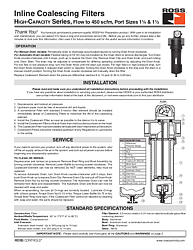
ROSS Inline Coalescing Filters — High-Capacity Series 450 scfm: Installation and Operating Instructions
Overview
The ROSS® Inline Coalescing Filters, High-Capacity Series 450 scfm are premium-quality coalescing filter units designed to remove liquid aerosols, oil mist, and fine particulate contamination from compressed air systems. Featuring borosilicate glass-fiber coalescing elements, these filters protect downstream pneumatic equipment from moisture and oil damage that can cause premature wear, valve malfunction, and reduced system efficiency.
Rated for flow up to 450 scfm, with port sizes of 1-1/4 and 1-1/2 inch, these filters are engineered for installation in industrial compressed air systems upstream of regulators, lubricators, and directional valves. The filter body is constructed from Aluminum for durability, and nitrile seals ensure compatibility with compressed air and standard lubricants.
ROSS Controls, founded in 1921, has over 100 years of expertise in fluid power and air preparation equipment. This document provides complete installation, operation, maintenance, and safety information. Read all instructions before installing.
Key Features
Coalescing Element Technology
The Inline Coalescing Filters, High-Capacity Series 450 scfm uses 0.3-micron rated or 0.01-micron rated borosilicate-glass-fiber coalescing element coalescing elements rated to efficiently remove liquid aerosols and oil mist from compressed air. Elements must be replaced (not cleaned) when the pressure differential across the filter reaches 8 to 10 psid (0.55 to 0.69 bar). Do not attempt to clean coalescing elements — replacement is mandatory.
- Flow capacity: up to 450 scfm
- Port sizes: 1-1/4 and 1-1/2 inch
- Element: 0.3-micron rated or 0.01-micron rated borosilicate-glass-fiber coalescing element
- Element replacement trigger: pressure differential 8–10 psid (0.55–0.69 bar)
- Differential pressure gauge port available on most models
- Bowl options: polycarbonate (with guard) or aluminum metal
- Drain options: manual, automatic internal drain (AID), or float drain
Drain Configurations
These filters are available with manual drain, automatic internal drain (AID), and float drain configurations. Manual drains are operated by turning or pushing the drain knob. Automatic drains operate by float or piston and can also be manually actuated. Flexible tubing (3/16-inch ID) can be installed on the drain stem for remote discharge.
- Manual drain: turn knob clockwise to discharge accumulated liquids
- Automatic internal drain: automatic float or piston actuation; manual override available
- Float drain: turn drain stem clockwise to drain manually; returns to auto position counterclockwise
- 3/16-inch ID flexible tubing compatible with drain stem for remote discharge
- Drain knob and clip accessible for service and drain removal
Bowl and Body Materials
The filter body is constructed from Aluminum. Bowl options include polycarbonate with shatterguard (for visual liquid level monitoring) or Aluminum bowl, or extended aluminum bowl (bowl ring: aluminum). Seals are Nitrile for compatibility with standard compressed air and lubricants. Replace polycarbonate bowls with metal if any signs of crazing, cracking, or deterioration are observed.
Technical Specifications
Standard Specifications
- Construction: Fiber
- Flow capacity: up to 450 scfm
- Port sizes: 1-1/4 and 1-1/2 inch
- Ambient/Media temperature (polycarbonate bowl): 40° to 175°F (4° to 80°C)
- Ambient/Media temperature (metal bowl): 40° to 175°F (4° to 80°C)
- Fluid media: Compressed air
- Inlet pressure — automatic drain (polycarbonate bowl): Up to 200 psig (up to 14 bar)
- Inlet pressure — automatic drain (metal bowl): Up to 200 psig (up to 14 bar)
- Inlet pressure — manual drain (polycarbonate bowl): 0 to 200 psig (0 to 14 bar)
- Inlet pressure — manual drain (metal bowl): 0 to 200 psig (0 to 14 bar)
- Filter element: 0.3-micron rated or 0.01-micron rated borosilicate-glass-fiber coalescing element
- Body: Aluminum
- Bowl: Aluminum bowl, or extended aluminum bowl (bowl ring: aluminum)
- Seals: Nitrile
- Torque drain nut: 5–15 in-lbs
- Torque lower baffle: 50–75 in-lbs
- Torque bowl ring: hand tight
Applications
Compressed Air Quality Improvement
The Inline Coalescing Filters, High-Capacity Series 450 scfm is designed for installation in industrial and manufacturing compressed air systems where liquid aerosols, water droplets, and oil mist must be removed before reaching sensitive downstream pneumatic components. Applications include point-of-use filtration at pneumatic cylinders, valves, and FRL stations.
Upstream of Precision Instrumentation
Coalescing filters are essential upstream of precision pneumatic instruments, air gauging systems, and spray painting equipment where oil or water contamination would cause measurement errors, coating defects, or equipment damage. The 0.01-micron rated element option provides maximum oil removal for critical applications.
Industrial Manufacturing and Process Control
These filters are used across automotive assembly, food and beverage processing, pharmaceutical manufacturing, electronics production, and general industrial automation wherever instrument-quality compressed air is required for reliable process control.
Safety and Compliance Standards
Before servicing, depressurize and lock out the compressed air supply per OSHA 1910.147 and EN 1037. Filters with polycarbonate bowls are designed for compressed air only. Do not use with alcohol, liquefied petroleum gas, or other hazardous fluids — these can cause bowl failure, hazardous leakage, or combustion.
Always use the metal bowl guard when supplied to minimize fragmentation hazard in the event of polycarbonate bowl failure. Avoid exposure of polycarbonate bowls to chemical cleaners, solvents, paints, and fumes. Replace any crazed, cracked, or deteriorated polycarbonate bowl immediately.
Installation and Setup Guide
Pre-Installation Steps
Depressurize and lock out the compressed air supply before installation. Ensure upstream pipes are free of excessive dirt and liquids before connecting the filter.
Installation Orientation and Position
Install the filter vertically with the drain mechanism at the bottom. Follow the flow direction arrow on the filter head. Install upstream of any regulators, lubricators, or valves in the airline, and as close as possible to the device it serves. Install a conventional 5-micron general-purpose filter immediately upstream of the coalescing filter to maximize element life.
Service and Element Replacement
To remove and replace the element: depressurize and lock out pressure; remove the bowl assembly by turning counterclockwise; remove the coalescing element assembly; install new element; reassemble. Do not clean coalescing elements — they must be replaced. Lubricate all O-rings with lithium grease when reassembling. When replacing bowl ring or shatterguard, torque to specification as listed in replacement parts documentation.
Why Choose ROSS Controls
ROSS Controls has provided premium fluid power and air preparation solutions since 1921. The coalescing filter line is engineered to deliver clean, dry, oil-free compressed air to protect your pneumatic investment. With a complete range from Bantam Series through High-Capacity Series, ROSS has a coalescing filter for every flow and port size requirement.
Contact ROSS at 1-800-GET-ROSS or visit www.rosscontrols.com for product selection assistance, replacement parts, and technical support.
Download This Document
Official ROSS Controls installation and operating instructions PDF: https://ross-admin-global-us-east.s3.amazonaws.com/production/uploads/document_language_file/file/72/ROSS_Filter_Inline_Coalescing_High-Capacity_450_scfm_SS-F018.pdf
Full document library: https://www.rosscontrols.com/en/documents
Related Products and Resources
- ROSS Modular Filters — Bantam, Miniature, Mid-Size, MD3, Full-Size, MD4, High-Capacity Series
- ROSS Coalescing Filters — Bantam through 840 scfm High-Capacity Series
- ROSS Regulators and Lubricators (FRL systems)
- ROSS Differential Pressure Gauges for filter monitoring
- ROSS Automatic and Manual Drain Kits
- 1-800-GET-ROSS | www.rosscontrols.com
Frequently Asked Questions
Q: When should the coalescing element be replaced?
A: Replace the coalescing element when the pressure differential across the filter reaches 8 to 10 psid (0.55 to 0.69 bar). A differential pressure gauge can be installed to monitor this continuously.
Q: Can coalescing elements be cleaned and reused?
A: No. Coalescing elements must be replaced, not cleaned. Attempting to clean borosilicate glass-fiber elements will damage the coalescing media and compromise filtration performance.
Q: What is the difference between a 0.3-micron and a 0.01-micron element?
A: The 0.3-micron element removes most liquid aerosols and bulk oil mist. The 0.01-micron rated element provides near-instrument-quality air, suitable for critical applications such as precision pneumatics, painting, and food processing.
Q: Can I use polycarbonate bowls with any fluid besides compressed air?
A: No. Polycarbonate bowls are designed for compressed air service only. Do not use with alcohol, liquefied petroleum gas, acetone, chlorinated solvents, or other substances that could attack polycarbonate and cause bowl failure.
Q: How do I manually drain an automatic internal drain (AID) model?
A: Turn the drain knob clockwise until the bowl drains. Return to the full counterclockwise position to restore automatic drain operation. Flexible 3/16-inch ID tubing can be attached to the drain stem for remote discharge.
Q: Where should the coalescing filter be installed in an air line?
A: Install the coalescing filter upstream of regulators, lubricators, and valves, and as close as possible to the equipment it serves. Install a conventional 5-micron general-purpose filter immediately upstream of the coalescing filter to maximize element life.
Q: Is the filter installed vertically or can it be horizontal?
A: The filter must be installed vertically with the drain mechanism at the bottom. Horizontal installation will prevent proper drainage of accumulated liquids and reduce filtration efficiency.
Q: What O-ring lubricant should be used when reassembling?
A: Lubricate all O-rings with lithium grease during reassembly. Ensure all O-rings are correctly seated before tightening the bowl assembly.
Q: What ROSS part numbers cover bowl assemblies for these filters?
A: Replacement bowl assemblies are available for both manual and automatic drain configurations in plastic and metal options. Refer to the Replacement Parts section of the original PDF documentation or contact ROSS at 1-800-GET-ROSS for specific part numbers for your model.
Q: Where can I purchase ROSS replacement filter elements?
A: Contact your authorized ROSS distributor or visit www.rosscontrols.com. Call 1-800-GET-ROSS for direct assistance identifying the correct replacement element part number for your filter model.